Pages

Wednesday, August 5, 2009

Copper Necklace Inspires More Digs at Roanoke

Necklace inspires more digs


Jim Driscoll operated the radar machine as he carefully drove across flat land near the old fort site just outside of the theater enclosure.
On a hot and humid afternoon last week, a Bobcat 5600 vehicle used a sophisticated radar that looked like a bush hog farm tractor attachment to try to find artifacts near the main gate to the Lost Colony's Waterside Theater on the north end of Roanoke Island.

In addition to the data the radar tomography amassed, yet another dig is planned for this fall as the quest to find out what happened to America's first colony continues.

This time last summer, the archeology group, First Colony Foundation and its radar sub contractor, had some success on the site. During a dig they uncovered a copper necklace in the wooded, sand dunes not too far from the theater.

It was an exciting time to see it "in situ," said foundation archeologist and co-director Eric Klingelhofer.

The necklace is on display at the Lindsay Warren Visitor's Center located in the Fort Raleigh National Historic Site, which encompasses the visitor's center, the Lost Colony and Elizabethan Gardens.

"The copper necklace was just put on exhibit,"
Jason Powell, park ranger said. "It's the first time in public."

He said the park service also plans to create an improved exhibit with renovations beginning in the fall.


More:

http://jimsonharvest.blogspot.com/2009/08/more-artifacts-from-lost-colony-on.html


© History Chasers

Click here to view all recent Searching for the Lost Colony DNA Blog posts

Bookmark and Share

Thursday, July 30, 2009

Down East in Carteret County; A World Away

Perhaps no other region of coastal North Carolina remains as untouched and culturally intact as the low marshy area in eastern Carteret County known as ''down east''. The residents of down east have retained their simple lifestyle and even their own way of speaking for nearly 300 years, largely due to the remoteness of the region.

Waterfront communities with evocative names such as Stacy, Straits, Atlantic and Sea Level are nothing more than collections of homes, fishing businesses, small schools, and churches. There are no incorporated towns, and daily life revolves around the ebb and flow of the tide.

The area is home to the famed High Tider accent. The dialect is a remnant of Elizabethan English that was once spoken in colonial Carolina. Combined with a slow southern drawl, the dialect is indigenous to the lowland areas of North and South Carolina. Many linguists have come to the area to record and study this curious manner of speaking, which is in danger of being assimilated as the last of the old timers passes away.

Although there are no definite geographic boundaries to Down East, locals know that it ''officially'' begins on the east side of the North River. From there, a broad marshy peninsula extends northeastward, bounded by the Neuse River and the Pamlico Sound on the north and the Cape Lookout National Seashore on the south and east.

The first settlers of this tidewater region were recipients of royal land grants in the early 1700s, and they made their living from the sea--as their descendants do today. One of the first down east places to be settled was Harker's Island, a narrow east-west island at the southern end of Core Sound. Originally home to a thriving band of Tuscarora Indians, the island is today a symbol of Carteret County's maritime heritage. Once accessible only by boat, the island wasn't connected to the mainland by bridge until 1941.

Cont.

http://www.coastalguide.com/packet/downeast-nc.shtml


© History Chasers

Click here to view all recent Searching for the Lost Colony DNA Blog posts

Bookmark and Share

Saturday, July 25, 2009

Events on the Outer Banks for July 25 to July 31


July 24, 2009

Looking for the events and activities coming up on the Outer Banks? Every Friday, Miss Kitty is going to bring you the happening events for the next week.

Saturday on the Outer Banks:

Enjoy a night of theater with The Lost Colony at Waterside Theater on Roanoke Island. The performance begins at 8 pm. After the show, enjoy a backstage tour of Waterside Theater. For tickets or more information, call 252-473-2127 or visit The Lost Colony.

You could head on over to Jolly Rogerwhere Michelle Sanchez will be hosting the ‘Alan Ross Karaoke Roadshow’ from 9 pm to 1 am. Three Legged Fox will be rocking the house over at Outer Banks Brewing Station(yeah, that’s the restaurant beneath the wind turbine on the big road). Or go see Gonzos Nose playing at Kelly’s Restaurant and Tavern.


Read about the rest of the week here:

http://kittydunes.wordpress.com/2009/07/24/events-on-the-outer-banks-for-july-25-to-july-31/


© History Chasers

Click here to view all recent Searching for the Lost Colony DNA Blog posts

Bookmark and Share

Wednesday, July 22, 2009

Search for ancestors of the Lost Colonists of America in North Devon


dave.tanner@archant.co.uk
21 July 2009
Mayor of Bideford Cllr Andy Powell swabs the DNA of Barnstaple businessman Philip Milton (right)
THE search for ancestors of the Lost Colonists of America is starting in earnest in North Devon with a Barnstaple businessman submitting his DNA for testing.

Financial advisor and Prospective Parliamentary Candidate Philip Milton is among the first to have answered the call of Mayor of Bideford Andy Powell, who is trying to establish whether people from the Bideford area were among the founding fathers of America - more than 30 years before the Pilgrim Fathers set sail from Plymouth.

Keen to establish the town's part in the early colonisation of the continent, Mr Powell is seeking local people whose surnames match with the 117 known names of the Lost Colonists of Roanoke Island in North Carolina, who disappeared without trace in the 1580s.

He hopes to establish that they were not "lost" but joined with the native American people to become the first permanent English settlers and that they included men and women from Bideford.

It is documented how ships from Bideford, captained by Sir Richard Grenville, were involved in the colonisation attempts made by Sir Walter Raleigh from 1584-1590.

Information he has discovered convinces Mr Powell of the likelihood that Bideford took part.

Many Native American people carry European DNA, he pointed out. In conjunction with a study in the US using DNA he is hoping to prove the existence of DNA from the Lost Colonists and from people emanating from Bideford and North Devon.

He is asking that people with the same surnames as the Lost Colonists who can trace their family history back at least 300 years to make contact with him.

After reading of Mr Powell's quest in the Gazette, Mr Milton was one of the first to come forward.

Cont. here:
http://www.northdevongazette.co.uk/northdevongazette/news/story.aspx?brand=NDGOnline&category=news&tBrand=devon24&tCategory=newsndga&itemid=DEED21%20Jul%202009%2016%3A14%3A08%3A060

© History Chasers

Click here to view all recent Searching for the Lost Colony DNA Blog posts

Bookmark and Share

Sunday, July 19, 2009

Jerry Wayne Ferguson

Jerry Wayne Ferguson, husband of Penny Ferguson, co-editor of this blog, passed from this life after a long courageous battle against cancer.


Jerry Wayne Ferguson, age 65 of London, KY passed away on July 16th, 2009 of complications from pneumonia after a long battle with cancer. His parents were Willis and Mattie Ferguson who both preceded him in death. He is survived by his wife Penny Feltner Ferguson of London, Kentucky, and two daughters, Cristie (Robert) Houston, and Amanda (Brandon) Sears, both of Richmond, Kentucky. He was blessed with five grandchildren: Daniel, Jonas, Hannah, Philomena, and Matthias Houston. He is also survived by one brother, Terry Ferguson of Lexington, Kentucky, and two sisters, Beverly Salyor of Fairfield, Ohio, and Jeanette Gaines of London, Kentucky. Visitation will be 9:30 to 11 a.m. on Tuesday, July 21st at House Rawlings Funeral Home in London, Kentucky. Service and burial will follow at Camp Nelson National Military Cemetery in Jessamine County at 1:30 p.m. Flowers are welcome or donations may be sent to the American Cancer Society Hope Lodge, 1500 College Way, Lexington, KY 40502.


© History Chasers

Click here to view all recent Searching for the Lost Colony DNA Blog posts

Bookmark and Share

Tuesday, July 14, 2009

Humans in the Americas 50,000 years ago?

That is one of the theories to be explored tomorrow night on Time Team America. Check your local PBS listings.

THE TOPPER SITE

In 1998, archaeologists from the Institute of Archaeology and Anthropology at the University of South Carolina, while excavating a prehistoric site on the Savannah river in Allendale County, SC, discovered stone implements far deeper in the ground than they had ever encountered before. Subsequent excavations and studies have revealed that ancient humans were present 16,000 or more years ago, some two to three thousand years earlier than previously allowed by textbooks. Known as the Topper Site, it appears to be one of several sites in the eastern U.S. producing evidence that humans were living in the western hemisphere during the last Ice Age.

======================================================

On July 15th, 2009, Time Team America visits one of the most controversial sites in North America: the Topper site, which is believed by its excavator to contain a 20,000-50,000 year old preclovis site.

Read the review

Waters, Michael R., Steven L. Forman, Thomas W. Stafford Jr., and John Foss 2009 Geoarchaeological Investigations at the Topper and Big Pine Sites, Allendale County, Central Savannah River, South Carolina. Journal of Archaeological Science 36(7):1300-1311. As far as I'm aware, this is the only peer-reviewed paper on Topper published to date. It details the stratigraphy and presents a suite of AMS and thermoluminescence dates for it; but concludes that the human origin of the "smashed core and microliths" preclovis occupation has not been proven.

Populating America: Four Theories


© History Chasers

Click here to view all recent Searching for the Lost Colony DNA Blog posts

Bookmark and Share

Thursday, July 9, 2009

Time Team America Digging on Roanoke

In case you missed the first episode of the Time Team America PBS series, You can view the full presentation here online.


© History Chasers

Click here to view all recent Searching for the Lost Colony DNA Blog posts

Bookmark and Share

Wednesday, July 8, 2009

PBS Time Team America premieres with Fort Raleigh July 8th

Dust off the old VCR or your DVD recorder or Tivo. This is one you'll want to save!
JC

Kris's Archaeology Blog


Time Team America: Fort Raleigh

Monday July 6, 2009

This week, the much-anticipated Time Team America begins its premiere season on PBS, five weeks over the summer during which public television viewers will get a first-hand look at high-tech archaeology in the United States.

The first program, airing the evening of Wednesday July 8th (8 pm EDT, check local listings), features ongoing investigations at Fort Raleigh, North Carolina, the site of the first English colony in the American continents. The site is perhaps more famously known as the Lost Colony of Roanoke Island, and its legend about Virginia Dare, the first English child born in the Americas, and the mysterious disappearance of the colony has inspired untold numbers of American children into learning about the past.

Time Team and Fort Raleigh

Time Team America's hour long video on Fort Raleigh documents three days of excavations, assisted by geophysical survey. The test area is located at an area of the island that had been identified as containing historic artifacts of the right age about 10 years ago. Two large trenches are excavated over the three days in this area, opened using a backhoe to strip off the wind-blown sand believed to have been deposited on the area after the American Revolution. Backhoe stripping is a perfectly legitimate technique, which I suspect will surprise some viewers; its good and bad points aren't described here, but someday I might get to that.

Time Team America excavating at Fort Raleigh, Roanoke Island
Time Team America digging team leader Chelsea Rose and digging team member Jeff Brown carefully sift through the soil as they excavate at Fort Raleigh National Park on Roanoke Island. In addition to searching for artifacts, they are looking for subtle differences in soil texture that would indicate decayed wooden structures built by Roanoke’s legendary lost colonists. Photo by Crystal Street

Cont. here:

http://archaeology.about.com/b/2009/07/06/time-team-america-fort-raleigh.htm

Related:
http://the-lost-colony.blogspot.com/2009/07/why-time-team-went-to-roanoke.html

© History Chasers

Click here to view all recent Searching for the Lost Colony DNA Blog posts

Bookmark and Share

Monday, July 6, 2009

Why the Time Team Went to Roanoke......

Time Team could not have picked a better site for its maiden voyage in the New World. Both the story of Britain's first attempt at American colonization and one of the oldest unsolved mysteries in American history, the location of the Lost Colony of Roanoke is truly one question that only archaeology can answer. But finding the Lost Colony is no small task. Over the last 400 years, the fragile footprint left by the vanished colonists has become even harder to find. In that time, the site has been host to all manner of disturbances, namely: various military garrisons, farmers, the Civil War, treasure hunters, enthusiastic re-constructionists, a movie set, thespians, erosion, dune formation, and finally, modern archaeologists. As a result, the site of the Lost Colony has remained hidden. Like the proverbial needle in a haystack, the traces of this short-lived and ephemeral settlement have continued to elude even the best of efforts.

The biggest break in this centuries-long search came in 1991, with the discovery of Thomas Hariot's science center. This discovery provided the first tangible link to the colonists on the island. It also firmly established that the modern fort reconstruction was not the site of the original colony. The visible ruins are now thought to date to a period long after the colonists' disappearance. Speculation of the colony's whereabouts had always been strategically linked with the fort's layout, and now archaeologists were free to look at the site with fresh eyes. Most still presume the settlement lies somewhere within the Fort Raleigh National Historic Site, buried under the forested sand dunes. Some speculate that the colony may be underwater or washing out to sea from an eroding beach. Others suspect it could be located on an entirely different part of Roanoke Island.

cont. here:

http://www.pbs.org/opb/timeteam/sites/ft_raleigh/why.php

This blog is
© History Chasers

Click here to view all recent Searching for the Lost Colony DNA Blog posts

Bookmark and Share

Sunday, June 28, 2009

Croatoan: Birthplace of America

Everything is Relative
By Jennifer Sheppard

Croatoan:
Birthplace of America

A compelling work by Scott Dawson who offers a definite plausible explanation of what happened to the 1587 colony of 117 men, women and children, that became known as The Lost Colony. Keep in mind the first time the colony was referred to as lost was when playwright, Paul Green, wrote the historical drama in 1937. Ask any native of the area and they will tell you they are descendants of the group known as the Lost Colony; therefore it was never lost.

It is difficult to classify this work as either fiction or non-fiction because it is a combination of both. A must read for anyone interested in the fate of the English men and women who landed on the shores of what is known today as the Outer Banks. Yes, 23 years before the ships landed in Jamestown, Virginia and 36 years before the Mayflower landed in Massachusetts, a group of people landed, on what are now, the shores of North Carolina, to establish a settlement.

This young author has woven a story around documented evidence of the actual events involving the 1584 -1587 voyages. He did a marvelous job of filling in the blanks, as he imagined it might have happened. And he makes a convincing point that the fate of the colony was perpetrated by sabotage and its abandonment by the sponsors rather than lost, as it has become known.

I met this author at a meeting of researchers, with whom I used to work. I am not easily impressed but I am impressed by Scott Dawson and his knowledge of the Outer Banks and commitment to his birth place, Croatoan (modern day Buxton which is located on Hatteras Island where he was born) and his willingness to shed new light on what has been considered the greatest unsolved mystery in North America.

This book includes pictures of various artifacts, uncovered during archeological digs in 2006. The gunlock (dated “to the 16th century, probably 1583 based on an identical one found in England”) discovered by Dr. David Phelps of East Carolina University, as well as the “gold signet ring that belonged to Master Kendall who was part of the 1585 voyage and who lived with 20 other English colonists in Croatoan for over a month in 1586”. Research groups are using genealogical, archaeological evidence, oral history and DNA to prove that there are descendants of “The Lost Colony” living in Eastern North Carolina today.

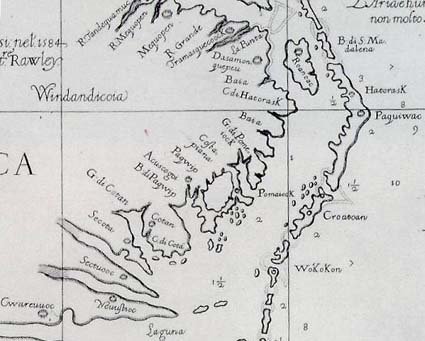
Other pictures include pipe fragments, a map of the Outer Banks with Native American villages and modern names, created by Scott Dawson, pieces of pottery “found during the Croatoan dig in 2006”, and pictures of the “1759 Croatoan land deed giving land to the Hatteras Indians and last but not least, a clipping from the Dare County Times showing a “photo of Lindy Miller after his discovery of a sword and other items in the same spot where the Croatoan village digs would occur 60 years later” as well as a list of Croatoan words and their modern day meanings.

I leave you with the following quote from Scott’s book.

“This colony was abandoned, not lost. The colonists wrote down where they were going and no one ever looked there! Everyone knew where Croatoan was back then just as we know now. That has never been a mystery”…….

Ordering information: Softcover, 5 ½ X 8 ½, 173 pgs, $14.95 plus $4.95 shipping. Happy Hunting! http://www.buybooksontheweb.com/product.aspx?ISBN=0-7414-5469-6


© History Chasers

Click here to view all recent Searching for the Lost Colony DNA Blog posts

Bookmark and Share