Pages

Sunday, November 24, 2013

Which First Thanksgiving?


No. 1. In 1586, the first thanksgiving held by Englishmen on the North American continent took place on Roanoke Island, North Carolina. This celebration was by the company of 100 men from Cornwall, England that Sir Walter Raleigh had brought to America to found a colony. After a year when the relief ship arrived, they held a thanksgiving dinner, and fed-up with the hardships and perils, they all went home.

No. 2. In 1609, at Jamestown, Virginia, the starving remnants of the first settlers held a thanksgiving dinner while awaiting the arrival of their relief ship.

No. 3. In 1612, also at Jamestown, Virginia, a dinner was held after the arrival of Governor Dale with a ship-load of girls intended to become the wives of the settlers.

No. 4. In 1619, a dinner of thanks was held at Berkley Plantation on the James River in Virginia.

No. 5. In 1621, at Plymouth Plantation, a great dinner of thanks was held. Pilgrim Edward Winslow in a letter of December 11, 1621, to a friend in England, described their First Thanksgiving (as printed in Mourt's Relation) as follows.

"Our harvest being gotten in our Governor sent four men on fowling, so we might after a more special manner rejoice together, after we had gathered the fruit of our labors. They, four, in one day killed as much fowl as with a little beside, served the company almost a week. At which time amongst other recreations, we exercised our arms, many of the Indians coming amongst us, and amongst the rest their greatest King Massasoit with some 90 men, whom for three days we entertained and feasted. And they went out and killed five deer which they brought to the Plantation, and bestowed on our Governor, and upon the Captain and others."
This latter Thanksgiving dinner is the one that has survived and became the National Holiday.


© History Chasers Click here to view all recent Historical Melungeons Blog posts Bookmark and Share

Enter your email address to start receiving this blog in your inbox


Enter your email address:
Delivered by FeedBurner

Saturday, September 21, 2013

Get a Family Tree DNA Coupon for $10. off any Test Costing $40. or More with a GEDCOM Upload

The coupon can be used toward any test costing $40. or more.

A Family Tree DNA Coupon Promotes GEDCOM Upload

A new Family Tree DNA coupon offer is promoting pedigree file (GEDCOM) uploads. This is a good way to improve your match comparisons. 
Here is what you do:
- See more at: 

http://www.haplogroup.org/family-tree-dna-coupon-gedcom/#sthash.QB8fT3Sv.dpbs

Saturday, September 14, 2013

Congratulations, Cyndi!!!!


15 Years of Cyndi's List

September 13, 2013
by Alan SmithSpokane Genealogy Examiner


Has it really been that long? I can recall in 1999 my attention being drawn to a website known as Cyndi’s List from a newspaper article. By that time Cyndi’s List had been on line for four years. Over the years, several other articles in the paper toted this wondrous site. It was the absolute best place to start your research because it was such a jump off site for countless other places on the web concerning genealogy.http://www.cyndislist.com/us/
What I did not know then, and just discovered was Cyndi’s List was home grown. On September 12, 1995, a single paged website with 1,025 links was presented to the Tacoma-Pierce County Genealogical Society meeting. That fall it was expanded to six pages and Cyndi’s list was born.

Cont. Here:

http://www.examiner.com/article/15-years-of-cyndi-s-list?cid=rss

http://www.cyndislist.com/us/

This blog is © History Chasers
Click here to view all recent Lost Colony Research Group Blog posts
Bookmark and Share

Friday, July 12, 2013

Buy Kathy Mattea ticket and get Lost Colony ticket for FREE!

Through July 15th at midnight, when you buy a ticket to see Kathy Mattea on July 21, you'll receive a voucher for a FREE ticket to see The Lost Colony good for any night in the 2013 season! Keep it for yourself, give it as a gift....whatever floats your boat. No promo codes, no secret passwords, no fees, no gimmicks....no kidding. It's that simple. We'll have your vouchers waiting for you when you pick your tickets up for the the Kathy Mattea concert. It's like saving $24 on your concert ticket!

Tickets are on sale now by calling 252-473-6000 or online at www.thelostcolony.org. The Lost Colony is proud to present this iconic singer/songwriter in the second concert in the PNC Presents: Live At The Waterside Concert Series. A crowd of nearly 1000 gathered on July 7th for the inaugural event of the series when Ralph Stanley made his first Outer Banks appearance in his 60 plus year career. Kathy Mattea is presented by The Lost Colony and PNC Bank and sponsored by Ace Hardware of the Outer Banks and Dixie 105.7.


This blog is © History Chasers
Click here to view all recent Lost Colony Research Group Blog posts
Bookmark and Share

Tuesday, June 25, 2013

Della Basnight returns to ‘The Lost Colony’ as Dame Coleman.

Della Basnight (right) returns to 'The Lost Colony' as Dame Coleman. (photo: OBXentertainment.com)

Della Basnight (right) returns to ‘The Lost Colony’ as Dame Coleman. (photo: OBXentertainment.com)

“I first auditioned for The Lost Colony when I was six or seven, and I had to go alone because Mama could not go with me”, said Della Basnight as she talked about her return to the stage of the Waterside Theatre in this season’s production of Paul Green’s The Lost Colony
She entered the old Courthouse, where the auditions were held, with great confidence and was determined to be a part of the show.  When asked by the director if she could behave backstage, she replied, “I’ll be real good.”  Her response generated a big laugh from the crowd.  That was it…her first laugh…her first vote of confidence.  She liked it and wanted to make people laugh; she knew the stage was for her. 


Cont. here:
http://obxentertainment.com/2013/06/22/della-basnight-returns-to-the-lost-colony-as-dame-coleman/

This blog is © History Chasers
Click here to view all recent Lost Colony Research Group Blog posts
Bookmark and Share

Monday, June 24, 2013

Kathy Mattea set for Lost Colony show

matteaTwo-time Country Music Association Female Vocalist of the Year Kathy Mattea will make her Outer Banks debut in July.

The concert is scheduled for Sunday, July 21 at 8 p.m. at The Lost Colony’s Waterside Theatre.
Mattea is one of country music’s most distinctive and critically acclaimed artists.
Over the course of more than 20 years in music, she has sold over 7 million albums, won two Grammy Awards and was twice named Country Music Academy Vocalist of the Year.
Her-top 10 list includes, but is not limited to, “Walking Away a Winner,” “Eighteen Wheels & a Dozen Roses,” “Train of Memories,” “Love at the Five & Dime,” “Comin’ from the Heart and 455 Rocket.”
Mattea has remained grounded as a folk-based roots performer who lets her own instincts be her guide. Her talent is matched by her big heart, which is evident in her support of many charities, including American Foundation for AIDS Research and Second Harvest Food Bank among others.

cont. here:

http://outerbanksvoice.com/2013/06/17/lost-colony-to-present-kathy-mattea/

This blog is © History Chasers
Click here to view all recent Lost Colony Research Group Blog posts
Bookmark and Share

Saturday, June 22, 2013

Roanoke, the Accidental Colony


Roanoke, the Accidental Colony


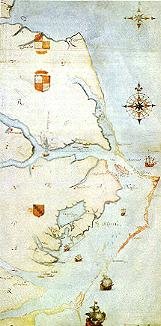
The Lost Colony, an accident of fate with a tragic outcome that reverberates to this day, should never have happened. The group of colonists sent out by Sir Walter Raleigh in 1587 to establish the Cittee of Raleigh, had never intended to locate on the Island of Roanoke. But after a four month long trip marked by delays, mishaps, evasive tactics and possibly outright sabotage, these some 117 men, women and children were unceremoniously dumped on the island by Captain Fernandez. All but but one* of them would vanish without a trace.


They had intended only to stop by the island where fifteen men had been left behind by Sir Richard Grenville the year before, after the failure of first settlement attempt. Governor John White and forty of his "best men" would make a short visit to check on the men, then they would continue on to their destination about 50 miles up the coast of the Chesapeake Bay. Exploration parties sent there previously had made favorable reports on the suitability of the area for settlement. But as soon as the pinnace carrying the men was in the water, Captain Fernandez ordered them to stay there on the island, forbidding them to re-board his ship, claiming he needed to return to the Caribbean as the season was growing short for privateering. Inexplicitly, he then sat at anchor for several weeks in a cruel taunting gesture to the colonists stranded on an island where something very sinister and unexplainable had obviously occurred. Among the first sights to greet the landing party were the bleaching bones of one of the fifteen Englishmen left behind the previous year. The other 14 had vanished without a trace, the fort had been destroyed and the houses had fallen into disrepair. Deer were grazing on melons which had grown up in the floors of the abandoned houses. Something was terribly wrong.


Trying to make the best of their situation, the Colonists began repairing the houses and building new more substantial ones of tile and brick. Their situation was truly precarious. Arriving too late to plant crops, they had not been allowed to take on salt, cattle, plants or fresh water at Hispaniola to replenish their dwindling supplies. They did not have sufficient food to exist for more than a few weeks. They were horrified when one of the assistants, George Howe, out crabbing alone, was killed and mutilated by Indians. Someone would have to return to England and get word to Sir Walter Raleigh that they were in peril. But who would even be able to see Raleigh and who would be believed? These men were, for the most part, middle class craftsmen and the like, unschooled in statecraft. There was only one answer after Christopher Cooper agreed to go, then withdrew his offer. The only man sure to get through to Raleigh and be believed was John White, the Colony Governor. He had been picked by Raleigh to lead this colony and was respected by him. John White did not want to leave his daughter, her husband and his granddaughter, nine day old Virginia Dare. The Colonists begged him to do so though and knowing it was their last chance, John White agreed to set sail with Edward Spicer, who had miraculously found the settlers after his flyboat became separated from them early in the voyage. White refused to sail with Captain Fernandez. He hurriedly prepared and left instructions for certain symbols to be carved if the colonists leave this location. They are to carve the name of the location to which they are relocating on door posts or trees; if they are in distress they are to carve a cross over the name.


Unfortunately, John White and Edward Spicer are blown far off course by terrible storms and barely make it to Ireland. By the time they reach England, Fernandez has been back for weeks, establishing himself as a hero of the expedition. White does see Raleigh, but it is unknown what he tells him.


John White will spend the next three years desperately trying to return to his Colony. He makes two abortive attempts to reach the Colonists from which he is lucky to survive the second one. He is injured and shot by enemy mariners attacking his ship. During this time, Sir Walter Raleigh's attentions are diverted in an attempt to save his Queen and save his country from the menacing threat of defeat by the mightiest Navy in the world; the Spanish Armada. Many believe he will fail. Queen Elizabeth I forbids the sailing of any ships to the area where the colonists are stranded. Due to Raleigh's efforts and history's most providential storm, the Spanish Armada is totally destroyed. England is saved.

*John White who left a few days later to return to England for supplies.

To be continued:

This blog is © History Chasers
Click here to view all recent Lost Colony Research Group Blog posts
Bookmark and Share

Tuesday, June 11, 2013

NC's 'The Lost Colony' drama receives Tony Award


Congratulations to the Lost Colony Drama

Sunday, June 09, 2013
Tony Awards

A North Carolina institution is taking pride in a Tony Award for major contributions to American theater.

Major acting awards were being presented during Sunday's televised Tony Awards show, but the prize honoring "The Lost Colony" came during a cocktail party Saturday in New York. The country's longest-running symphonic outdoor drama has been in production every summer since 1937 on the Outer Banks.
The Tony Honors for Excellence in Theatre notes that artists including Andy Griffth, Lynn Redgrave and Terrence Mann performed in the play based on the story of the early English colonists who vanished from their Outer Banks settlement.
The show got its start with one of President Franklin Roosevelt's New Deal programs funding theatre and other live performances during the Great Depression of the 1930s.


This blog is © History Chasers Click here to view all recent Lost Colony Research Group Blog posts

Friday, May 31, 2013

America, Found and Lost


Virginia Indians Fish

America, Found and Lost

Much of what we learned in grade school about the New World encountered by the colonists at Jamestown is wrong. Four hundred years later, historians are piecing together the real story.

By Charles C. Mann
Courtesy Trustees of the British Museum
It is just possible that John Rolfe was responsible for the worms—specifically the common night crawler and the red marsh worm, creatures that did not exist in the Americas before Columbus. Rolfe was a colonist in Jamestown, Virginia, the first successful English colony in North America. Most people know him today, if they know him at all, as the man who married Pocahontas. A few history buffs understand that Rolfe was one of the primary forces behind Jamestown's eventual success. The worms hint at a third, still more important role: Rolfe inadvertently helped unleash a convulsive and permanent change in the American landscape.
Like many young English blades, Rolfe smoked—or, as the phrase went in those days, "drank"—tobacco, a fad since the Spanish had first carried back samples ofNicotiana tabacum from the Caribbean. Indians in Virginia also drank tobacco, but it was a different species, Nicotiana rustica. Virginia leaf was awful stuff, wrote colonist William Strachey: "poor and weak and of a biting taste." After arriving in Jamestown in 1610, Rolfe talked a shipmaster into bringing him N. tabacum seeds from Trinidad and Venezuela. Six years later Rolfe returned to England with his wife, Pocahontas, and the first major shipment of his tobacco. "Pleasant, sweet, and strong," as Rolfe's friend Ralph Hamor described it, Jamestown's tobacco was a hit. By 1620 the colony exported up to 50,000 pounds (23,000 kilograms) of it—and at least six times more a decade later. Ships bellied up to Jamestown and loaded up with barrels of tobacco leaves. To balance the weight, sailors dumped out ballast, mostly stones and soil. That dirt almost certainly contained English earthworms.
And little worms can trigger big changes. The hardwood forests of New England and the upper Midwest, for instance, have no native earthworms—they were apparently wiped out in the last Ice Age. In such worm-free woodlands, leaf litter piles up in drifts on the forest floor. But when earthworms are introduced, they can do away with the litter in a few months. The problem is that northern trees and shrubs beneath the forest canopy depend on that litter for food. Without it, water leaches away nutrients formerly stored in the litter. The forest becomes more open and dry, losing much of its understory, including tree seedlings.

Cont. here:

http://ngm.nationalgeographic.com/2007/05/jamestown/charles-mann-text


This blog is © History Chasers
Click here to view all recent Lost Colony Research Group Blog posts
Bookmark and Share