By Janet Crain
The 500 year old map going on display at the Library of Congress on Dec. 13th raises some extremely intriguing questions.
In fact, if the government hadn't paid $10,000,000 to purchase the map in 2003 and another considerable amount to restore and conserve the map, plus reportedly more for a chamber to house the map than was spent on those for the Declaration of Independence and the Constitution, I would be tempted to dismiss this map as a fraud. But surely these guys know what they are doing.
The map was discovered in the Waldburg-Wolfegg castle archives in 1901. It was created by the German monk Martin Waldseemuller. The Duke of Lorraine brought Waldseemuller and a group of scholars together at a monastery in Saint-Die in France to create a new map of the world in 1505. The effort took two years and is stunningly accurate.
Some eighty years later and for many years after that, the English searched for a Northwest Passage to the Orient. This belief that such a passage existed was not completely squelched until Lewis and Clark made the Voyage of Discovery and reported back to Jefferson in 1805.
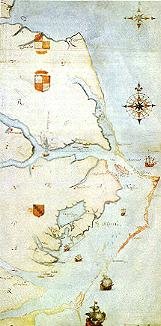
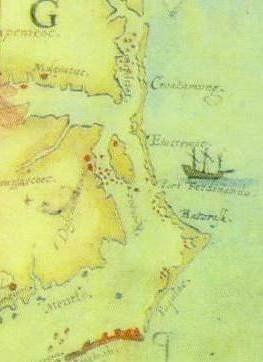
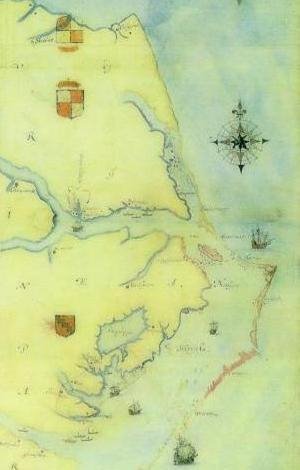
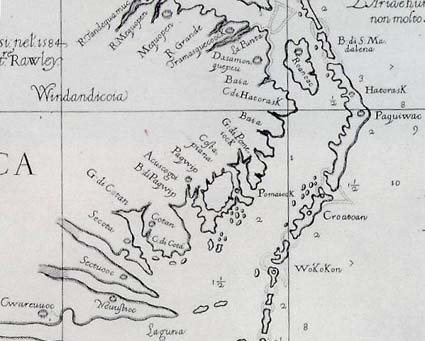
When the early English explorations along the Eastern coast of North America were made by the colonists, some of whom were later known as the Lost Colony, it was thought that the mainland was only a very narrow strip of land with a body of water on the other side which would lead to India and provide riches through trade routes.
How many futile trips were made searching for this chimerical goal? The lives and fortunes lost were in vain. It seems a shame this knowledge was not universally shared.
You can read all about this amazing map here:
http://news.aol.com/story/_a/centuries-old-map-baffles-researchers/20071203221609990001
Thursday, December 6, 2007
Centuries-Old Map Baffles Researchers

Friday, November 2, 2007
Captain Arthur/Edward Barlow
by Philip R. Beltz
Because I have begun to speak on the subject, I needed a working definition. From several authorities, the Melungeons have been variously described as: "One of a group of dark-skinned people of mixed Indian, White, Negro and other Cultures which live or have lived in the southern Appalachian Mountains".
Once into the subject of Melungeons, one must read about the "Lost Colony of Roanoke." I was surprised to see Master Arthur Barlowe, and later, Captain Edward Barlow featured not only for his actions and authority; but also for his documentary writings. This is apparently the same man.
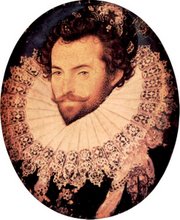
This pertains to Master, and later, Captain Arthur/Edward Barlow, of the 1584 voyage by Sir Walter Raleigh to Roanoke Island, North Carolina. This voyage began the "Lost Colony of Roanoke" story. But Captain Arthur Barlow returned to England. What happened to Arthur Barlow? What is the"official" response of the Barlow Family to this venture, 415 years ago?
I attended "THE MELUNGEON WORKSHOP" at Berea College, Kentucky on September 25 & 26, 1999. One of the speakers was an industrialist and immigrant from Portugal, Manuel Mira. Mira refers to "Master Arthur Barlowe". Mr. Mira spoke and autographed a copy of his book.
In addition, at the book sales table, I bought, "THE MELUNGEONS", by Bonnie Ball. She recounts the same story, but refers to "Captain Edward Barlow".
Please refer to Manuel Mira's:
"THE FORGOTTEN PORTUGUESE: THE MELUNGEONS AND OTHER GROUPS; THE PORTUGUESE MAKING OF AMERICA".
Master Arthur Barlow is referred to on pages: 33, 34, 110, 121 and 303.
Beginning with page 33:
"The Arrival of the Melungeons - Before 1558 or 1584?"
"Sir Walter Raleigh's first expedition departed England on April 27, 1584 and arrived at the Carolina coast on July 4. Included in this expedition were Captain Master Philip Amadas, Master Arthur Barlowe, and as Master Pilot, the Portuguese Simao Fernandes, from Terceira Island, Azores, ..."
"Master Arthur Barlow, who discovered part of the country now called Virginia, gave to Sir Walter Raleigh a narrative of the voyage. After having had contact with the natives, he writes the following description:"
"They are of colour yellowish,and their haire blacke for the most part, and yet we sawe children that had very fine auburn and chestnut colour haire .... and few early descriptions mention hair of other colours, except with the assumption that it represents a mixture with the Europeans. ... reddish hair is often found in children whose hair later becomes, to all appearances, black. 46"
Citation # 46 is "THE ROANOKE VOYAGES" by David Beers Quinn, Vol. I, pp. 102, 103.
Continuing on page 34:
"A similar story is told after Master Barlowe traveled inland near a town called Sequotan where Wingina appears to be the chief of all the villages from Pamlico River to Roanoke Island ...
'neere unto which, sixe and twentie yeers past, (1558) there was a shippe castaway, wherof some of the people were saved, and those were white people, whom the Countrey people preserved. After ten daies, remaining in and out Island uninhabited, called Wococan, (an island in the Carolina Outer Banks) they with the help of some of the dwellers of Sequotan, fastened two boates of the Countrey together, and made mastes unto them, and sailes of their shirtes, and having taken them such victuals as the Countrey yeelded, they departed after they had remained in this out Island three weeks: but shortly after, it seemed they were cast away, for the boates were found upon the coast, cast aland in another Island adioyning': ..."
"These shipwrecks prove that they were common in these parts of the east coast. They may not have survived but why not others?"
"'...other than these, there was never any people apparelled, or white of colour, either seen, or heard amongst these people'"[Ibid, page 111]
"These natives in particular may not have seen any other white men, but it is known that other explorers and navigators were traveling along the east coast since the early 1500s, ..."
Continuing, slightly repeating on page 110:
"In 1584, Sir Walter Raleigh obtained a charter from Queen Elizabeth I giving him the right to possess lands in the New World not already under Christian control. A voyage was planned with Arthur Barlowe and Philip Amadas in charge, and the Portuguese Simao Fernandes was the pilot. They departed on April 27 and arrived on July 13 at Roanoke, Virginia."
Full Article Here:
http://www.barlowgenealogy.com/Resources/melungeon.html