--------------------------------------------------------------------------------
BIBLIOGRAPHY OF BOOKS, PAMPHLETS, AND ARTICLES ON THE ROANOKE ISLAND COLONIES
Some of the following works are valuable sources of information about England's attempts to explore and settle North America in the 1580s. Others reveal attitudes toward, and interpretations of, these attempts. Many recently published books and pamphlets are still in print; older books are available in the rare-book collections of some large libraries or in facsimile reprints. Some of the articles are difficult to find except in a university library. Publications such as the Reader's Guide to Periodical Literature and America: History and Life and indexes to scholarly journals such as North Carolina Historical Review and The William and Mary Quarterly list numerous articles too specialized for inclusion here. This flyer is based loosely on England, Sir Walter Raleigh, the Roanoke Colonies, by William S. Powell.
Cont. here:
http://www.nps.gov/archive/fora/biblio.htm
Contact Information:
http://www.nps.gov/fora/biblio.htm
Fort Raleigh National Historic Site
National Park Service
Rt. 1, Box 675
Manteo, NC 27954
Call (252) 473-5772
Wednesday, January 28, 2009
Lost Colony of Roanoke Resources

Monday, August 11, 2008
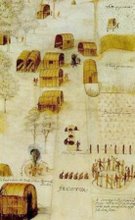
John White, A Festive Dance

Around AD 1585-93
In 1585, John White and a group of English settlers sponsored by Sir Walter Raleigh arrived on the east coast of North America to found new colonies. White had some artistic training and his duties included making visual records of anything unknown in England, including plants, animals, birds and the inhabitants, especially their costumes, weapons and ceremonies. In the area around Roanoke and the tidewaters of coastal North Carolina they found people who called themselves Secotan, who in mid-July held a green corn or harvest ritual, with ceremonies like the one recorded here. This may be the Green Corn or Harvest Festival, celebrating the first harvest of Indian corn or maize at the end of the summer.
cont. here:
http://www.britishmuseum.org/explore/highlights/highlight_objects/pd/j/john_white,_a_festive_dance.aspxMonday, June 9, 2008
Roanoke, the Accidental Colony

The Lost Colony, an accident of fate with a tragic outcome that reverberates to this day, should never have happened. The group of colonists sent out by Sir Walter Raleigh in 1587 to establish the Cittee of Raleigh, had never intended to locate on the Island of Roanoke. But after a four month long trip marked by delays, mishaps, evasive tactics and possibly outright sabotage, these some 117 men, women and children were unceremoniously dumped on the island by Captain Fernandez. All but but two of them would vanish without a trace.
They had intended only to stop by the island where fifteen men had been left behind by Sir Richard Grenville the year before, after the failure of first settlement attempt. Governor John White and forty of his "best men" would make a short visit to check on the men, then they would continue on to their destination about 50 miles up the coast of the Chesapeake Bay. Exploration parties sent there previously had made favorable reports on the suitability of the area for settlement. But as soon as the pinnace carrying the men was in the water, Captain Fernandez ordered them to stay there on the island, forbidding them to re-board his ship, claiming he needed to return to the Caribbean as the season was growing short for privateering. Inexplicitly, he then sat at anchor for several weeks in a cruel taunting gesture to the colonists stranded on an island where something very sinister and unexplainable had obviously occurred. Among the first sights to greet the landing party were the bleaching bones of one of the fifteen Englishmen left behind the previous year. The other 14 had vanished without a trace, the fort had been destroyed and the houses had fallen into disrepair. Deer were grazing on melons which had grown up in the floors of the abandoned houses. Something was terribly wrong.
Trying to make the best of their situation, the Colonists began repairing the houses and building new more substantial ones of tile and brick. Their situation was truly precarious. Arriving too late to plant crops, they had not been allowed to take on salt, cattle, plants or fresh water at Hispaniola to replenish their dwindling supplies. They did not have sufficient food to exist for more than a few weeks. They were horrified when one of the assistants, George Howe, out crabbing alone, was killed and mutilated by Indians. Someone would have to return to England and get word to Sir Walter Raleigh that they were in peril. But who would even be able to see Raleigh and who would be believed? These men were, for the most part, middle class craftsmen and the like, unschooled in statecraft. There was only one answer after Christopher Cooper agreed to go, then withdrew his offer. The only man sure to get through to Raleigh and be believed was John White, the Colony Governor. He had been picked by Raleigh to lead this colony and was respected by him. John White did not want to leave his daughter, her husband and his granddaughter, nine day old Virginia Dare. The Colonists begged him to do so though and knowing it was their last chance, John White agreed to set sail with Edward Spicer, who had miraculously found the settlers after his flyboat became separated from them early in the voyage. White refused to sail with Captain Fernandez. He hurriedly prepared and left instructions for certain symbols to be carved if the colonists leave this location. They are to carve the name of the location to which they are relocating on door posts or trees; if they are in distress they are to carve a cross over the name.
Unfortunately, John White and Edward Spicer are blown far off course by terrible storms and barely make it to Ireland. By the time they reach England, Fernandez has been back for weeks, establishing himself as a hero of the expedition. White does see Raleigh, but it is unknown what he tells him.
John White will spend the next three years desperately trying to return to his Colony. He makes two abortive attempts to reach the Colonists from which he is lucky to survive the second one. He is injured and shot by enemy mariners attacking his ship. During this time, Sir Walter Raleigh's attentions are diverted in an attempt to save his Queen and save his country from the menacing threat of defeat by the mightiest Navy in the world; the Spanish Armada. Many believe he will fail. Queen Elizabeth I forbids the sailing of any ships to the area where the colonists are stranded. Due to Raleigh's efforts and history's most providential storm, the Spanish Armada is totally destroyed. England is saved.
To be continued:

Sunday, January 13, 2008
Roanoke Colonies

The Roanoke Colony on Roanoke Island in Dare County in present-day North Carolina was an enterprise financed and organized by Sir Walter Raleigh in the late 16th century to establish a permanent English settlement in the Virginia Colony. Between 1585 and 1587, groups of colonists were left to make the attempt, all of which either abandoned the colony or disappeared. The final group disappeared after a period of three years elapsed without supplies from England, leading to the continuing mystery known as "The Lost Colony." The principal hypothesis is that the colonists disappeared and were absorbed by one of the local indigenous populations, although the colonists may possibly have been massacred by the Spanish. Other theories include a massacre by some of the hostile local tribes.
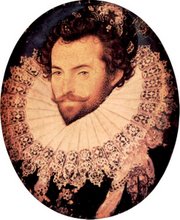
 Sir Walter Raleigh had received a charter for the colonization of the area of North America known as Virginia from Queen Elizabeth I of England. The charter specified that Raleigh had ten years in which to establish a settlement in North America or lose his right to colonization.
Raleigh and Elizabeth intended that the venture should provide riches from the New World, and a base from which to send privateers on raids against the treasure fleets of Spain.
In 1584, Raleigh dispatched an expedition to explore the eastern coast of North America for an appropriate location. The expedition was led by Phillip Amadas and Arthur Barlowe, who chose the Outer Banks of modern North Carolina as an ideal location from which to raid the Spanish, who had settlements to the South, and proceeded to make contact with local American Indians, the Croatan tribe of the Carolina Algonquians.First Group
The following spring, a colonizing expedition composed solely of men, many of them veteran soldiers who had fought to establish English rule in Ireland, was sent to establish the colony. The leader of the settlement effort, Sir Richard Grenville, was assigned to further explore the area, establish the colony, and return to England with news of the venture's success. The establishment of the colony was initially postponed, perhaps because most of the colony's food stores were ruined when the lead ship struck a shoal upon arrival at the Outer Banks. After the initial exploration of the mainland coast and the native settlements located there, the natives in the village of Aquascogoc were blamed for stealing a silver cup. In response the last village visited was sacked and burned, and its weroance (tribal chief) executed by burning.
Despite this incident and a lack of food, Grenville decided to leave Ralph Lane and approximately 75 men to establish the English colony at the north end of Roanoke Island, promising to return in April 1586 with more men and fresh supplies.
By April 1586, relations with a neighboring tribe had degraded to such a degree that they attacked an expedition led by Lane to explore the Roanoke River and the possibility of the Fountain of Youth. In response he attacked the natives in their capital, where he killed their weroance, Wingina.
As April passed there was no sign of Grenville's relief fleet. The colony was still in existence in June when Sir Francis Drake paused on his way home from a successful raid in the Caribbean, and offered to take the colonists back to England, an offer they accepted. The relief fleet arrived shortly after the departure of Drake's fleet with the colonists. Finding the colony abandoned, Grenville decided to return to England with the bulk of his force, leaving behind a small detachment both to maintain an English presence and to protect Raleigh's claim to Virginia.
Second group
In 1587, Raleigh dispatched another group of colonists. These 121 colonists were led by John White, an artist and friend of Raleigh's who had accompanied the previous expeditions to Roanoke. The new colonists were tasked with picking up the fifteen men left at Roanoke and settling farther north, in the Chesapeake Bay area; however, no trace of them was found, other than the bones of a single man. The one local tribe still friendly towards the English, the Croatans on present-day Hatteras Island, reported that the men had been attacked, but that nine had survived and sailed up the coast in their boat.
The settlers landed on Roanoke Island on July 22 1587. On August 18, White's daughter delivered the first English child born in the Americas: Virginia Dare. Before her birth, White reestablished relations with the neighboring Croatans and tried to reestablish relations with the tribes that Ralph Lane had attacked a year previously. The aggrieved tribes refused to meet with the new colonists. Shortly thereafter, George Howe was killed by natives while searching for crabs alone in Albemarle Sound. Knowing what had happened during Ralph Lane's tenure in the area and fearing for their lives, the colonists convinced Governor White to return to England to explain the colony's situation and ask for help. There were approximately 116 colonists—115 men and women who made the trans-Atlantic passage and a newborn baby, Virginia Dare, when White returned to England.
Crossing the Atlantic as late in the year as White did was a considerable risk, as evidenced by the claim of pilot Simon Fernandez that their vessel barely made it back to England. Plans for a relief fleet were initially delayed by the captains' refusal to sail back during the winter. Then, the coming of the Spanish Armada led to every able ship in England being commandeered to fight, which left White with no seaworthy vessels with which to return to Roanoke. He did manage, however, to hire two smaller vessels deemed unnecessary for the Armada defense and set out for Roanoke in the spring of 1588. This time, White's attempt to return to Roanoke was foiled by human nature and circumstance; the two vessels were small, and their captains greedy. They attempted to capture several vessels on the outward-bound voyage to improve the profitability of their venture, until they were captured themselves and their cargo taken. With nothing left to deliver to the colonists, the ships returned to England.
Because of the continuing war with Spain, White was not able to raise another resupply attempt for two more years. He finally gained passage on a privateering expedition that agreed to stop off at Roanoke on the way back from the Caribbean. White landed on August 18, 1590, on his granddaughter's third birthday, but found the settlement deserted. He organized a search, but his men could not find any trace of the colonists. Some ninety men, seventeen women, and eleven children had disappeared; there was no sign of a struggle or battle of any kind. The only clue was the word "Croatoan" carved into a post of the fort and "Cro" carved into a nearby tree. In addition, there were two skeletons buried. All the houses and fortifications were dismantled. Before the colony disappeared, White established that if anything happened to them they would carve a maltese cross on a tree near their location indicating that their disappearance could have been forced. White took this to mean that they had moved to Croatoan Island, but he was unable to conduct a search; a massive storm was brewing and his men refused to go any further. The next day, White stood on the deck of his ship and watched, helplessly, as they left Roanoke Island.
Full Article Here:
http://en.wikipedia.org/wiki/Roanoke_Colony
Tuesday, November 6, 2007
Indian Food and Cooking in Eastern North Carolina

On their third day in the New World, sometime in July 1584, Sir Walter Ralegh's reconnaissance party under Philip Amadas and Arthur Barlowe met three natives. Having no language in common, the two groups quickly resorted to the universal media of polite discourse: food and drink. The explorers took an Indian aboard one of their ships and persuaded him to sample their meat and wine, which Barlowe said, "he liked very well." In return, the Indian caught them as many fish as his canoe could hold.
Over the next few days the Englishmen entertained Granganimeo, an Indian nobleman, and some of his retinue. He reciprocated by sending "euery daye a brase or two of fatte Buckes, Conies [common cottontail rabbits], Hares [marsh rabbits], Fishe....fruites, Melon [pumpkins], Walnuts, Cucumbers [probably squash], Gourdes, Pease, and diuers rootes." Barlowe made special note of the Indians' corn, which he found "very white, faire, and well tasted."
At length Barlowe and seven other Englishmen visited the palisaded village on the north end of Roanoke Island. Although they seem to have arrived unexpectedly while Granganimeo was elsewhere, they got a taste of local hospitality. After washing the visitors and their clothes, Granganimeo's wife and retainers served the Englishmen a feast in his five-room house. It included roasted and stewed venison and fish, boiled corn or hominy, raw and cooked pumpkins and squash, and various fruits.
Barlowe did not record what beverages the Indians served him and his companions, but he did say that the Indians customarily drank wine "while the grape lasteth" and water "sodden with Ginger [sic] in it, and blacke Sinamone [perhaps dogwood or magnolia bark], and sometimes Sassafras, and diuers other wholesome, and medicinable hearbes." (Black drink, made mostly or exclusively of scorched yaupon leaves, was common throughout the region, but the spiced beverages Barlowe describes were not, and wine, if he was not mistaken, was probably unique in the Western Hemisphere.)
For safety Barlowe and company declined to sleep in the village and spent a rainy night in open boats in the sound. Their hosts evidently took no offense, for they sent along the leftovers, pots and all, and kept watch on shore.
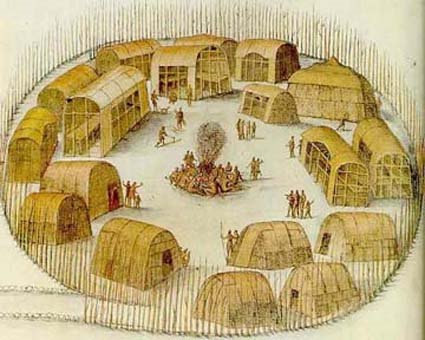
Not until Ralph Lane and his colonists spent eleven months in North Carolina (1585-1586) did Englishmen begin fully to appreciate the bounty of the region and the diversity of Indian cuisine. John White, who may not have stayed in the New World the whole time, made several revealing drawings of Indians cooking and eating. Thomas Harriot, a colonist with an analytical mind and a discriminating palate, devoted much of his "Briefe and True Report of the New Found Land of Virginia" to a catalog of native foodstuffs.
The waters of the region yielded tremendous quantities of fish-sturgeon, herring, mullet, and other species-upon which the Indians depended for much of their protein. Crabs, oysters, clams, scallops, and mussels were another major part of their diet. In spring, when stores laid in the previous fall were depleted and crops were not yet ripe, tribes living on the outer coastal plain often sent members who could be spared to nearby estuaries to subsist on shellfish. (In the spring of 1586, worsening relations with the Indians upon whom the colonists depended for food forced Ralph Lane to adopt this practice and disperse his band to various locations where fish and shellfish could be obtained easily.) Over generations, huge mounds of shells accumulated at favored spots. One of these, the present Tillett site on the south end of Roanoke Island, shows evidence of use from around the time of Christ to the disappearance of the coastal tribes in the seventeenth century. Harriot mentioned turtles and terrapins (both "very good meate, as also their egges" ), porpoises, and "Creuises" (crayfish or lobsters or both), but did not say whether Indians ate them.
The Indians of eastern North Carolina probably had no domestic animal except the dog, but the vast forests, marshes, and swamps abounded in bears, deer, rabbits, squirrels, turkeys, doves, partridges, and water birds. Several of the nominally edible mammals were entirely new to the Englishmen, and Harriot did a poor job of describing them. Saquenuckot, for example, could have been a muskrat, opossum, mink, or raccoon; so could Maquowoc.
Harriot listed six wild root vegetables eaten by the Indians. Openauk may have been the ground nut or the Indian or marsh potato-not the Irish potato. (Sir Walter Ralegh has long received undeserved credit for bringing the Irish potato to Europe. It is native to South America, and the Spanish probably introduced it before he was born.) Okeepenauk, "of the bignes of a mans head," may have been the wild potato, a relative of the sweet potato. The English identified coscushaw as casasava. If it belonged to the arum family, it was not poisonous like raw cassava; but the Indians' elaborate preparation probably made a considerable improvement in its taste. Harriot thought that tsinaw (probably some kind of smilax) was similar to the "China root" imported to England from the East Indies. Its name may be nothing more than a native's attempted pronunciation of China. Harriot had such a low opinion of kaishucpenauk (duck potatoes?) that he pointedly omitted "their place and manner of growing." He said little more about the hot-tasting habascon, perhaps the cow parsnip, except that the Indians added it to their stewpots for flavoring and never ate it alone.
Wild fruits added further zest and balance to the Indians' varied diet. Strawberries were available for the taking, as were crab apples, mulberries, persimmons, prickly pears, "Hurtleberies" (huckleberries, blueberries, or even cranberries), and many species that Harriot did not list. The Indians undoubtedly ate all four native varieties of grape (Harriot mentioned two) out of hand even if they did not make wine. In addition, the Indians collected many nuts and seeds, including chinquapins, two kinds of "walnuts" (probably the black walnut and one or more sorts of hickory nut), the five kinds of acorn that Harriot could distinguish (and perhaps others), and a grain that sounds like wild rice but probably came from an unrelated marsh grass.
Full Article Here:
Friday, November 2, 2007
Captain Arthur/Edward Barlow
by Philip R. Beltz
Because I have begun to speak on the subject, I needed a working definition. From several authorities, the Melungeons have been variously described as: "One of a group of dark-skinned people of mixed Indian, White, Negro and other Cultures which live or have lived in the southern Appalachian Mountains".
Once into the subject of Melungeons, one must read about the "Lost Colony of Roanoke." I was surprised to see Master Arthur Barlowe, and later, Captain Edward Barlow featured not only for his actions and authority; but also for his documentary writings. This is apparently the same man.
This pertains to Master, and later, Captain Arthur/Edward Barlow, of the 1584 voyage by Sir Walter Raleigh to Roanoke Island, North Carolina. This voyage began the "Lost Colony of Roanoke" story. But Captain Arthur Barlow returned to England. What happened to Arthur Barlow? What is the"official" response of the Barlow Family to this venture, 415 years ago?
I attended "THE MELUNGEON WORKSHOP" at Berea College, Kentucky on September 25 & 26, 1999. One of the speakers was an industrialist and immigrant from Portugal, Manuel Mira. Mira refers to "Master Arthur Barlowe". Mr. Mira spoke and autographed a copy of his book.
In addition, at the book sales table, I bought, "THE MELUNGEONS", by Bonnie Ball. She recounts the same story, but refers to "Captain Edward Barlow".
Please refer to Manuel Mira's:
"THE FORGOTTEN PORTUGUESE: THE MELUNGEONS AND OTHER GROUPS; THE PORTUGUESE MAKING OF AMERICA".
Master Arthur Barlow is referred to on pages: 33, 34, 110, 121 and 303.
Beginning with page 33:
"The Arrival of the Melungeons - Before 1558 or 1584?"
"Sir Walter Raleigh's first expedition departed England on April 27, 1584 and arrived at the Carolina coast on July 4. Included in this expedition were Captain Master Philip Amadas, Master Arthur Barlowe, and as Master Pilot, the Portuguese Simao Fernandes, from Terceira Island, Azores, ..."
"Master Arthur Barlow, who discovered part of the country now called Virginia, gave to Sir Walter Raleigh a narrative of the voyage. After having had contact with the natives, he writes the following description:"
"They are of colour yellowish,and their haire blacke for the most part, and yet we sawe children that had very fine auburn and chestnut colour haire .... and few early descriptions mention hair of other colours, except with the assumption that it represents a mixture with the Europeans. ... reddish hair is often found in children whose hair later becomes, to all appearances, black. 46"
Citation # 46 is "THE ROANOKE VOYAGES" by David Beers Quinn, Vol. I, pp. 102, 103.
Continuing on page 34:
"A similar story is told after Master Barlowe traveled inland near a town called Sequotan where Wingina appears to be the chief of all the villages from Pamlico River to Roanoke Island ...
'neere unto which, sixe and twentie yeers past, (1558) there was a shippe castaway, wherof some of the people were saved, and those were white people, whom the Countrey people preserved. After ten daies, remaining in and out Island uninhabited, called Wococan, (an island in the Carolina Outer Banks) they with the help of some of the dwellers of Sequotan, fastened two boates of the Countrey together, and made mastes unto them, and sailes of their shirtes, and having taken them such victuals as the Countrey yeelded, they departed after they had remained in this out Island three weeks: but shortly after, it seemed they were cast away, for the boates were found upon the coast, cast aland in another Island adioyning': ..."
"These shipwrecks prove that they were common in these parts of the east coast. They may not have survived but why not others?"
"'...other than these, there was never any people apparelled, or white of colour, either seen, or heard amongst these people'"[Ibid, page 111]
"These natives in particular may not have seen any other white men, but it is known that other explorers and navigators were traveling along the east coast since the early 1500s, ..."
Continuing, slightly repeating on page 110:
"In 1584, Sir Walter Raleigh obtained a charter from Queen Elizabeth I giving him the right to possess lands in the New World not already under Christian control. A voyage was planned with Arthur Barlowe and Philip Amadas in charge, and the Portuguese Simao Fernandes was the pilot. They departed on April 27 and arrived on July 13 at Roanoke, Virginia."
Full Article Here:
http://www.barlowgenealogy.com/Resources/melungeon.html
Monday, October 29, 2007
Can DNA Solve "The Lumbee Problem"?

Suppose Scots-Irish settlers in North Carolina in the early eighteenth century came upon a group of people who in some ways seemed to be indigenous, but spoke seventeenth century English and had English names. History or an episode of the Twilight Zone?
Indeed, this seems to be the history of the Lumbee Indians of North Carolina. But who are they really? Are they Indians? What is their origin?
A prominent theory is that the Lumbees are descendants of Native Americans and survivors of the Lost Colony of North Carolina.
In 1587, a group of colonists under Sir Walter Raleigh's charter landed in the Outer Banks of what is now North Carolina. This was the second or third group of colonists in the area. One group had returned to England with Sir Francis Drake. The latter group was headed by Governor John White. White returned to England to re-supply the colony; his voyage back to America was delayed by the complications of the English war with Spain and the winter weather. When White did return in 1590, the colonist were gone, but strange "clues" were found. The word "Croatan" was found carved in the wall of a structure that had been built by the colonists. The colonists were never found.
In the early 1700's, Scots-Irish settlers came upon English-speaking people in the interior of southeastern North Carolina. These people appeared to be of mixed race. It is said that in the early censuses, these people were enumerated as "mulattoes" or "free Negroes." The people themselves claimed to be Indians. They waged a legal and political struggle in t he nineteenth century for recognition as Indians.
http://geneablogie.blogspot.com/2007/10/can-dna-solve-lumbee-problem.html
Wednesday, October 17, 2007
The Roanoke Voyages in Literature

The Roanoke colonies pose several challenging questions: Who were the colonists? Who were their backers? How did they get along with one another? Why did they let relations with the Indians descend into open warfare? Where was their settlement? Was there more than one settlement? Does the restored sconce at Fort Raleigh National Historic Site make up Lane's New Fort in Virginia in toto? Is it the only substantial fortification the colonists built? What happened to the 1587 Lost Colony? Were the colonists failures? What does the whole exercise mean? Writers dealing with the Roanoke colonies have necessarily grappled with most of these questions. Even the most amateurish and tendentious of the answers they have assayed have stimulated lively, sometimes productive public debate over the scanty physical and documentary evidence the colonists left behind and over the place in history that the Roanoke colonies warrant.
Most works about the Roanoke colonies fit, seldom neatly, into one of four categories. There is no compelling reason to segregate them further, according to whether they seem predominantly factual or imaginative. Most nonfiction writers are heavily influenced by their own or their sources' imaginations. The indispensable contemporary accounts of the Roanoke colonies are by turns discursive, fictional, poetic, and dramatic. Not even Thomas Harriot's Briefe and True Report of the New Found Land of Virginia (1588), the first fundamentally scientific description of the peoples and resources of North America, is untainted by the author's imagination. The best fiction, poetry, and drama is solidly founded in historical research, if not in historical fact, and it engenders discussion and spreads information (correct or not) as few scholarly works could do. The reader should measure the ratio of fact to imagination in each work for himself.
Sunday, October 7, 2007
Early History of the Outer Banks of North Carolina

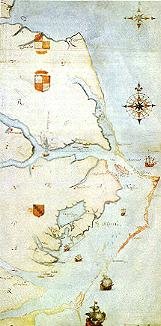
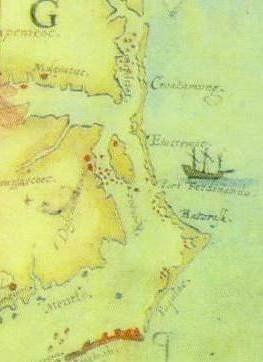
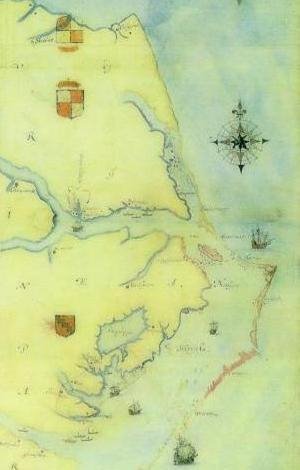
Jutting far into the ocean near the warm, circulating waters of the Gulf Stream, the Outer Banks was the first North American land reached by English explorers. A group of colonists dispatched by Sir Walter Raleigh set up the first English settlement on North American soil in 1587. But Native Americans inhabited these barrier islands long before white men and women arrived.
Historians believe humans have been living in the area that now encompasses North Carolina for more than 10,000 years. Three thousand years ago, people came to the Outer Banks to hunt, fish, and live off the land. The Carolina Algonkian culture, a confederation of 75,000 people divided into distinct tribes, spread across 6,000 square miles of northeastern North Carolina.
Archaeologists believe that as many as 5,000 Native Americans may have inhabited the southern end of Hatteras Island from 1000 to 1700. These Native Americans, known as the Croatan, formed the only island kingdom of the Algonkians. Isolation provided protection and the exclusive use of the island's seemingly limitless resources. For more than 800 years, the Croatan lived comfortably in what is now known as Buxton Woods Maritime Forest at Cape Hatteras. Contact with Europeans proved fateful, however. Disease, famine, and cultural demise eliminated all traces of the Croatan by the 1770s.
Early ventures to America's Atlantic Seaboard proved dangerous and difficult for European explorers because of the high winds, seething surf, and shifting sandbars. In 1524 Giovanni da Verrazano, an Italian in the service of France, plied the waters off the Outer Banks in an unsuccessful search for the Northwest Passage. To Verrazano, the barrier islands looked like an isthmus and the sounds behind them an endless sea. According to historian David Stick, the explorer reported to the French king that these silvery salt waters must certainly be the "Oriental sea . . . the one without doubt which goes about the extremity of India, China, and Cathay." This misconception-- that the Atlantic and Pacific Oceans were separated by only the skinny strip of sand we now call the Outer Banks-- was held by some Europeans for more than 150 years.
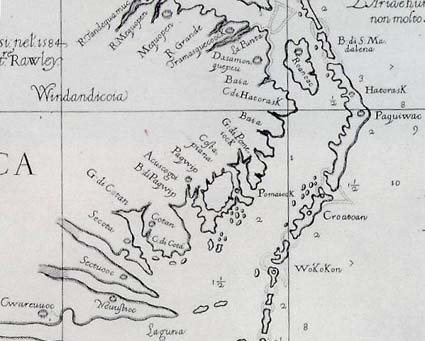
About 60 years after Verrazano's visit, two English boats arrived along the Outer Banks, searching for a navigable inlet and a place to anchor away from the ocean. The captains, Philip Amadas and Arthur Barlowe, had been dispatched by Sir Walter Raleigh to explore the New World's coast. They were hoping to find a suitable site for an English settlement.
The explorers finally found an entrance through the islands, well north of Cape Hatteras, probably at the present-day Ginguite Creek in northern Kitty Hawk. Traversing the inlet, they sailed south through the sounds to Roanoke Island. There, they disembarked, met the natives, and marveled at the abundant wildlife and cedar trees. Of their successful expedition they told Raleigh about the riches they discovered and the kindness with which the Native Americans had received them.
During the next three years, at least 40 English ships visited the Outer Banks, more than 100 English soldiers spent almost a year on Roanoke Island, and Great Britain began to gain a foothold on the continent, much to the dismay of Spanish sailors and fortune-seekers.
Full Article Here:
http://www.insiders.com/outerbanks/main-history2.htm