REMARKS
OF
HON. JOHN D. BELLAMY,
OF NORTH CAROLINA,
IN THE
HOUSE OF REPRESENTATIVES,
THURSDAY, FEBRUARY 1, 1900.
R E M A R K S
OF
HON. JOHN D. BELLAMY.
The House having under consideration the Indian appropriation bill-
Mr. BELLAMY said:
Mr. Chairman: I had the honor some time since of introducing
into this House a bill providing for the education and support of
the children of the Croatan Indians of North Carolina. On yes-
terday the chairman of the Committee on Indian Affairs very
courteously accorded to me an opportunity to address the commit-
tee upon the subject. Several of the members requested me, on
account of their interest, to present them to the House.
Mr. Chairman, the Indians of the United States are peculiarly
the wards of the nation, and very justly they should be so regarded
and so dealt with. They were once the proud possessors of our
soil, but to the inexorable decree of fate they have succumbed, and
the Teutonic race, against which in its progress all less civilized
peoples have given away and retired, has pressed them westward,
and the plains and forests of the eastern slope and seaboard of
America, once their happy haunts and hunting grounds, is inhab-
ited no longer by them, except by the remnants of a few scattered
tribes which almost have been, but not entirely, absorbed by con-
tact with the white man and his allies.
The white settlers of America, while they wrested from the
aborigines the soil on which they dwelt, which on account of the
nomadic habits of the Indian tribes could hardly be said to be
possessed by them, have been from the earliest period of our his-
tory imbued with a laudable feeling that justice and humanity
required that the Indians should receive Government consideration
and protection, that they might acquire fixed abodes, and by civil-
izing influences they might, in the course of time, become co-
sharers in the blessings of a free Government.
The last tribe left lingering on the scene of these once royal do-
mains is the Croatans or Hatteras Indians, inhabiting the State
of North Carolina, about 60 miles from the seaboard, in the
counties of Robeson, Scotland, Richmond, and Columbus, and
there they have been for a period so long that the '•memory of
man runneth not to the contrary thereof." That they have not
claimed the attention of the National Government before is a
matter which excites great surprise and is hard to be explained,
unless the smallness of their number and the lack of education
and enlightenment among them, and the w^ant of proper philan-
thropy among their neighbors, has caused them to be entirely
overlooked. And yet the public mind has been directed to them
on more than one occasion when they have shocked the country
by some atrocity which is incident to the Indian character.
There are in the settlement in Robeson County, where they
chiefly reside, about 3,000 souls, and with the scattered families
in adjoining counties the number may run to 2,000 men, making
the tribe about 5,000 people. . A number of them have migrated
to Georgia, Mississippi, and Florida, where they have become ab-
sorbed in the body politic. They are the most interesting people
in America, and no tribe can appeal stronger to the tender sym-
pathies and the generous beneficence of the American people than
the Croatan Indians of North Carolina. They, beyond cavil or
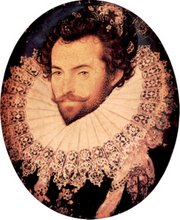
doubt, are the descendants of the lost colony of Sir Walter Raleigh,
about which there have been for over three hundred years so many
sad reflections.
Those at all familiar with the attempts at colonization made
by our English ancestors may recall the efforts of that gallant
knight and learned and ambitious favorite of Queen Elizabeth.
Not only could Sir Walter throw his cloak on the wet ground
that it might serve a footcloth for the dainty shoe of Elizabeth,
but he sought to extend the domains of her Most Gracious Majesty
that her reign might become memorable in the annals of history
and her Empire strengthened and enriched.
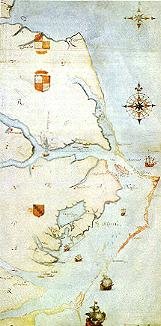
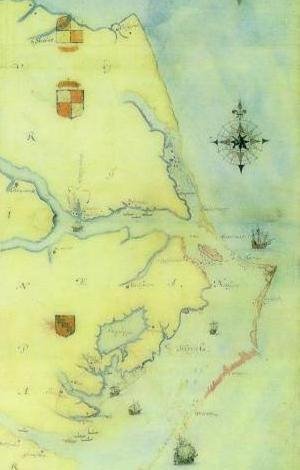
In the year 1584 Raleigh fitted out a fleet of ships under Amadas
and Barlow and discovered the country that is now known as
North Carolina, but then called Virginia, in honor of the virgin
Queen. Soon thereafter he began to make efforts to colonize the
new Eldorado. Two attempts failed: but undaunted, in 1587, in
three ships under John White, whom* he appointed governor, he
sent over 117 persons, including 17 women, and of the fate of these
people nothing is known or has been discovered with absolute cer-
tainty from that day to this, unless this is shown by the remarks
I shall now make, and which was first attempted by my old friend
and preceptor, Hamilton McMillan. These 117 colonists were left
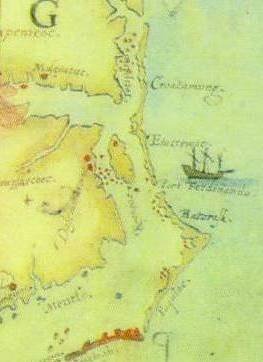
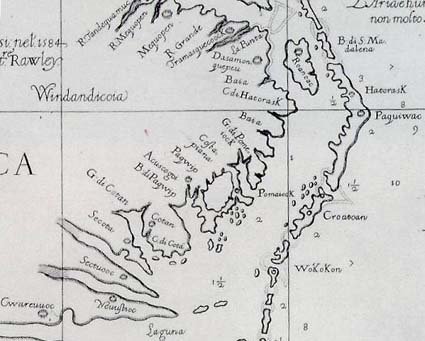
on Roanoke Island, near the "harbor of Hatorask," and there, on
August 18, 1587, the daughter of Governor White, the wife of
Ananias Dare, gave birth to a daughter, the first white child born
on American soil, and named and baptized, in honor of Her Majesty,
Virginia Dare.
The ships, leaving the colony, returned for supplies and recruits,
but when they reached England the Kingdom was agitated by a
threatened invasion from Spain. Afterwards the Spanish Armada
was defeated, and when peace was once more restored Raleigh
looked around to provide for the relief of his colony which he had
planted in the New World a few years before. But it was not
until 1590 that Governor White was dispatched to their rescue, and
when he reached Roanoke, in August, he found the island de-
serted; no trace of a human being could be found, but at the site
of the village where the settlers were left nearly three years be-
fore there was found a tree which had been deprived of its bark
and bore, in clear and well-cut characters, the word '• Croatan."
There had been an understanding by White with the colonists
before leaving that if they should remove their location they
should carve on a tree the name of the place to which they had
gone; and if they were in danger or sore distress they should
carve a cross above the name on the tree. White finding the
absence of the cross was buoyed with the hope of their discovery,
but after all efforts to trace them had proved fruitless, he was
forced to abandon the search and reluctantly returned to England.
The lost colony was never heard of, and their sad fate is a mat-
ter of deep and pathetic interest to the American people. Whether
they went to Croatan voluntarily or whether the men were mas-
sacred and the women taken for wives, or whether both men and
women intermarried with the Hatteras Indians is only a matter
of conjecture. But one fact is known, and that is that Lawson,
in his history of Carolina, written in the year 1714, imparts to us
that —
The Hatteras Indians, who lived on Roanoke Island or much frequented It,
tell us that several of their ancestors were white people and could talk in a
book, as we do; the truth of which is confirmed by gray eyes being found
frequently among those Indians and no others. They value themselves ex-
tremely for their afinity to the English, and are ready to do them all friendly
offices. It is probable that the settlement miscarried for want of timely sup-
plies from England or through the treachery of the natives, for we may rea
sonably suppose that the English were forced to cohabit with them for re
lief and conversation, and that in process of time they confined themselves to
the manners of their Indian relations, and thus we see how apt human na-
ture is to degenerate.
Long prior to the Revolutionary war there was found settled
near Lumber River, in Robeson County, N. C. , a tribe of Indians.
Many of them had blue eyes, and while possessing all other traits
and characteristics of Indians — the copper color, the high cheek
bone, the erect form — yet they lacked the nomadic habit. They
were settled in a neighborhood where they still remain, then, as
now, cultivating maize and potatoes and fruits. Their traditions
then, as now, were that their ancestors, Indian men, married
white women; that they came from Roanoke (in Virginia, they
say) ; that they were driven away by bad Indians, and, as one now
about 90 years of age told your speaker, that they were driven
across the river. Most of them own their own land, which they
either bought from the early settlers — who, on account of the In-
dian being already in possession, quitclaimed it for a nominal con-
sideration — or obtained it by an entry and grant from the Com-
monwealth. The names of the 117 lost colonists are still preserved
inHakluyt, Volume III, wherein is given an account of " The fourth
voyage made to Virginia with three ships in the j^ear 1587, where-
in was transported the second colony."
From the list of names are many now and from the earliest
times borne by men of this tribe, such as John Sampson, Robert
Wilkinson. Henry Berry, Richard Berry, John Burden, Henry
Dorrel (Dial); John Cheven, William Berden, and many others.
Thus it is seen that their blue eyes, the tradition of the white
mothers, the locality from which they came, the lack of the
nomadic habit derived from the infusion of English blood, the
similarity of names, the tradition of being driven by the bad In-
dians across the river, doubtless by the waxlike and hostile Tus-
caroras, who inhabited also the neighboring coast country, prove
conclusively to the student of the question that the lost colony of
Raleigh has been found. They are a remarkable people. It is
said by old residents that some of these Indians were volunteers
in the Revolutionary' war. That they sent two companies to the
war of 1812 is well authenticated.
They made gallant soldiers, as a number of our oldest inhabi-
tants can testify. From the earliest times up to the year 1835
they went to school with the whites, voted and shared in the
privileges of citizenship. But in that year the constitution of
North Carolina was amended, and thereafter for a period of thirty-
three years they were deprived, not only of the right to vote, but
even of the privileges of education, until the constitution of 1868
was passed, whereby they became restored to citizenship and ta
school privileges of the most meager character, but such as other
citizens enjoyed.
They were not permitted to attend the schools for whites, and
therei'ore were forced, if they received any education, to attend the
negro schools. They refused to a very great degree, on account
of the intense antipathy they now have for the negro.' the educa-
tion m the negro schools until, through the instrumentality of
Hamilton McMillan, esq., the legislature of North Carolina, in
1887, gave them separate schools of their own.
At the breaking out of hostilities between the North and the
South in 1861 these people, grown up in ignorance, but quietly
cultivating their little farms, were radely awakened by the Con-
federate authorities conscripting them and using them as laborers
to build the immense sand fortifications at New Inlet, on the Cape
Fear River, known as Fort Fisher; the same fortifications so
celebrated as having been the scene of the greatest naval bom-
bardment of the worlds history, as compared with which an offi-
cer who was at Sebastopol said:
The siege of Sebastopol as compared with the siege of Fort Fisher was but
child's play.
The work was hard, the Croatan murmured; he then deserted
and fl.ed to the swamps of his native heath. The conscripting
officers pursued them. Arresting an old Indian, they asked him
why he deserted. He told them that he did not want to work or
fight for a people who treated him so unjustly; that before 1835
he voted, he went to school, but since then he had been deprived
of both, and that he would neither work nor fight for the Con-
federacy, And thus it was they were arrested and deserted.
When at the close of the war many of them were in hiding, they
committed acts of depredation, for which they were properly out-
lawed, and then arose the band known as the Henry Berry Lowery
gang. For years they became a terror to the country, and in the
early seventies this band of Indians shot down and killed 27 white
men from first to last among the wealthiest, the bravest, and
best men of that county. The leader, Henry Berry Lowery. was
finally killed, peace and quiet was again restored, and under the
benign influence and rule of our people, inaugurated in the year
1887, they are becoming good citizens.
There is still much ignorance and a strong propensity to vio-
late the internal revenue laws among some few of them, but it is
because they know not the sinfulness of the violation of law. They
from time immemorial have raised fine fruit and grain, and have
always distilled brandy and' whisky, and, like some other citizens,
they feel that it is an unjust interference with their natural rights
to prevent them from converting their waste products into a sala-
ble article. Many of the cases in our United States courts for
manufacturing without license are from among these people.
They are and have always been a distinct people. They are true
friends, but bitter and implacable enemies.
They are brave, but reckless. They are honest in their dealings.
They are intensely religious. They are restless, active, and ener-
getic. Indolence and sloth are not known among them. They are
eager for education. They are capable of intellectual and moral
development, as is attested by some among them. A number
have become successful merchants. One of them filled the posi-
tion of United States Senator from one of our sister Southern
States. The descendant of another has become a member of Con-
gress.
Now, these are the people I commend to the kind consideration
of the American Congress. Their school f-acilities are poor. By
extending them aid you are giving expression in substantial form
to that noble sentiment of justice inherent in our people and which
has urged our Government to make large appropriations for the
education and support of Indian tribes which passes each session
of Congress. No tribe is entitled to more at our hands: and if in
the providence of God they be elevated by a sound moral and
mental training inaugurated by the Government, history will yet
say that Sir Walter Raleigh did not plant his colony in vain, and
there will yet arise some gifted American writer who will perpetu-
ate in song and weave in fiction the storj' of the Croatan Indians,
the descendants of the Indian chief, Manteo. created the first Lord
of Roanoke, and of Virginia Dare, the first white child born on
American soil. [Applause.]
Remarks of Hon. John D. Bellamy, of North Carolina,in the House of Representatives, Thursday, February 1, 1900 (1900)
Author: Bellamy, John Dillard, 1853-1942
Subject: Federal aid to Indians -- North Carolina; Lumbee Indians
Publisher: Washington : [s.n.]
Year: 1900
Possible copyright status: NOT_IN_COPYRIGHT
Language: English
Call number: b3123111
Digitizing sponsor: University of North Carolina at Chapel Hill
Book contributor: University Library, University of North Carolina at Chapel Hill
Collection: americana
Description