Pages

Showing posts with label Thomas Harriot. Show all posts

Friday, August 1, 2008

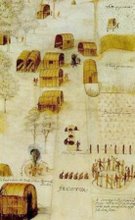
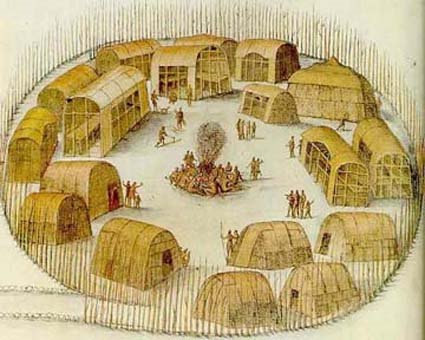
American Indian town of Pomeiooc

Black and white drawing of the American Indian town of Pomeiooc.  The town consists of several buildings surrounded by a fence.  In the center several people sit and stand around a fire.
Engraving of the American Indian town of Pomeiooc, published in Thomas Hariot's 1588 book A Briefe and True Report of the New Found Land of Virginia. (Illustration by Theodor de Bry. More about the illustration)


The towns of this country are in a manner like unto those which are in Florida, yet are they not so strong nor yet preserved with so great care. They are compassed about with poles stark fast in the ground, but they are not very strong. The entrance is very narrow as may be seen by this picture, which is made according to the form of the town of Pomeiooc. There are but few houses therein, save those which belong to the king and his nobles. On the one side is their temple separated from the other houses, and marked with the letter A. It is built round, and covered with skin mats, and as it were compassed about with curtains without windows, and has no light but by the door. On the other side is the king’s lodging marked with the letter B. Their dwellings are built with certain potes [sticks] fastened together, and covered with mats which they turn up as high as they think good, and so receive in the light and other. Some are also covered with boughs of trees, as every man lusts or likes best. They keep their feasts and make good cheer together in the middle of the town as it is described in the 17 figure. When the town stands far from the water they dig a great pond noted with the letter C where hence they fetch as much water as they need.


“The Towne of Pomeiooc.” Theodor de Bry’s engraving of the American Indian town of Pomeiooc, published in Thomas Hariot’s 1588 book A Briefe and True Report of the New Found Land of Virginia.

Wednesday, October 17, 2007

The Roanoke Voyages in Literature


After a pleasant visit to the Outer Banks, Ralegh's reconnaissance party under Philip Amadas and Arthur Barlowe returned to England in September 1584. Almost immediately chroniclers, spies, gossips, and dilettantes seized on reports of the Edenic land of Wingandacon — which turned out to be not the name of the place, but a garbled Algonquian reference to trees or to English clothing. Ever since, writers of many interests and attainments have occasionally taken on the first English attempts to colonize what is now the United States; most have paid special attention to the 1587 lost colony.


The Roanoke colonies pose several challenging questions: Who were the colonists? Who were their backers? How did they get along with one another? Why did they let relations with the Indians descend into open warfare? Where was their settlement? Was there more than one settlement? Does the restored sconce at Fort Raleigh National Historic Site make up Lane's New Fort in Virginia in toto? Is it the only substantial fortification the colonists built? What happened to the 1587 Lost Colony? Were the colonists failures? What does the whole exercise mean? Writers dealing with the Roanoke colonies have necessarily grappled with most of these questions. Even the most amateurish and tendentious of the answers they have assayed have stimulated lively, sometimes productive public debate over the scanty physical and documentary evidence the colonists left behind and over the place in history that the Roanoke colonies warrant.


Most works about the Roanoke colonies fit, seldom neatly, into one of four categories. There is no compelling reason to segregate them further, according to whether they seem predominantly factual or imaginative. Most nonfiction writers are heavily influenced by their own or their sources' imaginations. The indispensable contemporary accounts of the Roanoke colonies are by turns discursive, fictional, poetic, and dramatic. Not even Thomas Harriot's Briefe and True Report of the New Found Land of Virginia (1588), the first fundamentally scientific description of the peoples and resources of North America, is untainted by the author's imagination. The best fiction, poetry, and drama is solidly founded in historical research, if not in historical fact, and it engenders discussion and spreads information (correct or not) as few scholarly works could do. The reader should measure the ratio of fact to imagination in each work for himself.


Full Article Here: