Pages

Showing posts with label Spanish. Show all posts

Sunday, August 8, 2010

Did Sir Richard Greenville Leave the Ancestors of the Banker Ponies?


OCRACOKE PONIES

The Wild Bankers of Ocracoke Island
OCRACOKE'S FAVORITE RESIDENTS


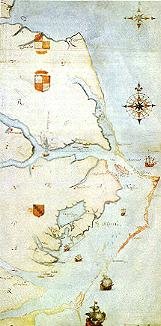
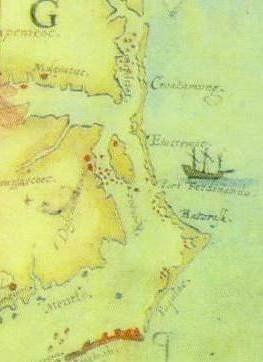
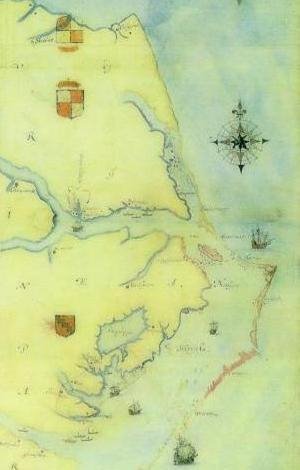
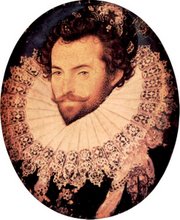
Legend has it that the "Banker" horses of Ocracoke were left by shipwrecked explorers of the 16th or 17th Century. European ships commonly carried livestock to the New World. If a ship ran aground near the coast, animals were thrown overboard to lighten the load so that the ship could be re-floated. The livestock were often left behind when the ship again set sail. Sir Richard Grenville's ship TIGER ran aground at Ocracoke Island in 1565.* There is speculation that he may have unloaded Spanish mustangs on the island.


Evidence also exists of a failed earlier Spanish colony further south along the Carolina coast in 1526. Their horses, if abandoned, may have slowly spread north to Ocracoke.
Banker horses have been documented on Ocracoke since the first European settlers came to stay in the 1730's. There have been as many as 300 horses on Ocracoke Island. They have played a major role in the island's history, serving residents as beasts of burden at work and at play, in beach rides and races.

The U.S. Life-saving Service used horses until 1915 for beach patrols and to haul equipment to and from shipwreck sites. The Coast Guard kept a small band of Banker ponies to patrol the beaches during World War II. For a period of the 1950's, islanders held annual July 4th pony "pennings". Horses and colts were rounded up and driven into the village to be corralled and then branded. Some horses were sold during the event.

Cont. here:


See also:


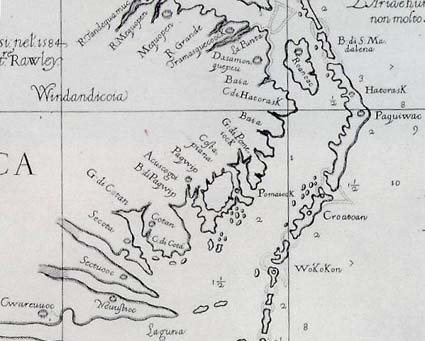
*With delays caused by the capture of a Spanish ship, the need to gather salt, and the purchase of supplies, the English finally arrived off Cape Fear on 23 June 1585. The next day they anchored and fished in the vicinity of present-day Beaufort Inlet. And finally on 26 June they reached Wococon on the Outer Banks. (It may or may not have been the present-day Ocracoke Inlet: inlets in this area open and close often and move continually.) On 29 June 1585 the Tyger ran aground at Wococon with the loss of most of the supplies on board.


This blog is © History Chasers
Click here to view all recent Lost Colony Research Group Blog posts
Bookmark and Share

Wednesday, January 20, 2010

Lost Spanish colony may be found


Pottery in St. Augustine may provide clues

Posted: January 19, 2010 - 12:12am

Three years after St. Augustine was founded, Alvara de Mendana, nephew of the governor of Peru, set out with two ships and 150 soldiers and sailed west to find gold and a new trade route to China.

Mendana's 1568 voyage found nothing, so he returned to Peru.

But a relentless lust for gold pushed the Spanish to dispatch more colonizing fleets. And one founded a colony somewhere in the Solomon Islands, northeast of Australia.

No one knows its exact location or why the colony disappeared, but Martin Gibbs of the University of Sydney's Department of Archaeology has done extensive research and thinks he has a few clues. He came to St. Augustine last week to look for some clues in possible similar objects.

For 27 years after Mendana's first voyage, the Spanish remained obsessed by an Inca legend of an island.

http://staugustine.com/news/local-news/2010-01-19/lost-spanish-colony-may-be-found

© History Chasers

Click here to view all recent Searching for the Lost Colony DNA Blog posts

Bookmark and Share

Friday, July 11, 2008

Public invited to see 500-year-old artifacts This Saturday

MORGANTON - People gathered around a woman and shouts of "hey, hey, hey" went up at the Berry archeological site on Thursday.

David Moore, lead archeologist at the site, was standing about 75 yards away. When he heard the shouts, he made his way over to the group.

What got the crowd excited was a find by Jeane Jones, of Dalton, Ga., of a tiny blue Spanish glass bead believed left behind from the first European settlement in the interior of what is now the United States.

It was the second glass bead found last week. One man found a piece of metal believed to be from the same era.

On July 12, the public will get a chance to take a look at the glass beads and other artifacts found at the site, as well as observe archaeologists at work. Archaeologists will be on hand to discuss the site and lead tours. Primitive skills experts also will demonstrate how native people crafted their weapons and tools.

Warren Wilson College and Western Piedmont Community College Archaeology Field School is sponsoring the open house.

Full Article Here:

http://www.morganton.com/servlet/Satellite?pagename=MNH/MGArticle/MNH_BasicArticle&c=MGArticle&cid=1173355790954

Thursday, May 1, 2008

Sir Richard Grenville's Horses Left Behind on the Outer Banks?


OCRACOKE PONIES

The Wild Bankers of Ocracoke Island
OCRACOKE'S FAVORITE RESIDENTS


Legend has it that the "Banker" horses of Ocracoke were left by shipwrecked explorers of the 16th or 17th Century. European ships commonly carried livestock to the New World. If a ship ran aground near the coast, animals were thrown overboard to lighten the load so that the ship could be re-floated. The livestock were often left behind when the ship again set sail. Sir Richard Grenville's ship TIGER ran aground at Ocracoke Island in 1565.* There is speculation that he may have unloaded Spanish mustangs on the island.


Evidence also exists of a failed earlier Spanish colony further south along the Carolina coast in 1526. Their horses, if abandoned, may have slowly spread north to Ocracoke.
Banker horses have been documented on Ocracoke since the first European settlers came to stay in the 1730's. There have been as many as 300 horses on Ocracoke Island. They have played a major role in the island's history, serving residents as beasts of burden at work and at play, in beach rides and races.

The U.S. Life-saving Service used horses until 1915 for beach patrols and to haul equipment to and from shipwreck sites. The Coast Guard kept a small band of Banker ponies to patrol the beaches during World War II. For a period of the 1950's, islanders held annual July 4th pony "pennings". Horses and colts were rounded up and driven into the village to be corralled and then branded. Some horses were sold during the event.

Cont. here:


See also:


*With delays caused by the capture of a Spanish ship, the need to gather salt, and the purchase of supplies, the English finally arrived off Cape Fear on 23 June 1585. The next day they anchored and fished in the vicinity of present-day Beaufort Inlet. And finally on 26 June they reached Wococon on the Outer Banks. (It may or may not have been the present-day Ocracoke Inlet: inlets in this area open and close often and move continually.) On 29 June 1585 the Tyger ran aground at Wococon with the loss of most of the supplies on board.


Sunday, April 6, 2008

Timeline of Events Leading Up to the Lost Colony

Introducing an excellent timeline done by Nelda Percival, webmaster and graphic artist for The Lost Colony Genealogy DNA Research Group


12 Oct 1492


Discovery of the Americas - The Spanish were especially well prepared by history to conquer, occupy, populate and exploit new lands and assimilate new people. America thus became the new frontier-land for those people used to its ways and with the military, diplomats and administrative arms at their disposal to face the challenge. By the middle of the 16th century, they had settled in the two most important viceroyalties, Mexico on the Atlantic, and Peru on the Pacific.


1493


Pope Alexander (1431 - 1503)
http://www.nndb.com/people/159/000092880/
Alexander VI, given name Rodrigo Borgia, Roman Catholic Pope from 1492 until his death, is the most memorable of the corrupt and secular popes of the Renaissance. Pope Alexander divides the world between Portugal and Spain, excluding all others


by Nelda L. Percival

The Lost Colony Genealogy & DNA Research Group

Cont. here: