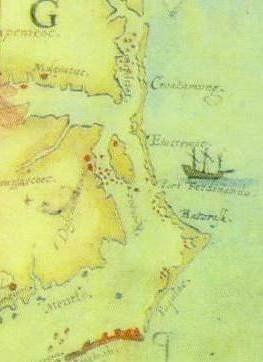
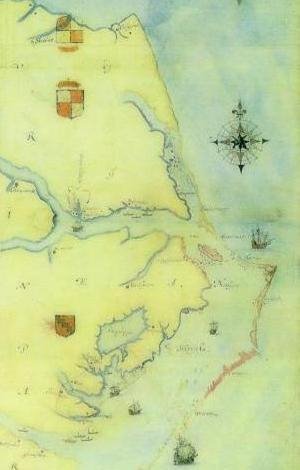
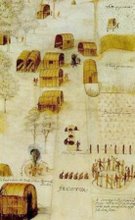
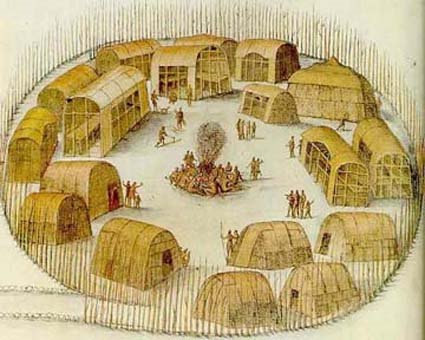
The earliest illustrations of North Carolina, painted by the artist John White, are coming to America this October. White traveled with a company of Englishmen who explored the region and left tantalizing records of their discoveries. One of their most unusual finds, an Indian “Women’s Towne,” was never illustrated or explained.
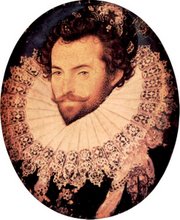
The expedition camped in America for a year, from 1585-86, under the leadership of Ralph Lane. In his journal, Lane describes venturing up the Roanoke River with a party of men, finding the Algonquian villages deserted, and growing desperate for food. He then mentions an Algonquian “women’s town” near the water.
He intends to plunder that settlement’s fish weirs: “… seeing all the Countrey fled before us, and therefore while wee had those two dayes victuall left, I thought it good for us to make our returne homeward, and that it were necessary for us to get the other side of the Sound of Weopomeiok in time, where wee might be relieved upon the wears [weirs] of Chypanum, and the womens Towne, although the people were fled.”
Historians have not determined why Lane referred to this village as“Women’s Towne.” According to Professor Michael Oberg, author of a newbook on the Roanoke Indians, “We do know that women could lead Algonquian village communities. It may be as simple as Lane referring to a village community governed by a weroansqua (female leader). But my short answer would be that we just don’t know.”
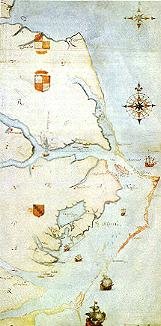
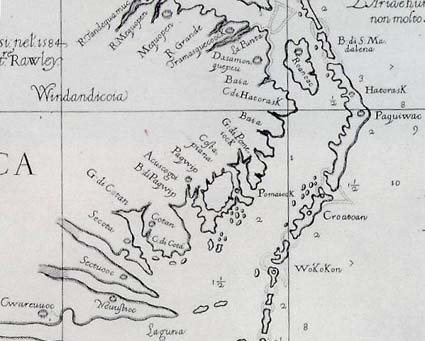
White’s map of the region shows two settlements at “Chypanum,” in Weapemeoc tribal territory on the north of Albemarle Bay, that are divided by the fork of an inlet and connected by a hatchmarked path.No other villages are shown linked in this way. Was one of these the Women’s Town, led by a Native American woman, or by women? It is unclear. Explorers reported that a weroansqua governed the Croatoan tribe on Croatoan Island (now Hatteras), but that village was never described as a “women’s town.”
A year after White ventured as an illustrator, he would return to America in a new role – as governor of the ill-fated “Lost Colony,” a gamble that cost him his daughter and granddaughter. Deborah Homsher has written a novel, THE RISING SHORE – ROANOKE, about that 1587 expedition. White’s daughter, Elenor Dare, is one of the narrators.
John White’s watercolors, on loan from the British Museum, will be on display at the North Carolina Museum of History in Raleigh from October 20 through January, in the exhibit, “Mysteries of the Lost Colony. A New World: England’s First View of America.” This is the first time these fragile paintings have been exhibited outside England in forty years.
For information, see
http://ncmuseumofhistory.org/.
For information on Elizabethan pioneers, with links to their original reports, see
http://www.risingshoreroaonke.com/.