Come along with me, past all the bicentennial hoopla, to a quiet place north of the White House. Here, at the National Museum of Health and Medicine, you'll find a glass case housing the most incredible Lincoln memorabilia on the planet: the man himself. His blood on the cuff of a surgeon's shirt. Snippets of his chocolate brown hair. A handful of bone fragments removed from his skull. Yes, Lincoln! Guess what that might mean? Lincoln's DNA! Scientists have been speculating about the president's health for decades. It's believed he had malaria, smallpox and depression. Syphilis has been debated. And there are hypotheses about three rare genetic disorders—Marfan syndrome, spinocerebellar ataxia 5 and multiple endocrine neoplasia 2B (MEN 2B). If scientists had access to Lincoln's DNA, might they be able to clarify the medical history of one of the world's greatest historical figures? Could they also sequence his entire genome, and perhaps trace his genealogical roots back to their origins? Should the 16th president's mortal remains be put to the test? I'm not the first person to ask this question nor am I the first to think it's a very intriguing idea. As far back as 1991, a panel of experts gave scientists a "qualified green light" to test Lincoln's DNA for Marfan syndrome—decades after a physician proposed that the president might have had it. At the time, researchers decided it wasn't technically feasible to move forward, but genetic testing is far more sophisticated today. Experts say it might be possible to extract chopped-up bits of DNA from these museum remnants, assemble them into the gene they're looking for, then make a diagnosis. There are, of course, considerable challenges: nobody knows whether there's enough DNA in good enough condition to do a gene test, or to do one conclusively. As for sequencing Lincoln's entire genome, "I don't think it's doable," says Dr. Philip Reilly, author of "Abraham Lincoln's DNA," because there are such small pieces left and there would likely be large gaps. If Lincoln had ataxia 5, a neurological disorder, he'd have something in common with 90 relatives descended from his paternal aunt and uncle. University of Minnesotagenetics professor Laura Ranum says there's a 25 percent chance. If so, the president would be a great example of somebody overcoming physical challenges to achieve greatness, she says. She'd love to see a test. So would Josephine Grima, of the National Marfan Foundation. "It would help raise awareness exponentially," she says. "Like what Roosevelt did for polio." http://www.newsweek.com/id/184812
by Janet Crain
http://historical-melungeons.blogspot.com/2009/02/secrets-of-lincolns-dna.html
© History Chasers
Click here to view all recent Searching for the Lost Colony DNA Blog posts
Showing posts with label Thomas Cary. Show all posts
Showing posts with label Thomas Cary. Show all posts
Tuesday, February 17, 2009
The Secrets of Lincoln's DNA
Those who are serious Lincoln scholars probably already knew and the rest of us who watched "The Plot to Steal Lincoln's Body" last night on the History Channel now know that Lincoln's body is buried under 10 feet of concrete. This was done after a serious attempt to steal his body which could have succeeded and following many years of subsequent paranoia and anxiousness on the part of the custodians of his remains. Therefore one would assume that his DNA is safe from a prying public whose inquiring minds want to know. But that is not the case. Not all of Lincoln's earthly remains lie under those tons of concrete.
Quite a bit of Abraham Lincoln's DNA was left behind if it can only be retrieved. There is blood, hair and bone fragments capable of yielding their secrets if approached in the right way. And if today's technology isn't up to the job, tomorrow's probably will be. Of equal importance to learning whether or not Lincoln actually suffered from one or more of the three serious genetic diseases long suspected, is the possible answer to two other enigmas. What was his ethnic origin and who really was his father? Many have refused to believed a lowly uneducated farmer such as Thomas Lincoln could be his biological father. While others have speculated that the Lincoln surname and his grandfather's given name, Abraham, suggest the paternal line was Jewish. Maybe the questions will all be answered in the future, if not soon, then later.


Monday, December 8, 2008
Catechna and The Tuscarora War

Outbreak of the Tuscarora War
The Tuscarora War was the most terrible Indian war that ever took place in North Carolina. The Indians struck in the autumn of 1711, and they could hardly have chosen a more advantageous time. The colonists were divided by political disagreement. Edward Hyde had come over from England the previous year to administer the colony as deputy governor. His right to the post was disputed by Thomas Cary who had previously held the office. In the dispute that followed, known as Cary's Rebellion, Hyde and Cary both attracted supporters who actually took up arms against each other. The colony was in the midst of civil war.
The Rebellion ended in the summer of 1711, but there was already evidence of serious unrest among the Indians. At the beginning of the year, the Meherrin had been reported as becoming more and more insolent. By mid-summer this attitude had spread to other tribes. At the same time, it was said that Cary supporters had offered rich rewards to the Tuscarora to attack the followers of Hyde. It was also said that the young men of the tribe had agreed to the offer but had been overruled by the old men. This latter report seems to have lulled the settlers into a false sense of security.
According to one prominent colonist, the increasing hostile attitude of the natives was because the whites "cheated these Indians in trading, and would not allow them to hunt near their plantations, and under that pretense took away from them their game, arms and ammunition." A more immediate cause might have been the founding of the town of New Bern in 1710 by Baron Christoph von Graffenried, the leader of a group of Swiss and Germans settling the area.
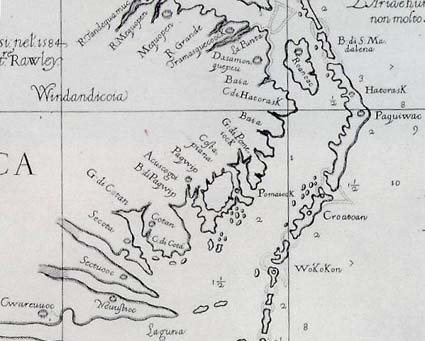
New Bern was established on the site of a Neusioc Indian town called Chattooka, or Cartouca. The natives who occupied the land were paid for it and they moved away, but apparently they were not satisfied. As Surveyor-General of the colony, John Lawson surveyed the site. According to von Graffenried, the site had also been chosen for him by Lawson who claimed it to be uninhabited. When it was found to be occupied by Indians, he charged the Surveyor-General with recommending they be driven off without payment. These accusations were not in keeping with Lawson's otherwise sympathetic attitude towards the natives, but, if true, they might explain the terrible fate he met soon thereafter.
In mid-September, 1711, Lawson invited von Graffenried to go with him on a trip up the Neuse. The purpose of the trip was to examine the river and to seek a better route to Virginia. Lawson assured the Baron there would be no danger from the Indians, but the prospect of such a route through, or near, their hunting grounds could have been a matter of great concern to the Indians. In any event, several days after their departure, both men were seized by the natives and taken to Catechna, the Tuscarora town of King Hancock, on Contentea Creek. After questioning the prisoners, the Indians decided to set them free. Before they were to leave the following day, the captives were questioned again. The King of Cartouca, the New Bern site, reproached Lawson who answered in anger. A general quarrel followed in which von Graffenried did not take part, but both he and Lawson were again confined. At another council meeting, the Indians decided to execute Lawson and to free the Baron who had promised presents for his freedom. Von Graffenried did not see it and the natives were very secretive about the manner of Lawson's death. Some said he was hanged and others said his throat was slit with a razor he carried with him. It was generally believed the Indians "stuck him full of fine small splinters of touchwood, like hogs' bristles, and so set him gradually on fire."
Subscribe to:
Posts (Atom)