Pages

Showing posts with label Family Tree DNA. Show all posts

Thursday, December 27, 2012

Lost Colony DNA Genotyping could answer a centuries-old mystery about a vanished group of British settlers


image: Lost Colony DNA Anne Poole (left), Research Director for the Lost Colony Research Group, and Roberta Estes (right) sifting through the dirt for artifacts. Roberta Estes

The legend of the Lost Colony of Roanoke has haunted American history for centuries. In July 1587, a British colonist named John White accompanied 117 people to settle a small island sheltered within the barrier islands of what would become North Carolina’s Outer Banks. When conditions proved harsher than anticipated, White agreed to sail back to Britain to shore up the settlement’s supplies—a trip that should have lasted a few months.
When White belatedly returned in 1590, the colonists had vanished—more than 100 men, women, and young children, their shelters and belongings, all gone. According to White’s writings, the only trace they left behind was a structure of tree trunks, with a single word carved into one post: CROATOAN.
The creepiness of the Lost Colonists’ disappearance didn’t discourage future American settlement. Nor has the lack of clues about their fate discouraged professional and amateur historians from trying to figure out what happened to them.
Archaeological digs, weather records, historical writings, genealogy—none have fully answered the question of what happened during White’s absence. But Roberta Estes, who owns DNAeXplain, a company that interprets the results of genetic heritage tests, is looking to DNA for help. Her hypothesis is that the Lost Colonists survived, and that evidence of their salvation is tucked away in the mitochondrial or Y chromosomal DNA of living descendents.
“They were stranded,” Estes says of the settlers. “They knew they couldn’t survive there on the island.” The colonists’ solution, in her estimation, was to go native.
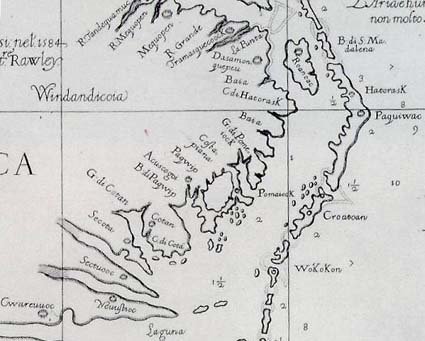
“Croatoan,” Estes explains, was a message to White indicating that the colonists had gone to live with the Croatan Indians who lived on nearby Hatteras Island. Estes’s volunteer organization, the Lost Colony Research Group, is recruiting people from the area to submit DNA samples and family histories to test her theory.
Studying patterns of short tandem repeats (STRs) on the Y chromosomes of living men can determine whether they are likely to share a common ancestor that was a member of the Lost Colony. For example, Estes can compare the STR profile of a man whose family history suggests that his ancestors lived on Hatteras Island in the 17th century against genetic databases to see if he’s related to anyone with a Lost Colonist surname, such as Dare, Hewet, or Rufoote.
Additionally, it’s possible to scan that man’s mitochondrial or Y chromosomal DNA for evidence of Native American heritage, creating a clearer picture of what became of the vanished colonists. “It is true that with Y chromosome and mitochondrial DNA you can assign them unequivocally to different ethnic groups,” says Ugo Perego, a senior researcher at the Sorenson Molecular Genealogy Foundation. But, he adds, it would be difficult to tell exactly when the European ancestry was introduced.
Estes has amassed early land-grant records detailing who lived in the Outer Banks area a few centuries ago. Some of the putative Native Americans living there are thought to have adopted the last names of their European neighbors, she says. If Estes can show that the descendents of these Native American families have DNA matching families with Lost Colony surnames, that would suggest that the colonists mixed with the Croatan Indians.

Cont. here:

http://www.the-scientist.com/?articles.view/articleNo/31423/title/Lost-Colony-DNA-/


This blog is © History Chasers
Click here to view all recent Lost Colony Research Group Blog posts
Bookmark and Share

Tuesday, November 2, 2010

Lost Colony Represented by Four Administrators at the FTDNA Conference


 The Lost Colony of Roanoke DNA Project was represented by four administrators at the 6th Annual Family Tree DNA Conference in Houston, TX this past weekend. The conference was held in the beautiful Sheraton North Hotel where the staff of both Sheraton and FTDNA did everything possible to make our stay pleasant and productive.


Those attending were Roberta Estes, Penny Ferguson, Rob Noles and Janet Crain.  I will have more photos later along with a personal narrative of my side trips on the way home.


Roberta Estes and other attendees at the first day's fabulous luncheon.


This blog is © History Chasers
Click here to view all recent Lost Colony Research Group Blog posts
Bookmark and Share

Tuesday, August 3, 2010

A Review of Family Tree DNA’s Family Finder – Part I

July 19th, 2010

Since late 2007, several “direct-to-consumer” or “DTC” genetic testing products have entered the marketplace, many of which offered some degree of autosomal ancestry analysis (including 23andMe, deCODEme, and Pathway Genomics, among others).

In early 2010, genetic ancestry testing company Family Tree DNA announced that it would begin offering a new genetic genealogy product (see “Announcing Family Finder – An Autosomal Test From Family Tree DNA”). The new product, called “Family Finder,” is one of only a very few autosomal genetic genealogy tests available to consumers.

Continued here:

http://www.thegeneticgenealogist.com/2010/07/19/a-review-of-family-tree-dnas-family-finder-part-i/


This blog is © History Chasers
Click here to view all recent Lost Colony Research Group Blog posts
Bookmark and Share

Tuesday, June 9, 2009

Family Tree DNA Announces Fantastic Sale

Received by project administrators tonight:

Dear Family Tree DNA Group Administrator,

Last summer we offered a pricing special that was the most successful
offering of its kind in our company’s history.

Many project administrators strongly supported our recruitment efforts and
both their projects and our database grew significantly.
This year we will offer an early summer special with an unparalleled
promotional discount.

Offer summary:

• Y-DNA37+mtDNA for $119. (The regular project price is $248 – a reduction
of more than 50%!!)

• The promotion will begin on June 9, 2009 and will end on June 24, 2009

• Kits ordered in this sale must be paid for by June 30, 2009

This is your new members’ opportunity to skip past the Y-DNA12 and Y-DNA25
tests and get the best Y-DNA Genealogical test on the market in addition to
an mtDNA test for an extremely reduced price!

I should also mention that according to one of our competitors’ method of
counting markers our 37-marker test could also be called a “41-marker test”
as we do
test and report markers 464e, 464f, 464g, and DYS19b. Though we test them,
it is very rare that individuals have results for these markers. Therefore,
by
our conservative counting method, our competitor's “33-marker test” is
actually a “29-marker test.” We mention this to make sure that you
understand the difference
between these tests and are able to compare “apples to apples.”

So... I hope that with this promotion your project can gain many new
members.

As always, that you for your continued support.

Max Blankfeld
Vice-President, Operations and Marketing
http://www.FamilyTreeDNA.com
"History Unearthed Daily"
max@familytreedna.com
713-868-1438


© History Chasers

Click here to view all recent Searching for the Lost Colony DNA Blog posts

Bookmark and Share

Sunday, December 7, 2008

Google Your Family Tree

FamilyLink.com, Inc. Announces New Guidebook for Free Online Genealogy - Google Your Family Tree
PROVO, UT, October 10, 2008 --- FamilyLink.com, Inc. announced today the availability of Google Your Family Tree, a new book that teaches family historians how to unlock the hidden power of the Internet's most popular search engine. Written by Daniel M. Lynch, the book received an enthusiastic reception in Philadelphia last month when it was unveiled at the Federation of Genealogical Societies (FGS) annual conference. Pre-orders for the book have been brisk, and it is expected to ship within two weeks.

"This book is well positioned to become the best-selling genealogy book of all time," said Paul Allen, chief executive officer of FamilyLink.com. "It is the right content, by the right author, at the right time. We couldn't be more pleased to be releasing this book this month as millions of people in the United States celebrate Family History Month." FamilyLink.com, Inc. and Lynch agreed to the deal in March of this year. "Dan has done an exceptional job documenting the hidden power Google offers to family history enthusiasts worldwide," Allen said. "It is the first such book written specifically for genealogists by an accomplished genealogist and technology expert."

Lynch was recently on the KSL NewsRadio Relatively Speaking Radio Genealogy Show with KSL NewsRadio personality and genealogy author Mary Slawson. During the show, Slawson commented about the book, "I just finished reading it today, and it's incredible. It's up there with Elizabeth Shown Mills' Evidence book. It will be in every major professional researcher's library and hopefully in most of the beginners' libraries. It's a great book!"

Lynch began his career in the technology industry in 1984 and has also been involved in genealogy research for nearly 30 years. A frequent lecturer and writer, he began sharing his Google tips with fellow genealogists at the local and national level shortly after the search engine launched ten years ago. As the capabilities of Google have expanded, so too have its applications for use by family historians. "Google is easily the most important tool available for anyone engaged in family history research," noted Lynch. The book is 352 pages and sells for $34.95 (USD). To learn more about the book, or to reserve a copy, go to www.GoogleYourFamilyTree.com.

Friday, August 29, 2008

GREAT NEWS!!!!! Summer Sizzling Sale Extended to 9/30th

This just in!!!

Dear Group Administrator,

Due to popular demand Family Tree DNA is extending its Sizzling Summer Sale until September 30th! This promotion is geared toward bringing new members to your projects by offering the following big incentives:


Product Promotion
Original
Sale
Y-DNA12 Free mtDNA
$189
$99
Y-DNA25 Free mtDNA
$238
$148
Y-DNA37 Reduced
$189
$119
Y-DNA37+mtDNA Reduced
$339
$189
Y-DNA67 Reduced
$269
$218
Y-DNA67+mtDNAplus Reduced
$409
$288
mtDNAplus Reduced
$189
$149

The purpose of this sale is to grow our database and at the same time help our Group Administrators encourage those “fence sitters” to climb off the fence and join your project.

To date, the reaction has been very strong and we feel the benefit to the database and to your projects justifies the extension of this promotion. We would also like to thank all of our Group Administrators who have sent details of this promotion out by email or by postings to blogs and lists. It is clearly working, and we ask that you continue your efforts to make this promotion a growth vehicle for your projects.

IMPORTANT: This promotion requires that payment is either made by credit card or received by the conclusion of the sale on September 30th, 2008.

As always, thank you for your continued support!


Bennett Greenspan

Friday, May 16, 2008

Statement From Family Tree DNA

Dear Fellow Genealogist,

This week an article was published in the UK newspaper Daily Mail, quoting Ancestors Magazine, under the title: "£200-a-time ancestral DNA test kits are a rip off, say experts", by Andrew Levy.

The article was based on tests by the following companies: Oxford Ancestors, Ancestry DNA, and International Biosciences.

Family Tree DNA was not contacted for testing purposes, nor mentioned in that article. Having tested over 350,000 individuals (over 100,000 of our direct customers and 250,000 participants in National Geographic's Genographic Project) we could supply anyone who asks us with thousands of examples that prove the opposite of what the article stated.

Unfortunately, the journalist's conclusion is based on opportunist companies who noted our success and jumped into Genetic Genealogy to get a piece of it, but who did not have the science or the database that would allow for a serious work. Again, note that Family Tree DNA was NOT one of the companies that the journalist approached.

About 2 years ago, Oxford Ancestors announced to the world that they found a descendant of Genghis Khan living in Florida - a Caucasian accountant. Family Tree DNA proved that Oxford Ancestors was wrong. Tom Robinson, the person in question, recounts the entire story in his blog at http://trrobinson.com/2006/06/16/genghis-khan-or-not--that-is-the-question.aspx#comment-56635. The Associated Press later distributed the news: "Robinson, an associate accounting professor at the University of Miami, canceled a planned trip to Mongolia after learning of the new results. He said he never sought publicity on his ancestry. “The results that Family Tree DNA gave me are pretty conclusive,” he said. “I’m certainly not going to look for any more tests on Genghis Khan.” (http://www.msnbc.msn.com/id/13467247/ )

Family Tree DNA is proud to have the largest database of its kind in the world (more than all other companies combined), to adhere to the best science in the field, and to be the expert source for journalists from the New York Times and Los Angeles Times, among others.

National Geographic would not have partnered with us if there was any possibility of tarnishing their century-old reputation.

Our scientists periodically have their papers published by renowned peer-reviewed journals like the American Journal of Human Genetics and Genome Research.

That article, in the end, demonstrates the following:

- While Family Tree DNA prices are in line with other companies, price is not the only thing that matters when choosing a DNA testing company

- Science and database size are important factors when choosing a testing company

You are welcome to share this e-mail with whomever you feel necessary, and we make ourselves available to anyone with questions about our work.
E-mail me anytime!

Max Blankfeld
Vice-President, Operations and Marketing
http://www.familytreedna.com/
"History Unearthed Daily"
max@familytreedna.com
713-868-1438

Saturday, May 3, 2008

Big Changes in Store at Family Tree DNA

Some Family Tree DNA Participants will find their haplogroup designation changed to the new nomenclature on May 5th.

While the name of the haplogroup a person belongs to may change, and will continue to change as more haplogroup branches are discovered and published, their actual DNA testing results and interpretation remain the same. The next issue of the Family Tree DNA newsletter, Facts and Genes, will discuss these changes in more depth and should help you better understand the changes to the Y-DNA haplogroup tree.

The Family Tree DNA website will be temporarily offline on Monday, May 5th, at 5 am CDT to facilitate this update in nomenclature and other maintenance. Service will be restored no later than 7 am CDT that day. Ysearch.org, our free publicly accessible website, will be offline and updated simultaneously.

If you would like more information about why the haplogroup nomenclature is changing and what this means to you, please visit the FAQ site below:

Y-DNA Haplogroup Nomenclature FAQ"

Public release date: 1-Apr-2008


Contact: Peggy Calicchia
calicchi@cshl.org
516-422-4012
Cold Spring Harbor Laboratory

Scientists reshape Y chromosome haplogroup tree gaining new insights into human ancestry

Wednesday, April 2, 2008 –The Y chromosome retains a remarkable record of human ancestry, since it is passed directly from father to son. In an article published online today in Genome Research (www.genome.org), scientists have utilized recently described genetic variations on the part of the Y chromosome that does not undergo recombination to significantly update and refine the Y chromosome haplogroup tree. The print version of this work will appear in the May issue of Genome Research, accompanied by a special poster of the new tree.

Human cells contain 23 pairs of chromosomes: 22 pairs of autosomes, and one pair of sex chromosomes. Females carry a pair of X chromosomes that can swap, or recombine, similar regions of DNA during meiosis. However, males harbor one X chromosome and one Y chromosome, and significant recombination between these dissimilar sex chromosomes does not occur. Therefore, the non-recombining region of the Y chromosome (NRY) remains largely unchanged over many generations, directly passed from father to son, son to grandson, and so on, along with genetic variations in the NRY that may be present. Scientists can use genetic variations, such as single nucleotide polymorphisms (SNPs), on the Y chromosome as markers of human ancestry and migration.

In 2002, the Y Chromosome Consortium (YCC) constructed a tree of 153 haplogroups based upon 243 unique genetic markers. In this report, researchers led by Dr. Michael Hammer of the University of Arizona recognized the need to revisit the Y chromosome haplogroup tree and incorporate the latest data. “The YCC effort in 2002 was a landmark in mapping the then known 300 or so Y-linked SNPs on a single tree, and getting the community to use the same nomenclature system,” explains Hammer. “The rate of SNP discovery has continued to increase over the last several years, as are publications on Y chromosome origins and affinities. While this new information is useful, ironically it also brings with it the danger of introducing more chaos into the field.”

Hammer’s group integrated more than 300 new markers into the tree, which allowed the resolution of many features that were not yet discernable, as well as the revision of previous arrangements. “The major lineages within the most common African haplogroup, E, are now all sorted out, with the topology providing new interpretations on the geographical origin of ancient sub-clades,” describes Hammer. “When one polymorphism formerly described as unique, but recently shown to have reversed was replaced by recently reported markers, a sub-haplogroup of haplogroup O, the most common in China, was considerably rearranged,” explains Fernando Mendez, a co-author of the study.

In addition to improving the resolution of branches, the latest reconstruction of the tree allows estimates of time to the most recent common ancestor of several haplogroups. “The age of [haplogroup] DE is about 65,000 years, just a bit younger than the other major lineage to leave Africa, which is assumed to be about 70,000 years old,” says Hammer, describing an example of the fine resolution of age that is now possible. “Haplogroup E is older than previously estimated, originating approximately 50,000 years ago.”

Furthermore, Hammer explains that this work has resulted in the addition of two new major haplogroups, S and T, with novel insights into the ancestry of both. “Haplogroup T, the clade that Thomas Jefferson’s Y chromosome belongs to, has a Middle Eastern affinity, while haplogroup S is found in Indonesia and Oceania.”

“More SNPs are being discovered, and we anticipate the rate to increase with the 1000 Genomes Project,” says Hammer, referring to the wealth of human genetic variation data that will soon be available. While this report represents a significant advance in mapping ancestry by Y chromosome polymorphisms, it is certain that future discoveries will necessitate continual revisions to the Y chromosome haplogroup tree, helping to further elucidate the mystery of our origins.

###

Scientists from the University of Arizona (Tuscon, AZ) and Stanford University (Stanford, CA) contributed to this study.

This work was supported by the Salus Mundi Foundation.

Media contacts:

Michael Hammer, Ph.D., has agreed to be contacted by email for more information (mfh@u.arizona.edu).

Interested reporters may obtain copies of the manuscript from Peggy Calicchia, Editorial Secretary, Genome Research (calicchi@cshl.org; +1-516-422-4012).

About the article:

The manuscript will be published online ahead of print on April 2, 2008. Its full citation is as follows: Karafet, T.M., Mendez, F.L., Meilerman, M.B., Underhill, P.A., Zegura, S.L., and Hammer, M.F. New binary polymorphisms reshape and increase resolution of the human Y-chromosomal haplogroup tree. Genome Res. doi:10.1101/gr.7172008.

About Genome Research:

Genome Research (www.genome.org) is an international, continuously published, peer-reviewed journal published by Cold Spring Harbor Laboratory Press. Launched in 1995, it is one of the five most highly cited primary research journals in genetics and genomics.

About Cold Spring Harbor Laboratory Press:

Cold Spring Harbor Laboratory Press is an internationally renowned publisher of books, journals, and electronic media, located on Long Island, New York. It is a division of Cold Spring Harbor Laboratory, an innovator in life science research and the education of scientists, students, and the public. For more information, visit www.cshlpress.com.

Genome Research issues press releases to highlight significant research studies that are published in the journal.

Tuesday, April 1, 2008

Scientists Reshape Y Chromosome Haplogroup Tree

PRESS RELEASE
EMBARGOED:

Not for release until 5:00 p.m. EDT (US time) on Tuesday, April 1, 2008.

Scientists reshape Y chromosome haplogroup tree gaining new insights into human ancestry

Wednesday, April 2, 2008 The Y chromosome retains a remarkable record of human ancestry, since it is passed directly from father to son. In an article published online today in Genome Research (www.genome.org), scientists have utilized recently described genetic variations on the part of the Y chromosome that does not undergo recombination to significantly update and refine the Y chromosome haplogroup tree. The print version of this work will appear in the May issue of Genome Research, accompanied by a special poster of the new tree.

Human cells contain 23 pairs of chromosomes: 22 pairs of autosomes, and one pair of sex chromosomes. Females carry a pair of X chromosomes that can swap, or recombine, similar regions of DNA during meiosis. However, males harbor one X chromosome and one Y chromosome, and significant recombination between these dissimilar sex chromosomes does not occur. Therefore, the non-recombining region of the Y chromosome (NRY) remains largely unchanged over many generations, directly passed from father to son, son to grandson, and so on, along with genetic variations in the NRY that may be present. Scientists can use genetic variations, such as single nucleotide polymorphisms (SNPs), on the Y chromosome as markers of human ancestry and migration.

In 2002, the Y Chromosome Consortium (YCC) constructed a tree of 153 haplogroups based upon 243 unique genetic markers. In this report, researchers led by Dr. Michael Hammer of the University of Arizona recognized the need to revisit the Y chromosome haplogroup tree and incorporate the latest data. The YCC effort in 2002 was a landmark in mapping the then known 300 or so Y-linked SNPs on a single tree, and getting the community to use the same nomenclature system, explains Hammer. The rate of SNP discovery has continued to increase over the last several years, as are publications on Y chromosome origins and affinities. While this new information is useful, ironically it also brings with it the danger of introducing more chaos into the field.

Hammer's group integrated more than 300 new markers into the tree, which allowed the resolution of many features that were not yet discernable, as well as the revision of previous arrangements. The major lineages within the most common African haplogroup, E, are now all sorted out, with the topology providing new interpretations on the geographical origin of ancient sub-clades, describes Hammer. When one polymorphism formerly described as unique, but recently shown to have reversed was replaced by recently reported markers, a sub-haplogroup of haplogroup O, the most common in China, was considerably rearranged, explains Fernando Mendez, a co-author of the study.

In addition to improving the resolution of branches, the latest reconstruction of the tree allows estimates of time to the most recent common ancestor of several haplogroups. The age of [haplogroup] DE is about 65,000 years, just a bit younger than the other major lineage to leave Africa, which is assumed to be about 70,000 years old, says Hammer, describing an example of the fine resolution of age that is now possible. Haplogroup E is older than previously estimated, originating approximately 50,000 years ago.

Furthermore, Hammer explains that this work has resulted in the addition of two new major haplogroups, S and T, with novel insights into the ancestry of both. Haplogroup T, the clade that Thomas Jefferson's Y chromosome belongs to, has a Middle Eastern affinity, while haplogroup S is found in Indonesia and Oceania.

More SNPs are being discovered, and we anticipate the rate to increase with the 1000 Genomes Project, says Hammer, referring to the wealth of human genetic variation data that will soon be available. While this report represents a significant advance in mapping ancestry by Y chromosome polymorphisms, it is certain that future discoveries will necessitate continual revisions to the Y chromosome haplogroup tree, helping to further elucidate the mystery of our origins.

Scientists from the University of Arizona (Tuscon, AZ) and Stanford University (Stanford, CA) contributed to this study.

This work was supported by the Salus Mundi Foundation.

Media contacts:

Michael Hammer, Ph.D., has agreed to be contacted by email for more information (mfh@u.arizona.edu).

Interested reporters may obtain copies of the manuscript from Peggy Calicchia, Editorial Secretary, Genome Research (calicchi@cshl.org; +1-516-422-4012).

About the article:

The manuscript will be published online ahead of print on April 2, 2008. Its full citation is as follows: Karafet, T.M., Mendez, F.L., Meilerman, M.B., Underhill, P.A., Zegura, S.L., and Hammer, M.F. New binary polymorphisms reshape and increase resolution of the human Y-chromosomal haplogroup tree. Genome Res. doi:10.1101/gr.7172008.

About Genome Research:

Genome Research (www.genome.org) is an international, continuously published, peer-reviewed journal published by Cold Spring Harbor Laboratory Press. Launched in 1995, it is one of the five most highly cited primary research journals in genetics and genomics. About Cold Spring Harbor Laboratory Press: Cold Spring Harbor Laboratory Press is an internationally renowned publisher of books, journals, and electronic media, located on Long Island, New York. It is a division of Cold Spring Harbor Laboratory, an innovator in life science research and the education of scientists, students, and the public. For more information, visit www.cshlpress.com. Genome Research issues press releases to highlight significant research studies that are published in the journal.

Thursday, November 15, 2007

Harvard Professor Henry Louis Gates, Jr. Joins Forces with Family Tree DNA to Launch AfricanDNA.com


Innovative Partnership Offers African Americans Unprecedented Choices in Search for Roots

BOSTON--(BUSINESS WIRE)--AfricanDNA.com, the first company dedicated to offering both genetic testing and genealogical tracing services for African Americans, is being launched this month by Henry Louis Gates, Jr., Alphonse Fletcher University Professor and Director of the W.E.B. Du Bois Institute for African and African American Research at Harvard University, in partnership with the Inkwell Foundation and Family Tree DNA, the world’s leader in genetic genealogy. The precedent-setting site is the only company in the field of genetic genealogy that will provide African Americans with family tree research in addition to DNA testing.

Gates, a celebrated author, educator and social critic, is a strong advocate of the value and benefits of genetic genealogy for African Americans. Noting that the process is still in its infancy, he says: “Most people don't realize it, but their roots are on the tips of their tongues. The available DNA data are not by any means complete, and these tests will not yield the names of any of the individuals on our distant family trees—just the general geographic areas in which our ancestors lived. Sometimes the tests yield multiple exact tribal matches, making it necessary for historians to interpret the most plausible result.”

AfricanDNA.com is the only company that offers the service of scholars interpreting multiple matches when compared to the database. A board of historical consultants will include Dr. Fatimah Jackson, Professor, Applied Biological Anthropology, University of Maryland; Dr. Linda Heywood and Dr. John Thornton, both African historians at Boston University; Evelyn Brooks Higginbotham, Professor of History and of African and African American Studies (Chair) at Harvard University; and Dr. David Eltis, director of the Trans-Atlantic Slave Trade Database at Emory University.

Gates comments that “sometimes African Americans will discover that their DNA can be traced to a white ancestor, especially on the father’s side, because of slavery. About 30 percent of the African American male population has a white male ancestor.”

AfricanDNA.com offers two premium tests. The Maternal Test (Female-mtDNA) is a high-resolution mtDNA test that looks at the mitochondria received by both men and women from their mothers. The Paternal Test, exclusively for males, is a Y-DNA test that details the inherited Y-chromosome. Both tests’ results will include placement in the ancestral tree of humankind. Tests will be processed at the Genomic Analysis and Technology Core laboratory at the University of Arizona, headed by Dr. Michael Hammer. The renowned geneticist has been associated with Family Tree DNA since the company’s inception. Both Family Tree DNA and the University of Arizona lab are respected for their commitment to stringent scientific standards and privacy guidelines.

Singular in the world of genealogy and genetics is AfricanDNA.com’s Genealogy Package. This unique product offers documented genealogical tracing of lineage as far back as records permit. Although former slaves, freed at the time of the Civil War, first appeared in the Federal census in 1870, many other records of African Americans under slavery still exist. Genealogists even discovered that Gates’ 4th great-grandfather—a Free Negro named John Redman—fought in the American Revolution, leading to Gates’ induction into the SAR (Sons of the American Revolution). DNA test takers who opt for the Genealogy Package will receive a customized family tree prepared by the AfricanDNA.com genealogy services group.

Genetic results of AfricanDNA customers will be compared with the database of Family Tree DNA, the most extensive comparative database of DNA test results in the world, including African results provided by leading anthropologists worldwide. These comparisons will point many AfricanDNA clients toward their African origins. A percentage of all profits will be donated to the Inkwell Foundation, dedicated to reforming the teaching of science and history in inner city schools using genetic and genealogical ancestry tracing.

Long interested in genealogical research and DNA testing, Gates is the author of
Finding Oprah’s Roots, Finding Your Own (Crown, 2007) and the forthcoming In Search of Our Roots: How 19 Extraordinary African Americans Reclaimed Their Past, to be published next spring (Crown, 2008). He is also the host and executive producer of the critically acclaimed 2006 PBS series “African American Lives” and its follow-up, “Oprah’s Roots.” “African American Lives 2” will be broadcast on PBS in February, 2008 in conjunction with Black History Month.

Professor Gates is Editor-in-Chief of the Oxford African American Studies Center, the first comprehensive scholarly online resource in the field of African American and African Studies. Gates, an influential cultural critic, has written for Time Magazine, The New Yorker and the New York Times. The recipient of 48 honorary degrees and a 1981 MacArthur Foundation “Genius Award,” Henry Louis Gates, Jr. received a National Humanities Medal in 1998, and in 1999 was elected to the American Academy of Arts and Letters.

Family Tree DNA, founded in April 2000, was the first company to develop the commercial application of DNA testing for genealogical purposes, which, until then, had only been available for academic and scientific research. Today, Family Tree DNA’s database exceeds 165,000 individual test records (roughly 110,000 Y-DNA and 55,000 mtDNA tests), making it the prime source for researching recent and distant family ties. Additionally, Family Tree DNA administers over 4400 surname projects, comprising some 65,000 unique surnames.

Press Release


http://home.businesswire.com/portal/site/google/index.jsp?ndmViewId=news_view&newsId=20071115005186&newsLang=en