Pages

Showing posts with label Roanoke island. Show all posts

Saturday, August 22, 2009

Roanoke Island Trip - Day 4


Wednesday – Day 4 - August 19th


After staying up way too late last night at the cast party, we slept a little late this morning. I can’t remember the last time I as up till 3AM for a positive reason! However, even with nothing stronger than water to drink, I could certainly feel the late night this morning. How did I ever think this was fun when I was younger?


By noon, Anne and I were absorbed in acid free boxes chocked full of surprises at the Outer Banks History Center. Anne focused on contributed genealogies of Outer Banks families and I was overwhelmed with the magnitude of the Elizabethan Collection, a 16+ box (think banker’s boxes) collection of information collected by research here and overseas that was connected with the preparations for the Roanoke Decoded conference which took place in the late 1990s. After the conference, all the prep was contributed and is now available for researchers. If you’re going to work with that collection, I suggest a day per box minimum, so plan on going to NC for a month as the center is only open Monday through Friday 9-5. Of course you’ll have to amuse yourself in the evenings and weekends while waiting for the center to reopen. Now what better excuse could you have for a month in NC?


I made another important discovery today. There are no quilt shops on the Outer Banks. Now you’d think with nearly 100 miles of ribbon-like highway and thousands of tourists on that one highway, at least some of them would be quilters and would want to take home more than a shirt, a sunburn and some sand in their shoes for souvenirs. Apparently not, because there not only aren’t any quilt shops, there aren’t even any plain old vanilla fabric stores. Hello, how can you live without JoAnne Fabrics? The closest store is at the far northern end of the Island where Kitty Hawk in located and is a WalMart with a very limited selection. No mind though, because I found some pink pirate material that will just have to suffice for my NC souvenir fabric. Talk about things that shouldn’t be pink, but it’s now “unique” and I like that. As far as I’m concerned a quilt shop located beside a Starbucks would be quite the ticket, and of course there are no Starbucks either. Is anyone listening out there….here’s an economic stimulus suggestion for someone!!!! Let me tell you, there are still tourists in NC and they are still spending money.


When visiting the Outer Banks, you have to stop at Kitty Hawk Kites. Kitty Hawk Kites is quintessential Outer Banks. Where is Kitty Hawk Kites? Everyplace. There are many of the stores and yes, they have just stunningly beautiful kites. One thing the Outer Banks always has is wind…and it‘s so hot there that you’ll be exceedingly grateful for that wind, let me tell you. So it’s also a kite flyer’s dream and even if you can’t fly a kite, you can there. There’s no way you can’t fly a kite on the shore line, so indeed, go fly a kite.


http://www.kittyhawk.com/


I was looking for a particular t-shirt. I bought the long sleeve version 2 years ago, and I wanted a short sleeve one as well. It says “don’t ask the locals for directions, they’ve lost one colony already”! Yep, my kind of place. Of course, sale is the word that Americans are in love with so if you tell them the second t-shirt is on sale, you’ll sell 2 for sure. My second (half price) t-shirt says something akin to “Woman who behave don’t make history”. In honor of the fabric, it’s kind of coral colored and has a small insignia size pirate skull and crossbones on it. I’m liking my pink pirate fabric better already. I always love visiting Kitty Hawk Kites! It’s a vacation for your inner child.


By now, I’m late for dinner. If you love seafood, the Outer Banks is the place for you and Beach Road which runs along, you’ve guessed it, the beach, is polka dotted with wonderful local hole-in-the-wall restaurants. Actually, its official street name is Virginia Dare Trail, but it’s always been called Beach Road down there and the locals and any tourist there for more than 24 hours still call it Beach Road.

We ate at the Beach Road Grill, a long-time local favorite and had their house-special steamed and spiced shrimp, served hot with drawn butter and cocktail sauce, along with black beans and rice. Their black beans and rice are served half on one side of the dish and half on the other (rice on one end and beans on the other) with hot salsa across both halves. Nothing like this up north, I guarantee you. Lovely waitress as well. Southern hospitality at its best. The harmonica player was going to start shortly, but we were just too tired to stay up late again, so we left amidst a beautiful sunset, crossed the bouncing bridge, watched the lightening over the sound above Manteo and went home under the poplar tree and called it a night.


http://www.thecoastalexplorer.com/BeachRoadGrill/


Read all posts in the Trip to Roanoke series:


© History Chasers


Click here to view all recent Searching for the Lost Colony DNA Blog posts

Bookmark and Share

Saturday, July 25, 2009

Events on the Outer Banks for July 25 to July 31


July 24, 2009

Looking for the events and activities coming up on the Outer Banks? Every Friday, Miss Kitty is going to bring you the happening events for the next week.

Saturday on the Outer Banks:

Enjoy a night of theater with The Lost Colony at Waterside Theater on Roanoke Island. The performance begins at 8 pm. After the show, enjoy a backstage tour of Waterside Theater. For tickets or more information, call 252-473-2127 or visit The Lost Colony.

You could head on over to Jolly Rogerwhere Michelle Sanchez will be hosting the ‘Alan Ross Karaoke Roadshow’ from 9 pm to 1 am. Three Legged Fox will be rocking the house over at Outer Banks Brewing Station(yeah, that’s the restaurant beneath the wind turbine on the big road). Or go see Gonzos Nose playing at Kelly’s Restaurant and Tavern.


Read about the rest of the week here:

http://kittydunes.wordpress.com/2009/07/24/events-on-the-outer-banks-for-july-25-to-july-31/


© History Chasers

Click here to view all recent Searching for the Lost Colony DNA Blog posts

Bookmark and Share

Thursday, September 18, 2008

Science Daily

Science News
Extreme Droughts Played Major Role In Tragedies At Jamestown, "Lost Colony"

Science Daily (Apr. 28, 1998) — WILLIAMSBURG, VA--The worst droughts of the past 800 years likely played a major role in the mysterious disappearance of Roanoke Island's "Lost Colony" and in the "starving time" endured by colonists at Jamestown, researchers from the College of William and Mary and the University of Arkansas have concluded after studying growth rings of ancient trees in the Tidewater area. The findings were just published in the current issue of Science journal.
more here

Tuesday, August 12, 2008

Happy 428th Birthday, Virginia Dare!!!

Virginia Dare (born August 18, 1587, date of death unknown) was the first child born in the Americas to English parents, Eleanor (or Ellinor/Elyonor) and Ananias Dare. She was born into the short-lived Roanoke Colony on Roanoke Island in present-day North Carolina, USA. What became of Virginia and the other colonists has become an enduring mystery. The fact of her birth is known because the leader of the colony, Eleanor Dare's father, John White, returned to England to seek assistance for the colony. When White returned three years later, the colonists were gone.

Historical explanations

John Smith and other members of the Jamestown Colony sought information about the fate of the colonists in 1607. One report indicated that the Lost Colonists took refuge with friendly Chesapeake Indians, but Chief Powhatan claimed his tribe had attacked the group and killed most of the colonists. Powhatan showed Smith certain artifacts he said had belonged to the colonists, including a musket barrel and a brass mortar. The Jamestown Colony received reports of some survivors of the Lost Colony and sent out search parties, but none were successful. Eventually they determined they were all dead.[1]
However, in her 2000 book Roanoke: Solving the Mystery of the Lost Colony, historian Lee Miller postulated that some of the Lost Colony survivors sought shelter with a neighboring Indian tribe, the Chowanoc, that was attacked by another tribe, identified by the Jamestown Colony as the "Mandoag," but who Miller thinks were actually the Eno, also known as the Wainoke. Survivors were eventually sold into slavery and held captive by differing bands of the Eno tribe, who, Miller wrote, were known slave traders. Miller wrote that English settlers with the Jamestown Colony heard reports in 1609 of the captive Englishmen, but the reports were suppressed because they had no way to rescue the captives and didn't want to panic the Jamestown colonists. William Strachey, a secretary of the Jamestown Colony, wrote in his The History of Travel Into Virginia Britania in 1612 that, at the Indian settlements of Peccarecanick and Ochanahoen, there were reportedly two-story houses with stone walls. The Indians supposedly learned how to build them from the Roanoake settlers.[2] There were also reported sightings of European captives at various Indian settlements during the same time period.[3] Strachey wrote in 1612 that four English men, two boys, and one maid had been sighted at the Eno settlement of Ritanoc, under the protection of a chief called Eyanoco. The captives were forced to beat copper. The captives, he reported, had escaped the attack on the other colonists and fled up the Chaonoke river, the present-day Chowan River in Bertie County, North Carolina.[4][2][5] For four hundred years, various authors have speculated that the captive girl was Virginia Dare. When White left the colony in 1587, there were eighty-seven men, seventeen women and eleven children among the colonists. Virginia Dare was one of two infants born to colonists in 1587 and was the only female child in the Lost Colony.


Possible descendants

The Chowanoc tribe was eventually absorbed into the Tuscarora. The Eno tribe was also associated with the Shakori tribe and was later absorbed by the Catawba or the Saponi tribes. Today one group is known as the Haliwa-Saponi tribe. From the early 1600s to the middle 1700s European colonists reported encounters with gray-eyed American Indians or with Welsh-speaking Indians who claimed descent from the colonists.[6][7] In 1669 a Welsh cleric named Morgan Jones was taken captive by the Tuscarora. He feared for his life, but a visiting Doeg Indian war captain spoke to him in Welsh and assured him that he would not be killed. The Doeg warrior ransomed Jones and his party and Jones remained with their tribe for months as a preacher.[6] In 1701, surveyor John Lawson encountered members of the Hatteras tribe living on Roanoke Island who claimed some of their ancestors were white people. Lawson wrote that several of the Hatteras tribesmen had gray eyes.[7] Some present-day American Indian tribes in North Carolina and South Carolina, among them the Coree and the Lumbee tribes, also claim partial descent from surviving Roanoke colonists. A non-profit organization, the Lost Colony of Roanoke DNA Project, has launched a Lost Colony DNA Project to test possible descendants.
Copyright (c) 2008 History Chasers
Permission is granted to copy, distribute and/or modify this document
under the terms of the GNU Free Documentation License, Version 1.2
or any later version published by the Free Software Foundation;
with no Invariant Sections, no Front-Cover Texts, and no Back-Cover Texts.
A copy of the license is included in the section entitled "GNU
Free Documentation License".
http://en.wikipedia.org/wiki/Wikipedia:Text_of_the_GNU_Free_Documentation_License


Monday, August 11, 2008

From the Ashes; a Golden Opportunity

From disaster to opportunity

Broadway costume designer rebuilds 'Lost Colony' wardrobe

William Ivey Long has been called the busiest costume designer on Broadway with a career that spans more than 50 shows. But a tragic event hundreds of miles away from New York made this past year his busiest ever.

In September 2007, an early morning fire swept through the home of "The Lost Colony" on Roanoke Island, N.C., destroying more than 5,000 costumes that had been assembled over the show's 71-year history. Long grew up in the summertime world, and in many ways, he never left it. He maintains a home there, and for many years, has served as set and costume designer for the long-running outdoor drama.

"I remember great sadness and shock," says Long, recalling when he first heard about the fire. "It took me two months to realize that this was an opportunity instead of a disaster."

The "opportunity" meant a chance to redesign the show's entire sweep of costumes from a historical perspective using newly available research. Long canceled commitments on two Broadway shows to work on the "The Lost Colony" project. He and his 60-person staff worked in New York and at the North Carolina theater to build the 1,000 costumes needed for the show. Some funds came from state and federal park services, but the majority of the $2.7 million needed to reconstruct sets, costumes and stage buildings came from individuals.

Long has been associated with "The Lost Colony" almost since the day he was born. His father, William Long Sr., held many jobs there, including technical director from 1949 to 1962. His mother, Mary Wood Long, worked in the costume shop while playing several onstage roles, including the part of Queen Elizabeth I from 1949 to 1953. During his early childhood, Long recalls sleeping in fabric bins underneath the cutting tables of the costume shop.

Continued here:

http://www.dailypress.com/features/dp-gl_williamiveylong_0810aug10,0,962645.story

John White, A Festive Dance

John White, A Festive Dance


North America

Around AD 1585-93

In 1585, John White and a group of English settlers sponsored by Sir Walter Raleigh arrived on the east coast of North America to found new colonies. White had some artistic training and his duties included making visual records of anything unknown in England, including plants, animals, birds and the inhabitants, especially their costumes, weapons and ceremonies. In the area around Roanoke and the tidewaters of coastal North Carolina they found people who called themselves Secotan, who in mid-July held a green corn or harvest ritual, with ceremonies like the one recorded here. This may be the Green Corn or Harvest Festival, celebrating the first harvest of Indian corn or maize at the end of the summer.

cont. here:

http://www.britishmuseum.org/explore/highlights/highlight_objects/pd/j/john_white,_a_festive_dance.aspx

Sunday, June 1, 2008

Roanoke Island Festival Park Celebrates First English Settlement in America

June 1 - 30

Roanoke Island Festival Park Events

Roanoke Island Festival Park is an interactive family attraction that celebrates the first English settlement in America. The centerpiece of the 25-acre island park adjacent to Manteo, North Carolina, is Elizabeth II, a representation of one of the seven English ships from the Roanoke Voyage of 1585. Costumed Elizabethan sailors greet visitors and help them experience sixteenth century seafaring life. Also visit the Settlement site, Roanoke Adventure Museum and see the Legend of Two-Path film. Events are scheduled throughout the year in our indoor Film Theatre and our Outdoor Pavilion. Admission is charged. The on-site Art Gallery, fossil pit, Museum Store, Outer Banks History Center and marsh-side boardwalks are free and open to all. Hours vary seasonally. For additional information, call (252) 475-1506, (252) 475-1500 or visit

roanokeisland.com

Saturday, May 24, 2008

The Lost Colony Genealogy and DNA Research Group Website


Open Invitation to Visit the Lost Colony Genealogy and DNA Research Group Website:


This website is to display the results of our research in support of attaining our goal which is to discover, if possible, whether any of the Roanoke Lost Colonists survived. Furthermore, others included on Raleigh's numerous voyages were also "lost" on the shores of what would become North Carolina. Perhaps they survived as well. The resources being used to solve this mystery are a combination of historical records, genealogy and DNA.


Our Mission


Our Mission....Is to gather as much data as possible to prove that at least some of the colonists did in fact survive as has been suggested by numerous historical accounts, possibly having assimilated into the indigenous tribesof the area or having been taken captive, or both. As the various tribes moved inland, the colonists would have moved with them. If the colonists were enslaved, they could have been sold or traded and not remained as a group, being scattered to various locations.

Our research group will be working to connect the genealogies with the historical records and genetic results from individuals who are likely candidates to be descendants of the Lost Colonists. We have assembled names of interest that are compiled from the Lost Colony settlers and also from the early families found in the areas where the colonists are believed to have settled. Early land transactions and grants reference individuals with many of these last names as Indians.

Possible candidates to be connected to the Lost Colony come from the following groups of individuals:


1. Those who have any of the surnames of interest and whose genealogy ends abruptly early in Eastern VA or NC.

2. Those who connect via any of these surnames to the British Isles.

3. Those whose family has an oral history of being connected to the Lost Colony.

4. Those with Native American heritage from Eastern or early NC or VA.


Friday, May 23, 2008

Opening Night Nears for Lost Colony Drama's 71st Season


Lost Colony production rises from the ashes


ROANOKE ISLAND, NC (WAVY.com) -- A local production company is getting ready for an opening night unlike any they've seen before.

WAVY News 10 was there last September, when a fire destroyed the Lost Colony's shop and its costumes. Eight months later, a piece of American history prepares to take the stage once again.


Friday, May 30th is opening night for the outdoor drama.

"The Lost Colony" depicts the first English settlers, who vanished without a trace. The production that battled back from a devastating fire is breathing new life into its 71st season.

Tony-award winning designer William Ivey Long's life has been a blur of fabric and thread for months. What began in his New York studio now overflows in the Lost Colony's new costume shop. Long grew up in the show. Even so, he went back to the drawing board, recreating the pieces with historical accuracy. "Now was the time to really show some of the reasons the colony may have failed. It was quite top heavy with gentry, and investors and merchants and upper class people of the 116 people that came over, only 40 were workers," said Long.

Again, opening night is May 30th at 8:30 p.m.

While the production is back on its feet, it still needs donations to help pay off the rebuilding efforts.

For more information about The Lost Colony, click HERE.

To read all this story and watch a video, click HERE.

Saturday, May 17, 2008

New public television series focues on Lost Colony

By Catherine Kozak
The Virginian-Pilot© May 15, 2008

IN THE SUN-DAPPLED WOODS of Fort Raleigh National Historic Site on Wednesday, there was an unusual amount of activity for the sedate park.

Men with big video cameras on their shoulders pointed lenses into dirt pits and at the faces of archaeologists. Nearby, beeping ground-penetrating radar flashed murky images on a small screen.

Meanwhile, a mini-excavator scooped out the top layers of previously explored soil to hasten access to the undisturbed areas that might hold intriguing artifacts.

The first episode of a new public television series, "Time Team America," is focused on the ongoing search for evidence of the Lost Colony on Roanoke Island. After arriving this week, the crew is expected to wrap up at Fort Raleigh by week's end.

As an excavation unearthed a kernel-size piece of lead-glazed earthenware from a layer of dirt, veteran archaeologist Nick Luccketti was summoned and quickly surrounded, a microphone hovering nearby.

"It's great to find it. I was hoping to find something a little more sizable. But it will do," he said into a camera, a wry smile on his face as he held the tiny broken bit.

Luccketti is a founding member of the First Colony Foundation, a nonprofit group that has renewed the archaeological exploration of the park after numerous fruitless investigations since the 1930s.

Another member of the foundation, Eric Deetz, also belongs to the TV production's archaeological team. Deetz had alerted series producer Graham Dixon to the foundation's work.

The colony of 117 men, women and children who had sailed from England in 1587 vanished without a clue sometime after August of that year.

As the oldest abiding American mystery, any artifact
that could help decipher their fate would be akin to the Holy Grail of U.S. archaeology.

Cont. here:

http://hamptonroads.com/2008/05/new-public-television-series-focues-lost-colony

Wednesday, May 7, 2008

Lost Colony Play Lifts Nation from Depression in 1937


by Harry McKown
July 2006


Conceived in the depth of the Depression, when supporting funds were hard to find, The Lost Colony was made possible ultimately as a cooperative effort by local people and several state and federal agencies. Workers from the Roanoke Island camp of the Civilian Conservation Corps build the open-air Waterside Theatre where the play was performed and later several of them joined the cast. The Rockefeller Foundation gave an organ to provide musical accompaniment. The Playmakers of the University of North Carolina at Chapel Hill provided lighting and other technical assistance and also supplied the director, Samuel Selden. Actors came from the Federal Theatre Project and from among the islanders themselves. The project had the support of North Carolina's U. S. Senator, Josiah William Bailey and Congressman Lindsay Warren. The U. S. Postal Service issued a stamp to publicize the event and the Treasury minted a commemorative half-dollar which the Roanoke Island Historical Society was allowed to sell for $1.50 to raise money.
The drama and the setting were ready.
The question remained, would anybody come? Getting to Roanoke Island on North Carolina's Outer Banks in 1937 was a challenge. From the North it involved a ferry ride, several miles on a "floating road" over a swamp, and the rest of the way on packed sand roads. The "easier" route from the west consisted of miles of graded dirt roads and two ferry trips. Nevertheless, approximately 2,500 people attended the first performance of The Lost Colony, and by the end of the summer attendance stood at about 50,000, including President Franklin Roosevelt. Originally, the play was scheduled to run only for the Summer of 1937. It had been so popular, however, and such a boon to the local economy that it returned in 1938 and by the end of the next year it was being seen by 100,000 people a season. Except for four years during World War II, The Lost Colony has played every Summer, becoming an institution on the North Carolina coast and in the American theater. It is one of the mainstays of the island's economy and has been a training ground for young actors and theater technicians around the country. Alumni of The Lost Colony include Andy Griffith, Chris Elliot, Eileen Fulton, Carl Kasell, William Ivey Long, and Joe Layton. The Lost Colony also set the pattern for dozens of similar productions, usually referred to as outdoor dramas, staged from Florida to Alaska.
Full Article Here:

Tuesday, May 6, 2008

Lost Colony Drama has Long History of Pleasing the Public


This Month in North Carolina History
July 1937 - The Lost Colony

Program from the first "Lost Colony" production, 1937.


On the 4th of July, 1937, a new form of American drama was born on Roanoke Island, North Carolina, as a part of the celebration of the 350th anniversary of the arrival of the first English settlers in North America. The Roanoke Island Historical Association, led by W. O. Saunders, editor of the Elizabeth City Independent, and D. B Fearing, a state Senator from Dare County, approached Pulitizer Prize-winning North Carolina author Paul Green about writing a play on the Roanoke settlement of 1587. Saunders, on a recent trip to Germany, had seen the outdoor religious plays at Oberammergau in Bavaria and wanted something similar for North Carolina. Green, as a student at the University of North Carolina at Chapel Hill, had been encouraged by his mentor, Professor Frederick Koch, to draw literary inspiration from local history and folklore. In fact, some years earlier, Green had written a one act play based on the Roanoke Island experience. Although he considered the play a failure, Green had been inspired by a visit to the island at the time and readily took on the job of writing the new play. Green envisioned a production that would combine drama, music, dance, and pageantry all in a sweeping outdoor setting. He called his creation The Lost Colony: A Symphonic Drama of American History .

Program from the 1952 "Lost Colony" featuring Andy Griffith as Sir Walter Raleigh.
Conceived in the depth of the Depression, when supporting funds were hard to find, The Lost Colony was made possible ultimately as a cooperative effort by local people and several state and federal agencies. Workers from the Roanoke Island camp of the Civilian Conservation Corps build the open-air Waterside Theatre where the play was performed and later several of them joined the cast.
cont. here:

Tuesday, April 29, 2008

English Delegation Visits Manteo, Jamestown and Williamsburg

By JON CAWLEY
5:17 PM EDT, April 28, 2008

JAMES CITY - The first ever visit by an English delegation from the town of Bideford to their sister-city of Manteo, North Carolina, will end Wednesday after a trip to Jamestown Settlement and Colonial Williamsburg.The group includes Bideford's Mayor, his wife and 17-year-old daughter along with the town's vice mayor and two residents. They arrived in Norfolk on April 23 and have since been meeting their North Carolina contemporaries and seeing the sights of coastal Manteo, just inland from the Outer Banks, said Bryant Brooks, a Dominion Virginia Power spokesman. Brooks said Dominion's involvement stemmed from "wanting to be good corporate citizens" and included trip coordination between the Virginia and North Carolina locales, where the power company has a widespread service area on both sides of the border.Brooks said the trip marked the first official visit to Manteo by a Bideford delegation.

A group of Manteo representatives toured Bideford on a similar trip about 10 years ago, he said.
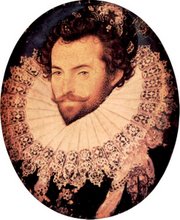
A historic tie between the two towns extends to the late 1500s when Sir Walter Raleigh sailed from Bideford to Roanoke Island — a site that later became known as the Lost Colony after its inhabitants inexplicably disappeared.

cont. here:

http://www.dailypress.com/news/local/williamsburg/dp-local_english_0429apr29,0,7165613.story

Friday, March 14, 2008

View an Audio Slideshow of John White's Paintings


Organized by the British Museum in London, “A New World: England’s First View of America,” at the Yale Center for British Art, presents maps, sketches and watercolors by the Elizabethan artist John White, about 20 of which constitute the only surviving visual record of England’s first settlement in North America. These images — of the Algonquian Indians and local flora and fauna — are immensely fragile and may be exhibited only once every 30 to 40 years, making this enchanting exhibition an event of historical importance as well.


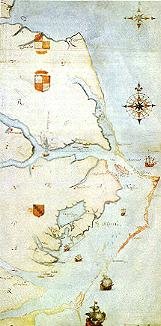
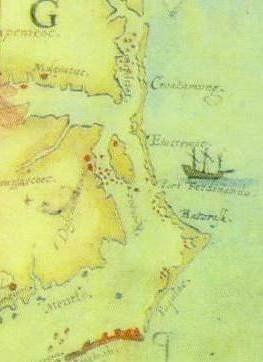
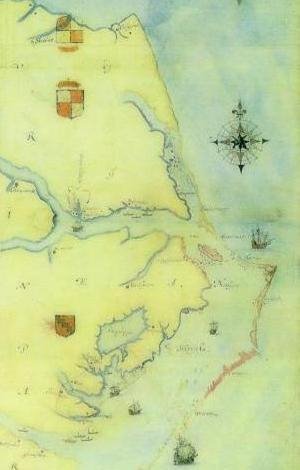
White is a mysterious figure. We don’t know where or when he was born, who his father was, or even when he died. What historians do know is that in 1585 he was a member of an expedition to create a permanent foothold for England in America. The expedition landed on Roanoke Island and began construction of a small fortified settlement, later exploring the surrounding islands and the mainland in longboats. During these explorations White produced drawings and maps of what he saw, perhaps to satisfy curiosity back home about the New World.


In 1587 he returned to Roanoke Island as the governor of a new colony, along with 115 brave English colonists. But insufficient supplies forced him to return immediately to England, leaving the colonists behind, along with his daughter, son-in-law and granddaughter, the first English child born in the New World. When he returned to the island three years later, he found all the colonists had vanished. So began the legend of the “Lost Colony of Roanoke.”


Saturday, March 1, 2008

Warren Wilson College to Host Showing of The First Lost Colony March 11

"The First Lost Colony," an episode of "Exploring North Carolina" that recently aired statewide on UNC-TV, will be shown March 11 at Warren Wilson College. The 30-minute program, free and open to the public, begins at 7 p.m. in Canon Lounge of the Gladfelter Student Center.

The program features continuing research by Warren Wilson College professor David Moore and fellow archaeologists at the Berry archaeological site near Morganton. The 12-acre site is the location of Fort San Juan, built by Spanish conquistador Juan Pardo in 1567 - two decades before Sir Walter Raleigh established the famous "Lost Colony" on Roanoke Island.

Artifacts from the Berry excavation will be exhibited at the March 11 showing. Moore also will be available to answer questions about the project and the 2008 Warren Wilson College Archaeology Field School from June 16-July 11.

For more information contact Moore at 828-771-2013 or dmoore@warren-wilson.edu.

http://www.warren-wilson.edu/storyteller/NEWS/NEWS-benjand-2008-2-28-11-57-57.php

Thursday, January 31, 2008

De Soto's Fort Located?

If Hernando de Soto and Juan Pardo had been successful and established a series of permanent settlements, we might all be speaking Spanish in this country rather than English. That’s one conclusion that archeologist Rob Beck of the University of Oklahoma likes to tell people about when he describes the discovery of Fort San Juan on the upper Catawba River in Burke County north of Morganton.That fort was established by de Soto’s men in 1567 – a couple of decades before Sir Walter Raleigh’s expedition set out from England and established a colony on Roanoke Island that disappeared – and became known as the Lost Colony.

The Fort San Juan story is told in a new episode of UNC-TV’s “Exploring North Carolina” series produced by narrator Tom Earnhardt of Raleigh and videographer Joe Albea of Greenville. It airs tonight at 8:30 p.m. and repeats Friday, Feb. 1 at 9:30 p.m. and Sunday, Feb. 3 at 6 p.m.The program describes how Beck and other archeologists, including David Moore of Warren Wilson College near Asheville and Christopher Rodning of Tulane, assembled the evidence that linked the 12-acre site in Burke County to a known site at Parris Island. S.C., where Spanish explorers established a fort in what then was called northern Florida.

Continued here:

http://jackbetts.blogspot.com/2008/01/was-first-lost-colony-in-burke-county.html

Tuesday, January 29, 2008

Lost Colony Dig; Probing the Past with Radar

BY ED BECKLEY | SENTINEL CORRESPONDENT


When doctors want to see a body's organs they use an magnetic resonance imaging machine (MRI) to view beautifully clear images of what's inside.

When archaeologists want to see what's below the surface of the earth they are now beginning to use a similar technology called computer-assisted radar tomography (CART).

An archaeologist with the First Colony Foundation was on site at Fort Raleigh Saturday with CART engineers testing the advanced ground penetrating system. Their hope is that CART will prove to be a viable tool to help find artifacts from Sir Walter Raleigh's 16th Century colonies in the future.

The First Colony Foundation comprises a team of top archaeologists who in recent years discovered the expanded Jamestown, Va. settlement. The group also is a partner with the National Park Service in search of the Elizabethan presence on Roanoke Island. It has dug its share of holes along Roanoke Sound the past couple of years.

http://obsentinel.womacknewspapers.com/articles/2008/01/23/top_stories/tops3441.txt