Pages

Showing posts with label north carolina indians. Show all posts

Sunday, November 8, 2009

Presentation Nov. 10th, Tues. The University of North Carolina at Pembroke


Mary Livermore Library – News and Events

The University of North Carolina at Pembroke

The Friends of the Library invite you to join us Tuesday, November 10 at 7:00 p.m. for Richard Folsom, author of Indian Wood, A Mystery of the Lost Colony of Roanoke Island. Mr. Folsom will share his research into the oldest mystery in the country. Reception will follow.

Product Description

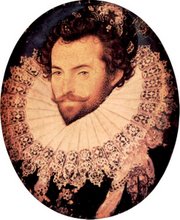
In 1587, Sir Walter Raleigh sent 116 men, women and children to Roanoke Island on the Outer Banks of North Carolina. They were to plant the first English colony in the New World. By 1590, they had disappeared. The colony was lost, and it remains America's oldest unsolved mystery.

Carl Bowden, a university professor, has discovered a document that may prove an intriguing new theory of what may have happened to the colonists. He made one phone call to a trusted colleague. Three hours later he was found murdered under the rotunda of the university library. Someone does not want the mystery of the Lost Colony to be solved and is willing to kill to protect the secret.


© History Chasers

Click here to view all recent Searching for the Lost Colony DNA Blog posts

Bookmark and Share

Saturday, August 23, 2008

Native American Dress


Beverley, Robert, ca. 1673-1722.


Indian man in his Summer Dress.

The upper part of his Hair is cut short, to make a ridge, which stands up like the Comb of a Cock, the rest is either shorn off, or knotted behind his


Page 4

Ear. On his Head are stuck three Feathers of the Wild Turkey, Pheasant, Hawk, or such like. At his Ear is hung a fine Shell with Pearl Drops. At his Breast is a Tablet or fine Shell, smooth as polish'd Marble, which sometimes also has etched on it, a Star, Half Moon, or other Figure, according to the makers fancy. Upon his Neck, and Wrists, hang Strings of Beads, Peak and Roenoke. His Apron is made of a Deer skin, gashed round the edges, which hang like Tassels or Fringe; at the upper end of the Fringe is an edging of Peak, to make it finer. His Quiver is of a thin Bark; but sometimes they make it of the Skin of a Fox, or young Wolf, with the Head hanging to it, which has a wild sort of Terror in it; and to make it yet more Warlike, they tye it on with the Tail of a Panther, Buffaloe, or such like, letting the end hang down between their Legs. The prickt lines on his Shoulders, Breast and Legs, represent the Figures painted thereon. In his Left Hand he holds a Bow, and in his Right an Arrow. The mark upon his Shoulder blade, is a distinction used by the Indians in Travelling, to shew the Nation they are of. And perhaps is the same with that which Baron Lahontan calls the Arms and Heraldry of the Indians. Thus the several letter'd marks, are used by several other Nations about Virginia, when they make a Journey to their Friends and Allies.

The Landskip is a natural representation of an Indian Field.


Page 5

Tab. 3. Is two Indian Men in their Winter Dress.

Seldom any but the Elder people wore the Winter Cloaks, (which they call Match-coats,) till they got a supply of European goods; and now most have them of one sort or other in the cold Winter Weather. Fig. 1. wears the proper Indian Match-coat, which is made of Skins, drest with the Furr on, sowed together, and worn with the Furr inwards, having the edges also gashed for beauty sake. On his Feet are Moccasins. By him stand some Indian Cabins on the Banks of the River. Fig. 2. wears the Duffield Match-coat bought of the English, on his Head is a Coronet of Peak, on his Legs are Stockings made of Duffields: That is, they take a length to reach from the Ankle to the Knee, so broad as to wrap round the Leg; this they sow together, letting the edges stand out an Inch beyond the Seam. When this is on, they Garter below Knee, and fasten the lower end in the Moccasin.

§. 4. I don't find that the Indians have any other distinction in their dress, or the fashion of their Hair, than only what a greater degree of Riches enables them to make; except it be their Religious persons, who are known by the particular cut of the Hair, and the unusual figure of their Garments; as our Clergy are distinguisht by their Canonical Habit.

The Habit of the Indian Priest, is a Cloak made in the form of a Woman's Petticoat; but instead of tying it about their middle, they fasten the gatherings about their Neck, and tye it upon the Right Shoulder, always keeping one Arm out to use upon occasion. This Cloak hangs even at the bottom,


Page 6

but reaches no lower than the middle of the Thigh; but what is most particular in it, is, that it is constantly made of a skin drest soft, with the Pelt or Furr on the outside, and revers'd; insomuch, that when the Cloak has been a little worn, the hair falls down in flakes, and looks very shagged, and frightful.

The cut of their Hair is likewise peculiar to their Function; for 'tis all shaven close except a thin Crest, like a Cocks-comb which stands bristling up, and runs in a semi-circle from the Forehead up along the Crown to the nape of the Neck: They likewise have a border of Hair over the Forehead, which by its own natural strength, and by the stiffning it receives from Grease and Paint, will stand out like the peak of a Bonnet.


Tab. 4. Is a Priest and a Conjurer in their proper Habits.

The Priest's Habit is sufficiently describ'd above.*

The Conjurer shaves all his Hair off, except the Crest on the Crown, upon his Ear he wears the skin of some dark colour'd Bird; he, as well as the Priest, is commmonly grim'd with Soot or the like; to save his modesty he hangs an Otter-skin at his Girdle, fastning the Tail between his Legs; upon his Thigh bangs his Pocket, which is fastn'd by tucking it under his Girdle, the bottom of this likewise is fring'd with Tassils for ornament sake. In the middle between them is the Huskanawing spoke of §. 32.


The dress of the Woman is little different from that of the Men, except in the tying of their Hair. The Ladies of Distinction wear deep Necklaces, Pendants and Bracelets, made of small Cylinders of the Conque shell, which they call

Peak: They likewise keep their Skin clean, and shining with Oyl, while the Men are commonly bedaub'd all over with Paint.

They are remarkable for having small round Breasts, and so firm, that they are hardly ever observ'd to hang down, even in old Women. They commonly go naked as far as the Navel downward, and upward to the middle of the Thigh, by which means they have the advantage of discovering their fine Limbs, and compleat Shape.


Tab. 5. Is a couple of Young Women.

The first wearing a Coronet, Necklace, and Bracelet of Peak; the second a wreath of Furs on her Head, and her Hair is bound with a Fillet of Peak and Beads. Between the two, is a Woman under a Tree, making a Basket of Silk-Grass, after their own manner.


Tab 6. Is a Woman, and a Boy running after her.

One of her Hands refts in her Necklace of Peak, and the other holds a Gourd, in which they put Water, or other liquid.

The Boy wears a Necklace of Runtees, in his right hand is an Indian Rattle, and in his left a roasting Ear of Corn. Round his Waste is a small string, and another brought cress thro his Crotch, and for decency a soft skin is fastn'd before.


© This work is the property of the University of North Carolina at Chapel Hill. It may be used freely by individuals for research, teaching and personal use as long as this statement of availability is included in the text.


Monday, August 11, 2008

John White, A Festive Dance

John White, A Festive Dance


North America

Around AD 1585-93

In 1585, John White and a group of English settlers sponsored by Sir Walter Raleigh arrived on the east coast of North America to found new colonies. White had some artistic training and his duties included making visual records of anything unknown in England, including plants, animals, birds and the inhabitants, especially their costumes, weapons and ceremonies. In the area around Roanoke and the tidewaters of coastal North Carolina they found people who called themselves Secotan, who in mid-July held a green corn or harvest ritual, with ceremonies like the one recorded here. This may be the Green Corn or Harvest Festival, celebrating the first harvest of Indian corn or maize at the end of the summer.

cont. here:

http://www.britishmuseum.org/explore/highlights/highlight_objects/pd/j/john_white,_a_festive_dance.aspx

Wednesday, June 4, 2008

Crotian - Croatan Indian Connection?


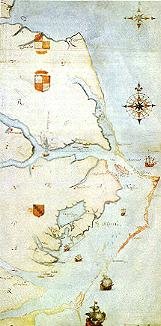
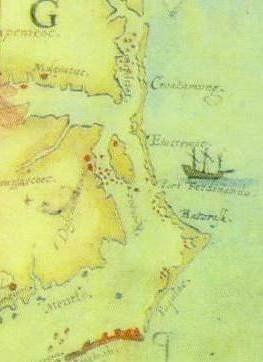
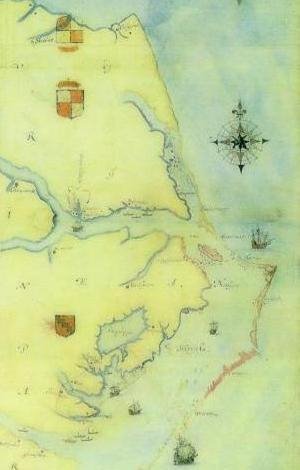
Many of the early European expeditions to the western shore of the Atlantic finished with shipwrecks. So was the case with some ships from Dubrovnik in the 16th century. It is interesting to mention that the Croatan Indians in the USA could possibly be the descendants of the saved Croatian crew, as authenticated by their name, brown hair, blue eyes and some of the words in their language. Two large islands appear on the Molineaux map of Virginia, USA (1599), with the names Croatoan and Croatamonge (see [Eterovic], p. 30).

An American writer John Lawson in his 1714 chronicle wrote that among Croatan Indians of that time there was a legend of a 16th century shipwreck with mariners who saved themselves and stayed with Indians.

In attempts to find Walter Raleigh's Lost Colony inhabited by the British Empire in 1587 on the island of Roanoke (near the Croatoan island, North Carolina, USA), the searchers found a CRO carved in Roman letters on a tree in 1590. Another big tree had a bark peeled off, and carved on it in capital letters was the word CROATOAN.


Monday, June 2, 2008

Lost Colony's Croatan Connection


The Croatan Indians of Sampson County, North Carolina:

Their Origin and Racial Status

A Plea for Separate Schools


WHITE'S LOST COLONY


There is a tradition among these Indians that their ancestors were white people, a part of Gov. White's Lost Colony, who amalgamated with the coast Indians and afterwards removed


to the interior, where they now reside. It is a matter of common knowledge that the Indians are a people of "traditions," being entirely destitute of written records. These traditions would be of little value were they not supported by authentic historical data.

Governor White left a colony of 120 men and women from England on Roanoke Island in 1587, and when he returned in 1590, he found no trace of the colony save the word "Croatan" carved upon a tree. According to a secret understanding which White had with the colonists before he returned to England, if they departed from Roanoke Island before his return they were to carve upon the trees or posts of doors "the name of the place where they should be seated." When White and his men returned in 1590 where they had left the colony three years before, they saw upon a tree carved in Roman letters the word "CROATAN" without any cross or sign of distress about the word, for he had the understanding that if any misfortune came to them they should put a cross over the word.

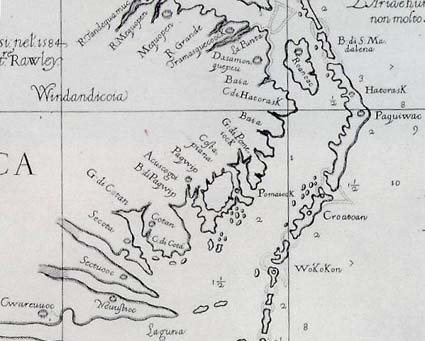
One of the early maps of the Carolina coast, which appears in Lederer's Travels, prepared in 1666, represents Croatoan as an island south of Cape Hatteras. Croatan is made as a part of the mainland directly west of Roanoke Island. Governor White indicates that the colony originally removed to Croatoan, and not Croatan.

The term Croatan, or Croatoan was applied by the English to the friendly tribe of Manteo, whose chief abode was on the island on the coast southward from Roanoke. The name Croatan seems to indicate a locality in the territory claimed by Manteo and his tribe. Manteo was one of two friendly Indians who had been carried to England by Sir Richard Grenville, and returned with Governor White, on the occasion of his first voyage in 1587. By direction of Sir Walter Raleigh, Manteo was baptized and in reward for his services to the English he was designated "Lord of Roanoke."

McMillan in his pamphlet says:

"It is evident from the story of Governor White, that the colonists went southward along the coast to Croatoan Island, now a part of


Carteret County, in North Carolina, and distant about 100 miles in a direct line from Albemarle Sound."

Dr. Hawks, in his history, speaks of this tribe as the "Hatteras Indians." From the first appearance of the English, relations of the most friendly character were known to exist between this tribe and the colony. Manteo was their chief.

The Hatteras Indians are described in the Hand Book of American Indians as follows:

"HATTERAS;--An Algonquian tribe living in 1701 on the sand banks about C. Hatteras, N. C., E. of Pamlico Sound, and frequenting Roanoke Id. Their single village, Sandbanks, had then only about 80 inhabitants. They showed traces of white blood and claimed that some of their ancestors were white. They may have been identical with the Croatan Indians (q. c.), with whom Raleigh's colonists at Roanoke Island are supposed to have taken refuge."


Full Text of John Lawson's Journal

John Lawson was an early English explorer who left a permanent record of his travels among the tribes of the Carolinas. He commenced his journey on December 28th, 1700. Lawson's History of North Carolina is regarded as the standard authority for the period it covers, and he says that there was a band of Indians in the eastern part of North Carolina known as Hatteras Indians, that had lived on Roanoke Island and that these told him that many of their ancestors were white people and could "talk in a book." That many of these Indians had grey eyes that were found among no other Indians, that they were friendly to the English and were ready to do all friendly services.

He says it is probable that White's Colony miscarried for want of timely supplies from England, or through the treachery of the natives, for we may reasonably suppose that the English were forced to cohabit with them and that in process of time, they conformed themselves to the manners of their Indian relations.


John Lawson travelled among the Indians of North Carolina before they had come in contact with any of the white settlers, and found the same tribe of Indians residing on the south side of the Neuse River known as the Coree Tribe. One


of the head men of this tribe was an Indian of the name of Enoe-Will, who travelled several days with Lawson as his guide. Speaking of this Indian Lawson says: "Our guide and land-lord, Enoe-Will, was the best and most agreeable temper that ever I saw within an Indian. Being always ready to serve not out of gain but real affection."

Lawson had with him his Bible, and Enoe-Will, his guide, was accompanied by his son Jack, 14 years old, and Enoe-Will requested Lawson to teach his son "to talk in his book" and "to make paper speak, which was called our way of writing."

From McPherson's Report, commenting on the above, we copy as follows:

"The presence of grey eyes and fair skin among these people in Lawson's time can not be explained on any other hypothesis than that of amalgamation with the white race; and when Lawson wrote (1709) there was a tradition among the Hatteras Indians that their ancestors were white people 'and could talk in a book;' and that 'they valued themselves extremely for their affinity to the English and were ready to do them all friendly offices.' I have already referred to the fact that Enoe-Will, a Coree Indian, who had been raised on the coast and who was probably nearly 70 years of age when he acted as Lawson's guide, knew that the English could 'talk in a book' and as he further expressed it, 'could make paper talk,' indication that he was familiar with the customs of the English.

"Couple this with the fact that the guide had an English name, 'Will,' which he probably assumed at the age of 20 or 21, and the information previously given by him that he lived on Enoe Bay when he was a boy leads quite certainly to the conclusion that the Corees had come in contact with at least some portion of the lost colony. It must be remembered that when Will was a boy there were no English settlements on the east coast of North Carolina other than White's Lost Colony.

"Their religion and idea of faith was more exalted than was common among the savages, and leads to the belief that they had had communication with the more civilized race from the East.
"There is an abiding tradition among these people at the present time that their ancestors were the Lost Colony, amalgamated with some tribe of Indians. This tradition is supported by their looks, their complexion, color of skin, hair and eyes, by their manners, customs and habits, and by the fact that while they are, in part, of undoubted Indian origin, they have no Indian names and no Indian language--not

Page 14

even a single word--and know nothing of Indian customs and habits.


'Speaking of the language of this people, Mr. McMillan says: 'The language spoken is almost pure Anglo-Saxon,' a fact which we think affords corroborative evidence of their relation to the Lost Colony of White. Mon (Saxon) is used for man, father is pronounced 'fayther,' and a tradition is usually begun as follows: 'Mon, my fayther told me that his fayther told him,' etc. 'Mension' is used for measurement, 'aks' for ask, 'hit' for it, 'hosen' for hose, 'lovend' for loving, 'housen' for houses. They seem to have but two sounds for the letter 'a,' one like a short 'o.' Many of the words in common use among them have long been obsolete in English-speaking countries."

© This work is the property of the University of North Carolina at Chapel Hill. It may be used freely by individuals for research, teaching and personal use as long as this statement of availability is included in the text.

Continued here:

http://docsouth.unc.edu/nc/butler/butler.html

See also:

http://www.dailyadvance.com/featr/content/features/stories/2006/08/25/082506_life_Indians.html

http://the-lost-colony.blogspot.com/2007/09/croatan-indians-of-sampson-county-north.html

Wednesday, April 23, 2008

The Tuscarora War, 1711-1715


— The Tuscarora War, 1711-1715 —


Bath State Historic Site

The Indians Retaliate . . .

From the first, there had been an Indian problem in Bath County. While disease had broken the power of the Pampticough tribe in the neighborhood of Bath, there remained many other small tribes scattered throughout Bath County. Behind these small tribes lay the powerful Tuscarora, an Iroquoian tribe closely connected to the Five Nations in New York. The movement of settlers into Bath County and up the Pamlico and Neuse Rivers had been watched with fear and resentment by the Tuscarora and the smaller tribes in this area. Favorite hunting grounds were being overrun and choice village sites were becoming sites for the settlers' towns.

While the chief danger to the settlers from Indian attacks came from the many Tuscarora, the first resistance the land-hungry settlers of Bath County faced came from the smaller tribes into whose territory they first moved. The first to resist the advancing tide of civilization were the Core (sometimes called Coree) and Nynee Indians, who lived south of the Neuse River. In 1703 they were declared public enemies by the Carolina government, which was determined to carry on a war against them. While the records of this conflict are gone, the Indians evidently were defeated, for the next time they are mentioned in history, they have moved into the interior where the Tuscarora have granted them land only six miles from one of their chief towns.

Throughout Bath County during the first decade of the eighteenth century, rumors of Indian plots and conspiracies constantly spread. In 1703, Lionel Reading wrote that an Indian had told one settler that several villages had "fully resolved to make trail (trial) of it for to see which is the ardiest." The next year word spread that some of the Tuscarora towns near the Pamlico settlement were becoming unusually friendly with the Bear River Indians, with the apparent intention of inciting them to attack the whites. About this same time the Machapunga Indians began to harass the settlers, which took the form of threats, hog-stealing, and actual assault on one settler. The settler did not fail to note that the Machapunga moved their village "nigh a wildnernesse where upon the least Intimation they can easily repair without being pursued."
Throughout this period the Bear River and Machapunga Indians continued their petty annoyances, and the settlers continued to petition the government for something to be done about the situation. Little seems to have been though for the settlers remained prey to roving bands of Indians who would enter a settler's home, ransack it, kill his hogs, and assault him if he protested.

In 1707, Robert Kingham reported that the settlers on the Pamlico told him that "they expected ye Indians every day to come and cutt their throat and yet they had no person to head ym [them] or Else they would goe and secure all ye Pamticough Indians."

Obviously, relations between the early white settlers and the Indians were not as harmonious as many historians have pictured. From the first, the Indians resented the colonists' encroachment upon their territory and used every means they had to show this resentment, at times resorting to out and out war. The Tuscarora, by all odds the dominant Indian power in North Carolina, had watched the steadily growing settlements with distrust, seething over each movement into a new area. When the tide of civilization flowed into the Pamlico-Neuse region, they saw the handwriting on the wall. They now decided they must make a stand or gradually be overrun, and by the summer of 1711, apparently decided to try to destroy the whites.

Other actions by the whites also caused the Indians to act. Perhaps nothing made them hate the settlers of Bath County more than the whites' kidnapping and enslavement of their people. By 1710, this had reached such proportion that the Tuscarora sought permission of the government of Pennsylvania to settle in that colony so that their children born and those soon to be born might have room to sport and play without danger of slavery. In their quaint phrases, they begged "a cessation from murdering and taking them, that by the allowance thereof, they may not be afraid of a moose, or any other thing that Ruffles the Leaves."

Closely akin to this problem was the ill-feeling and misunderstanding surrounding trade between Indians and the white settlers. The whites felt that the Indian traders were hard men who drove hard bargains. Conversely, the Indians soon saw that the whites were cheating them in their transactions, for the traders, John Lawson tells us, esteemed it "a Gift of Christianity not to sell to them so cheap as [they did] to the Christians." The traders, knowing the Indians' weakness for strong drink, often got the Indians drunk as a means of defrauding and stripping them of their property. One observer reports that the Indians were never "contented with a little, but when once begun, they must make themselves quite drunk; otherwise they will never rest, but sell all they have in the World, rather than not have their full dose."

Certainly another reason for the Indians' decision to take up the tomahawk was the indignities inflicted on them by the white settlers. The Indians were a proud, dignified, and lordly people, unaccustomed to the condescending and often insulting way the whites often treated them. Just a few days before they sought their revenge they complained to a settler who had been unfortunate enough to fall into their hands, that they "had been very badly treated and detained by the inhabitants of the Pamtego, Neuse and Trent Rivers, a thing which was not to be longer endured." That the whites, who looked upon the Indians "with Scorn and Disdain" and considered them "little better than Beasts in Human Shape," eventually felt their wrath cannot be too surprising.

Full Article Here:


Saturday, March 1, 2008

Warren Wilson College to Host Showing of The First Lost Colony March 11

"The First Lost Colony," an episode of "Exploring North Carolina" that recently aired statewide on UNC-TV, will be shown March 11 at Warren Wilson College. The 30-minute program, free and open to the public, begins at 7 p.m. in Canon Lounge of the Gladfelter Student Center.

The program features continuing research by Warren Wilson College professor David Moore and fellow archaeologists at the Berry archaeological site near Morganton. The 12-acre site is the location of Fort San Juan, built by Spanish conquistador Juan Pardo in 1567 - two decades before Sir Walter Raleigh established the famous "Lost Colony" on Roanoke Island.

Artifacts from the Berry excavation will be exhibited at the March 11 showing. Moore also will be available to answer questions about the project and the 2008 Warren Wilson College Archaeology Field School from June 16-July 11.

For more information contact Moore at 828-771-2013 or dmoore@warren-wilson.edu.

http://www.warren-wilson.edu/storyteller/NEWS/NEWS-benjand-2008-2-28-11-57-57.php

Friday, October 19, 2007

Gods and Men: The Meeting of Indian and White Worlds on the Carolina Outer Banks


by Michael Leroy Oberg


It was on the fourth of July in 1584 that Philip Amadas and Arthur Barlowe, soldiers and sailors both in the service of Sir Walter Ralegh, arrived off the coast of what is today North Carolina, setting in motion the forces that would transform the life of Manteo The two explorers travelled with instructions to scout out the location for the colony Ralegh hoped to establish in America in the very near future.

By the 13th ofJuly, the English voyagers had landed on Hatorask Island, taking possession of the land in the name of the Queen 'according to the ceremonies used in such enterprises'. They then returned to their two ships, anchored off the western side of the island, and waited. On the third day, according to Barlowe, they 'espied one small boate rowing towards us, having in it three persons'. These Roanoke Indians landed at Hatorask. Two of them remained with their boat while 'the third came along the shoare side towards us'. Where 'he walked up and downe upon the point of the lande next unto us'. Several Englishmen, including Barlowe and Amadas, rowed ashore to greet him. After the lone Indian 'had spoken of many things not understoode by us, we brought him with his owne good liking, aboord the shippes, and gave him a shirt, a hatte, and some other things, and made him taste of our wine, and our meate, which he liked very well'. He then 'requited the former benefits receaved' before he departed by providing the explorers with enough fish for an impressive banquet.


The three natives returned to Roanoke Island with word that the newcomers posed no threat, for the next day, Barlowe reported, 'there came unto us divers boats, and in one of them the Kings brother, accompanied with fourtie or fiftie men, very handsome, and goodly people, and in their behaviour as mannerly, and civill, as any of Europe'. Granganimeo, the brother of the Roanoke weroance Wingina, met the English on the shore, and 'made all signes of joy, and welcome, striking on his head, and his breast, and afterwardes on ours, to shewe we were all one, smiling and making shewe the best he could, of all love, and familiaritie'.


'We were all one', Granganimeo tried to tell Barlowe. The Roanokes took great interest in the English voyagers. Trading commenced quickly. Indians offered deerskins for English trade goods. Others brought 'with them leather, corrall, divers kindes of dies very excellent, and exchanged with us'. Such intercultural exchange provided the foundation for a fragile middle ground on the coast of Hatorask Island, as Indians and Englishmen each took steps to incorporate the other into their own conceptual world, and to make sense of the strangers they then were encountering.


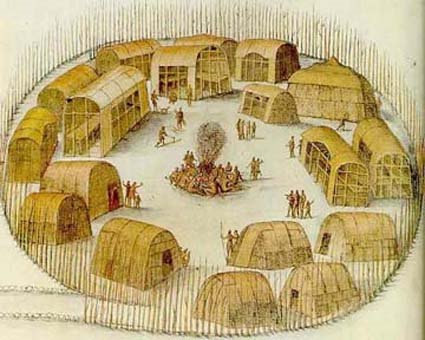
After several days, and after the Indians 'had beene divers times aboord our shippes', Barlowe and seven others sailed around the southern tip of Roanoke Island, and north along the island's western shore, before stopping for several nights at the Roanokes' village 'of nine houses, built of Cedar, and fortified round about with sharpe trees, to keepe out their enemies', on the northern tip of the island. Though far from trusting entirely in his hosts, Barlowe wrote that he and his companions 'were entertained with all love, and kindness and with as much bounties after their manner, as they could possibly devise'.


What Barlowe saw on Roanoke Island impressed him. The Indians were pure of heart, he wrote, and friendly. 'Wee found the people most gentle, loving, and faithful, void of all guile, and treason, and such as lived after the manner of the golden age. The earth', he wrote, brought forth for the Indians 'all things in aboundance, as in the first creation, without toile or labour'. Roanoke, or the surrounding islands, Barlowe reported, would provide the ideal location for a future English settlement.
Full Article Here: