Early Vistor to Roanoke
One of the illustrious figures of the sixteenth century to visit North Carolina was Sir Francis Drake, who came in June 1586. Like Sir Walter Ralegh, Drake was a Devon man. Born at Crowndale, near Tavistock, about 1543, he was the son of Edmund Drake, a sailor who became a yeoman farmer. In 1549 when the Roman Catholic peasants of the West Country rebelled against the new prayer book, the Drakes, who were Protestants, lost all their possessions and had to seek refuge first in Plymouth and later in Kent, where they lived aboard an old ship. There the elder Drake preached to the sailors. Because the family was persecuted for its religious beliefs under Mary Tudor, Francis grew up a staunch Protestant.
Beginning his career in 1566, at about age 23, Drake became an ocean sailor by joining his relative, John Hawkins, in the slave trade with the Spanish colonies in the New World. Stopped by a large Spanish force at San Juan de Ullua in 1568 Hawkins and Drake made an agreement with them but when it was to their advantage, the Spanish attacked. After the ensuing battle Drake hastily returned to Plymouth and was later accused by Hawkins of desertion. From these expeditions Drake learned much about ships and the Western Hemisphere, and he developed a great hatred for the Spanish. For the rest of his life he conducted a personal war against Spain.
Drake returned to the Caribbean in 1569, 1571, and 1572, and attacked Panama in the latter two voyages. In 1572 he was wounded while two of his brothers died in battle. When he returned to England, Queen Elizabeth had made peace with Spain and he had to go into hiding, possibly in Ireland, where he reappeared in 1575. At that time he announced that he was going to the Mediterranean to open up the spice trade in Alexandria, but his true plan was to circumnavigate the world. In 1581, after his return from this successful and profitable voyage, Queen Elizabeth knighted him.
Relations with Spain continued to deteriorate, and in 1585 Drake returned to the West Indies. On Hispaniola he captured the supposedly impregnable city of Santo Domingo. Later in Columbia he captured Cartagena. By now with one-third of his men dead and many others unfit for service, Drake was unable to attack Havana. After sacking St. Augustine, he sailed up the coast to Roanoke Island where he arrived on 26 June 1586. There he visited Sir Walter Ralegh's colony headed by Ralph Lane, planted in 1585. He found a disheartened group of men. The once-friendly Indians were now hostile, and the supply ship was late. Drake offered Lane victuals for one month and a ship, the 40 tun Francis. He also agreed to take some of Lane's weaker men back to England and to replace them with his own men. A major storm, however, forced the Francis out to sea and caused a change in plans. Drake offered Lane a larger ship, the 170 tun Bark Bonner but it was too large to pass through the inlets. Instead Lane and his colonists decided to return to England with Drake.
This expedition did not make great profits for investors but it did inflict great damage on the Spanish Empire and led almost directly to the launching of the Armada that Philip II began to assemble. The Spanish planned to attack in 1587; but, learning of these plans, Drake attacked Cadiz and Lisbon, where he destroyed ships, and at Cape St. Vincent, where he burned barrel staves needed for casks for food and water. These actions delayed the Armada until 1588 and caused it to sail with unseasoned casks which leaked water and allowed food to spoil.
Full Article Here:
http://www.nps.gov/archive/fora/drake.htm
Showing posts with label Spanish Armada. Show all posts
Showing posts with label Spanish Armada. Show all posts
Monday, November 26, 2007
SIR FRANCIS DRAKE

Sunday, October 7, 2007
Early History of the Outer Banks of North Carolina

Early Inhabitants
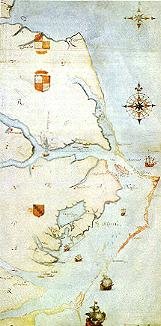
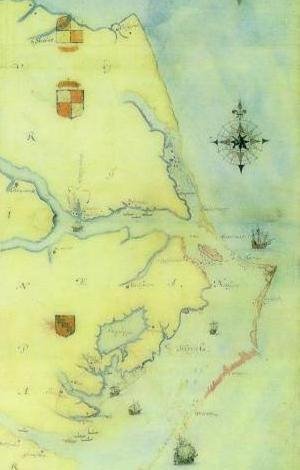
Jutting far into the ocean near the warm, circulating waters of the Gulf Stream, the Outer Banks was the first North American land reached by English explorers. A group of colonists dispatched by Sir Walter Raleigh set up the first English settlement on North American soil in 1587. But Native Americans inhabited these barrier islands long before white men and women arrived.
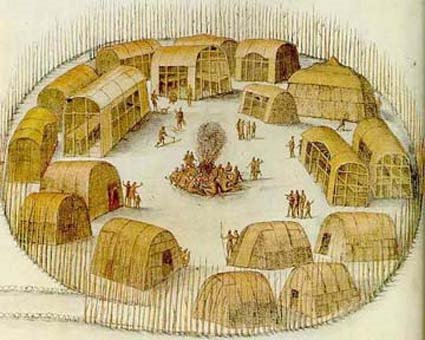
Historians believe humans have been living in the area that now encompasses North Carolina for more than 10,000 years. Three thousand years ago, people came to the Outer Banks to hunt, fish, and live off the land. The Carolina Algonkian culture, a confederation of 75,000 people divided into distinct tribes, spread across 6,000 square miles of northeastern North Carolina.
Archaeologists believe that as many as 5,000 Native Americans may have inhabited the southern end of Hatteras Island from 1000 to 1700. These Native Americans, known as the Croatan, formed the only island kingdom of the Algonkians. Isolation provided protection and the exclusive use of the island's seemingly limitless resources. For more than 800 years, the Croatan lived comfortably in what is now known as Buxton Woods Maritime Forest at Cape Hatteras. Contact with Europeans proved fateful, however. Disease, famine, and cultural demise eliminated all traces of the Croatan by the 1770s.
Early ventures to America's Atlantic Seaboard proved dangerous and difficult for European explorers because of the high winds, seething surf, and shifting sandbars. In 1524 Giovanni da Verrazano, an Italian in the service of France, plied the waters off the Outer Banks in an unsuccessful search for the Northwest Passage. To Verrazano, the barrier islands looked like an isthmus and the sounds behind them an endless sea. According to historian David Stick, the explorer reported to the French king that these silvery salt waters must certainly be the "Oriental sea . . . the one without doubt which goes about the extremity of India, China, and Cathay." This misconception-- that the Atlantic and Pacific Oceans were separated by only the skinny strip of sand we now call the Outer Banks-- was held by some Europeans for more than 150 years.
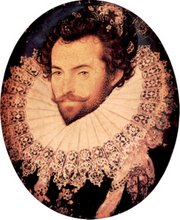
About 60 years after Verrazano's visit, two English boats arrived along the Outer Banks, searching for a navigable inlet and a place to anchor away from the ocean. The captains, Philip Amadas and Arthur Barlowe, had been dispatched by Sir Walter Raleigh to explore the New World's coast. They were hoping to find a suitable site for an English settlement.
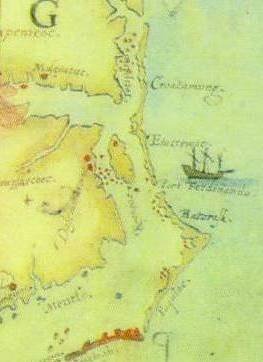
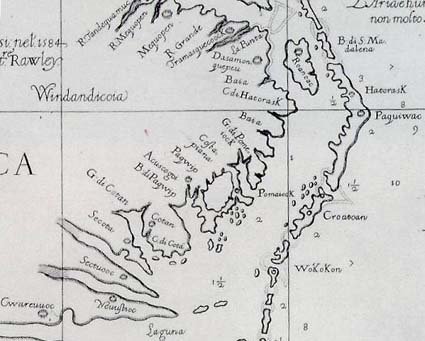
The explorers finally found an entrance through the islands, well north of Cape Hatteras, probably at the present-day Ginguite Creek in northern Kitty Hawk. Traversing the inlet, they sailed south through the sounds to Roanoke Island. There, they disembarked, met the natives, and marveled at the abundant wildlife and cedar trees. Of their successful expedition they told Raleigh about the riches they discovered and the kindness with which the Native Americans had received them.
During the next three years, at least 40 English ships visited the Outer Banks, more than 100 English soldiers spent almost a year on Roanoke Island, and Great Britain began to gain a foothold on the continent, much to the dismay of Spanish sailors and fortune-seekers.
Full Article Here:
http://www.insiders.com/outerbanks/main-history2.htm

Subscribe to:
Posts (Atom)