Pages

Showing posts with label john white. Show all posts

Monday, June 20, 2016

Archaeologists find pieces of a small medicine jar that are linked to the Lost Colony


MANTEO, N.C.
Archaeologists have found pottery pieces that could have been part of a jar belonging to a medicine maker of the Roanoke voyages, and even a member of the lost colony.

The two quarter-sized fragments, colored blue, white and brown, were buried in the soil two feet below the surface not far from The Lost Colony theater ticket house. An earthen mound believed to be a fort from the period lies 75 yards from the discovery site.

“It was an exciting find,” said Eric Deetz, an archaeologist with the First Colony Foundation who was part of the dig earlier this month. “That pottery had something to do with the Elizabethan presence on that island.”

The ointment or medicine jar would have been 3 inches tall and 1.5 inches in diameter, Deetz said. He called it the most significant piece of pottery found in the area since the 1940s.

Continued here:

http://tinyurl.com/zfporpt


This blog is © History Chasers
Click here to view all recent Lost Colony Research Group Blog posts
Bookmark and Share

Tuesday, October 19, 2010

Searching for Secotan

Secotan panel is formed


By JONATHAN CLAYBORNE
jonathan@wdnweb.com
Staff Writer
Published: Tuesday, October 19, 2010 2:17 AM EDT
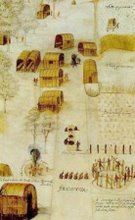
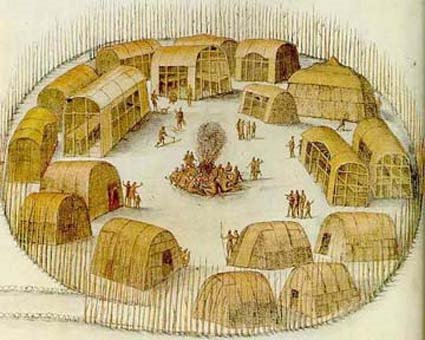
The Beaufort County Committee of 100 has announced the formation of a committee devoted to a search for the lost Algonquian Indian village painted by English watercolorist John White as part of an expedition 425 years ago.

The village, known as Secotan, was the capital of the Secotan nation, said Tom Thompson, Beaufort County’s chief economic developer.

Some experts believe the village, painted by White in 1585, was located in Beaufort County, perhaps on Bath Creek-adjacent land now owned by PotashCorp.

The newly hatched committee, named Secotan 1585, was designed to “support the efforts of the Beaufort County Committee of 100 and its partner, the First Colony Foundation, in the archaeological search for Secotan,” reads a news release. “Members may volunteer to be engaged in the archaeological excavation at such point as it begins. They will be kept abreast of the progress being made in finding and documenting the village by a monthly newsletter.

“There is no charge (for) being a member of the Secotan 1585 committee and the only membership (criterion) is a strong interest in Indian history in Eastern North Carolina, particularly in Beaufort County.”

Interested parties are asked to call 252-946-3970 or e-mail the Beaufort County Economic Development Commission at info@beaufortedc.com.

The Committee of 100 is a nonprofit partner of the publicly funded EDC.

First Colony’s website reads this nonprofit “is dedicated to conducting archaeological and historical research, combined with public education and interpretation, relating to the story of North Carolina and America’s beginnings with the attempts by Sir Walter Raleigh to establish English colonies at Roanoke Island in the 1580s under his charter from Queen Elizabeth I.”

First Colony’s members include Gordon Watts, the underwater archaeologist who helped discover the remains of the Civil War ironclad USS Monitor.

Despite its renowned associates, Secotan 1585 is open to all comers, its backers indicated.

“The committee was started in response to a large number of calls and e-mails and personal contacts” from people interested in the search for Secotan, said Tom Thompson, Beaufort County’s chief economic developer.

Thompson said he counts the approximately 450 members of the Committee of 100 as being involved with Secotan 1585.

“Most of them appear to be very interested,” he said.

The formation of this committee was announced soon after Steven Beckel, general manager of PotashCorp’s Aurora facility, sent county officials a letter detailing the company’s response to calls for further archaeological work on land the company owns at Beasley Point in Bath.


More here: 

http://www.google.com/url?sa=X&q=http://www.wdnweb.com/articles/2010/10/19/news/doc4cbce52e67297013149262.txt&ct=ga&cad=:s7:f1:v0:d1:i0:lt:e0:p0:t1287469954:&cd=_HsVFr8ycEM&usg=AFQjCNGmeCLswIqX7XmDEYyUPIunrCdNkQ

SeeRelated:


http://www.google.com/url?sa=X&q=http://www.wdnweb.com/articles/2010/10/19/news/doc4cbce52e67297013149262.txt&ct=ga&cad=:s7:f1:v0:d1:i0:lt:e0:p0:t1287469954:&cd=_HsVFr8ycEM&usg=AFQjCNGmeCLswIqX7XmDEYyUPIunrCdNkQ


This blog is © History Chasers
Click here to view all recent Lost Colony Research Group Blog posts
Bookmark and Share

Sunday, August 23, 2009

Roanoke Island Trip - Day 5


Day 5 - August 20 – Thursday

by Roberta Estes

I’ve been looking forward to today for 2 years now. Anne and I are going to Hatteras Island which is where Croatoan is located. Croatoan, if you recall, is the location that the Lost Colony carved on the post and the tree at Fort Raleigh as a message to John White telling him where the colony had removed to. He found it on his return voyage in 1590 and was thrilled that the colonists were among the friendly Indians headed by Manteo, their friend who had gone with them to England twice.

John White was also greatly relieved by what he did not find; no cross. Their agreement was that if the colonists left under duress or in distress, they would carve not only their location, but a cross. There were no crosses anyplace, and the houses had been disassembled and removed, not ransacked, so their move was obviously orderly and planned, not hurried.

John White wanted to visit Hatteras Island, they called Croatoan, but a violent storm interfered with is plans, drowned some of the men, and nearly sank their ships. They had to abandon those plan and return to England. So close, yet so far away.

Anne and I retraced that journey today. After leaving Roanoke Island, we crossed the bouncing bridge and turned onto NC 12. NC 12 is the ribbon highway that runs the length of Hatteras land for more than 50 miles. The island starts out running North to South, but does a dog-leg turn in about 45 miles at Buxton and then runs East to West. The North to South portion is generally not inhabitable. Now of course there are a couple of tiny villages with a few hearty souls who must not need insurance who have built right on the sand dunes on the ocean on a tiny spit of land not more than an eighth of a mile wide in some locations. But these locations do not support any agriculture because there is only sand and no dirt. In fact, these areas are quite picturesque. The park service has erected sand fences in some areas to attempt to reduce erosion and the sand drifts around the fences. However, the road has been washed out many times and new inlets through the island are often created during hurricanes and other bad storms, letting us know indeed how fragile those islands truly are.

In some locations, maritime forest exists on the islands. While this is different than mainland forests, it’s still beautiful and often blocks the view of the ocean making the distance to the ocean from the road seem far greater than it is.

This site has beautiful photos of the Outer Banks. Take a look and share the unique charm and the stark beauty. You can see Maritime forest in many of these photos.

http://www.duke.edu/~jspippen/vistas/outerbanks.htm


We stopped in Buxton and visited Scott Dawson at the Croatoan Inn. Scott and his wife own the inn and Scott has a beautiful collection of Native artifacts found on the beaches and elsewhere on Hatteras Island.

http://www.thecroatoaninn.com/

Scott is a wealth of information about the history of Hatteras Island. He is passionate about the colonists who he believes assimilated with the Indians. Indeed, they told us they were going to Croatoan and Hatteras Island is Croatoan. This part of Hatteras Island is the first location between Roanoke and the end of Hatteras Island that can sustain a population and grown food, and the Indians have inhabited that island at least seasonally for thousands of years.

Scott has done a great deal of research on the topic and his book “Croatoan, Birth Place of America” is now in its second printing.

http://www.buybooksontheweb.com/product.aspx?ISBN=0-7414-5469-6


We had read the book and wanted to see the area for ourselves as well as some of the landmarks Scott discussed in his book. Even though he couldn’t leave the hotel and go with us, he was kind enough to tell us how to locate several items, including the Cora tree.

The Cora Tree and the coffins are in very close proximity. The coffins were, unfortunately, reburied many years ago, right after they were accidentally excavated by a drag line operator before anyone realized the significance of what he had stumbled upon. However, we do know the general area where the canal digging as going on and the Cora tree is in the same vicinity.

The Cora tree is quite interesting, although maddeningly inconclusive just like so much else about the Lost Colony. Recalling that the colonists were to carve the location of where they were moving on a tree or post, this tree is over 1000 years old, so even in 1600 or so it would have been remarkable. At that time it was already 600 years old, a substantial tree.

Did the colonists carve a second message to their hoped-for rescuers after they moved to Croatoan? Were they trying to tell John White where they went if they moved a second time? Is Cora similar to Coree? The locals tell the story that
Cora was a witch who was hung in the tree and lightening carved the name Cora in the bark.

From there Anne and I drove around the area where we knew the coffins to have been, and revisited the sites of earlier archaeological digs, although there have been very few on Hatteras Island, with most digs being focused on Fort Raleigh and that area. Earlier digs on Hatteras (Croatoan) were very successful, unearthing a gunlock and the Kendall family signet ring among other English items. In the 1930s, a man found a sword in that area as well. Again, while confirming the presence of the English on the island, it doesn’t confirm that the colonists themselves were there and that that they weren’t later artifacts. Kendal was in the 1585-86 military expedition, but not in the 1587 group, so we may be finding artifacts from the military expedition, not the colonists themselves.

How I would love to test the DNA of the skeletal remains in those caskets. It could potentially tell us a great deal about what happened between 1587 when the colonists moved to Croatoan and the next “sighting” we have directly of their descendants which is in 1701 when John Lawson visits the Hatteras Indians and reports that they have grey eyes and some have light hair as well. The Hatteras told Lawson that their ancestors were white people and talked in books. The Hatteras also tell of a ghost boat which appears on misty nights and is Raleigh’s boat which has come for them.

How many misty and foggy nights indeed did the colonists spend watching for any sign through the mists of their rescuers? Did they every give up waiting? At some point, had they assimilated so well into the Native culture that they no longer wanted to be rescued? Did they in fact survive to have descendants in the present generation, or did they survive only long enough to be annihilated by disease or warfare with other warring nations and the white settlers as well during the long and bloody Tuscarora War and preceding events?

After some artifact hunting on the beach, from which we turned up empty handed, we ate at a place that passes for fast food. Let’s just suffice it to say it took as long to get a salad, burger and piece of pizza as it would have taken to wait on a table at the nicer restaurant (20 minutes) and have ordered and eaten a dinner. Let’s just say that calling the food mediocre would be doing it a favor. That restaurant is definitely on my “never again” list.

Our drive home was in the dark, and it’s amazing just how dark dark is on the island. Of course, there are no street lights and in the areas with no habitation, there is also no ambient light. The mainland is often out of sight and if you look eastward of course there is just ocean and more ocean. Anne and I watched the ocean and wondered if Hurricaine Bill will cause severe rains and flooding, but this evening, and for a couple of more evenings, Hurricane Bill isn’t a problem. But one this is for sure on the Outer Banks, if this hurricane misses you, there’s always another one waiting in the wings. The surfers count on that.

We arrived home under the poplar tree quite late, for the last time for me. I packed and got my car ready to load in the morning. I slept restlessly trying to decide whether to risk the traffic by going north by Washington DC or take the longer route westward and up 77. By 4:30 AM or so, I had come up with a compromise plan which took me north to Richmond they west on 64 which should keep me out of traffic and rain with little backtracking. My GPS this morning was not happy with my decision. How I just love having a bossy woman in my car. I swear she sounds more disgusted with every direction of hers that I don’t follow. She gets confused sometimes and got herself all bolluxed up near Richmond, nearly sending me to Washington DC in spite of what I told her to do.

This morning when I woke up, I looked out the bedroom window to see condensation running down the window….and it wasn’t raining. It was just that humid. No need to dry your hair here, because it’s going to be wet again in 2.7 minutes. And makeup – only waterproof. But none for me thank you…..I got over that about the same time I got over staying up late.

As I was loading my car for my final trip across the bouncing bridge, Turkey Lurkey ran up and offered some parting advice….I’m not sure I understood her correctly, but I think it was something about not celebrating Thanksgiving this year.


Read all posts in the Trip to Roanoke series:


© History Chasers


Click here to view all recent Searching for the Lost Colony DNA Blog posts

Bookmark and Share

Wednesday, October 1, 2008

Return To Ronoake

John White (1590)
From Richard Hakluyt, Principal Navigations, Voyages of the English Nation, III (1600)

The 15 of August towards Euening we came to an anker at Hatorask, in 36 degr. and one third, in fiue fadom water, three leagues from the shore. At our first comming to anker on this shore we saw a great smoke rise in the Ile Roanoak neere the place where I left our Colony in the yeere 1587, which smoake put vs in good hope that some of the Colony were there expecting my returne out of England.
The 16 and next morning our 2 boates went a shore, & Captaine Cooke, & Captain Spicer, & their company with me, with intent to passe to the place at Roanoak where our countreymen were left. At our putting from the ship we commanded our Master gunner to make readie 2 Minions and a Falkon well loden, and to shoot them off with reasonable space betweene euery shot, to the ende that their reportes might bee heard to the place where wee hoped to finde some of our people. This was accordingly performed, & our twoe boats put off vnto the shore, in the Admirals boat we sounded all the way and found from our shippe vntill we came within a mile of the shore nine, eight, and seuen fadome: but before we were halfe way betweene our ships and the shore we saw another great smoke to the Southwest of Kindrikers mountes: we therefore thought good to goe to that second smoke first: but it was much further from the harbour where we landed, then we supposed it to be, so that we were very sore tired before wee came to the smoke. But that which grieued vs more was that when we came to the smoke, we found no man nor signe that any had bene there lately, nor yet any fresh water in all this way to drinke. Being thus wearied with this iourney we returned to the harbour where we left our boates, who in our absence had brought their caske a shore for fresh water, so we deferred our going to Roanoak vntill the next morning, and caused some of those saylers to digge in those sandie hilles for fresh water whereof we found very sufficient. That night wee returned aboord with our boates and our whole company in safety.
continue here

Saturday, August 23, 2008

Native American Dress


Beverley, Robert, ca. 1673-1722.


Indian man in his Summer Dress.

The upper part of his Hair is cut short, to make a ridge, which stands up like the Comb of a Cock, the rest is either shorn off, or knotted behind his


Page 4

Ear. On his Head are stuck three Feathers of the Wild Turkey, Pheasant, Hawk, or such like. At his Ear is hung a fine Shell with Pearl Drops. At his Breast is a Tablet or fine Shell, smooth as polish'd Marble, which sometimes also has etched on it, a Star, Half Moon, or other Figure, according to the makers fancy. Upon his Neck, and Wrists, hang Strings of Beads, Peak and Roenoke. His Apron is made of a Deer skin, gashed round the edges, which hang like Tassels or Fringe; at the upper end of the Fringe is an edging of Peak, to make it finer. His Quiver is of a thin Bark; but sometimes they make it of the Skin of a Fox, or young Wolf, with the Head hanging to it, which has a wild sort of Terror in it; and to make it yet more Warlike, they tye it on with the Tail of a Panther, Buffaloe, or such like, letting the end hang down between their Legs. The prickt lines on his Shoulders, Breast and Legs, represent the Figures painted thereon. In his Left Hand he holds a Bow, and in his Right an Arrow. The mark upon his Shoulder blade, is a distinction used by the Indians in Travelling, to shew the Nation they are of. And perhaps is the same with that which Baron Lahontan calls the Arms and Heraldry of the Indians. Thus the several letter'd marks, are used by several other Nations about Virginia, when they make a Journey to their Friends and Allies.

The Landskip is a natural representation of an Indian Field.


Page 5

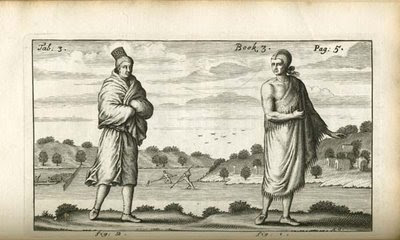
Tab. 3. Is two Indian Men in their Winter Dress.

Seldom any but the Elder people wore the Winter Cloaks, (which they call Match-coats,) till they got a supply of European goods; and now most have them of one sort or other in the cold Winter Weather. Fig. 1. wears the proper Indian Match-coat, which is made of Skins, drest with the Furr on, sowed together, and worn with the Furr inwards, having the edges also gashed for beauty sake. On his Feet are Moccasins. By him stand some Indian Cabins on the Banks of the River. Fig. 2. wears the Duffield Match-coat bought of the English, on his Head is a Coronet of Peak, on his Legs are Stockings made of Duffields: That is, they take a length to reach from the Ankle to the Knee, so broad as to wrap round the Leg; this they sow together, letting the edges stand out an Inch beyond the Seam. When this is on, they Garter below Knee, and fasten the lower end in the Moccasin.

§. 4. I don't find that the Indians have any other distinction in their dress, or the fashion of their Hair, than only what a greater degree of Riches enables them to make; except it be their Religious persons, who are known by the particular cut of the Hair, and the unusual figure of their Garments; as our Clergy are distinguisht by their Canonical Habit.

The Habit of the Indian Priest, is a Cloak made in the form of a Woman's Petticoat; but instead of tying it about their middle, they fasten the gatherings about their Neck, and tye it upon the Right Shoulder, always keeping one Arm out to use upon occasion. This Cloak hangs even at the bottom,


Page 6

but reaches no lower than the middle of the Thigh; but what is most particular in it, is, that it is constantly made of a skin drest soft, with the Pelt or Furr on the outside, and revers'd; insomuch, that when the Cloak has been a little worn, the hair falls down in flakes, and looks very shagged, and frightful.

The cut of their Hair is likewise peculiar to their Function; for 'tis all shaven close except a thin Crest, like a Cocks-comb which stands bristling up, and runs in a semi-circle from the Forehead up along the Crown to the nape of the Neck: They likewise have a border of Hair over the Forehead, which by its own natural strength, and by the stiffning it receives from Grease and Paint, will stand out like the peak of a Bonnet.


Tab. 4. Is a Priest and a Conjurer in their proper Habits.

The Priest's Habit is sufficiently describ'd above.*

The Conjurer shaves all his Hair off, except the Crest on the Crown, upon his Ear he wears the skin of some dark colour'd Bird; he, as well as the Priest, is commmonly grim'd with Soot or the like; to save his modesty he hangs an Otter-skin at his Girdle, fastning the Tail between his Legs; upon his Thigh bangs his Pocket, which is fastn'd by tucking it under his Girdle, the bottom of this likewise is fring'd with Tassils for ornament sake. In the middle between them is the Huskanawing spoke of §. 32.


The dress of the Woman is little different from that of the Men, except in the tying of their Hair. The Ladies of Distinction wear deep Necklaces, Pendants and Bracelets, made of small Cylinders of the Conque shell, which they call

Peak: They likewise keep their Skin clean, and shining with Oyl, while the Men are commonly bedaub'd all over with Paint.

They are remarkable for having small round Breasts, and so firm, that they are hardly ever observ'd to hang down, even in old Women. They commonly go naked as far as the Navel downward, and upward to the middle of the Thigh, by which means they have the advantage of discovering their fine Limbs, and compleat Shape.


Tab. 5. Is a couple of Young Women.

The first wearing a Coronet, Necklace, and Bracelet of Peak; the second a wreath of Furs on her Head, and her Hair is bound with a Fillet of Peak and Beads. Between the two, is a Woman under a Tree, making a Basket of Silk-Grass, after their own manner.


Tab 6. Is a Woman, and a Boy running after her.

One of her Hands refts in her Necklace of Peak, and the other holds a Gourd, in which they put Water, or other liquid.

The Boy wears a Necklace of Runtees, in his right hand is an Indian Rattle, and in his left a roasting Ear of Corn. Round his Waste is a small string, and another brought cress thro his Crotch, and for decency a soft skin is fastn'd before.


© This work is the property of the University of North Carolina at Chapel Hill. It may be used freely by individuals for research, teaching and personal use as long as this statement of availability is included in the text.


Monday, July 21, 2008

England's First View of America


British Museum Exhibition of
John White Watercolors

A New World: England's First View of America
July 15, 2008 - October 15, 2008

Jamestown Settlement

Jamestown Settlement will exhibit the 16th-century watercolor drawings of John White from the British Museum’s “A New World: England’s First View of America” July 15 through October 15, 2008.

The drawings are the earliest visual record by an Englishman of the flora, fauna and people of the New World. White accompanied a number of expeditions sponsored by Sir Walter Raleigh to Virginia in the 1580s and was governor of the short-lived colony at Roanoke Island, part of modern North Carolina. He departed for England in 1587 to obtain more supplies, but war with Spain delayed his return until 1590. By then the colonists had vanished, and Roanoke became known as the “Lost Colony.”

Jamestown, America’s first permanent English colony, was established 17 years later, about 100 miles away. White’s depictions of the Algonquian-speaking people of the region have been an important resource in the development of Jamestown Settlement’s gallery exhibits and outdoor re-created Powhatan Indian village.

Additional Reading:


Thursday, May 22, 2008

New Dig on Roanoke Reveals Artifacts Previously Not Seen

Search ongoing for Lost Colony site

BY JESSICA BOWEN SENTINEL STAFF

Director of Native American Studies Program at University of Oklahoma, Joe Watkins, Ph.D., screens dirt for potential clues leading the the disappearance of America's early settlers. With his experienced eye he carefully examines for any sign of native American or European lifestyle.

Archaeological teams are geared up to answer the on-going mystery of Fort Raleigh's early settlers.Last week, First Colony Foundation (FCF) teamed up with scholars and the premier production of Time Team America to excavate grounds in hopes of finding artifacts that would answer any of the numerous questions surrounding the mystery. Fort Raleigh is the first of five sites for Time Team America's series and the team only had three days to complete the excavation. Thus, they worked from sun-up to sun-down, ensuring not a minute was wasted.

The team consists of archaeologists, geophysicists, sketch artists, and graphic artists along with the several in the production field. Lead digger Chelsea Rose explained the teams are "looking for artifacts or evidence of features of buildings" including post-holes relative to structures.To ensure no artifacts are being destroyed or overlooked, the diggers take extra care when sifting the soil. The first few layers, according to Rose, are from blown sand that came in as part of a dune, making it easy for the team to sift through. "We've got to get to the darker layers underneath if we're going to find anything," she noted.

After the soil has been removed, the team carefully sifts through each layer with screens. Ian MacDonald, with FCF, explained the soil goes through a large screen, then a smaller window screen, to guarantee no small pieces have been ignored. "We go as quickly as reasonable," noted MacDonald, "being very thorough in the process."If the team discovers an artifact, FCF Co-Director Nick Luccketti and archaeologist Eric Klingelhofer of FCF will analyze the findings to determine its authenticity.On the second day, the team found a very small piece of what is believed to be Native American pottery. "If you look real closely you can see pieces of shell, and you learn to recognize immediately," said Joe Watkins, Ph.D., Native American Archaeologist and a member of the Time Team. "I have a point of view different that others, I use the point of view of Native Americans."


As of press time, the teams had discovered several artifacts "both prehistoric and historic," said Klingelhofer. Along with the pottery found on their second day, two small sherds of English essex black ware was found on their third day. The black-ware is believed to have been used for cups and plates. According to Luccketti, the essex black-ware is unlike any artifact from previous excavations and seem to be connected with domestic use.

Full Article Here:

http://obsentinel.womacknewspapers.com/articles/2008/05/21/features/feats2251.txt

Pocahantas and Virginia Dare

by Barry Wetherington

"Heyr laeth Ananias & Virginia Father Salvage mvrther AI save seaven nameswritten heyr mai God hab mercye Eleanor Dare 1591."

They found one skeleton.

On forty-six rocks are 704 words to test Elizabethan usage.

No evidence of hoax in this regard was detected by the many experts who examined them."Father wee ben heyr 5 yeeres in primaeval splendovr Eleanor Dare 1592."Here the story seemed to end. FYI, below is a very long magazine article addressing the isue of theThe Virginia Dare stone(s), suggesting that Ananias Dare's wife Eleanor,daughter of Colony boss John White, escaped the Lost Colony to the Atlanta area, and wrote many messages on stones found in that region, the article of which I have read but not critically for examination.

This is a fascinating story premise. In the total of a couple hours Iwas able to devote to it, and w/o having even seen Pearce's book, I would very much like to have some carbon-dating, etc done on these artifactsbefore arriving at any conclusions. (FN: For fairness, I have previously offered a written premise forconsideration that Pocahontas might have been just barely old enough to have been able to have been the daughter of Virginia Dare, based upon a 11-12 yr old VA Dare birthing Poca, that at age about 10, 'saved' John Smith, then, as is acknowledged, traveled to visit the queen of England, dieing just before returning, see discussion below). It is not clear to me that the developments posed here would have asignificant bearing upon that premise - nevertheless, there is one 'fact' I find VERY tantalizing. Bones were claimed found:". . . [the returning] third party had expected to find them [the 'Lost'Colony]waiting at Roanoke. But Fort Raleigh, made of logs, had been pulled down. Theyfound one skeleton."There is no mention of the present location of that skeleton. If it is available, that would present a potentially incredible opportunity. If the remains of Pocahontas could be located where they were placed when moved form their known resting place in the Church at Gravesend London England, a dna comparison of her remains to the dna from the skeleton could reveal much of interest!

http://thedarestones.blogspot.com/2008/05/pocahantas-and-virginia-dare.html

http://thedarestones.blogspot.com/2008/05/witness-for-eleanor-dare.html

Saturday, May 3, 2008

Virginia Dare Leaden Plaque; Hoax or Genuine Evidence?


Did Virginia Dare die while captive of Powhatan?


If the story reported in several newspapers in 1924 is true, it must have been very exciting when Russel Kaufman and Elroy Yerovi of Washington, NC struck a metal object when digging a hole for a tree and discovered its startling message.

In 1924 (several) newspapers* reported a find in Washington, NC by a Russel Kaufman and Elroy Yerovi of a “hammered lead” note whose waxen coating was removed to reveal: “ Virgin Dare, Died Here, Captif of Powhatan, 1590 Charles R.” it also stated that the Smithsonian Institute was making further excavations. The find was on “P Street, N.W. Washington” which is about 3.5 miles from Roanoke.

The articles from Oshkosh, Wisconsin in The Daily Northwestern 16 January 1924 and Appleton, Wisconsin in the Appleton Post Crescent 21 January, 1924 are accessable here:

http://www.genpage.com/VD1.jpg

http://www.genpage.com/VD2.jpg

Other newspapers reporting the find:

*Decatur, Illinois in the Decatur Review 14 January, 1924
Appleton, Wisconsin in the Appleton Post Crescent 21 January, 1924
Mansfield, Ohio in the Mansfield News 20 January 1924
Reno, Nevada in the Nevada State Journal 18 January 1924
Oshkosh, Wisconsin in The Daily Northwestern 16 January 1924

Contributed by Pat Bowen

Virginia Dare was the first known English child born in the New World. The child of Elinor and Ananias Dare, she was among the Colonists left behind in 1587 on Roanoke Island. The fact of her birth is known because the leader of the colony, sent to establish Raleigh Citee, Eleanor Dare's father, John White, returned to England to seek assistance for the colony. When White returned three years later, the colonists were gone. Neither Virginia's fate nor that of the Colony's is known after 400 years.

It is not known where the leaden plaque is now or what conclusions were reached concerning its validity. Perhaps modern techniques could confirm or deny the authenticity of this plaque. Any further information would be deeply appreciated.

History Chasers

Washington, NC


View Larger Map

Sunday, April 27, 2008

New World Seen With an Old World Eye

You can view the difference between John White's paintings and the corresponding De Bry engravings here:

http://www.virtualjamestown.org/images/white_debry_html/jamestown.html


At the Yale Center for British Art, rare paintings and engravings are put to the truth test in 'A New World: England's First View of America.'
By Paul Lieberman, Los Angeles Times Staff Writer April 27, 2008


NEW HAVEN, CONN. -- VISITORS who pass quickly by may detect nothing unusual about the 500-year-old woodcut of Brazil's Tupinamba Indians, shown in decorative feathered garb. But those who stop and examine it will certainly notice the severed arm in the background -- and someone about to gnaw on it. In this early depiction of the New World, made following a Portuguese explorer's trip, the natives are cannibals."People in Europe thought the unknown world was full of monsters and very frightening savages," said curator Elisabeth Fairman, leading a group past the 1505 woodcut on the wall of the Yale Center for British Art.


The frightening scene is just a setup for very different scenes to come -- in the historic watercolors that gave Britain and much of the world its first images of what became known as America, images used to this day to teach school children what Native Americans looked like and how they lived before Europeans put their stamp on this land."These are the 18 drawings . . . the iconic images everyone knows," Fairman said as the group stood before colorful renditions of friendly Indians in a land of plenty. Fish virtually jump from the water into their canoe. Corn grows in neat rows. Families wave. People sit around a fire. A dog romps. is that these images -- part of "A New World: England's First View of America" -- are something else.


"Propaganda," said Fairman, the Yale museum's curator of rare books and manuscripts. Or perhaps they can be seen, more charitably, as a limited snapshot of a small group of people at a short-lived moment -- right before the clash of cultures began to take its toll.


The watercolors were the work of John White, a British gentleman who was on several voyages sponsored by Sir Walter Raleigh to the coast of what was then called "Virginia" -- after England's Virgin Queen, Elizabeth -- but is now North Carolina.


White's watercolors provided visions of Native Americans that would be viewed as near gospel for two centuries, but they were based on a mere two-week encounter with one tribe, the Algonquians, during a 1585 voyage to establish an English military presence in the New World. Two years later, White returned to lead a delegation of 115 civilians, hoping to establish a permanent settlement at the "Cittie of Raleigh," that group including his daughter Eleanor Dare, who gave birth to the first English child born in North America, the aptly named Virginia Dare.


White then left them behind to go back to England for more supplies and by the time he returned, in 1590, there was no trace of them -- not his daughter, granddaughter or any member of what became known as the "Lost Colony of Roanoke."So the settlers vanished, but White's watercolors endured, thanks to their use in illustrating popular books on the New World whose text ("A Briefe and True Report of the New Found Land of Virginia") was written by mathematician Thomas Harriot, who also was on the 1585 expedition.


Of course, that was long before there was technology to easily duplicate a painting. Mass reproduction in this case was achieved through engravings made by a Belgian goldsmith, Theodore de Bry, whose images of the same Indians also are part of the exhibit.And there's the catch -- the engravings made by De Bry took liberties with White's original watercolors, pushing them in a clear direction. While the Native Americans were shown as benign to start, De Bry made them even more palatable to audiences back home and clear candidates for conversion to Christianity.


One stunning example is White's "Indian Man and Woman Eating" ("Their Sitting at Meate"), showing the pair squatting around a platter of what appears to be boiled corn. But they are squatting in a way that may have seemed uncomfortable to the British audience, so the engraved version has their legs stretched out; and their facial features appear European.


Another White watercolor shows an "Indian Woman and Young Girl," with the mother looking off into the distance and the girl holding a doll that's obviously a gift from the visitors from across the ocean. In the engraving that became the circulated image, "A Cheiff Ladye of Pomeiooc," the mother's gaze is redirected at the girl, who now is playing not only with the doll but a Western rattle.


The message to the folks back home: These people may dress differently than we do, but they are not all that different."What he's paying attention to," Fairman said of White, "is how they eat, what they eat, how they catch their food, how they treat their children, how they interact with each other . . . and how you tell who's in charge, who the priests are . . . all the kind of information people in the Elizabethan court, and the people on the next voyages, need to know."


Full Article Here:


http://www.latimes.com/entertainment/la-ca-yaleart27apr27,0,3125192.story

Friday, March 14, 2008

View an Audio Slideshow of John White's Paintings


Organized by the British Museum in London, “A New World: England’s First View of America,” at the Yale Center for British Art, presents maps, sketches and watercolors by the Elizabethan artist John White, about 20 of which constitute the only surviving visual record of England’s first settlement in North America. These images — of the Algonquian Indians and local flora and fauna — are immensely fragile and may be exhibited only once every 30 to 40 years, making this enchanting exhibition an event of historical importance as well.


White is a mysterious figure. We don’t know where or when he was born, who his father was, or even when he died. What historians do know is that in 1585 he was a member of an expedition to create a permanent foothold for England in America. The expedition landed on Roanoke Island and began construction of a small fortified settlement, later exploring the surrounding islands and the mainland in longboats. During these explorations White produced drawings and maps of what he saw, perhaps to satisfy curiosity back home about the New World.


In 1587 he returned to Roanoke Island as the governor of a new colony, along with 115 brave English colonists. But insufficient supplies forced him to return immediately to England, leaving the colonists behind, along with his daughter, son-in-law and granddaughter, the first English child born in the New World. When he returned to the island three years later, he found all the colonists had vanished. So began the legend of the “Lost Colony of Roanoke.”


Tuesday, February 26, 2008

What Really Happened to the Lost Colony?

UNC professor shares his theory

Click-2-Listen
By BRENDA KLEMAN
Staff Writer
Friday, February 22, 2008

BARCO — What really happened to the Lost Colony? That's a question that has baffled historians for more than 400 years. One University of North Carolina professor shared his theory as to what happened to the ill-fated colonists during a lecture Saturday, Feb. 16 at the Currituck Public Library.

In the last half of the 20th century historians have concluded that the 120 English colonists were either killed by American Indians, or that they left the island and joined various Indian tribes, said professor David La Vere, of UNC at Wilmington.

Historian David La Vere discusses his opinion of what happened to the Lost Colony during a forum held at the Currituck Public Library in Barco Saturday.

However, La Vere believes the colonists' disappearance was due to a combination of both beliefs. La Vere has devoted years to investigating the disappearance of the settlers, who in 1587 landed on the shores of Roanoke Island. Three years later the settlers had vanished and the only clue left behind was a mysterious inscription found on a tree. The vanishing settlers are remembered in history as the "Lost Colony."

Historians believe that the settlers were hindered by a bad drought, which made it difficult for them to grow crops, La Vere said. That's when their leader, Gov. John White, sailed back to England to get more supplies. White was unable to return to Roanoke Island until 1590, a delay that La Vere said he believes was due to England's politics and it's war with Spain.

When White finally made it back to Roanoke Island, all that remained of any sign of the settlers was the word "Croatan" inscribed on a tree. La Vere said he believes Croatan is a reference to an island of the same name near Buxton, where he believes about 20 of the settlers went after waiting as long as possible for White to return before giving up and leaving. At Croatan, the settlers would wait and watch for the return of supply ships. He said he believes the remaining settlers tried to make it north to Virginia in hopes of finding other white settlements, La Vere said.

While anthropologists, archeologists and other scientists are still studying disappearance of the Lost Colony, La Vere said he believes the 100 or so colonists who tried to reach Virginia mistakenly traveled up the Chowan River and were either killed or captured and put into slavery by the Mangoak Native American tribe.

"It makes most sense to me that the Mangoaks killed or captured the colonists," La Vere said.
He also said that he believes Croatan was friendly Indian territory, and the survivors of the group of 20 were probably adopted into Indian society, married and had children.

La Vere said there have been reports of blond-haired American Indians spotted in the early 17th century, but as of now, there is no information to confirm they were descendants of the Lost Colony.

La Vere has performed extensive research on American Indians who lived in parts of North Carolina and Virginia during the late 16th and early 17th centuries, and how they may have played a role in the colonists' disappearance. To help explain his theory, La Vere discussed the tribes that inhabited North Carolina's Albemarle and Piedmont areas, as well as the area known today as Chesapeake, Va.

Full Article Here:

http://www.dailyadvance.com/news/content/news/stories/2008/02/22/022208currlostcolony.html?cxtype=rss&cxsvc=7&cxcat=7

Saturday, February 23, 2008

The White-De Bry Map of Virginia (1590)

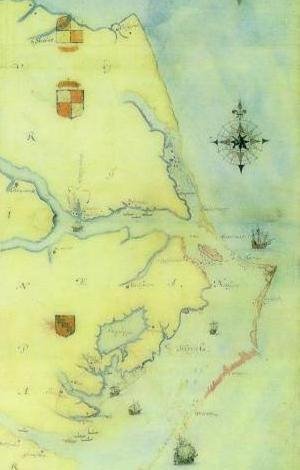
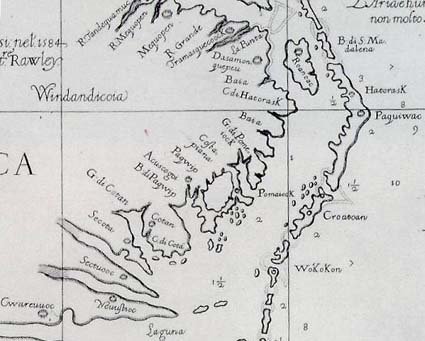
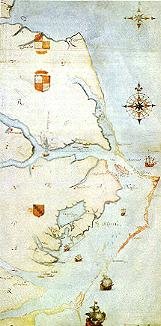
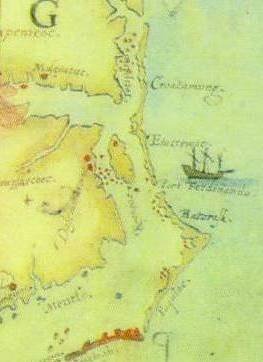
In 1590 Theodor De Bry published Part I of his America, which included several of his engravings based on drawings of the New World by John White. Notable among them is a map of the east coast of North America from the lower Chesapeake Bay south past Cape Lookout. Three probable sources of this collaborative map are extant: a crude pen-and ink map, perhaps by Ralph Lane, and two of an unknown number of White's detailed watercolor sketch maps — one, on a large scale, covering much the same area as the engraving; the other, on a small scale, showing southeastern North America and part of the West Indies.


Some features unique to the White-De Bry are corrections; others are errors; still others may be based on sketch maps now lost. Following is the key to the White-De Bry map which was taken, with many liberties, from Appendix I of David B. Quinn's Roanoke Voyages (London, 1955).

MAP KEY found here:


Friday, February 8, 2008

Roanoke Island: The Beginnings of English America


Well before the Jamestown settlers first sighted the Chesapeake Bay or the Mayflower reached the coast of Massachusetts, the first English colony in America was established on Roanoke Island. David Stick tells the story of that fascinating period in North Carolina's past, from the first expedition sent out by Sir Walter Raleigh in 1584 to the mysterious disappearance of what has become known as the lost colony.

Included in the colorful cast of characters are the renowned Elizabethans Sir Francis Drake and Sir Richard Grenville; the Indian Manteo, who received the first Protestant baptism in the New World; and Virginia Dare, the first child born of English parents in America. Roanoke Island narrates the daily affairs as well as the perils that the colonists experienced, including their relationships with the Roanoacs, Croatoans, and the other Indian tribes. Stick shows that the Indians living in northeastern North Carolina—so often described by the colonists as savages—had actually developed very well organized social patterns.

The fate of the colonists left on Roanoke Island by John White in 1587 is a mystery that continues to haunt historians. A relief ship sent in 1590 found that the settlers had vanished. Stick makes available all of the evidence on which historians over the centuries have based their conjectures. Methodically reconstructing the facts—and exposing the hoaxes—he invites readers to draw their own conclusions concerning what happened.

Exploring the significance of that first English settlement in the New World, Stick concludes that speculation over the fate of the lost colony has overshadowed the more important fact that the Roanoke Island colonization effort helped prepare for the successful settlement of Jamestown two decades later. "Had it been otherwise," he contends, " those of us living here today might well be speaking Spanish instead of English."

The four hundredth anniversary of the exploration and settlement of what came to be called North Carolina occurred in 1984. For that occasion, America's Four Hundredth Anniversary Committee commissioned this factual and readable history.


Amazon Book Review

http://www.amazon.com/Roanoke-Island-Beginnings-English-America/dp/0807841102


Monday, February 4, 2008

'Mysteries of the Lost Colony' Exhibit Proves to be Huge Hit


Nearly 58,000 Saw Lost Colony Exhibit

Approximately 58,000 people took advantage of the once-in-a-lifetime opportunity to see the exhibit “Mysteries of the Lost Colony” and “A New World: England’s First View of America” from the British Museum. The exhibit ran from Oct. 20, 2007, to Jan. 14, 2008, at the N.C. Museum of History in Raleigh.

“This was the most exciting exhibit the museum has ever presented,” says Ken Howard, director of the N.C. Museum of History. “It had one of the highest attendance records for an exhibit, and visitor response was extremely positive.”

“Mysteries of the Lost Colony” and “A New World” brought many “firsts” to the N.C. Museum of History. For example, it was the first venue in North America to showcase the complete collection of watercolor drawings made by John White on his voyages to Virginia (now North Carolina) in the 1580s. These watercolors appeared in the traveling exhibition “A New World: England’s First View of America,” presented by the British Museum in London.

In “Mysteries of the Lost Colony,” visitors learned about England’s first attempts at a permanent settlement in America and about several theories surrounding the colonists’ disappearance at Roanoke Island. The exhibit also featured the 70-year history of the outdoor drama “The Lost Colony,” based in Manteo. Mysteries of the Lost Colony was presented by the N.C. Museum of History in collaboration with the Roanoke Island Historical Association, producer of “The Lost Colony.”

Visitors Contributed Toward Costume Replacement Fund

Mysteries of the Lost Colony showcased nine costumes, stage props and a number of artifacts saved from the Sept. 11, 2007, fire that struck Waterside Theatre and destroyed three buildings at “The Lost Colony” site. Among the devastating losses were hundreds of the costumes, including historic ones from the drama’s early years, housed in the Irene Smart Rains Costume Shop.

To help with recovery efforts, a donation box was placed in the exhibit for “The Lost Colony” Costume Replacement Fund, and visitors contributed more than $1,300 toward new costumes. Additionally, the Museum Shop carried merchandise from “The Lost Colony” gift shop in Manteo. All proceeds from these items went toward the fund, and the sales raised more than $5,000.

“We are thankful to the N.C. Museum of History for allowing us to partner with this historical project,” says Carl V. Curnutte, executive director and producer of “The Lost Colony.” “The funds collected from exhibit visitors reaffirm our commitment to ‘The Lost Colony’ — America’s story. We are thankful to those who contributed to our replacement fund. Their gift will help us keep telling this story for the next 70 years.”

The museum’s hours are Monday through Saturday, 9 a.m. to 5 p.m., and Sunday, noon to 5 p.m. For more information, call 919-807-7900 or visit ncmuseumofhistory.org. The museum is part of the Division of State History Museums, Office of Archives and History, an agency of the N.C. Department of Cultural Resources, http://www.ncculture.com/.


Wednesday, January 9, 2008

HATTERAS DIG IN 1997 UNEARTHED IMPORTANT FINDS


The Virginia Pilot
Sunday, June 15, 1997

After unearthing artifacts from two living room-sized sand pits, archaeologist David S. Phelps may well be on the trail of the famed ``Lost Colony'' of Roanoke Island.

Phelps, director of East Carolina University's Coastal Archaeology Office, has been digging on North Carolina's Outer Banks for more than a decade. This spring his team uncovered objects that could indicate that at least a few of the first English settlers in America who mysteriously disappeared from Sir Walter Raleigh's colony migrated south onto Hatteras Island.


Colonists who left the Fort Raleigh area between 1587 and 1590 may have mingled with the Croatan Indians, whose capital was the present town of Buxton - now the home of the Cape Hatteras Lighthouse.

``The Native Americans of this area were at least trading artifacts with the English - if not living with some of the Lost Colonists,'' Phelps said Thursday from alongside one of the 8-foot-deep dig sites. ``We found much more than we'd hoped to here. This is certainly part of the Lost Colony story.''

Handmade lead bullets, pieces of white and red clay pipes, a leather clasp, fragments of European pottery and even a nickle-sized corroded brass or copper coin with a tiny hole drilled in each end are among Phelps' favorite finds from the recent dig. The coin, he said, is similar to a 1563 coin found on Roanoke Island, about 50 miles to the north.

His team also discovered two fire hearths where Phelps said American Indians and colonists may have manufactured weapons and tools together.

Bill Kelso, who directs Jamestown's Rediscovery archaeological project near Williamsburg, Va., said he is ``very excited'' about Phelps' finds.

``It is entirely possible that some of the Lost Colonists went in that direction, toward Hatteras,'' Kelso said Friday. ``That may have been why they left that word `CROATOAN' carved in the tree. We really have no information about European artifacts found in America that date to the 16th century.

``I'd really love to see what Dr. Phelps has found.''

The ``Lost Colony'' legacy began in 1584 when Philip Amadas and Arthur Barlowe first explored North America for England's Queen Elizabeth. Outer Banks History Center curator Wynne Dough said there is ``considerable controversy over where Amadas and Barlowe first set foot on land. Some say it was between Cape Hatteras and Cape Lookout.''

Those men never set up camp in America. But the next year, Englishman Ralph Lane led an expedition back to the Outer Banks to establish an encampment on Roanoke Island. Capt. John White organized Raleigh's colony of 117 men, women and children the following year - in 1587.


Colonists were supposed to establish a permanent settlement on Roanoke Island. White returned to England for supplies later that year. But war broke out in Europe and he didn't return to America until 1590.

By then, all of the colonists had disappeared.

Full Article Here:

SORRY THIS LINK NO LONGER WORKS AS IT DID WHEN I FIRST WROTE THIS ARTICLE

http://scholar.lib.vt.edu/VA-news/VA-Pilot/issues/1997/vp970615/06160222.htm

Monday, December 24, 2007

Mysteries of the Lost Colony


The following excerpt is from The Knightshift Blogspot:


After we got back to our cars, Anita went on and then Lisa and I drove a few blocks to the North Carolina Museum of History to check out something that I've been wanting to see since it started in October...


For more than 400 years, one of the greatest enigmas of American history has been that of the Roanoke Colony, more commonly known as "the Lost Colony". 116 English colonists had simply vanished when Governor John White returned to Roanoke Island with fresh supplies in 1590. The only thing left behind amid the ruins of their fort was a cryptic word "Croatoan" carved in a tree.


What happened to them? Were they killed off or did they move elsewhere or did they (as some believe) inter-marry with neighboring tribes of Native Americans... which raises the possibility that descendants of the Lost Colony are living among us today?


"Mysteries of the Lost Colony" is an exhibit of the British Museum currently on display at the North Carolina Museum of History. There's lots of good stuff about the Lost Colony itself, but the real centerpiece of the show is the large number of original watercolors by John White (whose daughter Eleanor would be the one to give birth to Virginia Dare, the first English child born in the New World). A talented artist by trade before he was appointed to be governor of the colony, White did many depictions of the natives and wildlife of present-day coastal North Carolina. A lot of them have been reproduced in history books over the years, and it was quite a thrill to be able to see the originals, made by White himself. Toward the end of the tour, there's an interactive video with one of the actresses of CBS's CSI shows that lets you vote on what you think was the fate of the colony. When we left, "Killed" had a slim lead over "Absorbed", which is what I've come to believe is what happened to them. Maybe in the next few years the Lost Colony DNA Project will be able to come up with some indication about whether the colonists did indeed become the ancestors of the modern-day Lumbee and other Native American tribes in the state. If you want to see "Mysteries of the Lost Colony", it's on display until January 13th, 2008.


Wednesday, October 24, 2007

'Mysteries of the Lost Colonies' Opens at N.C. Museum of History


Programs planned to comple-ment exhibit.


The N.C. Museum of History will offer a variety of programs that complement the exhibition "Mysteries of the Lost Colony and A New World: England's First View of America from the British Museum," on view from Saturday, Oct. 20, to Jan. 13, 2008, in Raleigh. All programs are free, except the Curator's Tour on Saturday and the program on historic plants on Oct. 25.


"Mysteries of the Lost Colony" is presented by the N.C. Museum of History in collaboration with the Roanoke Island Historical Association, producer of the outdoor drama "The Lost Colony."


"A New World: England's First View of America" is presented in collaboration with the British Museum. For ticket information, call (919) 807-7900 or go to http://www.ncmuseumofhistory.org/.


• Curator's Tour: "A New World: England's First View of America," Saturday, Oct. 20, 2 p.m. A ticket to "Mysteries of the Lost Colony and A New World: England's First View of America" is required. (Free for associates members.) Presented by Kim Sloan, curator of "British Drawings and Watercolours Before 1880" and Francis Finlay, curator of the Enlightenment Gallery, British Museum. The paintings of John White gave the Elizabethan world its first glimpse of America. Join the exhibition curator for a special look at Mr. White's works.


• "Historic Plants of Colonial America," Thursday, Oct. 25, 2-4 p.m., $15 ($10 associates members). The program will take place at the Doris Duke Center, Sarah P. Duke Gardens, Durham. To register, call (919) 730-2503. Presented by Mark McVicker, nursery manager, Thomas Jefferson Center for Historic Plants. Botanists John Clayton, André Michaux and John and William Bartram were instrumental in discovering many plants in North America and introducing them to colonial and European gardens. Mr. McVicker will discuss the impact and significance of their finds. The program is presented in conjunction with the Sarah P. Duke Gardens.


• "What Happened to the Lost Colony?," Saturday, Oct. 27, 2 p.m. To register, call (919) 807-7992 by Oct. 24. Presented by David LaVere, professor of history, University of North Carolina at Wilmington. "The Lost Colony" is North Carolina's legendary whodunit. Join Mr. LaVere as he presents his theory about this centuries-old unsolved mystery.


• "A Very Cold Case: A Progress Report on the Search for the Lost Colonists," Saturday, Nov. 10, 2 p.m., To register, call (919) 807-7992 by Nov. 8. Presented by Dr. Charles Ewen, professor of anthropology and director of Archaeology Laboratories, East Carolina University. Drawing upon recent archaeological research, Dr. Ewen will examine several theories concerning what happened to the colonists at Roanoke Island.


The N.C. Museum of History's hours are Tuesdays through Saturdays from 9 a.m. to 5 p.m., and Sunday from noon to 5 p.m. From Saturday, Oct. 20, through Jan. 13, 2008, the museum will be open on Mondays from 9 a.m. to 5 p.m. Admission is free.

The museum is part of the Division of State History Museums, Office of Archives and History, an agency of the N.C. Department of Cultural Resources. The department's Web site is http://www.ncculture.com/.

Roanoke, the Accidental Colony


by Janet Crain

The Lost Colony, an accident of fate with a tragic outcome that reverberates to this day, should never have happened. The group of colonists sent out by Sir Walter Raleigh in 1587 to establish the Cittee of Raleigh, had never intended to locate on the Island of Roanoke. But after a four month long trip marked by delays, mishaps, evasive tactics and possibly outright sabotage, these some 117 men, women and children were unceremoniously dumped on the island by Captain Fernandez. All but but two of them would vanish without a trace.

They had intended only to stop by the island where fifteen men had been left behind by Sir Richard Grenville the year before, after the failure of first settlement attempt. Governor John White and forty of his "best men" would make a short visit to check on the men, then they would continue on to their destination about 50 miles up the coast of the Chesapeake Bay. Exploration parties sent there previously had made favorable reports on the suitability of the area for settlement. But as soon as the pinnace carrying the men was in the water, Captain Fernandez ordered them to stay there on the island, forbidding them to re-board his ship, claiming he needed to return to the Caribbean as the season was growing short for privateering. Inexplicitly, he then sat at anchor for several weeks in a cruel taunting gesture to the colonists stranded on an island where something very sinister and unexplainable had obviously occurred. Among the first sights to greet the landing party were the bleaching bones of one of the fifteen Englishmen left behind the previous year. The other 14 had vanished without a trace, the fort had been destroyed and the houses had fallen into disrepair. Deer were grazing on melons which had grown up in the floors of the abandoned houses. Something was terribly wrong.

Trying to make the best of their situation, the Colonists began repairing the houses and building new more substantial ones of tile and brick. Their situation was truly precarious. Arriving too late to plant crops, they had not been allowed to take on salt, cattle, plants or fresh water at Hispaniola to replenish their dwindling supplies. They did not have sufficient food to exist for more than a few weeks. They were horrified when one of the assistants, George Howe, out crabbing alone, was killed and mutilated by Indians. Someone would have to return to England and get word to Sir Walter Raleigh that they were in peril. But who would even be able to see Raleigh and who would be believed? These men were, for the most part, middle class craftsmen and the like, unschooled in statecraft. There was only one answer after Christopher Cooper agreed to go, then withdrew his offer. The only man sure to get through to Raleigh and be believed was John White, the Colony Governor. He had been picked by Raleigh to lead this colony and was respected by him. John White did not want to leave his daughter, her husband and his granddaughter, nine day old Virginia Dare. The Colonists begged him to do so though and knowing it was their last chance, John White agreed to set sail with Edward Spicer, who had miraculously found the settlers after his flyboat became separated from them early in the voyage. White refused to sail with Captain Fernandez. He hurriedly prepared and left instructions for certain symbols to be carved if the colonists leave this location. They are to carve the name of the location to which they are relocating on door posts or trees; if they are in distress they are to carve a Moline or Maltese* cross over the name.

Continued here:

http://www.genpage.com/Roanoke_Lost_Colony.html#Unfortunately

Saturday, October 20, 2007

First of many replacement 'Lost Colony' costumes finished

By KRISTIN DAVIS,
The Virginian-Pilot © October 19, 2007

ROANOKE ISLAND

The Richmond fabric store, the one she'd shopped at all the years she'd lived in the city, had almost everything the costumer needed.

It didn't always turn out that way. There had been times when Joan Brumbach stopped in and couldn't find a thing. But she was lucky that Saturday almost two weeks ago. She needed 125 yards of all-natural fabrics right away.

Brumbach had been charged with making the first five replacement costumes for "The Lost Colony," the 70-year-old play that lost its costume shop and everything inside in a Sept. 11 fire at Roanoke Island's Waterside Theatre.

She had less than two weeks.

The costumes, fit for four Elizabethan ladies and one gentleman, were needed for the opening of a North Carolina Museum of History exhibit in Raleigh today.

Later, they will go into "The Lost Colony" costume stock.
There are no patterns to start from. The fire got those, too. But the costume bibles - big binders full of descriptions and photographs of every look at every angle - survived because they were someplace else.

This is where Brumbach starts.

White petticoat, bum roll, colored petticoat, colonist skirt (pinned up), white colonist blouse, colonist bodice, white cap. Times four. Good colonist breeches, good colonist shirt, good colonist singlet, Plymouth vendor hat.

Full Article Here:

http://content.hamptonroads.com/story.cfm?story=134989&ran=124526