Pages

Showing posts with label Lumbee. Show all posts

Wednesday, April 20, 2016

The Life of Angus Chavers, a Confederate POW


The Life of Angus Chavers, a Confederate POW


Angus Chavers and his wife Melissa
The Life of Angus Chavers, a Confederate POW

Dr. Dean Chavers


March 12, 2013

Most of the Lumbees who fought in the Civil War were in the Confederate Army. A second smaller group of them enlisted and fought in the Union Army, which meant they could possibly face their own brothers in battle. A third group was shanghaied or hijacked to work on the batteries and breastworks (temporary fortifications) around Fort Fisher near Wilmington; they were largely treated as slaves, and were assigned to do the rough work of construction. Many of them died at Fort Fisher from diseases caused by bad water and mosquitos.


A fourth group were local boys and men who refused to be conscripted to work on the breastworks, doing the work of slaves to build barriers to keep the Union soldiers out. Henry Berry Lowrie and some of his brothers refused to be enlisted; they knew they would be in the mud, dirt, and mosquitoes building breastworks; since they refused to work on the breastworks, they were cast out and labeled as outlaws by the Robeson County, North Carolina authorities.

Read more at http://indiancountrytodaymedianetwork.com/2013/03/12/life-angus-chavers-confederate-pow-147909


This blog is © History Chasers
Click here to view all recent Lost Colony Research Group Blog posts
Bookmark and Share

Saturday, January 16, 2010

Lumbees welcome new tribal chairman

Early Lumbee School

Published: 06:53 AM, Fri Jan 15, 2010
Lumbees welcome new tribal chairman

"It is with great pleasure that I accept this noble position," Swett said during his inauguration speech. "It is a responsibility that I take seriously, and one that I will pour my heart and soul into ... because it concerns you."

Approximately 500 to 600 people attended the ceremony, which was held at the Southeastern North Carolina Agricultural Center in Lumberton.

Swett replaces Jimmy Goins as tribal chairman, who served six years as the leader of the 50,000-person tribe. Goins was barred by the tribe's term limits from seeking re-election.

In addition to Swett, newly elected Lumbee Tribal Council members Robert Earl Chavis, Terry Collins and Homer Fields were sworn in, as well as re-elected council members Audrey Hunt, Helen Locklear, Kernice Locklear and James Taft Smith.

Tribal Supreme Court Justice Gary Locklear swore them in. Swett used his father's Bible and momentarily choked up with emotion during the ceremony.

As Swett's position is analogous to that of president or governor, the 21-person Tribal Council is the tribe's legislature. All serve three-year terms.

http://www.fayobserver.com/Articles/2010/01/15/968523


© History Chasers

Click here to view all recent Searching for the Lost Colony DNA Blog posts

Bookmark and Share

Sunday, August 17, 2008

Lumbee Surnames: Who Knew There Were So Many?

Artwork by Hatty Ruth Miller, Lumbee  artist
Genealogical materials

BRIT004. Britt, Morris F. "Appendix T. List of Lumbee surnames with dates of appearance in the greater Lumbee Settlement (N=523 surnames) 1740-2007." 107 pages. Key source Key source

Publication type: Unpublished manuscript (appendix to forthcoming book)

Full text: PDF files of sections of the manuscript can be downloaded from the table below.

Morris F. Britt has been compiling Lumbee surnames since 1986 (see his "Indian names in Robeson County," Robeson County Register 1.3 (August 1986): 113; item 1027). He began thinking there were about a dozen names; then, in examining the 1990 federal census for Robeson County, he found that there were 120. He went on to study the 1910 federal census for Robeson County (see his "Robeson County Indian names: An analysis based upon the Census of 1910," Robeson County Register 6.3 (1991): 120-122; item 1039). He continued compiling surnames as part of his research for a forthcoming book on Lumbee origins. Once he recorded additional names discovered by Jane Blanks Barnhill for her book of Lumbee cemetery records, Sacred Grounds: "Gone but Not Forgotten" (see item BARN002), his list had grown to 523 documented surnames and—with his detailed recounting of the sources in which he found each name—107 pages.

In his preface to this list, Britt explains that he has included "not only the most frequent, prominent 'core' Lumbee surnames but all such names, however infrequent, ever identified in the Settlement from the 1740s to the present" (p. 3). He also lists the sources from which he derived the names: "land and tax records, cemetery records, death certificates, census reports, wills, deeds, petitions for acknowledgment, military and church records, and newspaper notices" (p. 3).

Britt offers important advice to researchers in his preface. To summarize: (1) many names in Robeson County can be Lumbee, White, African American, or all three; thus, a surname alone does not guarantee Lumbee ancestry. (2) Lumbee ancestors have been listed with a wide range of designations in historical records, including Mulatto, free persons not White, and free persons of color. In early Robeson and Bladen County census records and tax lists, the designation Indian appeared only once (in a 1768 Bladen tax list). Therefore, Britt says, "As a cautionary note, you cannot take any single-entry racial designation, White, African-American, or Indian, 'as gospel' " (p. 2).

Britt provides this list of surnames—in advance of the publication of his book—as an aid to researchers. It should prove especially valuable to those seeking enrollment in the Lumbee Tribe. In his documentation of the sources in which he found each Lumbee surname, Britt notes whenever the surname was "self-identified as Indian in the 1900 federal census of Robeson County." He also notes whenever a surname is included in Carol Smith Oxendine's 1982 document, 1900 Federal Census information of Indians of Robeson County (see item 1023). Smith's document lists both people self-identified as Indian in the census and those verified as Indian through research. When referring to this document, Britt uses these phrases: "1900 Robeson County Indian Census schedule," "1900 Indian Census Schedule," or "1900 Indian Census Schedule of Robeson County." One of the Lumbee Tribe's requirements for enrollment is tracing ancestry back to people listed as Indian in the 1900 federal census of Robeson County.

Because of the length of this document, it has been divided into ten parts. All researchers should download and read Part 1, which includes Britt's preface explaining how the list was compiled and offering advice to researchers. The table below shows the first and last surname included in each part of the document.

List of Lumbee surnames with dates of appearance in the greater Lumbee Settlement (N=523 surnames) 1740-2007

Part 1 Title page, introduction, Adams—Alford
Part 2 Alford —Braveboy/Braboy / Brayboy / Braceboy
Part 3 Braveboy / Braboy / Brayboy / Braceboy—Carsey
Part 4 Carter—Davis
Part 5 Davis—Groom
Part 6 Groom—Knights
Part 7 Kober—Mitchell
Part 8 Mitchell—Quick
Part 9 Quinto—Sweat / Sweet
Part 10 Sweeting—Young (end)

Home Page URL: lumbeebibliography.net

This page was updated on May 7, 2008 1:18 PM


Copyright © 2007, Glenn Ellen Starr Stilling. This document may be reproduced only if this copyright notice is reproduced with it.

Tuesday, July 15, 2008

Acknowledging the Lumbee Indians

Dr. Jack Campisi
Anthropologist consultant, Lumbee Tribe of North Carolina
Testimony before the Committee on Indian Affairs
United States Senate
Legislative hearing on S.660, “To provide for the acknowledgment of the Lumbee Tribe
of North Carolina, and for other purposes.”
July 12, 2006


I hold a doctorate in anthropology, have dedicated my career to research in tribal
communities, and have taught these subjects as an adjunct professor at Wellesley College.
Between 1982 and 1988, I conducted a number of studies for the Lumbee Tribe of North
Carolina. Each of these included fieldwork in the community for periods of time varying from a
week to three weeks. In all, I spent more than twenty weeks in Robeson County carrying out a
variety of research projects. Besides being responsible for synthesizing the thousands of pages of
documentation collected during the ten years it took to carry out the archival research, and for
designing and carrying out the community research, I had the honor of writing the petition that
was submitted on December 17, 1987, to the Branch of Acknowledgment and Research (now the
Office of Federal Acknowledgment) under the federal regulations that govern acknowledgment
of eligible Indian tribes, 25 C.F.R. Part 183. Specifically, I drafted the Historical Narrative
section, and researched and wrote the sections dealing with community and political continuity.
Subsequent to the completion of the petition, I continued research with the Lumbee Tribe, most
recently in 2002. The material that follows is based on my twenty years’ research on the Tribe’s
history and community.

Over the course of the past twenty-five years, I have worked on 28 tribal petitions for
federal acknowledgment. None has exceeded the Lumbee petition in documentation and no
group has exhibited more evidence of community cohesion and political continuity than the
Lumbee Tribe. It is my professional opinion that the Lumbee Tribe exists as an Indian tribe and
has done so over history. I will outline below the main arguments and evidence in support of this
conclusion.

An Overview of Lumbee Tribal History:

Monday, July 14, 2008

Lumbee Refuge

Refugees

Bladen County encompassed a portion of what is today Robeson County, and the Lumber River was at this time called by English colonials, "Drowning Creek." After the violent upheavals of the Yamasee War of 1715-1717, and the Tuscarora War of 1711-1715, families of Waccamaw Indians had left South Carolina Colony in 1718, and had very likely established a village west of present-day Pembroke, North Carolina by 1725. The “mixed crew” that Rutherford observed in 1754 were located in the same locale as the earlier Waccamaw settlement.

The research of the noted anthropologist, John R. Swanton of the Smithsonian Institution corroborates much of the oral tradition of the Lumbee Indians of Robeson County. Swanton posited that the Lumbee were the descendants of Siouan peoples of which the most prominent were the Cheraw and Keyauwee. These communities that would later comprise the Lumbee would also have included Siouan refugee groups of the Eno, Shakori, as well as coastal groups such as the Waccamaw and Cape Fear Indians. Interestingly, colonial migrants to the present-day Robeson County Lumber River basin came into contact with an acculturated population of Native Americans who reportedly spoke some English, owned European trade goods, and used primitive English-style farm tools in their agricultural pursuits. By then, English, Gaelic speaking highland Scots, and Welsh colonials had begun to make their way from present-day Fayetteville, North Carolina, to Laurinburg, North Carolina, and eventually, to Drowning Creek, or the present-day Lumber River. Critical to keep in mind is that at the same time that Native peoples were fleeing into the Robeson County region and seeking refuge from the incalculable destruction of warfare and disease, European colonials were in pursuit, attempting to gain a foothold, then wrest control of the resessed region of Robeson County.

By the mid-eighteenth century, Indians continued to populate the Lumber River basin area and its numerous tributaries. whites slowly moved into and established settlements, but overall, they initially lived on the periphery of those lands to which the ancestors of the Lumbee had managed to secure title with the colonial administration of North Carolina. The main Indian settlements during the late eighteenth century were Prospect and Red Banks. Individual land ownership by Native Americans had far-reaching consequences for the history of Robeson County in that Native peoples were less subject to the political and economic dominance of whites, managing to live in a homogeneous network of settlements that provided social and cultural security.

http://en.wikipedia.org/wiki/Robeson_County,_North_Carolina#Refugees

Friday, July 4, 2008

James Revel, the Unhappy Sufferer Who Was Put to Apprentice by His Father

Revel is a well known Lumbee surname.
James Revel

The Poor Unhappy Transported Felon's Sorrowful Account of His Fourteen Years Transportation, at Virginia, in America. In Six Parts. Being a Remarkable and Succinct History of the Life of James Revel, the Unhappy Sufferer Who Was Put Apprentice by His Father to a Tinman, Near Moorfields, Where He Got into Bad Company and Before Long Ran Away, and Went Robbing with a Gang of Thieves, But His Master Soon Got Him Back Again; Yet Would Not Be Be [sic] Kept from His Old Companions, But Went Thieving with Them Again, for Which He Was Transported Fourteen Years. With an Account of the Way the Transports Work, and the Punishment They Receive for Committing Any Fault. Concluding with a Word of Advice for All Young Men.
[York: C. Croshaw, ca. 1800].
Full Text Here:


Click on image to enlarge:

Thursday, July 3, 2008

Lumbee - Lost Colony Connection

In 1914, the Federal government sent special Indian agent O.M. McPherson to look into the Lumbee band.

After studying historical records and talking to county residents, he wrote, "At the coming of the first white settlers to what is now known as Robeson County (in the early 1700s), there was found located on the banks of the Lumbee River a large tribe of Indians speaking the English language, tilling the soil, owning slaves, and practicing many of the arts of civilized life."

McPherson concluded, "I have no hestitancy in expressing the belief that the Indians originally settled in Robeson and adjoining counties in North Carolina where an amalgamation of the Hatteras Indians with Gov.White's Lost Colony(took place)."

The Lumbees are regarded as Indians in North Carolina, and in previous decades have encountered overt discrimination. In the not-so-distant days of Southern segregation, there were three school systems in Robeson County-for whites, blacks, and Indians-three different washrooms and water fountains in the courthouse and three places for the races to sit in the movie theaters. There has been a long-standing tradition here that Lumbees should marry people of their own race and not "marry white" or marry blacks.

Lumbees say that there seem to be other Indian tribes mixed in their heritage, including Cherokees, Tuscaroras and the Eastern Siouan Indians such as the Cheraw and Keyauwee.

Another advocate of the Lost Colony theory was Caucasian historian Stephen B. Weeks, who wrote in 1891 of the Indians along the Lumbee, that "their language is the English of 300 vears ago, and their names are in many cases the same as those borne by the original colonists."

Proponents of the Lost Colony theory argue that the Indian-white group sought refuge in North Carolina swamps and that the forbidding nature of the landscape helped the group keep its identity.

The Lost Colony theory and the Lumbee seem quite well accepted among most of the 82,000-plus Indians, whites and blacks in Robeson County.

The relationship between Indians and whites seems to have been fairly harmonious here until the decades immediately before the Civil War when restrictive laws were passed against nonwhites in North Carolina. Tensions reached a high during the Civil War and the years immediately following when "the Lowrie War" wracked this Carolina swampland. Henry Berry Lowrie, the leader of the outlaw Lowrie Indian Band of this period, has been regarded as a great hero of the Indians here. He disappeared mysteriously in 1872.

The Lumbees have long disputed the contention of whites and some other Indian tribes that they are a mixture of black and white. While Lumbees acknowledge that there are some black ancestors in the group, they say that the overwhelming majority of Lumbee ancestors were Indian and white.

The Indians here bitterly resisted white efforts to treat them like blacks and refused to go to black schools in the 19th century. In 1887 the Indians opened the Croatan Normal School here.

The Croatan Normal School grew and in 1941 was renamed Pembroke State College for Indians. For a dozen years afterward it was the only state-supported four-year college for Indians in the country. Whites were admitted in the raid-1950s after the U.S. Supreme Court outlawed segregation. The name of the institution has now been changed to Pembroke State University.

Monday, April 7, 2008

Native American Resource Center

The Museum of Native American Resource Center
Universary of North Carolina at Pembroke

The mission of the Native American Resource Center is to educate the public about the prehistory, history, culture, art and contemporary issues of American Indians, with special emphasis on the Robeson County Native American community; to conduct scholarly research; to collect and preserve the material culture of Native America; to encourage Native American artists and craftspersons; and to cooperate on a wide range of projects with other agencies concerned with Native America. Our museum contains exhibits of authentic Indian artifacts, arts and crafts. These items come from Indian people all over North America, from Abenaki to Zuni. Many other items come from North Carolina Native Americans, with special emphasis on Robeson County Indian people. Particular focus is placed on the largest North Carolina tribe, the Lumbee.

According to local legends, the Indians of Robeson County are descendants of several tribal groups (three languages families - Eastern Siouan, Iroquoian and Algonkian) and John White's Lost Colony. Today, the Lumbee number over 50,000, with the majority residing in Robeson and adjoining counties.

The Center is located in historic Old Main, the first brick structure on campus (1923). Old Main is listed on the National Resister of Historic Places, and also houses the Department of American Indian Studies.

More Here:

http://www.uncp.edu/nativemuseum/about.htm

Saturday, March 22, 2008

Tales From Inside the Melting Pot

By: Stephanie Rose Bird

Like most African Americans from the southeast coast of the United States I thought I knew my ethnic heritage. We have a lengthy heritage for the most part, entwined for better or worse, with the stodgy old plantation culture of colonial America. So, we have names like Smith, Brown, Black, and White but also Irish and Scottish surnames as well as plenty monikers from elsewhere across Europe. Some of us mixed right into Native American communities becoming Seminole, Creek, and Lumbee—a beautiful, undeniably tri-racial people. Back to the beginning of my story, we assume we know our heritage and by all indications it is West African with some English/Irish and Native American but before I put the period there, that has come to mean African American, right? Well, maybe not............

Cont. Here:

http://www.divinecaroline.com/article/22362/46278-tales-melt

Thursday, March 13, 2008

A Report on the Condition and Tribal Rights of the Indians of Robeson and Adjoining Counties of North Carolina

On June 30, 1914, O.M. McPherson published the following "A Report on the Condition and Tribal Rights of the Indians of Robeson and Adjoining Counties of North Carolina" excerpts below:

- The Croatan Indians comprise a body of mixe-blood people residing chiefly in Robeson County NC. A few of the class of people reside in Bladen, Columbus, Cumberland, Scotland, and Hoke Counties, NC, and in Sumter, Marlboro, and Dillon Counties, SC.

- They further have had a tradition among them that their ancestors, or some of them, came from "Roanoke in Virginia"

- excerpt of letter of Hamilton McMillan of Fayetteville NC dated July 17, 1890: "The Croatan tribe lives principally in Robeson County, NC though there is quite a number of them settled in counties adjoining in North and South Carolina. In Sumter County, SC there is a branch of the tribe, and also in east Tennessee. Whereas the Indians now living in Robeson County claim to be descendants of a friendly tribe who once resided in eastern North Carolina, on the Roanoke River."

- At one time the Croatans were known as "Redbones," and there is a street in Fayetteville so called because some of them once lived on it. They are known by this name in Sumter County, SC, where they are quiet and peaceable, and have a church of their own. They are proud and high-spirited, and caste is very strong among them.

This stands as one of the earliest references to the mixed-blood settlement in Sumter County. McMillan presented himself as a person well acquainted with the Sumter Co. people, and he proposed them to be Indians, and closely related to the present-day Lumbees.

http://www.sciway3.net/clark/freemoors/Indian.htm

Monday, November 5, 2007

Descendants of the 'Lost Colonists' Forced to Flee Their Own Homes

Cartuca was the capital of the people whose ancestors were known to Raleigh's colonists as Croatans. That the people of King Tom Taylor of Cartuca were descended from members of the Lost Colony may be concluded from the Congressional Report of 1914-1915, by Special Indian Agent O.M. McPherson. It precluded their classification as "Native Americans," with the benefits they would derive from this status. Hugh and Clement Taylor were both members of the Lost colony, but it is not known which, if either, was an ancestor of King Taylor.

When John Lawson and Baron De Graffenried conspired and contracted for the settlement of Palatines in the geographically strategic site of Cartuca--now New Bern--in 1710, the people of King Taylor were pleased at the prospect of European neighbors. Their king was maternally descended from Sir Manteo (knighted Lord of Roanoake and Dasamonguepeuk by Queen Elizabeth) and an english adventurer named Taylor, and they were pleased at the prospect of European neighbors.

The Palatines, from the border electorate of European kings, between France and Germany, had other plans, however. They had no intentions of allowing the Indians to remain in the area of the junction of the Trent and Neuse Rivers. The site controlled heavy freight traffic to the land's interior. With a few well-placed cannons De Graffenried could control shipping there as surely as his ancestors (cousins to the English royalty) controlled the junction of the Neckar and the Rhine.

The sale of Cartuca (Core Tucka, the new Currituck)was a momentous event for the Indians. They saw it as the beginning of a new way of life for them. What sort of a new way of life was soon to become clear to them as the mysterious Corees, who became extinct.

On the night of the celebration of the sale of Cartuca to the whites, it became clear to King Taylor that John Lawson had bargained away far more than Taylor ever intended to sell. His first awareness of the real extent of his peoples' loss brought from him an eloquent plea for brotherhood and cooperation between the whites and the Indians, in the English dialect of the Raleigh colonists.

The unaccustomed spectacle of a savage in European clothing, presenting an impassioned plea for unity with the Europeans, was more than one of the Palatines could take. Michel, a geologist and mining expert, raging drunk on raw rum, jumped on King Taylor and pummeled him mercilessly.

Such behavior on such an occasion was inconceivable to the Indians. To even interrupt a tribal chief was a capitol offense, at the chief's discretion. Michel's brutality ended the festivities for the natives of Cartuca. When Michel was pulled from the battered and bleeding Taylor, John Lawson delivered an ultimatum to the Indians. They must immediately leave Cartuca--and the surrounding area!

The shock to the Indians was profound. The loss to them was suddenly clear. Their home, with its wattled Welsh peasant style houses was no longer theirs. They were expected to vacate Cartuca immediately!

After his painful humiliation before the assembly of whites and his people, King Taylor raged in drunken indignation and disbelief in his own cabin. He rambled on about his white ancestry. He spoke of the nobility of his Indian ancestors, and the appreciation shown to them by the Virgin Queen. And he moaned his grief that John Lawson and the Palatines were such ungracious subjects of a sovereign who succeeded her.

As King Taylor rambled on, loudly and bitterly, English settlers and their friendly Tuscarora neighbors from the Albemarle, who had come to the celebration of New Bern's founding, continued to carouse around the big bonfire with the Palatines. Each outburst of rage and frustration from Taylor's house brought a roar of raucous laughter from the wild gang around the fire.

Loudly some wag in the crowd pointed out to Michel that his English was not nearly so fine as that of King Taylor! Another pointed out that the beating Michel gave him only served to sharpen Taylor's tongue! At this, Michel jumped up, kicked a shower of burning embers from the fire, and vowed to kick as many sparks from the Indian leader's arsch!

Michel ran to Taylor's house, followed by the drunken mob that roared its approval, and kicked open the door. King Taylor was astonished to find his privacy so violated. As he rose to protest, the enraged German pounced on him. Michel again pummeled Taylor mercilessly, knocking him down. When the Indian chief struggled to rise, Michel slammed a boot to his body that kicked him out the door. That was the way King Taylor left his home in Cartuca.
The Indian leader sprawled unconscious in the dirt, as Michel ordered the other Indians from their home. The women of the Taylor household were allowed to hastily gather a few belongings, as the young Indian men picked up their battered father and erstwhile spokesman, of whom they had always been so proud. Then they vanished into the darkness, the way Indians always do.

This was really the opening battle of the Tuscarora War, of which John Lawson was the first officially documented victim. This was the opening battle of the war that pitted the Iroquoian Tuscaroras of Roquis Pocosin, who allied themselves with their English neighbors, against a hodge-podge of Sioux, Algonquins and renegade Iroquois (mostly Tuscaroras)--who saw their destinies prefigured in the disgraceful beating Taylor took. King Taylor--who had so prided himself on his English ancestry.....

Full Article Here:

http://www.dickshovel.com/coreewho.html

Monday, October 29, 2007

Can DNA Solve "The Lumbee Problem"?


How does a group of people who have American Indian ancestry but no records of treaties, reservations, Native language, or peculiarly "Indian" customs come to be accepted--socially and legally--as Indians?That question is asked on the jacket of the 2001 printing of The Lumbee Problem--The Making of an American Indian People by anthropologist Karen I. Blu (University of Nebraska Press, 2001; copyright 1980, Karen I. Blu). And that's just the surface of "the Lumbee problem."

Suppose Scots-Irish settlers in North Carolina in the early eighteenth century came upon a group of people who in some ways seemed to be indigenous, but spoke seventeenth century English and had English names. History or an episode of the Twilight Zone?

Indeed, this seems to be the history of the Lumbee Indians of North Carolina. But who are they really? Are they Indians? What is their origin?

A prominent theory is that the Lumbees are descendants of Native Americans and survivors of the Lost Colony of North Carolina.

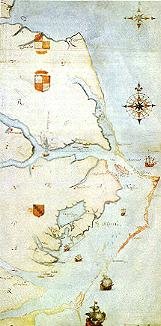
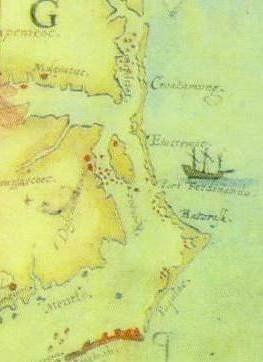
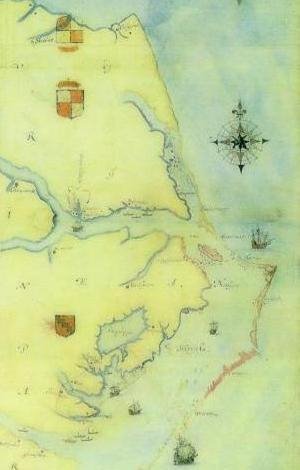
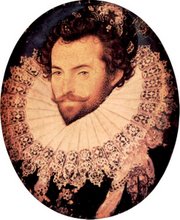
In 1587, a group of colonists under Sir Walter Raleigh's charter landed in the Outer Banks of what is now North Carolina. This was the second or third group of colonists in the area. One group had returned to England with Sir Francis Drake. The latter group was headed by Governor John White. White returned to England to re-supply the colony; his voyage back to America was delayed by the complications of the English war with Spain and the winter weather. When White did return in 1590, the colonist were gone, but strange "clues" were found. The word "Croatan" was found carved in the wall of a structure that had been built by the colonists. The colonists were never found.

In the early 1700's, Scots-Irish settlers came upon English-speaking people in the interior of southeastern North Carolina. These people appeared to be of mixed race. It is said that in the early censuses, these people were enumerated as "mulattoes" or "free Negroes." The people themselves claimed to be Indians. They waged a legal and political struggle in t he nineteenth century for recognition as Indians.


http://geneablogie.blogspot.com/2007/10/can-dna-solve-lumbee-problem.html