Pages

Showing posts with label lost colony. Show all posts

Monday, June 5, 2017

If a Tree Fell on the Eastern Shore and No One Heard it, Would there Still Be Artifacts?


EASTERN SHORE
It started with an uprooted tree in the yard, which left a big hole, which opened a window into the past.
Colonial-era clay pipes and pottery pieces. Hand-forged nails and odd yellow-ish bricks. Tiny coins – one of the oldest types of farthing. And jetons – brass tokens once used for accounting that have rarely been found in this country.
It wasn’t the first time scientists had descended on Eyreville. In 2005, an international geology team spent months on the property, coring more than a mile deep into a 56-mile-wide underground crater that was blasted by a meteor 35 million years ago.
On that deep-time calendar, the 400-year-old artifacts in the yard were left there, like, yesterday.
But in U.S. history terms, that’s significant. The so-called Contact Period spanned 1520 to 1620, the dawn of European settlement here. Rare stuff.
The jetons? They match others excavated from the oldest parts of the 1607 fort at Jamestown and at Roanoke Island, the last known location of what became the Lost Colony.
Cont. here:
This blog is © History Chasers
Click here to view all recent Lost Colony Research Group Blog posts

Monday, June 20, 2016

Archaeologists find pieces of a small medicine jar that are linked to the Lost Colony


MANTEO, N.C.
Archaeologists have found pottery pieces that could have been part of a jar belonging to a medicine maker of the Roanoke voyages, and even a member of the lost colony.

The two quarter-sized fragments, colored blue, white and brown, were buried in the soil two feet below the surface not far from The Lost Colony theater ticket house. An earthen mound believed to be a fort from the period lies 75 yards from the discovery site.

“It was an exciting find,” said Eric Deetz, an archaeologist with the First Colony Foundation who was part of the dig earlier this month. “That pottery had something to do with the Elizabethan presence on that island.”

The ointment or medicine jar would have been 3 inches tall and 1.5 inches in diameter, Deetz said. He called it the most significant piece of pottery found in the area since the 1940s.

Continued here:

http://tinyurl.com/zfporpt


This blog is © History Chasers
Click here to view all recent Lost Colony Research Group Blog posts
Bookmark and Share

Sunday, January 15, 2012

Jamestown and Lost Colony Surnames


What's in a Name??

 Roberta Estes

Recently we were able to obtain the records of the Jamestown colonists who share surnames with the Lost Colonists thanks to a contribution from a benefactor.  
The records have been extracted, by surname.  Historic Jamestown has done a superb job of researching their colonists and what information is known about every known Jamestown colonist up through about 1625 is provided on their site for a nominal fee.  You can see all of the biographies by surname at the site. 
 

The information has been incorporated on our website under the appropriate surname.  To view the results, click on this link to go to our website, then click on "surname research", then on the surname you are interested in viewing.  Then click on the Jamestown link.

The following Lost Colony surnames are also represented at Jamestown:

·       Archer (Archard perhaps)
·       Brooke(s)
·       Brown(e)
·       Cooper by variant spellings
·       Ellis
·       Flory/Flower
·       Johnson
·       Kendall
·       Martin
·       Nichols
·       Powell
·       Russell
·       Scott
·       Smith
·       Stephens/Stevens
·       Taverner
·       White
·       Wilkinson
·       Williams
·       Wotton
·       Yonge/Young

Several of these names have several Jamestown colonists.  There are 100 different records in total, so take a look and see if there is anything for one of your surnames.


This blog is © History Chasers
Click here to view all recent Lost Colony Research Group Blog posts
Bookmark and Share

Saturday, January 7, 2012

Hatteras Dig Reveals Old and New World Artifacts pt. 2

Continued from yesterday: These artifacts discovered last spring on Hatteras Island are very important because this midden contained European and Native American artifacts in close proximity to each other, proving there was contact between the two cultures at this time. Imagine a midden in which not only were Indian artifacts found, but also a clay pipe and a thimble.


                                                    Photos property of Roberta Estes©


This blog is © History Chasers
Click here to view all recent Lost Colony Research Group Blog posts
Bookmark and Share

Wednesday, November 16, 2011

Who Said?

 Who said?


"The most challenging job in show business I ever had was: The Lost Colony, an outdoor drama in North Carolina. No matter how hot it got, we still painted our entire bodies like Native Americans and danced in sand. However,  I wouldn’t trade that experience for anything."

V


V


V


V


V


V

V


V


V


V


V


V

Give up?

Adam Perry.


http://www.thebroadwayblog.com/2011/11/16/3360-theater-buff-adam-perry-of-anything-goes-and-more


This blog is © History Chasers
Click here to view all recent Lost Colony Research Group Blog posts
Bookmark and Share

Sunday, August 14, 2011

Tyrrell County Genealogical and Historical Society MEETING CANCELLED

This meeting has been cancelled due the approach of Hurricane Irene. This post will remain in place for your information. See:

http://the-lost-colony.blogspot.com/2011/08/tyrrell-county-genealogical-and_23.html
Tyrrell County Genealogical and
Historical Society
August 2011 Meeting
The Tyrrell County Genealogical and Historical Society will hold its August meeting on 28 Aug 2011 at the Senior Citizens Center located in the Columbia Medical Center. The address is 406 Bridge Street, Columbia, NC 27925. (Directions are included at the end of this article.)

Jennifer Sheppard, a Professional Genealogist with the Lost Colony Research Group, Genealogy~DNA~Archealogy will be the guest speaker.  Ms Sheppard will talk about the Lost Colony Research Group’s ongoing search for descendants of the so called “Lost Colony”. She will share information about the group’s research, DNA testing and the archaeology digs taking place on Hatteras Island. A DVD of the April 2010 dig in Buxton  will also be shown. In addition she will have conch shells (found in one of the middens) on display at the meeting.   

The DVD includes interviews with Roberta Estes, Administrator for the Lost Colony Research Group showing the types of artifacts found during that particular dig. Also included is a spot with Anne Poole, Principal Researcher for the Group, explaining native middens, their content; and information on how the Indians would have used these items in their daily lives.  

The public is cordially invited to attend this meeting and all “drop-ins” are welcome. 

Directions to the Tyrrell County Genealogical and Historical Society’s meeting
-

Take Route 64 to Columbia.  At the stoplight, turn left onto Broad Street (if coming from the Outer Banks, you would turn right). Continue on past Main Street, to Bridge Street and turn right onto Bridge Street. (406 Bridge St., Columbia, NC 27925). Then turn left into the parking lot - this is the Columbia Medical Center Complex.  Please Note: the parking lot is one-way.

For more information about the Lost Colony Research group, please visit
www.lostcolonyresearch.org.


This blog is © History Chasers
Click here to view all recent Lost Colony Research Group Blog posts
Bookmark and Share

Tuesday, July 26, 2011

Save the Date: Virginia Dare's Birthday Celebration

 by Roberta Estes


You're Invited  to  Virginia Dare's Birthday Party
August 18th


Once again, we're celebrating the birthday of little Virginia Dare, born on Roanoke Island on August 18th, 1587, the first European child to be born in what is now America.  Virginia is 424 years old this year!

Every year, the National Park Service hosts a birthday party and celebration for Virginia at the Fort Raleigh National Historic site.  This includes the Park area near the Waterside Theater where the plays are held and the Fort area as well as the Elizabethan Gardens, located nearby but separately.  In the past, we've been near the Waterside Theater, but this year, we're in a new location at the Elizabethan Gardens.  

Now for the great news - entrance to the Elizabethan Gardens is free that day in celebration of Virginia's birthday.

Dawn Taylor and Baylus Brooks will be representing our group.  They will have the list of colonists, info about our projects, and some of the archaeological artifacts found in recent digs on Hatteras Island.  

The Faire includes free activities, music, games and fun for all.  Actors from the play mingle with the crown, in costume of course, during the day.  Be sure to stay for the special play in the evening.  Awards are presented to cast members and a real baby Virginia Dare is included in the case, just for this one special evening.  This is truely an event to remember.

Baylus and Dawn are looking forward to meeting and greeting people.  Hopefully you can be one of them.  We welcome any of our members not just as visitors, but as volunteers as well.  If you're coming to visit and can spend an hour or two, plan on joining Dawn and Baylus at the table.  Just let us know so we're expecting you.  

The address for the Elizabethan Gardens is 1411 National Park Drive, Manteo, NC and we'll be there from about 9 to about 3.


This blog is © History Chasers
Click here to view all recent Lost Colony Research Group Blog posts
Bookmark and Share

Friday, July 15, 2011

Anne Poole ~ Lost Colony Genealogy and DNA Research Group

Anne Poole ~ Lost Colony Genealogy and DNA Research Group
There are few people out there, who have found their calling. Anne Poole, who hails from our own home state of North Carolina, never really went searching for hers. Instead it was dropped right in her lap at a very tender and early age. And I for one, am so glad it was. She and a team of dedicated volunteer researchers, are one a mission to solve one of America’s oldest mysteries. And the answer, may not be any further than your own back yard.
Anne, has become a dear friend of mine. She reminds me of a strong southern woman, who walked right off the pages of one’s favorite book. Recently, I came up with the idea of she and I sitting down for a blog chat. Least that is what I’m going to call it. Here goes…
Q: Anne…I know you are from North Carolina. But where exactly were you born and raised ?
A: I hail from right here in Durham !
Q: Now I know you have two daughters. And recently, we found out that I have a Hatteras/Ocracoke
family tie to both. Would you mind telling everyone a little about their Outer Banks bloodline ?
A: Sure. Susan and Elizabeth have their OBX connections from their great grandmother, who was a Dailey and was born on Ocracoke Island. She is on their daddy’s side. She also looked very, very, native with dark skin and gray eyes…..I used to say that her eyes looked like steel they were so gray !
 Cont. here:
http://hatgensoc.wordpress.com/2011/07/16/an-interview-with-anne-poole-co-founder-of-the-lost-colony-genealogy-and-dna-research-group/
This blog is © History Chasers
Click here to view all recent Lost Colony Research Group Blog posts
Bookmark and Share

Wednesday, July 13, 2011

Tuesday, July 12, 2011

Thursday, April 28, 2011

Andy's Tornado Terror

Andy was returning from his third visit to North Carolina, where he has been taking part in archaeological digs in his bid to find evidence of the first British settlements and prove the part played by people from Bideford in the founding of America.
All his visits have been strangely dogged by natural disasters, but this one ended in terror. “I really feel that this time I cheated death,” he said.
After two weeks of successful digs with Professor Mark Horton and students from Bristol University, Andy stayed behind an extra day to visit Bideford’s twin town of Manteo, where the Bideford Youth Pipe Band was performing.
Over the weekend the tornadoes struck.
“I was told they usually have around 20 tornadoes during April, but in two days they had 62,” he said.
“Three people died within a mile of the local airport from where my journey home began. We set off in a twin turbo-prop plane with 58 passengers. The 35 minute flight to the main Newark Airport for the flight home took us two hours. We flew straight into the storm over Newark. We were told to strap ourselves in and hold on to everything that was dear. Our descent was at a 45 degree angle as we tried to get down and beat the storm. There was zero visibility, lighting was flashing and 70mph cross-winds were reported. My 16 stone frame was lifted from the seat, despite being strapped in.
Cont. here:

This blog is © History Chasers
Click here to view all recent Lost Colony Research Group Blog posts
Bookmark and Share

Thursday, April 14, 2011

Processing Artifacts

 by Roberta Estes


Most people think of an archaeological dig as the actual digging.  That’s the Indiana-Jones-esque exciting part.  After that, most people don’t think much about what happens – but in reality, that is only the beginning of the process.
 
I’d like to take you along with me on a typical day of processing artifacts – and of course along the way, you’ll be able to see some of what was found during this dig.
 
At the dig site, when something is found either directly by digging or in the sifting process, it is put in a specimen bag and labeled as to the trench number, the level and sometimes other pertinent information. 
 
At the end of the day, those bags, and you hope there ARE bags, are taken back to the headquarters, wherever that may be, do be processed.  In our case, you saw in earlier blogs that we had rented a house and the processing takes place there.  Fortunately, they have a nice deck out back, so we can use the deck in the washing and drying phase of artifact processing.
 

Generally, the bags are full of artifacts and a lot of dirt.  They often just look like mud pies.  Back at the house, we remove the artifacts and try to determine whether they are metal, shell, bone or pottery.  Different artifacts are processed differently.

Old shell sometimes disintegrates in water, so the shell has to be evaluated as to it’s condition before processing.
 
Bone can be fairly stable, or very crumbly. It too had to be evaluated.  Generally, when we can, we wash bone very gently and use a toothbrush to clean any crevices.  Pottery and glass are very washable.  Iron can’t be immersed in water, so it is dry brushed.  Below, Alex, one of our lovely students (in the orange shirt) is dry brushing an iron lock and I’m cleaning a piece of a hand blown wine bottle.


Another piece of the wine bottle is shown below.  Notice the very uneven rim.  Can’t you just see this touching Blackbeard’s lips?
 
 
When we dump the contents of the bag out, it is generally a muddy mess.  This pile is actually relatively clean.  In some cases, you can barely tell there is anything except dirt, mud and sand.

After the artifacts are cleaned with water and a soft brush, we place them in drying trays on newspaper along with their artifact bag to dry outside in the sun on the porch. 
 

  After they dry, they are brought back in to the processing table where they are identified, dated, if possible, logged as to how many, the size of the artifact, where it was found and sometimes they are drawn or photographed, or both.

  
In the photo above, Dr. Mark Horton is seated in the center identifying the objects.  Two students are working with him.  The student to the left is logging the items into a log book.  This log book plus measurements, photographs and other data will be combined into a report that fully documents the dig, called a field report.  Of course, after the team returns to Bristol, they will be studying the data to more fully understand this homestead we have found.


Editor's note: click on the images twice to open them up to their full size. 

This blog is © History Chasers
Click here to view all recent Lost Colony Research Group Blog posts
Bookmark and Share

Wednesday, April 13, 2011

Jasmine, Sweet Jasmine

by Roberta Estes

One thing I love about new places is their flora and fauna, especially when it’s blooming.  Yesterday, while walking near a dig pit, I noticed several yellow flowers on the ground.  This was in a forested area.  There were no yellow flowers nearby, so I looked around and finally, up, to find a canopy of Jasmine overhead.
 
Its sweet smell was also wafting through the forest, an unexpected delight.  In Michigan, we don’t have climbing flowering vines, except for trumpet vine, so Jasmine was something I had never experienced before.  Jasmine climbs to the top of the highest trees and then flowers at the very top in the sun.  This makes it rather difficult to photograph.  However, I found a tree with a decent “view” to the top, as this area is rather canopied, and took a few photos that I’d love to share with you.


Editor's note:
These photos can be viewed at high resolution by clicking on the image, then clicking again on the resultant image. Enjoy!

This blog is © History Chasers
Click here to view all recent Lost Colony Research Group Blog posts
Bookmark and Share

Saturday, April 9, 2011

Under the House

by Roberta Estes
 
Have you ever eaten under a house?  No, really….a picnic maybe?  Well, you haven’t lived until you have.  In Hatteras, many houses are on stilts, and under the house becomes a living or a storage area – well – at least until the next flood.  Anything left under the house just gets washed away.
 
In our case, we rented a house for a group of individuals and we have to feed about 25 folks 3 meals per day.  Our lovely pirate, George, cooks for us.  Blackbeard beware – you have serious competition…
  
 
Here’s the pirates lair – under the house.  


Only on Hatteras will you find a pirate that cooks for you, and has his lair under the house!  Truly a unique  Outer Banks experience.


This blog is © History Chasers
Click here to view all recent Lost Colony Research Group Blog posts
Bookmark and Share

Monday, April 4, 2011

Jonas Squires

by Roberta Estes
While sometimes records are sparse, there are often clues held within records that convey more than the actual words.  Let’s take a look at the Jonas Squires records and see what we can determine.
According to the research records of Jonas Squires descendant, we first find Jonas Squires, planter, purchasing land, 88 acres on “Matchapongo Swamp” in 1732, adjacent to William Barrows, land first surveyed for Francis Gurganus.  In 1741, Jonas witnessed a will for Cornelius Collier.  In 1738, Jonas Squires, also again called “planter”, purchased land and in 1750 he trades his original 88 acres. In this document, Jonas signs his name.  Jonas is shown on the 1743 and 1744 tithable tax lists and is not noted as a person of color.  By 1765, Jonas was dead because his son, Appleton, conveys his land to his other son, Eyaberton.
Aside from what these records say directly, there is a great deal more information just beneath the surname.
First, this man had money to purchase land.  This was not a land grant.  Secondly, Jonas witnessed a will.  A man of mixed race would never have been called up on to witness a will for a white man.  Third, Jonas is referenced as a “planter”, twice, a term associated with the aristocracy of rather well-to-do farmers.  Fourth, Jonas is on the tithable list.  Indians holding Indian lands did not have to pay taxes on their land.  Jonas is not listed as a “person of color”.  Fifth, and perhaps most telling, Jonas knew how to sign his name.  Native people and people of “mixed blood” in this era never knew how to sign their name and they always signed with a mark. 
For the past several years, the Lost Colony Research group has been compiling all records relating to various surnames of interest in Eastern NC.  In this case, the first mention we find of the Squires surname is in 1728 in a 450 acre land patent on “the west side of the NW river of Cape Fear at the place where Samuel Swann and Mr. Squires were building a saw mill, joining Ephraim Vernon, Levingston's Creek to the mouth and the said river.”  While this record does not give “Mr. Squires” first name, we know from this reference that he was a respected man, as only men of relatively high social stature were references as Mr. or Esquire or even as a planter.  This record certainly implies that this man was white.  An Indian would never have been referred to as “Mr.”. 
However, there certainly were Indians living in this area who had adopted the surname of Squires.  The first record of these men is found in a 1731 deed that was not recorded until 1737 that says “John Squires, King of Aromallsket (sic) Indians with advice and consent of John Mackey and Long Tom to William Spencer Jr. all of Currituck County, 20 pounds, land on North side of old Aromattskeet Creek called Table of Pine Creek, 140 acres, total cost of 180 pounds, rest to be paid later. 
This man was definitely Indian, as he was stated to be such.  John Squires could not sign his name.
This begs the question of just how John Squires, the Mattamuskeet Indian, obtained his Squires surname.  It’s well know that Native people often adopted surname of those they knew or respected or with whom they were establishing “fictive kinship relationships”.  For example, one of the Mattamuskeet in a 1738 Mattamuskeet Indian land transaction was Charles Eden, an Indian who had adopted the same name as the Governor of NC. 
We know that in 1728 there is a successful white man by the surname of Squires on the Cape Fear River.  We know that in 1732, Jonas Squires, who appears to be white, is purchasing land on the Mattchepungo Swamp and in 1731 a deed which was not filed until 1737 (assuming the 1731 or 1737 is not mis-transcribed) conveys land from the Indian John Squires, also living at Mattamuskeet, stated variously in different deeds as the King of the Aromuskeet and Mattamsukeet, by different spellings.  John Squires, the Indian, could not spell his name and signed with a mark.
Perhaps the Native Squires gentlemen took the surname of Jonas Squires, or Mr. Squires from the 1728 transaction.
Taking a look at the Lost Colony Y-line DNA project, we have four descendants of Jonas Squires and all four individuals match.  His haplogroup is definitely European, although it’s not unusual to find Native men who were (or their ancestors were) sired by European men, often traders.  In this case, Jonas appears to be white based on the historical records and the DNA confirms that this line is genetically European.  Now of course, we need the DNA from one of the Native Squires men for comparison.


This blog is © History Chasers
Click here to view all recent Lost Colony Research Group Blog posts
Bookmark and Share

Sunday, April 3, 2011

Back on the Road Again

by Roberta Estes

 For the past several years, the Lost Colony Research Group has sponsored and coordinated an archaeological dig on Hatteras Island.  This April marks our fourth dig in cooperation with the University of Bristol and we welcome you to blog along with us on our journey.
Today was arrival day for most of the crew.  Several from our group are present at this dig.  Not everyone is arriving at the same time.  Anne Poole has been here on the island for several days already setting up and getting ready, along with Cousin George.  Bless Cousin George, he cooks for us all for 2 weeks on the “gypsy wagon”.  Nancy Frey, our British genealogist who lives in Canada arrived yesterday as well.
Louisa, our graduate student from the University of Bristol has also been here for several days preparing as well.  She also worked last December on getting ready for this spring’s dig.  Coordinating an effort of this size is nothing trivial.  Yesterday evening through about 3AM this morning, the rest of the Bristol crew arrived on several flights.  Altogether, it was a 25 hour trip for them.  Canceled flights and other misadventures plagued them, but eventually they did all arrive safely.  This morning was the “things that go bite in the day” lecture.  We discovered last year that British students aren’t familiar with the wildlife here that Hatteras Islanders take for granted.  You know, things such as snakes, ticks and alligators.
And then, the dig began. 
But I hadn’t arrived yet.  I was still in the death grip of Old Man Winter – or at least still struggling to escape him.  I awoke this morning in Beckley, Va. to discover there was SNOW on the vehicles.  Now it was bad enough for me, but folks there believe that spring has already arrived, and there were couple on motorcycles.  They had a very cold ride.
I put off my departure by going to Tamarack to see what new and wonderful artisan creations they had, and I was not disappointed.  They had ample new goodies to keep me interested for a long time.  I’ll probably stop on the way back to purchase.  Unfortunately, it is Saturday, and their quilter in residence, Elaine Bliss was not in today.  I always enjoy visiting with Elaine.
By 10 AM, I had hoped the snow would have melted off, but it had not.  I decided I really needed to go ahead and leave as I had a 9 hour drive in front of me and I really did not want to navigate Highway 12 on Hatteras Island at night.  I don’t know….it’s just something about the sea covering the road that I find disconcerting…..
I headed South, after taking note of a very confused goose who was standing in the grassy area of the cloverleaf, wondering to himself where he took a wrong turn, as snow and sleet pelted him.  Not only had the snow not melted, it got WORSE and turned into a blizzard.  By the time I got to Flat Top, which seemed to be the highest elevation while crossing the Appalachian Mountains, there was a significant amount of snow covering everything.  Dawn, who lives on Hatteras Island, pleaded with me to pull over and make a snowball, put it in the cooler and bring it to her.  She tells me they don’t get snow on Hatteras.  Had I been able to find a place to pull off to take a photo, I would have also gotten her snowball….but that didn’t happen.
By the time I was descending the mountain on the other side of the two tunnels, the snow had stopped and I wondered where the smoke was coming from.  Shortly, I discovered it wasn’t smoke, but was fog, drifting through the valleys.  Fog was followed by very high winds that caused people to fight for control of their vehicles, then rain, then brilliant sunshine by Winston-Salem and 64 degrees, then overcast by Raleigh and raining off and on between there and Hatteras Island.  I have experienced a years worth of weather in just under 12 hours.
I have also discovered that the reason hotels are only open here in the spring, summer and fall is because they do not have heat.  Suffice it to say that I’m glad I have long underwear with me and two quilts from my car.  If I get any colder, I’ll also be sleeping in my down vest….but I digress.
North Carolina never disappoints me.  The beauty and diversity here found in nature and the nature of the people are truly unparalleled elsewhere.  One of today’s finds was a house on State road 98 near Rocky Mount that was almost complete covered by wisteria.  This reminded me of a forest type of ginger bread house found only fairy tales.  Wonderful fodder for a fertile imagination….

 
Then, in Manteo, I found the most remarkable pink pick-up truck.  I didn’t realize that trucks came in this color of pink.  I think this must be hibiscus pink.  It was parked outside another colorful feature of the island that I’ve talked about during every trip, Kitty Hawk Kites.  Truly a colorful scene, and one to be found only on the Outer Banks of North Carolina.  


 Welcome home!


This blog is © History Chasers
Click here to view all recent Lost Colony Research Group Blog posts
Bookmark and Share

Saturday, February 12, 2011

Grenville and the Lost Colony of Roanoke is now shipping

Andrew Thomas Powell will be in the states visiting in April. He will be speaking at the Hatteras Island Genealogy Society Meeting in Avon (on Hatteras Island) on April the 12th, along with yours truly. If you purchase one of his books, bring it with you and he'll gladly sign it for you. So you'll have a signed first edition book!! I've read it and it's wonderful. It was Andy's fault that I stayed a wake way, way too late for a couple of nights in a row. I just could not put it down.

Roberta Estes


This blog is © History Chasers
Click here to view all recent Lost Colony Research Group Blog posts
Bookmark and Share

Tuesday, November 2, 2010

Lively Session in Geographic DNA Projects led by Roberta Estes at DNA Conference

 Roberta Estes,  Lost Colony of Roanoke and Cumberland Gap Administrator, demonstrates a "hands on" approach as she leads the session on Geographic DNA Projects during the break out session where attendees could select a session in their own interest.


This blog is © History Chasers
Click here to view all recent Lost Colony Research Group Blog posts
Bookmark and Share

The Lost Colony may now be found


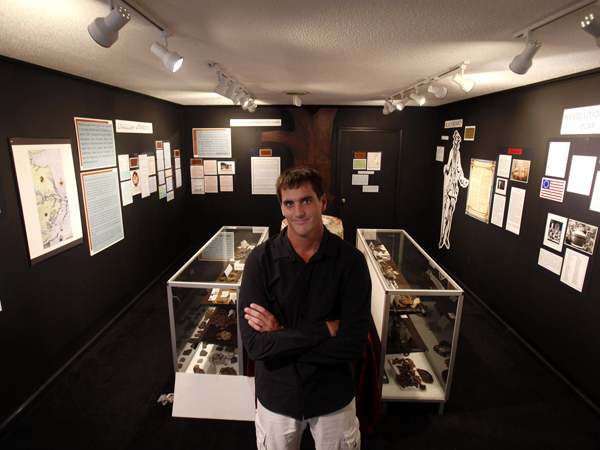
It’s a typical day at the Hatteras Histories and Mysteries Museum in Buxton, N.C., and Scott Dawson is buzzing around glass cases full of centuries-old arrowheads and broken pottery. Puzzled visitors listen as he explains for the gazillionth time the difference between fact and speculation. • He speaks with certainty in a voice tinged with more than a hint of frustration. • “Anybody who researches it knows that the colony came down here,” he says, confidently dismissing competing theories on America’s oldest unsolved mystery. • The artifacts, many unearthed during archaeological digs in the past year, may hold the clues that finally answer the question: What happened to the Lost Colony, a group of 117 Englishmen who settled on a tiny island off the North Carolina coast and then vanished with barely a trace?

Hatteras Island native Scott Dawson stands in his Hatteras Histories and Mysteries Museum, which he opened in Buxton after the April dig. (L. Todd Spencer | The Virginian-Pilot)
The 32-year-old Dawson has a personal stake in what happened to the early settlers. The son of a family whose roots can be traced back to the Croatoan Indians, he thinks his ancestors have been falsely maligned by the legends that have grown up around the case of the missing Englishmen.
“The two drops of Croatoan blood that I have have boiled over,” he said. “I want the history of this tribe and this island to stop being ignored.”
He’s counting on science to help him set the record straight.

It was 1587 when the group now known as the Lost Colony sailed across the Atlantic Ocean to the New World on an adventure that ultimately fell far short of its intended purpose.
European explorers had been making the journey for years, and the first English contact with Native Americans on the Outer Banks is credited to a military expedition in 1584. Similar expeditions followed in 1585 and 1586.
The next year – 20 years before Jamestown was founded and 33 before the pilgrims landed at Plymouth Rock – Sir Walter Raleigh dispatched the group of men, women and children in his bid to establish the first permanent English stronghold in America.
The colonists intended to settle near the Chesapeake Bay, but when their captain refused to sail farther north, they were forced to make a temporary home on Roanoke Island, where they’d planned to pick up 15 men left there the year before.
All they found were bones.
Less than a week after arriving, one colonist was killed, presumably by Indians.
In a desperate attempt to save the struggling colony, which included his newborn granddaughter Virginia Dare, Gov. John White and some colonists sailed back to England for help. White’s begging would go unheeded for three years.
With their leader gone and surrounded by strangers, the colonists lived out their final days. Nothing is known about what happened to them after White left.
Today, their legend lives on at the Fort Raleigh National Historic Site on Roanoke Island, where they were last seen by a white man. There, at Waterside Theater, an outdoor symphonic drama mixes fact with romantic speculation about the colony’s fate.
White returned in 1590, only to find the entire group gone. But they’d left behind one clue that continues to haunt modern-day historians and amateur sleuths: the word “Croatoan” carved into a tree.

Cont. here:


http://hamptonroads.com/2010/10/lost-colony-may-now-be-found


This blog is © History Chasers
Click here to view all recent Lost Colony Research Group Blog posts
Bookmark and Share

Tuesday, October 5, 2010

Lost Colony Drama's "Eleanor Dare" Speaks in Manteo

Photo courtesy Lost ColonyMarjalene Thomas, and long time Elizabeth City educator and actor will speak today at 10:30 a.m. at Bob-BQ's to the Museum Guild. Thomas played Eleanor Dare in
Photo courtesy Lost Colony 

Marjalene Thomas, and long time Elizabeth City educator and actor will speak today at 10:30 a.m. at Bob-BQ's to the Museum Guild. Thomas played Eleanor Dare in "The Lost Colony" for seven seasons. She had performed in the drama in one part or another since its second season in 1938.
Albemarle Players alum returns home
By Robert Kelly - Goss
Marjalene Thomas remembers the good old days. Oh, these days life is good too, but Thomas, a long-time area educator and actor, recalls with fondness when she was involved with Encore Theatre’s precursor, Albemarle Players.
“This area has been so strong in the arts and that is one reason my whole family just loved it,” said Thomas from her home in Manteo this week.
Thomas, 83, will be in Elizabeth City today to speak to the Museum Guild about her days with the Albemarle Players and share photographic memories. Friend and fellow Albemarle Players member Nancy Ferebee says the many productions put on by the players were great fun and says Thomas was instrumental in making those plays exciting, quality entertainment for the area.
“One reason we moved to Elizabeth City from Burlington, N.C. was because it was so active in the arts and had a good school system and was close to the Outer Banks where we had a summer home,” said Thomas.
That was in 1958.

cont.

http://www.google.com/url?sa=X&q=http://www.dailyadvance.com/features/albemarle-players-alum-returns-home-144364&ct=ga&cad=:s7:f1:v0:d1:i0:lt:e0:p0:t1286314656:&cd=8uqiemNHhyA&usg=AFQjCNFW7Qv7T69M-2E9csTBLNJwfpMAGA


This blog is © History Chasers
Click here to view all recent Lost Colony Research Group Blog posts
Bookmark and Share