Pages

Showing posts with label native americans. Show all posts

Saturday, September 12, 2009

Cherokee Revealed - Translated Moravian records disclose a forgotten history

Hat Tip: Laree

Cherokee Revealed - Translated Moravian records disclose a forgotten history

CHURCH MISSIONS: 19TH-CENTURY DOCUMENTS

Courtesy of Moravian Archives, Bethlehem, PA.

This map showing the settlements of the Cherokee Nation was drawn by Moravian missionary John Daniel Hammerer and is dated to 1766.

Published: September 8, 2009

In front of the house stands a long, open shed covered with clapboards adequately provided with benches and other seats, as well as a raised plank for writing on. The Talk was held under this shed. At a short distance from this stands a tall pole. A designated Indian took his position at this pole with a drum, and beat the drum as a sign of the beginning of the meeting. He kept drumming until Indians were seen coming in lines. In the heat, the Indians used turkey wings in stead of fans to make a breeze for themselves. -- Report from Abraham Steiner, a Moravian missionary to the Cherokee at Springplace, Ga., May 22, 1801, translated from the German.

This glimpse into the shared history of Moravians and Cherokees was shrouded in archaic German script for over 200 years at the Moravian Archives in Winston-Salem.

The words were found among hundreds of diaries, letters and other papers that recorded about 100 years of history between the Moravian missionaries and their Cherokee brethren. The records constitute the only known account of daily life in the Cherokee nation.

In 1992, workers began to translate and transcribe the documents. But money grew tight and work slowed on the project because the staff had to consider prioritizing other projects and possibly cutting back hours or staff, said Daniel Crews, the archivist of the Moravian Church, Southern Province.

Then earlier this year, members of the Cherokee Nation made a $125,000 grant, to be paid over five years, to translate and transcribe the documents. The archives have committed two archivists to work on the collection two days a week for the next five years, Crews said, with the hope of publishing their findings in a series of books after the work is complete.

The Cherokee Nation is made up of those people descended from ancestors who survived the Trail of Tears, the removal of the Cherokee in 1838 from the Eastern United States to the Indian Territory, which is now Oklahoma.

The Eastern Band, the Cherokee whose ancestors went into the mountains rather than accept removal, have also agreed to help pay for the project, Crews said, but have not announced how much they will donate.

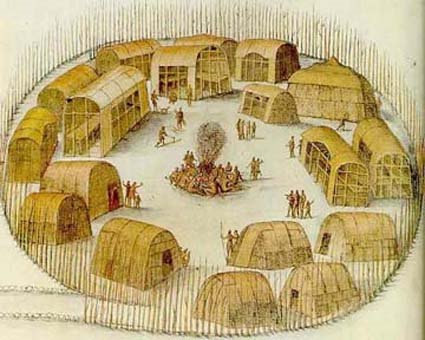
The records contain details about what the Cherokee ate, how they built their villages, and the way they danced and dressed.

Jack Baker, a member of the Cherokee Nation tribal council, said that such information is available nowhere else.

Cont. here:

http://www2.journalnow.com/content/2009/sep/08/cherokee-revealed-translated-moravian-records-disc/news/


© History Chasers

Click here to view all recent Searching for the Lost Colony DNA Blog posts

Bookmark and Share

Sunday, June 28, 2009

Croatoan: Birthplace of America

Everything is Relative
By Jennifer Sheppard

Croatoan:
Birthplace of America

A compelling work by Scott Dawson who offers a definite plausible explanation of what happened to the 1587 colony of 117 men, women and children, that became known as The Lost Colony. Keep in mind the first time the colony was referred to as lost was when playwright, Paul Green, wrote the historical drama in 1937. Ask any native of the area and they will tell you they are descendants of the group known as the Lost Colony; therefore it was never lost.

It is difficult to classify this work as either fiction or non-fiction because it is a combination of both. A must read for anyone interested in the fate of the English men and women who landed on the shores of what is known today as the Outer Banks. Yes, 23 years before the ships landed in Jamestown, Virginia and 36 years before the Mayflower landed in Massachusetts, a group of people landed, on what are now, the shores of North Carolina, to establish a settlement.

This young author has woven a story around documented evidence of the actual events involving the 1584 -1587 voyages. He did a marvelous job of filling in the blanks, as he imagined it might have happened. And he makes a convincing point that the fate of the colony was perpetrated by sabotage and its abandonment by the sponsors rather than lost, as it has become known.

I met this author at a meeting of researchers, with whom I used to work. I am not easily impressed but I am impressed by Scott Dawson and his knowledge of the Outer Banks and commitment to his birth place, Croatoan (modern day Buxton which is located on Hatteras Island where he was born) and his willingness to shed new light on what has been considered the greatest unsolved mystery in North America.

This book includes pictures of various artifacts, uncovered during archeological digs in 2006. The gunlock (dated “to the 16th century, probably 1583 based on an identical one found in England”) discovered by Dr. David Phelps of East Carolina University, as well as the “gold signet ring that belonged to Master Kendall who was part of the 1585 voyage and who lived with 20 other English colonists in Croatoan for over a month in 1586”. Research groups are using genealogical, archaeological evidence, oral history and DNA to prove that there are descendants of “The Lost Colony” living in Eastern North Carolina today.

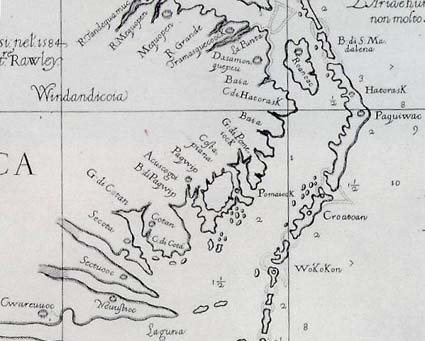
Other pictures include pipe fragments, a map of the Outer Banks with Native American villages and modern names, created by Scott Dawson, pieces of pottery “found during the Croatoan dig in 2006”, and pictures of the “1759 Croatoan land deed giving land to the Hatteras Indians and last but not least, a clipping from the Dare County Times showing a “photo of Lindy Miller after his discovery of a sword and other items in the same spot where the Croatoan village digs would occur 60 years later” as well as a list of Croatoan words and their modern day meanings.

I leave you with the following quote from Scott’s book.

“This colony was abandoned, not lost. The colonists wrote down where they were going and no one ever looked there! Everyone knew where Croatoan was back then just as we know now. That has never been a mystery”…….

Ordering information: Softcover, 5 ½ X 8 ½, 173 pgs, $14.95 plus $4.95 shipping. Happy Hunting! http://www.buybooksontheweb.com/product.aspx?ISBN=0-7414-5469-6


© History Chasers

Click here to view all recent Searching for the Lost Colony DNA Blog posts

Bookmark and Share

Friday, December 12, 2008

Archaeological Sites and Studies

ONLINE REPORTS & SUMMARIES OF NORTH CAROLINA

ARCHAEOLOGICAL SITES & STUDIES


North Carolina’s First Colonists: 12,000 Years Before Roanoke
Stephen R. Claggett
Office of State Archaeology
North Carolina State Historic Preservation Office

Four hundred years ago the English Roanoke colonists met numerous native inhabitants along the coast of what would become the state of North Carolina. Even earlier, during the 1540s, Spanish explorers under the leadership of Hernando de Soto “discovered” several Indian groups occupying the interior regions of the Carolinas. Today we know that the coastal Indians were part of a larger group occupying the entire mid-Atlantic coastal area, identifiable by a shared language and culture called Algonkian. The Native Americans whom de Soto met included Siouan, Iroquoian and Muskogean speakers, whose descendants are now recognized as the historic tribes of the Catawba, Cherokee and Creek Indians. Within a very short period of time—some 50 years—after those first contacts, the early European explorers of North Carolina had met, interacted with, and begun the process of significant cultural displacement of all the major native groups in the state.
What can we learn about those Indian groups from accounts of the earliest European explorers? Surviving chronicles from de Soto and the Roanoke colonists include many details of the land and its potential or imagined wealth. But with the notable exceptions of the John White paintings and Thomas Hariot’s writings, we possess surprisingly little knowledge about the early historic Indians who lived in our state. Tantalizing bits of information can be gleaned from the early series of exploration accounts, but when the actual diversity and complexities of “Indian” culture are considered, we must conclude that their description by explorers was incidental to those for geography, searches for treasure, or daily hardships of the first European explorers.
continue

Wednesday, May 14, 2008

Thousands of Citizens Denied Basic Rights in Virginia During the Twentieth Century

LOSS OF IDENTITY IN VIRGINIA

Walter Plecker's racist crusade against Virginia's Native Americans.
"Some of these mongrels, finding that they have been able to sneak in their birth certificates unchallenged as Indians, are now making a rush to register as white." -- W.A. Plecker


"By (Plecker's) standards, codified by the General Assembly in the 1924 Racial Integrity Act, one drop of Negro blood would cause a person to be categorized as black. That was designed to stop light-skinned people with black ansestry from "passing" as white people and thus avoiding the Jim Crow discrimination laws.


"Dr. Plecker sought to categorize many of the "Indians" in Virginia as black. He was forced to finesse the equivalent of one drop of Indian blood, however. Many of the so-called "First Families of Virginia" traced their ancestry back to the son of Pocahontas and John Rolfe, and were proud of their connection to what they considered to be Native American royalty."

Trying to locate documentation regarding Native Americans is very difficult. An outrageous example of this difficulty is the goings-on in Virginia in the early-to-mid 1900's, an era when the eugenics movement was in its heyday.

Plecker was the "vital records czar" for the state of Virginia during the era of the "one drop law." W.A. Plecker, acting as Virginia's first Registrar of Vital Statistics, was determined to designate all so-called Melungeons as other than white.

Michael Everette Bell, Ph.D. (Department of History, Virginia Commonwealth University, Richmond, Virginia, says:

"For a balanced examination of Plecker and his ideology, see the 'Richmond's History' article by Arthur Zilmence, Walter Ashby Plecker: A Contextual Evaluation."

Ron Welburn (rwelburn@english.umass.edu) says:

"One of the best discussions of what Plecker was doing is in Helen Rountree's POCAHANTAS' PEOPLE: THE POWHATAN INDIANS OVER FOUR CENTURIES; read the chapter, 'The Racial Integrity Fight.'"

Virginia's former registrar of the Bureau of Vital Statistics, Dr. Walter Ashby Plecker, a small-town doctor who became registrar of the state's Bureau of Vital Statistics in 1912, spent decades trying to deny the existence of Indians in Virginia. He believed there were no real native-born Indians in Virginia and anybody claiming to be Indian had a mix of black blood and, because in Virginia at that time one drop of African blood rendered an individual completely Aftican, Plecker thereby classified Indians as Blacks. Plecker ran the Bureau from 1912 to 1946.
The "ancestral registration" provisions of the law were strictly enforced by Plecker.
In 1925, he began a campaign to force the U.S. Census Bureau to report no Indians in Virginia in 1930. The Census Bureau conceded to mark Virginia Indians with a footnote: "Includes a number of persons whose classification as Indians has been questioned." Plecker believed that all Indians had 'polluted' their blood by mingling it with free African-Americans. Plecker thus saw those who claimed Indian ancestry as opportunists seeking what Helen Rountree called a 'way station to whiteness'--in other words, he saw all Indians as blacks attempting to 'pass.'"
Nonetheless, in 1930, the U.S. Census reported 779 Indians in Virginia, noting for the first time there were 59 Indians in Caroline County.

Plecker even issued in 1943 a list of surnames belonging to "mongel" or mixed-blood families suspected of having Negro ancestry who must not be allowed to pass as Indian or White.
Plecker's successor, Russell E. Booker Jr., termed Plecker's activities from 1912 to 1946 as "documentary genocide".

Plecker helped pass the 1924 Racial Integrity Act, a strict race classification and law which institutionalized the "one drop rule," under which any person, including Indians, who was believed to have "one drop" or more of "Negro blood" was designated as Black. A person with no "non-Caucasian blood" was classified as white, as well as persons who claimed 1/16th or less "Indian blood," which applied to those who had been proud of their so-called impurity: prominent white persons who claimed to be descended from Pocahantas. To be anything but white in Virginia meant exclusion from employment, education, and basic services. The aristocratic descendants of Pocahontas--resentful of being lumped in with "Negroes, Mongolians, American Indians, Malayans, or any mixtures thereof, or any other non-Caucasian strains" twisted arms until the legislature decreed that persons with no more than one-sixteenth Native American ancestry might still be considered white.

"As for those who 'mingled their blood' with African-Americans, they, too, would be absorbed--though they might not like the consequences. Let us consider the example of the Gingashins. This eastern tribe had two strikes against it: Its members refused to give up their traditional lifeways; even worse, they intermarried freely and unashamedly with blacks.

"This was anathema to Virginia elites. Intermarriage with whites could be, and was, tolerated. Intermarriage with blacks, however, was an intolerable challenge to the arbitrary color line that had been in place since the first chattel slavery law passed in 1661. Thus, in 1813, the Gingashins made their way into the history books, becoming the first U.S. tribe to be terminated.

"Needless to say, Gingashin identity did not die with the legal decree. As late as 1855, Rountree notes, county maps showed an "Indian Town," an Indiantown Creek, and a settlement of seven houses. Eventually, however, white antagonism, not to mention opportunism, forced the Gingashins to merge into a sympathetic African-American community. Tribes such as the Pamunkeys, Mattaponis, Upper Mattaponis, Nansemonds, Rappahannocks, and Chickahominies took note of the lesson--and learned how to resist.

"A century later, armed with the awesome power of the state, Plecker declared war on these people. Consulting a listing of surnames associated with Native American ancestry--such as Beverly (from beaver), Sparrow, Penn or Pinn, Fields, Bear, and so on--and drawing his authority from century-old census records that were likely to list Indians as "mulattoes"--particularly if the census were taken in summertime, Houck notes--Plecker embarked on a crusade to re-classify every Native American in the state as an African-American." ("Battles in Red, Black and White" http://xroads.virginia.edu/~CAP/POCA/POC_law.html)

Plecker changed and/or destroyed labels on vital records to classify Indians as "colored, mongrel, mulatto," investigated the pedigrees of racially "suspect" citizens, and provided information to block or annul interracial marriages with Whites. He not only did this to Indians, but other races as well.

Knowledge of this historical development is vitally necessary for those who are searching their Native heritage to understand why records in the Virginia Bureau of Vital Statistics are incorrect or missing.