Pages

Showing posts with label hawkins. Show all posts

Wednesday, May 13, 2009

Melungeon Conference and Celebration, June 12-13

Tennessee Events
Melungeon Conference and Celebration, June 12-13
The weekend of June 12-13 will feature two events focusing on the Melungeons, the multi-ethnic people that have been a part of Appalachia folklore for over generations, and the subject of scientific research for the last half-century. The Melungeon Historical Society will hold their first annual conference on Friday, June 12, in Rogersville, Tennessee, while the Vardy Community Historical Society holds their Spring Fling at their museum on Vardy Road in Hancock County, Tennessee.
History, genealogy, and the latest DNA technology will come together at the first annual Melungeon Historical Society conference o June 12. "For nearly two hundred years, writers and researchers have speculated about the origins of the Melungeons," says Wayne Winkler, president of MHS. "For the most part, the story of the Melungeons has been told through myths and legends. The Melungeon Historical Society believes that answers will be found through scholarly research."
The public is invited to this event, which will be held at the Hawkins County Rescue Squad meeting room, 955 East McKinney Avenue, Rogersville, Tennessee. Registration begins at 9:30 am, and the conference will run until about 8:30 pm, with lunch and dinner breaks.
Presentations at the MHS conference will begin at 10 a.m. and will cover topics such as the origin and historical uses of the term "Melungeon," DNA research on Melungeon families, and other topics related to the multi-ethnic people first documented in the Clinch River region in the early 19th century. The use of DNA technology in genealogy will be covered by Roberta Estes, founder of DNAExplain, a Michigan company that analyzes and interprets individual DNA tests.
Other presenters include Jack Goins, Hawkins County Archivist and author of Melungeons and Other Pioneer Families; Kathy Lyday-Lee, a professor at Elon University who taught a course on Melungeons; and Kathy James, who will present DNA information on the Gibson and Collins families.
"This conference is of special interest to those who want to learn more about the Melungeons," said Winkler, "but it is also designed to benefit anyone interested in genealogy and especially in the use of DNA technology to trace family lines." The conference is free, but donations are suggested to help promote the work of the Melungeon Historical Society.
On Saturday, June 13, the Vardy Historical Society will hold its Spring Fling from 10 am until 2 pm. The location is the Vardy Church Museum, which features displays from the Presbyterian mission which provide education opportunities for Melungeon children from 1899 to the early 1970s.
The Spring Fling features Appalachian crafts such as basket and chair weaving, apple butter making, corn grinding, shuck dolls, hominy making, a tractor show, and plenty of music.
For more information on the MHS conference, contact Winkler at 423.439.6441 or winklerw@etsu.edu. For information on the VCHS Spring Fling, contact Claude Collins at claudefreeda@aol.com or 423.733.2305.

Cont. here:
http://genevents.genwebsite.org/documents/3F5232DE471AF9D91304D1CE63F5CA9C74AC83FF.html

© History Chasers

Click here to view all recent Searching for the Lost Colony DNA Blog posts

Bookmark and Share

Monday, November 26, 2007

SIR FRANCIS DRAKE

Early Vistor to Roanoke


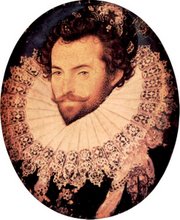
One of the illustrious figures of the sixteenth century to visit North Carolina was Sir Francis Drake, who came in June 1586. Like Sir Walter Ralegh, Drake was a Devon man. Born at Crowndale, near Tavistock, about 1543, he was the son of Edmund Drake, a sailor who became a yeoman farmer. In 1549 when the Roman Catholic peasants of the West Country rebelled against the new prayer book, the Drakes, who were Protestants, lost all their possessions and had to seek refuge first in Plymouth and later in Kent, where they lived aboard an old ship. There the elder Drake preached to the sailors. Because the family was persecuted for its religious beliefs under Mary Tudor, Francis grew up a staunch Protestant.

Beginning his career in 1566, at about age 23, Drake became an ocean sailor by joining his relative, John Hawkins, in the slave trade with the Spanish colonies in the New World. Stopped by a large Spanish force at San Juan de Ullua in 1568 Hawkins and Drake made an agreement with them but when it was to their advantage, the Spanish attacked. After the ensuing battle Drake hastily returned to Plymouth and was later accused by Hawkins of desertion. From these expeditions Drake learned much about ships and the Western Hemisphere, and he developed a great hatred for the Spanish. For the rest of his life he conducted a personal war against Spain.

Drake returned to the Caribbean in 1569, 1571, and 1572, and attacked Panama in the latter two voyages. In 1572 he was wounded while two of his brothers died in battle. When he returned to England, Queen Elizabeth had made peace with Spain and he had to go into hiding, possibly in Ireland, where he reappeared in 1575. At that time he announced that he was going to the Mediterranean to open up the spice trade in Alexandria, but his true plan was to circumnavigate the world. In 1581, after his return from this successful and profitable voyage, Queen Elizabeth knighted him.

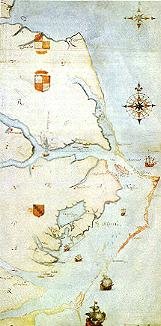
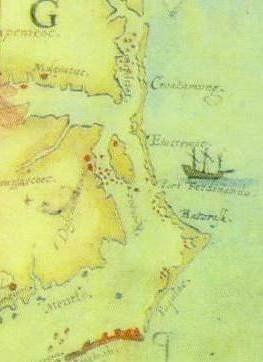
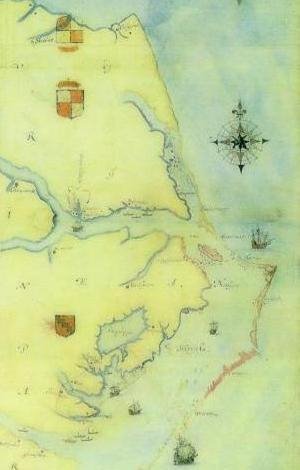
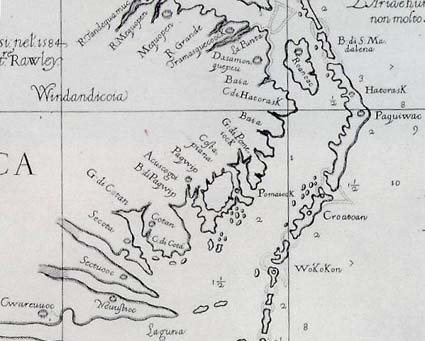
Relations with Spain continued to deteriorate, and in 1585 Drake returned to the West Indies. On Hispaniola he captured the supposedly impregnable city of Santo Domingo. Later in Columbia he captured Cartagena. By now with one-third of his men dead and many others unfit for service, Drake was unable to attack Havana. After sacking St. Augustine, he sailed up the coast to Roanoke Island where he arrived on 26 June 1586. There he visited Sir Walter Ralegh's colony headed by Ralph Lane, planted in 1585. He found a disheartened group of men. The once-friendly Indians were now hostile, and the supply ship was late. Drake offered Lane victuals for one month and a ship, the 40 tun Francis. He also agreed to take some of Lane's weaker men back to England and to replace them with his own men. A major storm, however, forced the Francis out to sea and caused a change in plans. Drake offered Lane a larger ship, the 170 tun Bark Bonner but it was too large to pass through the inlets. Instead Lane and his colonists decided to return to England with Drake.

This expedition did not make great profits for investors but it did inflict great damage on the Spanish Empire and led almost directly to the launching of the Armada that Philip II began to assemble. The Spanish planned to attack in 1587; but, learning of these plans, Drake attacked Cadiz and Lisbon, where he destroyed ships, and at Cape St. Vincent, where he burned barrel staves needed for casks for food and water. These actions delayed the Armada until 1588 and caused it to sail with unseasoned casks which leaked water and allowed food to spoil.

Full Article Here:

http://www.nps.gov/archive/fora/drake.htm