This is a great video about Bideford, England, connected to the Lost Colonists. They are trying to get funding for touristm and such.
Bideford has applied for a share of £1 Million of funding from the Portas Pilot scheme for towns struggling to make good in these dire economic times. The youtube video needs your vote of support. You can watch the video here, but afterward, please click through to YouTube on the link below the video and click "Like".
http://www.youtube.com/watch?feature=player_embedded&v=BQ5EdKrHtOQ#!
This blog is © History Chasers
Click here to view all recent Lost Colony Research Group Blog posts
Showing posts with label lost colonists. Show all posts
Showing posts with label lost colonists. Show all posts
Friday, March 30, 2012
Bideford's Portas Pilot

Sunday, July 24, 2011
From Roanoke to Hatteras: A Two-day Hunt for Clues to the Lost Colony
From Roanoke to Hatteras:
A Two-day Hunt for Clues to the Lost Colony
By Baylus C. Brooks

Baylus C. Brooks & Dawn F. Taylor in Roger & Celia Meekin’s Roanoke Island backyard on the Croatan Sound north of Manteo.
Doug was a terrific host, proudly guiding a tour through the temperature-controlled and oh-so-cool artifact storage area. Yes, the “cool” reference was literal! He showed his small audience the many artifacts found during the various excavations on Roanoke Island in the search for Sir Walter Raleigh’s elusive first colony in what is today, North Carolina.
Doug allowed LCRG researchers access to the maps and photos collections available in their archives collection. After the tour of the artifacts and a brief overview of the collections room, the researchers studied aerial photos from 1945-1958 revealing Hatteras island’s layout prior to the man-made structuring of Brigand’s Bay, purposeful terraforming of lakes and ponds on a significant scale, and even prior to the replacement of the island’s dirt roads with a comfortably-paved Highway 12, which opened the island to large scale development for the first time in 1952.
Many people contribute to LCRG. The primary focus of research for the group is to study Hatteras Island through standard genealogical analysis, including deed records (paired with Dare County GIS data), logs, diaries, wills, court records, and archaeology in an effort to understand the families who lived on the island and how they arrived there. Nancy Frey contributes her expertise on UK genealogy, a valuable asset for later DNA comparison. Ultimately, the group employs DNA analysis and genealogical data correlation (LCRG president, Roberta Estes’ expertise) of Hatteras Islanders to be compared to members of John White’s final “abandoned” (not exactly “lost”) colony of 1587 in order to determine whether or not native Hatteras Islanders today are the result of “blending” between White’s colonists and Algonquian inhabitants of then-called “Croatoan” Island, today’s Hatteras Island. Finally, LCRG employs archaeology (organized by Anne Poole and George Ray) to verify the physical existence of Croatoan villages and hopefully, to find actual evidence of the “Lost” Colony.

Doug demonstrates to Celia how the wooden artifact was used as a well by Roanoke’s 16th-century Elizabethan visitors. Photos: Dawn Taylor
All of this study is backed up by historical records and analysis provided by ECU Maritime Studies graduate student, Baylus C. Brooks and Andrew Thomas Powell, former mayor of Bideford, England and author of the recently-published Grenville and the Lost Colony of Roanoke. Other members of LCRG include our web-mistress Nelda Percival, blog administrator and librarian Janet Crain, blog and DNA project administrator Penny Ferguson, early English records researcher Joe Chandler, NC genealogist Jennifer Shepherd, Spanish researcher Dr. Ana Oquendo Pabon, specialty genealogist, Robert Noles, with the contributions of myriad others. Hopefully, the preponderance of data from these varied disciplines and analysis of LCRG’s many more devoted scholars and support staff will finally prove that White’s colony is still among our state’s citizenry today and that the colony was, after all, successful and not “lost” as previously supposed.

Doug demonstrates to Celia how the wooden artifact was used as a well by Roanoke’s 16th-century Elizabethan visitors. Photos: Dawn Taylor
All of this study is backed up by historical records and analysis provided by ECU Maritime Studies graduate student, Baylus C. Brooks and Andrew Thomas Powell, former mayor of Bideford, England and author of the recently-published Grenville and the Lost Colony of Roanoke. Other members of LCRG include our web-mistress Nelda Percival, blog administrator and librarian Janet Crain, blog and DNA project administrator Penny Ferguson, early English records researcher Joe Chandler, NC genealogist Jennifer Shepherd, Spanish researcher Dr. Ana Oquendo Pabon, specialty genealogist, Robert Noles, with the contributions of myriad others. Hopefully, the preponderance of data from these varied disciplines and analysis of LCRG’s many more devoted scholars and support staff will finally prove that White’s colony is still among our state’s citizenry today and that the colony was, after all, successful and not “lost” as previously supposed.
The pair of researchers stopped at Hatteras’ public library and also at the Graveyard of the Atlantic Museum in Hatteras Village for a visit with Clara Scarborough who guided them through the facility’s conservation and archives area in search of log books and local history. The conservation lab contained many artifacts from old wrecks, including the Corolla wreck, the oldest known to our coast and originally surveyed by ECU’s Maritime Studies Program before its transportation to the museum by cooperating agencies where it is to be conserved and displayed. The “Graveyard” Museum in Hatteras Village is one of three North Carolina Maritime Museums that also include Southport and Beaufort.
Two excellent days of research and study ended with the perfect dinner cooked by Dawn Taylor’s culinary couplet, her father Kenneth Dickerson and her cousin Edith Jennette Bradley. Perhaps the heat and humidity were made more bearable by the constant island breezes and the tropical atmosphere. Then again, maybe it was the food! Either way, a lot of work got done pleasantly despite the heat of this July’s summer swelter.

Dawn Taylor and Clara Scarborough at the “Graveyard of the Atlantic” Museum. Photo: Baylus Brooks
This blog is © History Chasers
Click here to view all recent Lost Colony Research Group Blog posts

Tuesday, July 27, 2010
"A Kingdom Strange"
by Janet Crain
It is important to remember that this little band of would be settlers carried an enormous weigh on their backs. They were the forerunners of the English colonies that became the United States. Had they been discovered they would have been murdered by the Spanish as the French Huguenots were in Florida. Had John White not have made it back to Ireland and later made an ill fated trip to Roanoke nothing would be known of the colonists.
Fortunately we do know a great deal and after more than 400 years more is being discovered.
Rob Hardy: "A Kingdom Strange"

July 27, 2010 9:42:00 AM
The Lost Colony of Roanoke was a failed initial effort of England to colonize America. It may have been a failure, but it continues to fascinate people; there is a famous outdoor stage production with music that attempts to dramatize the settlement at its site and a reconstructed fort.
The fascination isn't so much because of historic significance, but because the 117 settlers vanished without a trace. That is, almost without a trace. In "A Kingdom Strange: The Brief and Tragic History of the Lost Colony of Roanoke" (Basic Books), historian James Horn finds all the traces we can ever expect to turn up, and speculates on answers as close as we are going to get. That ought to make it an attractive volume for anyone who has heard of the colony's mysterious disappearance.
The larger attraction of the book, however, is to put the colony into historic context. The colony was an attempted blow by Britain against Spain, and what's more, it became lost at least partially because of the larger war between Britain and Spain. The hapless colonists, who if things had gone differently would have been celebrated as the Jamestown settlers are now, were instead the victims of a global war.
Horn imagines that Walter Raleigh, having moved to London in 1575, looked at a map of the New World and saw an extensive New France, and an even greater New Spain, but a "New England" was nowhere to be seen. During the reign of the father of Queen Elizabeth, Henry VIII, there was maritime trading with Europe and the Mediterranean, but little interest in America. Spain, however, had been particularly active in colonizing, and King Philip II had papal authority to convert the indigenous people to Catholicism. He deliberately took action to destroy the French settlements on the coasts of what are now South Carolina and Georgia because he did not want the Protestant heretics to take hold. Philip would have felt the same way about the attempts by Elizabeth to settle her Protestant countrymen into the area, although the British settlers, of course, would feel compelled to convert the heathens to their true church.
http://www.google.com/url?sa=X&q=http://www.cdispatch.com/lifestyles/article.asp%3Faid%3D7114&ct=ga&cad=:s7:f1:v0:i1:ld:e1:p1:t1280280831:&cd=sRGXXiFYHTQ&usg=AFQjCNGSD-JSleC7jChHTnYk8yF2UupGoAThis blog is © History Chasers
Click here to view all recent Searching for the Lost Colony DNA Blog posts
Monday, February 8, 2010
Lost Colony Video Pt. 1
An interesting look at the Lost Colony as presented by In Search Of... Hosted by Leonard Nimoy and broadcast weekly from 1976 to 1982. Season 4 Episode 6 Part 1:
http://www.youtube.com/watch?v=o99Y4Brq-GY
Part 2 click here:
http://the-lost-colony.blogspot.com/2010/02/lost-colony-video-pt-2.html
© History Chasers
Click here to view all recent Searching for the Lost Colony DNA Blog posts
Monday, January 4, 2010
White Seed, new book about the Lost Colony

I am reading an exciting new book, White Seed
I will report back with a review on this book.
© History Chasers
Click here to view all recent Searching for the Lost Colony DNA Blog posts
Wednesday, December 30, 2009
We're Number Three LOL
On a list of the greatest mysteries of all time, the Lost Colony is named number three!!!
3. The Roanoke Colony [ Wikipedia | Amazon

In 1584, Sir Walter Raleigh dispatched an expedition to the East Coast of North America as Queen Elizabeth I had given him permission to colonise Virginia. He returned from the trip with two American Indians and samples of animals and plants. Between 1585 and 1587, two groups of colonists were left on Roanoke Island (part of present day North Carolina) to establish their settlement.
Following fights with the local native tribes, the first colony were low on food and men to defend the settlement, so when Sir Francis Drake visited after a raid in the Carribean and offered to take them back to England, they accepted and left. In 1857 121 new colonists arrived and found the local natives (the Croatans) to be friendly. The first English child born in the Americas was the daughter of one of these colonists. The group tried to befriend some of the other tribes that the previous colonists had fought with which resulted in the killing of George Howe. The remaining members of the group convinced the leader to return to England to get help. The leader (John White) returned to England leaving behind ninety men, seventeen women, and eleven children.
When White returned in August 1590, the settlement was deserted. There were no signs of a struggle and no remains were found at all. The only clue was the word “Croatoan” carved into a post of the fort and “Cro” carved into a nearby tree. The settlement became known as the Lost Colony and no members of it were ever seen again. Some speculation exists today which suggests that the settlers left and merged with some of the nearby tribes. This is supported by the fact that many years later some of the tribes were practising Christianity and understood English.
http://www.google.com/url?sa=X&q=http://ricojrod.wordpress.com/2009/12/31/top-10-unsolved-mysteries-2/&ct=ga&cd=ytEQ243I7P0&usg=AFQjCNEsTleliUnF3n1ZTOh9HlDagcvjqg© History Chasers
Click here to view all recent Searching for the Lost Colony DNA Blog posts
Saturday, December 26, 2009
First English Christmas in the New World

Since most of our cast of players in the drama that fascinates and drives our research into the Lost Colony, came from London and other parts of England, it is interesting to think about the customs of the world they left behind.
And whereas most of us are finished with Christmas 2009, the Elizabethans were just getting started with their celebrations which culminated on the 12th Day of Christmas. The wealthier people and certainly the Royal Court had huge banquets and entertainments every night during this time. Our major players had probably attended such events the year before they left for the colony.
What a contrast between that year and the year which followed after their virtual abandonment in the New World. No Court entertainments or stuffed peacocks there. Only hunger and dispair unless some Indian tribe took them in and fed them. And would this have happened in the midst of a terrible drought?
Elizabethan Christmas
An Elizabethan Christmas is something that we today would recognise on the whole, of course some of the traditions varied from ours but they are very similar on balance.
Turkey is a popular meat at Christmas and despite it being introduced to England earlier in the centuary, during an Elizabethan Christmas you would have eaten Duck or Goose for your Christmas meal, both common birds to England, fortunately for Turkeys, it was to be sometime before they had a reason to panic at the onset of winter!
For the Elizabethan Christmas dinner of 1588 everyone was ordered to eat Goose for the Christmas meal by Queen Elizabeth, as a celebration of the recent victory over the Spaniards and their armada.
As we stated in an earlier article on this site,(Elizabethan diet) Peacocks were considered food too and they would often be skinned and roasted then the cooked bird would have its skin, feathers and all, placed back over it. Obviously Peacocks were expensive so this limited the practice.
Another firm favourite for the Elizabethan Christmas meal was wild boar, im sure you have seen films where the boars head is cooked and put on a platter in the middle of a table, this is historically accurate and actually happened, the meat from the head was consumed during the Christmas meal but not yet.
Elizabethan Christmas’s wouldn’t be complete, like today’s, without a Christmas pudding whereas ours are of a sweet confection with raisins and plums within the Elizabethans wasn’t.
A Christmas pudding then was made of meat and spices with a filling ingredient of Oatmeal, to keep it all together the mixture was cooked within the gut of the poor unfortunate Boar we met earlier.
This would then be served with pieces of meat from the Boars head which was on display.
The Elizabethans introduced Brussels Sprouts into the Christmas in the late 1580’s and they have been dreaded ever since.
http://www.seatofmars.com/elizabethanchristmas.htmAn Elizabethan Christmas Feast: Sugar, Spice and All Things Nice
by Marta Patiño

The Christmas feast was the highlight of the year for those households that could afford it and no expense was spared. A popular main dish was Brawn and mustard, made from force-fed boar meat. Other traditional meats served included roast beef, goose and turkey.
Turkey was first introduced to Europe from the Americas during Henry VIII's reign and gradually rose in popularity as a Christmas dish, given that it was cheap and quick to fatten. For the well-to-do, the most traditional meat eaten on Christmas Day was goose. It is said that in 1588 Elizabeth I ordered the entire country to serve goose at their Christmas feast, since it was the first meal she had eaten following England's victory over the Spanish Armada and would thus provide a fitting tribute to the Navy Royal. Christmas was a singular occasion and each household would have spent as much as possible on their Christmas feast. That said, many households wouldn't have been able to comply with the Queen's demand, since goose was at that time an expensive luxury.
The main meat dishes were accompanied by plum porridge, minced pies and a beer brewed specially for the occasion. During the Elizabethan age water could carry disease and was not considered fit to drink. Instead, beer was the staple drink for the majority of people at all levels of society and it was common for country homes to house their own brewery. Beer was also sold at tap houses and taverns, which did a rollicking trade during the 12 days of Christmas.
Banqueting tables at grand homes were decked with spectacular fare for the Christmas feast, affording the nobility an ideal opportunity to flaunt their wealth and creativity. Roasted swans and peacocks provided a dramatic centrepiece for affluent tables. These elegant birds were placed at the centre of the table, their feathers still in place despite the birds having been thoroughly cooked. The trick was to skin them for the roasting process before slipping them back in their skins. Wealthy households also liked to serve wild boar, the animal's head providing yet another spectacular table decoration.
© History Chasers
Click here to view all recent Searching for the Lost Colony DNA Blog posts
Saturday, August 22, 2009
Roanoke Island Trip - Day 4

Wednesday – Day 4 - August 19th
After staying up way too late last night at the cast party, we slept a little late this morning. I can’t remember the last time I as up till 3AM for a positive reason! However, even with nothing stronger than water to drink, I could certainly feel the late night this morning. How did I ever think this was fun when I was younger?
By noon, Anne and I were absorbed in acid free boxes chocked full of surprises at the
I made another important discovery today. There are no quilt shops on the Outer Banks. Now you’d think with nearly 100 miles of ribbon-like highway and thousands of tourists on that one highway, at least some of them would be quilters and would want to take home more than a shirt, a sunburn and some sand in their shoes for souvenirs. Apparently not, because there not only aren’t any quilt shops, there aren’t even any plain old vanilla fabric stores. Hello, how can you live without JoAnne Fabrics? The closest store is at the far northern end of the
When visiting the Outer Banks, you have to stop at Kitty Hawk Kites. Kitty Hawk Kites is quintessential Outer Banks. Where is Kitty Hawk Kites? Everyplace. There are many of the stores and yes, they have just stunningly beautiful kites. One thing the Outer Banks always has is wind…and it‘s so hot there that you’ll be exceedingly grateful for that wind, let me tell you. So it’s also a kite flyer’s dream and even if you can’t fly a kite, you can there. There’s no way you can’t fly a kite on the shore line, so indeed, go fly a kite.
I was looking for a particular t-shirt. I bought the long sleeve version 2 years ago, and I wanted a short sleeve one as well. It says “don’t ask the locals for directions, they’ve lost one colony already”! Yep, my kind of place. Of course, sale is the word that Americans are in love with so if you tell them the second t-shirt is on sale, you’ll sell 2 for sure. My second (half price) t-shirt says something akin to “Woman who behave don’t make history”. In honor of the fabric, it’s kind of coral colored and has a small insignia size pirate skull and crossbones on it. I’m liking my pink pirate fabric better already. I always love visiting Kitty Hawk Kites! It’s a vacation for your inner child.

We ate at the Beach Road Grill, a long-time local favorite and had their house-special steamed and spiced shrimp, served hot with drawn butter and cocktail sauce, along with black beans and rice. Their black beans and rice are served half on one side of the dish and half on the other (rice on one end and beans on the other) with hot salsa across both halves. Nothing like this up north, I guarantee you. Lovely waitress as well. Southern hospitality at its best. The harmonica player was going to start shortly, but we were just too tired to stay up late again, so we left amidst a beautiful sunset, crossed the bouncing bridge, watched the lightening over the sound above Manteo and went home under the poplar tree and called it a night.

Read all posts in the Trip to Roanoke series:
© History Chasers
Click here to view all recent Searching for the Lost Colony DNA Blog posts
Saturday, August 15, 2009
Lots of Lost Colony Events Coming Up!!!
The Searching for the Lost Colony DNA Project will be well represented August 18th with several board members hosting a booth at the Virginia Dare Birthday festivities. If you are in the area, be sure and drop by to say "Hi".
August 18Other Important Activities:
Virginia Dare's Birthday Celebration
Celebrate Virginia Dare's 422 birthday as The Elizabethan Gardens, The Lost Colony and Fort Raleigh National Historic Site join together to present a full day of activities you and your family are sure to enjoy; no birthday is complete without cake and ice cream. There will be special activities all day at The Gardens. Free admission.
May 29 - August 20
72nd Anniversary Season of The Lost Colony
Waterside Theatre. Monday - Saturday at 8 p.m. (no performance on July 4, 11, 18, or August 8, 15). Compelling unsolved mystery of America’s beginnings. Featuring music, dance, drama, riveting action, and special effects with lavish costumes and sets. Children 11 and under are free on Monday and Friday and half price on Saturday with a paying adult. (252) 473-2127 or thelostcolony.org
May 29 - August 20
Backstage Tours of The Lost Colony
Waterside Theatre. 6 p.m. During this 45-minute walking tour you'll see how The Lost Colony’s stage is transformed right before your eyes and learn other "tricks of the trade" while visiting the theatre, costume shop, and props areas. Tours are held nightly. Tickets are $7 per person. Reservations required. (252) 473-2127 or thelostcolony.org
June - August
Friday – What REALLY Happened to the Lost Colony? 2:00 p.m. Once you know the basic true facts, it is no mystery at all! Scott Dawson will mesmerize you with his vast knowledge and stacato style. He is the author of a book on the subject and lectures widely. And why this topic at a life-saving station? Because in their day they were the social, cultural and educational centers of their villages. This is precisely the kind of topic a visitor would hear there. chicamacomico.net
August
Evening racing at Nor'banks Sailing in Duck
Monday Evenings in June,July and August. Evening racing takes place at Nor'Banks Sailing in Duck. Racing begins 2 hours before Sunset and all small sailboats are welcome. Come and charter a boat or bring your own and participate in some very casual "beer can" races on the water behind Nor'Banks Sailing in Duck. For more information call Jon Britt at 252-202-6880.
August
Whalehead Club Wednesday Wine Festivals
July, August and September - 3 p.m. to 7 p.m. Come and celebrate the interesting world of wines! All wine connoisseurs and novices are welcome! Enjoy a Wednesday afternoon of wine tasting and entertainment under the tents on the north lawn of Currituck Heritage Park. With your $20 admission adults can sample wines from North Carolina and the world; keep your souvenir glass; take a complimentary tour of the Whalehead Club; listen to popular local musical artists perform on the stage; sample food from local vendors. Children and leashed pets are welcome. Admission to taste the wines is $20 - parking free. For more information call 252-453-9040.
August 3 - 26
Lisa Cooper and Glenn Dodenhoff - Painters
Art Gallery, Roanoke Island Festival Park. (252) 475-1500 or roanokeisland.com
August 4, 11, 18, 25
Munchkin' Madness
Laser Tag for the little guys & gals, 5-10 years old. A great time for the younger laser tag player to play against other similarly aged kids. (252) 480-8512 or obxgearworks.com
August 5, 12, 19
Bloody Mary and the Virgin Queen
Film Theatre, Roanoke Island Festival Park. 3 p.m. A humorous musical farce based on the relationship between Queen Elizabeth I and her half-sister, Mary Tudor. The two loathed one another and yet are buried in the same tomb in London’s Westminster Abbey. The production takes place in the tomb, in the present day. Tickets required. (252) 475-1500 or roanokeisland.com
August 5 - 31
Ray Matthews - Photography
Dare County Arts Council Gallery. First Friday Opening Reception August 7, 6-9 pm. (252) 473-5558 or darearts.org
August 6, 13, 20
Shepherd of the Ocean
Film Theatre, Roanoke Island Festival Park. 3 p.m. A whimsical comedy about Sir Walter Raleigh and Queen Elizabeth I. Takes place moments before Sir Walter Raleigh’s execution for treason. Tickets required. (252) 475-1500 or roanokeisland.com
August 8, 15
Oklahoma!
Waterside Theatre. Oh what a beautiful evenin’ when The Lost Colony presents Rodgers & Hammerstein's landmark all-American frontier musical Oklahoma! at star-canopied Waterside Theatre. Advance tickets: $15 for Preferred Seating, $10 for House Seats. Performance day tickets: $20 for Preferred Seating, $15 for House Seats. (252) 473-2127 or thelostcolony.org
August 17
Meet the Artist
Waterside Theatre’s Gift Shop Kiosk. 7 p.m. - 8:20 p.m. Greet local North Carolina folk artists and craftsman as they showcase their talents before The Lost Colony’s Monday performance. (252) 473-2127 or thelostcolony.org
August 18
Virginia Dare Faire
Fort Raleigh National Historic Site. Celebrate Virginia Dare’s 422nd birthday. Attend a full day of free activities for the family that include make and take crafts; games; entertainment, activities, free cake and ice cream. Reserve your seats early for the evening performance of The Lost Colony that cameos infant actors as baby Virginia. Ticket charges apply. (252) 473-2127 or thelostcolony.org
August 18
Virginia Dare Anniversary Performance
Waterside Theatre. 8 p.m. See a special performance of The Lost Colony that features infant actors in the role of baby Virginia. This traditional anniversary performance is held on the birthday of Virginia Dare, the first English child born in America. (252) 473-2127 or thelostcolony.org
Oklahoma!
Waterside Theatre. Oh what a beautiful evenin’ when The Lost Colony presents Rodgers & Hammerstein's landmark all-American frontier musical Oklahoma! at star-canopied Waterside Theatre. Advance tickets: $15 for Preferred Seating, $10 for House Seats. Performance day tickets: $20 for Preferred Seating, $15 for House Seats. (252) 473-2127 or thelostcolony.org
August 17
Meet the Artist
Waterside Theatre’s Gift Shop Kiosk. 7 p.m. - 8:20 p.m. Greet local North Carolina folk artists and craftsman as they showcase their talents before The Lost Colony’s Monday performance. (252) 473-2127 or thelostcolony.org
August 18
Virginia Dare Faire
Fort Raleigh National Historic Site. Celebrate Virginia Dare’s 422nd birthday. Attend a full day of free activities for the family that include make and take crafts; games; entertainment, activities, free cake and ice cream. Reserve your seats early for the evening performance of The Lost Colony that cameos infant actors as baby Virginia. Ticket charges apply. (252) 473-2127 or thelostcolony.org
August 18
Virginia Dare Anniversary Performance
Waterside Theatre. 8 p.m. See a special performance of The Lost Colony that features infant actors in the role of baby Virginia. This traditional anniversary performance is held on the birthday of Virginia Dare, the first English child born in America. (252) 473-2127 or thelostcolony.org
http://www.outerbanks.org/events/calendar_of_events/august.asp
© History Chasers
Click here to view all recent Searching for the Lost Colony DNA Blog posts
Wednesday, July 22, 2009
Search for ancestors of the Lost Colonists of America in North Devon
dave.tanner@archant.co.uk
21 July 2009
 |
| Mayor of Bideford Cllr Andy Powell swabs the DNA of Barnstaple businessman Philip Milton (right) |
THE search for ancestors of the Lost Colonists of America is starting in earnest in North Devon with a Barnstaple businessman submitting his DNA for testing.
Financial advisor and Prospective Parliamentary Candidate Philip Milton is among the first to have answered the call of Mayor of Bideford Andy Powell, who is trying to establish whether people from the Bideford area were among the founding fathers of America - more than 30 years before the Pilgrim Fathers set sail from Plymouth.
Keen to establish the town's part in the early colonisation of the continent, Mr Powell is seeking local people whose surnames match with the 117 known names of the Lost Colonists of Roanoke Island in North Carolina, who disappeared without trace in the 1580s.
He hopes to establish that they were not "lost" but joined with the native American people to become the first permanent English settlers and that they included men and women from Bideford.
It is documented how ships from Bideford, captained by Sir Richard Grenville, were involved in the colonisation attempts made by Sir Walter Raleigh from 1584-1590.
Information he has discovered convinces Mr Powell of the likelihood that Bideford took part.
Many Native American people carry European DNA, he pointed out. In conjunction with a study in the US using DNA he is hoping to prove the existence of DNA from the Lost Colonists and from people emanating from Bideford and North Devon.
He is asking that people with the same surnames as the Lost Colonists who can trace their family history back at least 300 years to make contact with him.
After reading of Mr Powell's quest in the Gazette, Mr Milton was one of the first to come forward.
Cont. here:
http://www.northdevongazette.co.uk/northdevongazette/news/story.aspx?brand=NDGOnline&category=news&tBrand=devon24&tCategory=newsndga&itemid=DEED21%20Jul%202009%2016%3A14%3A08%3A060
© History Chasers
Click here to view all recent Searching for the Lost Colony DNA Blog posts
Wednesday, July 8, 2009
PBS Time Team America premieres with Fort Raleigh July 8th
Dust off the old VCR or your DVD recorder or Tivo. This is one you'll want to save! This week, the much-anticipated Time Team America begins its premiere season on PBS, five weeks over the summer during which public television viewers will get a first-hand look at high-tech archaeology in the United States. The first program, airing the evening of Wednesday July 8th (8 pm EDT, check local listings), features ongoing investigations at Fort Raleigh, North Carolina, the site of the first English colony in the American continents. The site is perhaps more famously known as the Lost Colony of Roanoke Island, and its legend about Virginia Dare, the first English child born in the Americas, and the mysterious disappearance of the colony has inspired untold numbers of American children into learning about the past. Time Team and Fort Raleigh Time Team America's hour long video on Fort Raleigh documents three days of excavations, assisted by geophysical survey. The test area is located at an area of the island that had been identified as containing historic artifacts of the right age about 10 years ago. Two large trenches are excavated over the three days in this area, opened using a backhoe to strip off the wind-blown sand believed to have been deposited on the area after the American Revolution. Backhoe stripping is a perfectly legitimate technique, which I suspect will surprise some viewers; its good and bad points aren't described here, but someday I might get to that.
JC
Kris's Archaeology Blog
Time Team America: Fort Raleigh
Monday July 6, 2009
Time Team America digging team leader Chelsea Rose and digging team member Jeff Brown carefully sift through the soil as they excavate at Fort Raleigh National Park on Roanoke Island. In addition to searching for artifacts, they are looking for subtle differences in soil texture that would indicate decayed wooden structures built by Roanoke’s legendary lost colonists. Photo by Crystal Street
Related:
http://the-lost-colony.blogspot.com/2009/07/why-time-team-went-to-roanoke.html
© History Chasers
Click here to view all recent Searching for the Lost Colony DNA Blog posts

Monday, July 6, 2009
Why the Time Team Went to Roanoke......
Time Team could not have picked a better site for its maiden voyage in the New World. Both the story of Britain's first attempt at American colonization and one of the oldest unsolved mysteries in American history, the location of the Lost Colony of Roanoke is truly one question that only archaeology can answer. But finding the Lost Colony is no small task. Over the last 400 years, the fragile footprint left by the vanished colonists has become even harder to find. In that time, the site has been host to all manner of disturbances, namely: various military garrisons, farmers, the Civil War, treasure hunters, enthusiastic re-constructionists, a movie set, thespians, erosion, dune formation, and finally, modern archaeologists. As a result, the site of the Lost Colony has remained hidden. Like the proverbial needle in a haystack, the traces of this short-lived and ephemeral settlement have continued to elude even the best of efforts.
The biggest break in this centuries-long search came in 1991, with the discovery of Thomas Hariot's science center. This discovery provided the first tangible link to the colonists on the island. It also firmly established that the modern fort reconstruction was not the site of the original colony. The visible ruins are now thought to date to a period long after the colonists' disappearance. Speculation of the colony's whereabouts had always been strategically linked with the fort's layout, and now archaeologists were free to look at the site with fresh eyes. Most still presume the settlement lies somewhere within the Fort Raleigh National Historic Site, buried under the forested sand dunes. Some speculate that the colony may be underwater or washing out to sea from an eroding beach. Others suspect it could be located on an entirely different part of Roanoke Island.
http://www.pbs.org/opb/timeteam/sites/ft_raleigh/why.phpThis blog is
© History Chasers
Click here to view all recent Searching for the Lost Colony DNA Blog posts
Sunday, June 28, 2009
Croatoan: Birthplace of America
Everything is Relative
By Jennifer Sheppard
By Jennifer Sheppard
Croatoan:
Birthplace of America
A compelling work by Scott Dawson who offers a definite plausible explanation of what happened to the 1587 colony of 117 men, women and children, that became known as The Lost Colony. Keep in mind the first time the colony was referred to as lost was when playwright, Paul Green, wrote the historical drama in 1937. Ask any native of the area and they will tell you they are descendants of the group known as the Lost Colony; therefore it was never lost.
It is difficult to classify this work as either fiction or non-fiction because it is a combination of both. A must read for anyone interested in the fate of the English men and women who landed on the shores of what is known today as the Outer Banks. Yes, 23 years before the ships landed in Jamestown, Virginia and 36 years before the Mayflower landed in Massachusetts, a group of people landed, on what are now, the shores of North Carolina, to establish a settlement.
This young author has woven a story around documented evidence of the actual events involving the 1584 -1587 voyages. He did a marvelous job of filling in the blanks, as he imagined it might have happened. And he makes a convincing point that the fate of the colony was perpetrated by sabotage and its abandonment by the sponsors rather than lost, as it has become known.
I met this author at a meeting of researchers, with whom I used to work. I am not easily impressed but I am impressed by Scott Dawson and his knowledge of the Outer Banks and commitment to his birth place, Croatoan (modern day Buxton which is located on Hatteras Island where he was born) and his willingness to shed new light on what has been considered the greatest unsolved mystery in North America.
This book includes pictures of various artifacts, uncovered during archeological digs in 2006. The gunlock (dated “to the 16th century, probably 1583 based on an identical one found in England”) discovered by Dr. David Phelps of East Carolina University, as well as the “gold signet ring that belonged to Master Kendall who was part of the 1585 voyage and who lived with 20 other English colonists in Croatoan for over a month in 1586”. Research groups are using genealogical, archaeological evidence, oral history and DNA to prove that there are descendants of “The Lost Colony” living in Eastern North Carolina today.
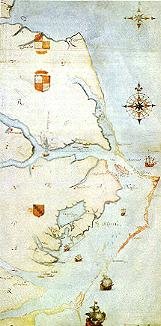
Other pictures include pipe fragments, a map of the Outer Banks with Native American villages and modern names, created by Scott Dawson, pieces of pottery “found during the Croatoan dig in 2006”, and pictures of the “1759 Croatoan land deed giving land to the Hatteras Indians and last but not least, a clipping from the Dare County Times showing a “photo of Lindy Miller after his discovery of a sword and other items in the same spot where the Croatoan village digs would occur 60 years later” as well as a list of Croatoan words and their modern day meanings.
I leave you with the following quote from Scott’s book.
“This colony was abandoned, not lost. The colonists wrote down where they were going and no one ever looked there! Everyone knew where Croatoan was back then just as we know now. That has never been a mystery”…….
Ordering information: Softcover, 5 ½ X 8 ½, 173 pgs, $14.95 plus $4.95 shipping. Happy Hunting! http://www.buybooksontheweb.com/product.aspx?ISBN=0-7414-5469-6
© History Chasers
Click here to view all recent Searching for the Lost Colony DNA Blog posts
Saturday, June 20, 2009
A Chance to be Knighted Without a Trip to England
Book signing, chance to be knighted
|

She'll be signing copies of "Roanoke Revisited: The Story of the Lost Colony," which can be found in Festival Park's Museum Store. The book tells the stories of the first English settlements in the New World, and of the fabled lost colony of Roanoke Island. The stories have been compiled from reports that were originally prepared by colony leaders and published in the 16th century by Richard Hakluyt.
And there is no need to travel across the Atlantic Ocean to England to be knighted by their current monarch, Queen Elizabeth II; you can be knighted right here on Roanoke Island, where England's New World began. That's right; the queen, Miss Barbara Hird, will knight worthy young lords and ladies after each production of Shepherd of the Ocean. Call (252) 475-1500 or visit roanokeisland.com
For more information about this event call (252) 475-1500 or visit online at www.roanokeisland.com.
© History Chasers
Click here to view all recent Searching for the Lost Colony DNA Blog posts
Sunday, April 19, 2009
Where Were the Lost Colonist From?
Where were the Lost Colonists from?
Click here to find out:
http://www.rootsweb.ancestry.com/~molcgdrg/faqs/asum.htm
© History Chasers
Click here to view all recent Searching for the Lost Colony DNA Blog posts
Tuesday, February 17, 2009
Captain John Smith Set Out to Find the Lost Colonists
Captain John Smith

Only 27 when he explored Chesapeake Bay, John Smith proved
himself an energetic and resourceful leader.
himself an energetic and resourceful leader.
"There is but one entrance by sea into this country, and that is at the mouth of a very goodly bay, 18 or 20 miles broad. The cape on the south is called Cape Henry, in honor of our most noble Prince. The land, white hilly sands like unto the Downs, and all along the shores rest plenty of pines and firs ... Within is a country that may have the prerogative over the most pleasant places known, for large and pleasant navigable rivers, heaven and earth never agreed better to frame a place for man's habitation..."- Captain John Smith, 1612 Smith's Journey
The real Captain (a military rather than maritime title) John Smith arrived at the mouth of the Bay in 1607 after a lengthy and rather miserable voyage across the Atlantic. Taken prisoner under mutiny charges during the trip, he discovered that the King of England had designated Smith a member of the newly formed governing council of Jamestown. The first summer in Jamestown was dreadful, as many men died from disease and malnutrition. To escape the rivalries of the colony, find passage to the western ocean, discover gold and locate the colonists of the Lost Colony of Roanoke, Smith gathered 14 men for a voyage up the Chesapeake. Using only a "two to three tons burden" knock-down boat brought from England, the men set out on June 2, 1608
Cont. here:
Cont. here:
© History Chasers
Click here to view all recent Searching for the Lost Colony DNA Blog posts
Friday, February 6, 2009
The Elizabethan Age - The Spanish Armada

The Spanish Armada was very important to the fate of the colonists because it was at least the reason given as to why John White could not return for three long years to his colony and his family. JC
The Elizabethan Age - The Spanish Armada
On Sunday 7th August 1588 the fleet of the Spanish Armada lay in the English Channel, close to the cliffs of Calais. The Spanish fleet intended to mount the invasion and conquest of England by the Catholic King Philip II of Spain. The success of the Spanish Armada would mean that Queen Elizabeth, viewed as a Protestant heretic, would be deposed and the English people subjugated to Spanish rule and forcibly converted to Catholicism. The English were fighting for their lives, their freedom and their way of life.
The Spanish Armada
The Spanish Commander was the Duke of Medina Sidonia who led 19,000 fighting men. The English were led by Lord Charles Howard of Effingham the Lord High Admiral of England with men such as Lord Sheffield, Sir Richard Grenville, John Hawkins, Martin Frobisher and, of course, Francis Drake. These supremely important people and events have been detailed in the Spanish Armada section of the Project Gutenberg EBook of Ten Great Events in History, by James Johonnot. The story of the English battle against the might of Spain and the Spanish Armada has been told in colorful detail under the following easy-to-read sections:
Elizabethan Dictionary
The Elizabethan Age - The Spanish Armada
On Sunday 7th August 1588 the fleet of the Spanish Armada lay in the English Channel, close to the cliffs of Calais. The Spanish fleet intended to mount the invasion and conquest of England by the Catholic King Philip II of Spain. The success of the Spanish Armada would mean that Queen Elizabeth, viewed as a Protestant heretic, would be deposed and the English people subjugated to Spanish rule and forcibly converted to Catholicism. The English were fighting for their lives, their freedom and their way of life.
The Spanish Armada
The Spanish Commander was the Duke of Medina Sidonia who led 19,000 fighting men. The English were led by Lord Charles Howard of Effingham the Lord High Admiral of England with men such as Lord Sheffield, Sir Richard Grenville, John Hawkins, Martin Frobisher and, of course, Francis Drake. These supremely important people and events have been detailed in the Spanish Armada section of the Project Gutenberg EBook of Ten Great Events in History, by James Johonnot. The story of the English battle against the might of Spain and the Spanish Armada has been told in colorful detail under the following easy-to-read sections:
Elizabethan Dictionary
Wednesday, January 28, 2009
Lost Colony of Roanoke Resources

--------------------------------------------------------------------------------
BIBLIOGRAPHY OF BOOKS, PAMPHLETS, AND ARTICLES ON THE ROANOKE ISLAND COLONIES
Some of the following works are valuable sources of information about England's attempts to explore and settle North America in the 1580s. Others reveal attitudes toward, and interpretations of, these attempts. Many recently published books and pamphlets are still in print; older books are available in the rare-book collections of some large libraries or in facsimile reprints. Some of the articles are difficult to find except in a university library. Publications such as the Reader's Guide to Periodical Literature and America: History and Life and indexes to scholarly journals such as North Carolina Historical Review and The William and Mary Quarterly list numerous articles too specialized for inclusion here. This flyer is based loosely on England, Sir Walter Raleigh, the Roanoke Colonies, by William S. Powell.
Cont. here:
http://www.nps.gov/archive/fora/biblio.htm
Contact Information:
http://www.nps.gov/fora/biblio.htm
Fort Raleigh National Historic Site
National Park Service
Rt. 1, Box 675
Manteo, NC 27954
Call (252) 473-5772
Wednesday, August 13, 2008
Lost Colony: New clues, old mystery Recently recovered artifacts being identified
Wednesday August 13, 2008
| |
The artifacts from the May 2008 archaeological excavations at Fort Raleigh National Historic Site have been researched and verified.
According to an interim report submitted to the National Park Service by Phillip Evans, Eric Klingelhofer, Nick Luccketti, and Clay Swindell, all of the First Colony Foundation (FCF), hundreds of the discoveries date back to the era of The Lost Colony.
The project was initially planned to excavate two areas where anomalies had previously been detected by ground penetrating radar surveys. The two areas contained rectangular shaped objects, which according to the report, "do not normally occur in nature, it is presumed that the anomalies are cultural in origin and could possibly be structures or features associated with the original colony."
Working with Time Team USA, an American version of the BBC archaeological series broadcasted since 1994, FCF began their twelve day excavation. Time Team USA excavated for three of the twelve days, bringing together multiple specialists and a film crew to document the project.
There were numerous findings during the excavation, including copper plates and 215 Native American pottery sherds. The sherds verified to date are separated into three series: Colington series, Cashie series, and Untyped fine sand tempered series.
As described in the report, the Colington phase covers the Late Woodland period in the Albemarle region. The material is affiliated with those that formed the chiefdoms and were visited and described by the English explorers in the 1580s. The shell tempered ceramics vary little through time and house an unusual display of decorative designs.
Also included in the Colington phase are motif engraved ceramic smoking pipes, bone/shell tools, marine shell/stone, copper, beads, ornaments, and pendants. There were a total of 208 Colington series artifacts discovered during the excavation.
According to an interim report submitted to the National Park Service by Phillip Evans, Eric Klingelhofer, Nick Luccketti, and Clay Swindell, all of the First Colony Foundation (FCF), hundreds of the discoveries date back to the era of The Lost Colony.
The project was initially planned to excavate two areas where anomalies had previously been detected by ground penetrating radar surveys. The two areas contained rectangular shaped objects, which according to the report, "do not normally occur in nature, it is presumed that the anomalies are cultural in origin and could possibly be structures or features associated with the original colony."
Working with Time Team USA, an American version of the BBC archaeological series broadcasted since 1994, FCF began their twelve day excavation. Time Team USA excavated for three of the twelve days, bringing together multiple specialists and a film crew to document the project.
There were numerous findings during the excavation, including copper plates and 215 Native American pottery sherds. The sherds verified to date are separated into three series: Colington series, Cashie series, and Untyped fine sand tempered series.
As described in the report, the Colington phase covers the Late Woodland period in the Albemarle region. The material is affiliated with those that formed the chiefdoms and were visited and described by the English explorers in the 1580s. The shell tempered ceramics vary little through time and house an unusual display of decorative designs.
Also included in the Colington phase are motif engraved ceramic smoking pipes, bone/shell tools, marine shell/stone, copper, beads, ornaments, and pendants. There were a total of 208 Colington series artifacts discovered during the excavation.
Tuesday, August 12, 2008
Happy 428th Birthday, Virginia Dare!!!
 Virginia Dare (born August 18, 1587, date of death unknown) was the first child born in the Americas to English parents, Eleanor (or Ellinor/Elyonor) and Ananias Dare. She was born into the short-lived Roanoke Colony on Roanoke Island in present-day North Carolina, USA. What became of Virginia and the other colonists has become an enduring mystery. The fact of her birth is known because the leader of the colony, Eleanor Dare's father, John White, returned to England to seek assistance for the colony. When White returned three years later, the colonists were gone.
Historical explanations
John Smith and other members of the Jamestown Colony sought information about the fate of the colonists in 1607. One report indicated that the Lost Colonists took refuge with friendly Chesapeake Indians, but Chief Powhatan claimed his tribe had attacked the group and killed most of the colonists. Powhatan showed Smith certain artifacts he said had belonged to the colonists, including a musket barrel and a brass mortar. The Jamestown Colony received reports of some survivors of the Lost Colony and sent out search parties, but none were successful. Eventually they determined they were all dead.[1]
However, in her 2000 book Roanoke: Solving the Mystery of the Lost Colony, historian Lee Miller postulated that some of the Lost Colony survivors sought shelter with a neighboring Indian tribe, the Chowanoc, that was attacked by another tribe, identified by the Jamestown Colony as the "Mandoag," but who Miller thinks were actually the Eno, also known as the Wainoke. Survivors were eventually sold into slavery and held captive by differing bands of the Eno tribe, who, Miller wrote, were known slave traders. Miller wrote that English settlers with the Jamestown Colony heard reports in 1609 of the captive Englishmen, but the reports were suppressed because they had no way to rescue the captives and didn't want to panic the Jamestown colonists. William Strachey, a secretary of the Jamestown Colony, wrote in his The History of Travel Into Virginia Britania in 1612 that, at the Indian settlements of Peccarecanick and Ochanahoen, there were reportedly two-story houses with stone walls. The Indians supposedly learned how to build them from the Roanoake settlers.[2] There were also reported sightings of European captives at various Indian settlements during the same time period.[3] Strachey wrote in 1612 that four English men, two boys, and one maid had been sighted at the Eno settlement of Ritanoc, under the protection of a chief called Eyanoco. The captives were forced to beat copper. The captives, he reported, had escaped the attack on the other colonists and fled up the Chaonoke river, the present-day Chowan River in Bertie County, North Carolina.[4][2][5] For four hundred years, various authors have speculated that the captive girl was Virginia Dare. When White left the colony in 1587, there were eighty-seven men, seventeen women and eleven children among the colonists. Virginia Dare was one of two infants born to colonists in 1587 and was the only female child in the Lost Colony.Possible descendants
The Chowanoc tribe was eventually absorbed into the Tuscarora. The Eno tribe was also associated with the Shakori tribe and was later absorbed by the Catawba or the Saponi tribes. Today one group is known as the Haliwa-Saponi tribe. From the early 1600s to the middle 1700s European colonists reported encounters with gray-eyed American Indians or with Welsh-speaking Indians who claimed descent from the colonists.[6][7] In 1669 a Welsh cleric named Morgan Jones was taken captive by the Tuscarora. He feared for his life, but a visiting Doeg Indian war captain spoke to him in Welsh and assured him that he would not be killed. The Doeg warrior ransomed Jones and his party and Jones remained with their tribe for months as a preacher.[6] In 1701, surveyor John Lawson encountered members of the Hatteras tribe living on Roanoke Island who claimed some of their ancestors were white people. Lawson wrote that several of the Hatteras tribesmen had gray eyes.[7] Some present-day American Indian tribes in North Carolina and South Carolina, among them the Coree and the Lumbee tribes, also claim partial descent from surviving Roanoke colonists. A non-profit organization, the Lost Colony of Roanoke DNA Project, has launched a Lost Colony DNA Project to test possible descendants.- Copyright (c) 2008 History Chasers
- Permission is granted to copy, distribute and/or modify this document
- under the terms of the GNU Free Documentation License, Version 1.2
- or any later version published by the Free Software Foundation;
- with no Invariant Sections, no Front-Cover Texts, and no Back-Cover Texts.
- A copy of the license is included in the section entitled "GNU
- Free Documentation License".
- http://en.wikipedia.org/wiki/Wikipedia:Text_of_the_GNU_Free_Documentation_License
Subscribe to:
Posts (Atom)