Pages

Showing posts with label ocracoke. Show all posts

Monday, June 6, 2011

Hatteras Island Genealogy and Preservation Society is Not Your Grandma's Genealogy Society

 The Hatteras Island Genealogy Society is planning some rocking events. Check it out!


"We're planning to host cooking demonstrations by local chefs and cooks, using LOCALLY CAUGHT seafood and local NC produce. MORE information will be posted as the details are finalized, and a sponsor is assigned to the event. Hatteras Island, Ocracoke and Dare County restaurants and caterers who are interested in one of your own being the featured chef or cook during a 30-45 minute segment of the event, please post a comment...thanks!

Several Non Profit Groups will be on hand to give us more information about the FREE services they provide. We're also planning free cooking demonstrations, live music and entertainment, and at least one free toddler play area. More information to follow..."
This blog is © History Chasers
Click here to view all recent Lost Colony Research Group Blog posts
Bookmark and Share

Sunday, August 8, 2010

Did Sir Richard Greenville Leave the Ancestors of the Banker Ponies?


OCRACOKE PONIES

The Wild Bankers of Ocracoke Island
OCRACOKE'S FAVORITE RESIDENTS


Legend has it that the "Banker" horses of Ocracoke were left by shipwrecked explorers of the 16th or 17th Century. European ships commonly carried livestock to the New World. If a ship ran aground near the coast, animals were thrown overboard to lighten the load so that the ship could be re-floated. The livestock were often left behind when the ship again set sail. Sir Richard Grenville's ship TIGER ran aground at Ocracoke Island in 1565.* There is speculation that he may have unloaded Spanish mustangs on the island.


Evidence also exists of a failed earlier Spanish colony further south along the Carolina coast in 1526. Their horses, if abandoned, may have slowly spread north to Ocracoke.
Banker horses have been documented on Ocracoke since the first European settlers came to stay in the 1730's. There have been as many as 300 horses on Ocracoke Island. They have played a major role in the island's history, serving residents as beasts of burden at work and at play, in beach rides and races.

The U.S. Life-saving Service used horses until 1915 for beach patrols and to haul equipment to and from shipwreck sites. The Coast Guard kept a small band of Banker ponies to patrol the beaches during World War II. For a period of the 1950's, islanders held annual July 4th pony "pennings". Horses and colts were rounded up and driven into the village to be corralled and then branded. Some horses were sold during the event.

Cont. here:


See also:


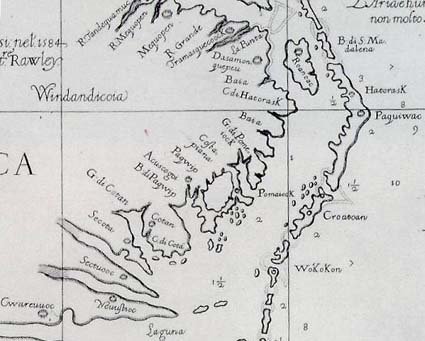
*With delays caused by the capture of a Spanish ship, the need to gather salt, and the purchase of supplies, the English finally arrived off Cape Fear on 23 June 1585. The next day they anchored and fished in the vicinity of present-day Beaufort Inlet. And finally on 26 June they reached Wococon on the Outer Banks. (It may or may not have been the present-day Ocracoke Inlet: inlets in this area open and close often and move continually.) On 29 June 1585 the Tyger ran aground at Wococon with the loss of most of the supplies on board.


This blog is © History Chasers
Click here to view all recent Lost Colony Research Group Blog posts
Bookmark and Share

Saturday, June 20, 2009

Road Trip back in Time

Road trips have become a tradition of summer. Everyone has memories from childhood of piling into the family car and hitting the road. The trips can be long or short, jam-packed with stops or just a quick visit. The great thing about road trips is that the possibilities are endless.

Road Trip to North Carolina

~Heading back toward the mainland on Route 64 the hustle and bustle of the beach community begins to quiet and the small town of Manteo is another worthwhile pit stop. The town of Manteo was named after a member of the Croatan tribe and it's history, as well as the history of Roanoke Island, stretches far back. The 1584, English settlers established a foothold on the island. Due to lack of supplies, bad weather and tense relations with the native tribes the fort eventually failed. Three years later, another group of settlers arrived to try to make a more permanent colony. Among them was the Dare family. Two months after they arrived on Roanoke, they gave birth to the first English-speaking child in the New World. The patriarch of the group was forced to leave the burgeoning colony. When he arrived back in 1590 there was no sign of the the English settlers. Their whereabouts where never discovered and the mystery remains. The Lost Colony has been the subject of many theories over the centuries. The most popular one was that the Croatans came to the help of the starving colonists and brought them into their tribe. There were countless reports of American Indians with blue eyes and light complexions, convincing some they were the missing colonists.

Today you can spend the day exploring Fort Raleigh National Historic Site, where you can get the full story of the various attempts to colonize the island. Take a stroll through the beautiful Elizabethan Gardens with its vibrant colors and traditional layouts. The young and old alike will enjoy boarding the Elizabeth II, a replica of the small ship that the colonists traveled over on from England. You can even stay to take in a performance of The Lost Colony play in the wooden fort.

~The majority of the Outer Banks are connected by bridges spanning the breaks between islands. However, when you get to the southern tip of Hatteras it is time to hop on board the car ferry. When you disembark on the far side, the only place to go is south to the quiet village of Ocracoke. The easiest way to see Ocracoke is on foot. The Ocracoke Lighthouse was built in 1823 and stands 75 feet tall over the village. The stark white building is the second oldest lighthouse in the United States. Despite the peaceful atmosphere that Ocracoke gives off, in the early 1700s it was home to a famous sailor. Edward Teach, also known as Blackbeard, was one of the most feared pirates of his time. For years he sailed the oceans looting and plundering. Eventually, Blackbeard decided to retire before the authorities caught up with him. He took his riches and retired to Ocracoke but apparently retirement wasn't good enough. The Governor of Virginia overreached his authority and made it clear that he wanted Blackbeard gone. On November 11, 1718 the HMS Pearl arrived in the waters off of Ocracoke and did not leave until Teach was taken care of. The tales of pirates and tall lighthouses are common occurences throughout the islands of North Carolina.

http://www.examiner.com/x-5511-Baltimore-Historic-Travel-Examiner~y2009m5d29-On-the-road-North-Carolina


© History Chasers

Click here to view all recent Searching for the Lost Colony DNA Blog posts

Bookmark and Share

Thursday, May 1, 2008

Sir Richard Grenville's Horses Left Behind on the Outer Banks?


OCRACOKE PONIES

The Wild Bankers of Ocracoke Island
OCRACOKE'S FAVORITE RESIDENTS


Legend has it that the "Banker" horses of Ocracoke were left by shipwrecked explorers of the 16th or 17th Century. European ships commonly carried livestock to the New World. If a ship ran aground near the coast, animals were thrown overboard to lighten the load so that the ship could be re-floated. The livestock were often left behind when the ship again set sail. Sir Richard Grenville's ship TIGER ran aground at Ocracoke Island in 1565.* There is speculation that he may have unloaded Spanish mustangs on the island.


Evidence also exists of a failed earlier Spanish colony further south along the Carolina coast in 1526. Their horses, if abandoned, may have slowly spread north to Ocracoke.
Banker horses have been documented on Ocracoke since the first European settlers came to stay in the 1730's. There have been as many as 300 horses on Ocracoke Island. They have played a major role in the island's history, serving residents as beasts of burden at work and at play, in beach rides and races.

The U.S. Life-saving Service used horses until 1915 for beach patrols and to haul equipment to and from shipwreck sites. The Coast Guard kept a small band of Banker ponies to patrol the beaches during World War II. For a period of the 1950's, islanders held annual July 4th pony "pennings". Horses and colts were rounded up and driven into the village to be corralled and then branded. Some horses were sold during the event.

Cont. here:


See also:


*With delays caused by the capture of a Spanish ship, the need to gather salt, and the purchase of supplies, the English finally arrived off Cape Fear on 23 June 1585. The next day they anchored and fished in the vicinity of present-day Beaufort Inlet. And finally on 26 June they reached Wococon on the Outer Banks. (It may or may not have been the present-day Ocracoke Inlet: inlets in this area open and close often and move continually.) On 29 June 1585 the Tyger ran aground at Wococon with the loss of most of the supplies on board.


Wednesday, April 23, 2008

Historic Bath, North Carolina

Welcome to Historic Bath —North Carolina's First Town

European settlement near the Pamlico River in the 1690s led to the creation of Bath, North Carolina's first town, in 1705. The town's location seemed ideal with easy access to the river and the Atlantic Ocean 50 miles away at Ocracoke Inlet.

The first settlers were French Protestants from Virginia. Among early inhabitants were John Lawson, surveyor general of the colony and author of the first history of Carolina (1709), and Christopher Gale, first chief justice of the colony.

By 1708, Bath consisted of 12 houses and about 50 people. Trade in naval stores, furs, and tobacco was important, and Bath became the first port of entry into North Carolina. In 1707, a grist mill and the colony's first shipyard were established in the town. A library sent to St. Thomas Parish in 1701 became the first public library in the colony. The parish also established a free school for Indians and blacks.

Early Bath was disturbed by political rivalries, epidemics, Indian wars, and piracy. Cary's Rebellion (1711) was an armed struggle over religion and politics in the colony. An epidemic of yellow fever and a severe drought occurred in 1711. The Tuscarora War between the weakened settlers and the powerful Tuscarora Indians followed immediately. Bath became a refuge for the surrounding area until the Indian power was broken. Bath was also the haunt of Edward Teach, better known as the pirate "Blackbeard." An expedition of the British Navy killed him in a naval battle near Ocracoke in 1718.

Cont. Here:

http://www.nchistoricsites.org/bath/