Pages

Showing posts with label virginia. Show all posts

Saturday, June 20, 2009

A Chance to be Knighted Without a Trip to England

Book signing, chance to be knighted


Actress and co-editor Miss Barbara Hird can be found after each Thursday's performance of "Shepherd of the Ocean" in the Roanoke Island Festival Park Mall on Thursdays, June 4, 11 and 18.

She'll be signing copies of "Roanoke Revisited: The Story of the Lost Colony," which can be found in Festival Park's Museum Store. The book tells the stories of the first English settlements in the New World, and of the fabled lost colony of Roanoke Island. The stories have been compiled from reports that were originally prepared by colony leaders and published in the 16th century by Richard Hakluyt.

And there is no need to travel across the Atlantic Ocean to England to be knighted by their current monarch, Queen Elizabeth II; you can be knighted right here on Roanoke Island, where England's New World began. That's right; the queen, Miss Barbara Hird, will knight worthy young lords and ladies after each production of Shepherd of the Ocean. Call (252) 475-1500 or visit roanokeisland.com

For more information about this event call (252) 475-1500 or visit online at www.roanokeisland.com.


© History Chasers

Click here to view all recent Searching for the Lost Colony DNA Blog posts

Bookmark and Share

Friday, August 1, 2008

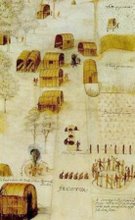
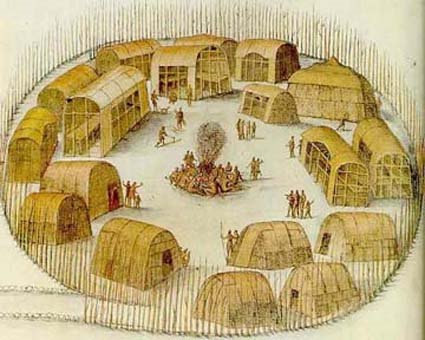
American Indian town of Pomeiooc

Black and white drawing of the American Indian town of Pomeiooc.  The town consists of several buildings surrounded by a fence.  In the center several people sit and stand around a fire.
Engraving of the American Indian town of Pomeiooc, published in Thomas Hariot's 1588 book A Briefe and True Report of the New Found Land of Virginia. (Illustration by Theodor de Bry. More about the illustration)


The towns of this country are in a manner like unto those which are in Florida, yet are they not so strong nor yet preserved with so great care. They are compassed about with poles stark fast in the ground, but they are not very strong. The entrance is very narrow as may be seen by this picture, which is made according to the form of the town of Pomeiooc. There are but few houses therein, save those which belong to the king and his nobles. On the one side is their temple separated from the other houses, and marked with the letter A. It is built round, and covered with skin mats, and as it were compassed about with curtains without windows, and has no light but by the door. On the other side is the king’s lodging marked with the letter B. Their dwellings are built with certain potes [sticks] fastened together, and covered with mats which they turn up as high as they think good, and so receive in the light and other. Some are also covered with boughs of trees, as every man lusts or likes best. They keep their feasts and make good cheer together in the middle of the town as it is described in the 17 figure. When the town stands far from the water they dig a great pond noted with the letter C where hence they fetch as much water as they need.


“The Towne of Pomeiooc.” Theodor de Bry’s engraving of the American Indian town of Pomeiooc, published in Thomas Hariot’s 1588 book A Briefe and True Report of the New Found Land of Virginia.

Thursday, May 15, 2008

Aftershocks from Plecker's Abuse of Human Rights in Virginia

by Janet Crain

Today is May 15th, Bloggers Unite for Human Rights Day. Yesterday, we published some preliminary background material about a man many people depise, who caused a great injustice in American to American citizens in the 20th Century. His efforts would, in fact, still be implemented into the 1960's. A rigid, autocratic man, Walter Ashby Plecker fancied himself a white knight defending and protecting the racial purity of the white race. Born into a well-to-do Virginian family he became a doctor. He was married, but never had children. He listed his hobbies as birds and books. He worked hard delivering many babies in poor households lacking basic hygiene and what most consider necessities. Many of these people were black or Indian. Concerned by a high incidence of syphilitic blindness, he began dispensing silver nitrate to be put in the eyes of newborns. He also contrived an incubator that could be put together in the poorest of homes.

A devout Presbyterian, he actually believed the mixing of races to be a sin. He helped establish churches around the state and supported fundamentalist missionaries. Plecker belonged to a conservative Southern branch of the church that believed the Bible was infallible and condoned segregation. Members of Plecker’s branch maintained that God flooded the earth and destroyed Sodom to express his anger at racial interbreeding. He carried out a life long attempt to prevent this from happening, carrying his efforts to the most extreme measures.

The Eugenics Movement suited his needs perfectly. He was proud to be a scientist, practicing what he believed to be the latest scientific methods to improve mankind. He became a celebrity within the eugenics movement, which eventually began to lose support among scientists and furnish a platform for white supremacy. He spoke around the country, was widely published and wrote to every governor in the nation to urge passage of racial laws just as tough as Virginia’s Racial Integrity Act. He dined at the New York home of Nazi sympathizer, Harry H. Laughlin, the nation’s leading eugenics advocate.

In 1932, Plecker gave a keynote speech at the Third International Conference on Eugenics in New York. Among those in attendance was Ernst Rudin of Germany who, 11 months later, would help write Hitler’s eugenics law.

In 1935, Plecker wrote to Walter Gross, the director of Germany’s Bureau of Human Betterment and Eugenics. Writing on state stationery, he outlined Virginia’s racial purity laws and asked to be put on a mailing list for bulletins from Gross’ department. Complimenting the Third Reich for sterilizing 600 children in Algeria who were born to German women and black men, he commented; “I hope this work is complete and not one has been missed,” he wrote. “I sometimes regret that we have not the authority to put some measures in practice in Virginia.”


The Racial Integrity Act essentially narrowed race classifications on birth and marriage certificates to two choices: “white person” or “colored.” The law defined a white as one with no trace of black blood. A white person could have no more than a one-sixteenth trace of Indian blood—an exception, much to Plecker’s regret, legislators made to appease the descendants of Pocahontas and John Rolfe, who were considered among Virginia’s first families.

The act forbade interracial marriage and lying about race on registration forms. Violators faced felony convictions and a year in prison.

Plecker strongly supported sterilization laws, arguing that feebleminded whites were prone to mate with Indians and blacks. He had no role in administering the law, however.

The Racial Integrity Act, on the other hand, was his to enforce, and Plecker went about it obsessively. He sold copies of eugenics books in his office and mailed his diatribes against racial interbreeding at government expense, stretching the Racial Integrity Act when necessary.

Plecker served in his powerful position as the first registrar of Virginia’s Bureau of Vital Statistics from 1912 until 1946. Working with a vengance, he led the effort to purify the white race in Virginia by forcing Indians and other nonwhites to classify themselves as blacks. It amounted to bureaucratic genocide. He not only altered records and refused to register children as their rightful identity, he wrote insulting letters to new mothers which surely caused a lifetime of grief and frustration. The aftershocks are still being felt today. Indian tribes seeking recognition cannot provide the proof of their existance required because of Plecker's altered records. Families separated due to his draconian actions will never be reunited as the brothers, sisters, cousins, aunts and uncles because they have passed on in many cases. A lifetime lost. And genealogical brickwalls and roadblocks are encountered every day by persons trying to research their families.


"Those who fail to learn the lessons of history are doomed to repeat them." ---George Santayana

You can read more about this abuse of human rights here:

http://www.amren.com/mtnews/archives/2004/09/the_black_white.php

Thursday, April 10, 2008

Defining mixed-blood Indians in colonial Virginia and the Carolinas

“A Rose by any other name is a Cactus”


By Steven Pony Hill


--------------------------------------------------------------------------------

Augusta County, VA (Orders 1773-1779)

19 AUG 1777….Nat, an Indian boy in the custody of Mary Greenlee who detains him as a slave complains that he is held in unlawful slavery. Commission to take depositions in Carolina or elsewhere.

17 SEP 1777….On the complaint of Nat an Indian or Mustee Boy who says he is to be set free from service of Mary Greenlee…nothing appeared to this Court but a bill of sale for ten pounds from one Sherwood Harris of Granville County, NC that through several assignments was made over to James Greenlee deceased, late husband to the said Mary….said Mulattoe or Indian Boy is a free man and no slave.
( Nat was most likely half-Indian, so therefore Mulatto or Mustee could be used interchangeably, use of these terms were influenced by the status of his servitude)


--------------------------------------------------------------------------------
Charles City County, VA (Orders 1687-95)

DEC 1690….Thomas Mayo an Indian belonging to Jno. Evans is adjudged 14 years old.


--------------------------------------------------------------------------------
Chesterfield County, VA (Orders 1767-71)

6 APR 1770…On motion of Sibbell, an Indian woman held in slavery by Joseph Ashbrooke, have leave to prosecute for her freedom in forma pauperis.
- Sibbell an Indian wench V. Joseph Ashbrooke, for pltf. To take deposition of Elizabeth Blankenship and Thomas Womack.
- Sybill a Mulatto V. Joseph Ashbrooke – dismissed.
(Sibell was most likely less than full blooded Indian…she was described as Indian up to the point it was determined that she was legally a slave, then she was described as mulatto…use of the term is influenced by the status of her servitude)

--------------------------------------------------------------------------------

Dinwiddie County, VA

18 AUG 1794...registered free papers of “Nancy Coleman a dark brown, well made mulatto woman..freed by judgement of the Gen’l Court of John Hrdaway being a descendant of an Indian.”

10 FEB 1798…registered free papers of “Daniel Coleman a dark brown free Negro, or Indian…formerly held as a slave by Joseph Hardaway but obtained his freedom by a judgment of the Gen’l Court.
”
14 AUG 1800…registered free papers of “Hagar Jumper a dark brown Mulatto or Indian woman short bushy hair, obtained her freedom from Stephen Dance as being a descendant of an Indian.”

27 MAY 1805…registered free papers of “Betty Coleman a dark brown Negro woman…formerly held as a slave by John Hardaway…liberated by judgment of the Gen’l Court as descended of an Indian.”


--------------------------------------------------------------------------------

Goochland County, VA

7 MAR 1756…Elizabeth, daughter of Ruth Matthews, a free mulattoe, baptized by the Rev. William Douglas of St. James Northam Parish.

26 SEP 1757….Cumberland County Court to bind out the children of Ruth Matthews, an Indian woman, to William Fleming.
(Ruth is described as ‘a free mulatto’ at one time, ‘an Indian’ at another.)

--------------------------------------------------------------------------------

Henrico County, VA


5 MAY 1712…..Thomas Chamberlayne brings before this Court his servant Mulatto man Robin and informed the Court that he hath several times run away. Ordered to serve one year from (release date).
- Robin Indian (filed) against Major Chamberlayne…next Court.

FEB 1712….Robin Indian ordered free from Thomas Chamberlayne’s service at end of year’s service.

MARCH 1713….Thomas Chamberlayne against his servant Robin Mulatto hath unlawfully absented himself for 16 weeks.
(Robin is described as Mulatto until he is determined to be illegally held as a slave, then he is described as Indian…use of the term is influenced by his servitude…his former master tactfully uses the term Mulatto to influence the Court to return him to slavery)

APR 1722…Peg an Indian woman servant belonging to Richard Ligon appeared…be adjudged free..he be summoned.
JUN 1722…Peg a Mulatto servant born in this County whose mother was an Indian intitled to freedom at the age of thirty years, having petitioned for her freedom against her master Richard Ligon.
(Mulatto is used here to describe an Indian half-blood)

JAN 1737….petition of Tom a Mulatto or Mustee setting forth that he is the grandson of a white free woman and hast a just right to freedom but that his master Alexander Trent contrary to law or equity detains him in slavery.
(the terms Mulatto and Mustee are used here interchangeably)

JUL 1739…On the petition of Indian Jamey alias James Musttie is exempted from paying County Levyes.

NOV 1740…petition of Thomas Baugh it is ordered that the Church Wardens of Dale Parish do bind out Joe a Mulatto the son of Nan an Indian woman according to law.
(Mulatto is used here to describe an Indian half-blood)

18 NOV 1747….will of Richard Randolph…to my son John the third part of my slaves, he taking my two Negroes, Indian John and Essex as a part of his third which two Negroes I propose he should have.
(an Indian is described here as a ‘Negro’…the term is influenced by his servitude)

2 DEC 1754….Church wardens of Henrico Parish do bind out Ezekiel Scott and Sarah Scott, children of John Scott, Tommy son of Indian Nan, Henry Cockran son of John Cockran, and Isham Roughton an Indian according to Law.

5 MAR 1759….Ordered that the Church Wardens of Henrico Parish bind out Ben Scott and Roger an Indian Boy according to Law.

Cont. Here:

http://www.geocities.com/ourmelungeons/mixed_bloods.html

Saturday, February 23, 2008

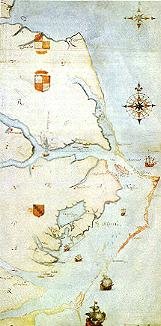
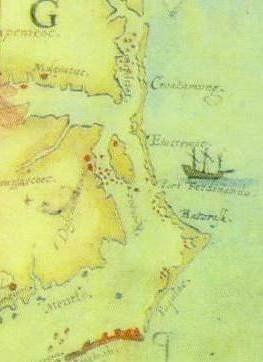
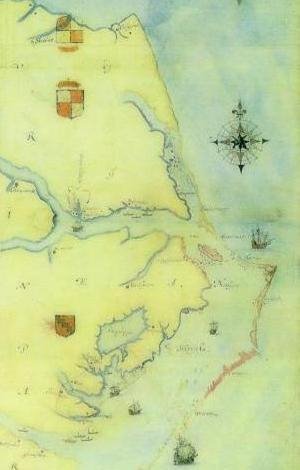
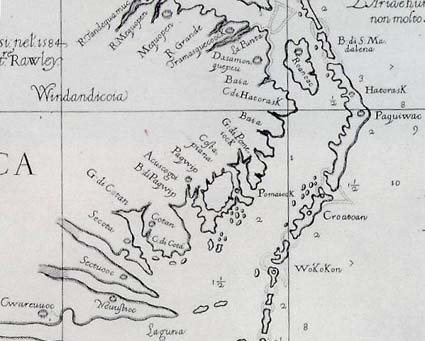
The White-De Bry Map of Virginia (1590)

In 1590 Theodor De Bry published Part I of his America, which included several of his engravings based on drawings of the New World by John White. Notable among them is a map of the east coast of North America from the lower Chesapeake Bay south past Cape Lookout. Three probable sources of this collaborative map are extant: a crude pen-and ink map, perhaps by Ralph Lane, and two of an unknown number of White's detailed watercolor sketch maps — one, on a large scale, covering much the same area as the engraving; the other, on a small scale, showing southeastern North America and part of the West Indies.


Some features unique to the White-De Bry are corrections; others are errors; still others may be based on sketch maps now lost. Following is the key to the White-De Bry map which was taken, with many liberties, from Appendix I of David B. Quinn's Roanoke Voyages (London, 1955).

MAP KEY found here:


Wednesday, January 16, 2008

Virginia Indian Tribes

Part 1

The Chickahominy Indian Tribe, whose name has been translated as “course ground corn people,” was officially recognized by the Commonwealth of Virginia General Assembly on March 25, 1983. With approximately 875 Chickahominy people living in the vicinity of the Tribal Center, the Chickahominy are based in Charles City County near the many towns along the Chickahominy River where the tribe lived in 1600. The Chickahominy had early contact with the English settlers because of their proximity to Jamestown, and they taught early colonists how to survive by growing and preserving their own food. As the English prospered and claimed more land, the Chickahominy tribe was forced out of their homeland. The treaty of 1646 awarded reservation land to the Chickahominy and other tribes in the “Pamunkey Neck” area of Virginia where the Mattaponi reservation exists todays. After 1718, they were forced off this reservation, and over the ensuing years Chickahominy families moved to Chickahominy Ridge in present day Charles City County where they now reside. Here the tribe purchased land and established the Samaria Baptist Church, which remains an important focal point for the community.

The Chickahominy Indian Eastern Division (CIED) also originated with the historic Chickahominy tribe. This tribe, based in New Kent County, was established in the early 20th century and has approximately 130 members today. Their members established the Tsena Commocko Baptist Church, and in recent years have purchased approximately 40 acres as tribally held land.