Melungeon Myth of Drake Dropping off Passengers on Roanoke
By Janet Lewis Crain
A myth exists on the Internet that the Melungeons, a group of dark skinned
persons of mysterious origins found living in East Tennessee two hundred
years ago descend from Turkish prisoners and sundry other non-English persons
said to have been rescued by Sir Francis Drake during the sacking of Cartagena and
then deserted on Roanoke Island in 1586. In truth, there is NO evidence there
were any left behind there, much less several hundred. This myth was introduced
in a book published in the 1990's by Brent Kennedy titled The Melungeons:
The Resurrection of a Proud People : An Untold Story of Ethnic Cleansing in
America.
This book might have lanquished in obscurity on the shelves of a few Libraries
and book stores had it not been for the Internet and the new found surge
of interest in genealogy. Suddenly everyone fancied him or herself a Melungeon.
Several Unions were held of people from various mailing lists and persons attending
were happily discovering knots.on the back of their head, thought to indicate
Turkish ancestry. Having someone in your Family tree who possessed six
fingers was a definite plus. These traits were all described in the afore mentioned book.
No one ever looked too closely into the incident said to have occurred in 1586. But
that is precisely what this paper intends to do.
In the sixteenth century, Sir Francis Drake was one of the most famous men in England, indeed the English speaking world and beyond. He could do no wrong in his Queen's eyes. He had brought her an enormous return on her personal investment in an earlier voyage. A brilliant man in many ways, Drake was ruthless, but highly admired by the captives he had freed and the Maroons who came to his aid to help him fight and share in the rewards.
Drake was returning home from the sacking of Cartagena when he decided to
visit Roanoke and dispose of some of the freed prisoners and Maroons he had
acquired during his adventures. He was carrying a human cargo of some several hundred. Ivor Noel Hume in "Virginia Adventures" contends Drake
highly inflated the numbers. The voyage had not been financially successful
in spite of his daring and flamboyant actions. It is quite likely he was
advancing his case by sending back reports of greater exploits than actually
had occurred. There were reports of many nationalities released from the
Spanish prisons as well as Maroons who had come in from their strongholds in
the surrounding areas to help Drake as he was known to be generous with the
spoils of his marauding. Alas this voyage would not compare to previous ones.
This voyage is of great interest to Melungeon researchers because this
voyage in 1586 is the basis of the Turkish connection first started by
statements in Brent Kennedy's book: Melungeons; an Untold Story of Ethnic
Cleansing. It is, in fact, the keystone of the Turkish Connection Theory.
Remove it and the rest crumbles. That is what I propose to do.
It is known that many of the people with him never reached Roanoke. Many died of
strange fevers in Florida. These fevers were the scourge of sea travel at
that time. Caused in part by the crowding together of humans in the cargo
holds of ships where the fetid air trapped and spread any contagious
disease like wildfire, and probably acerbated by nutritional deficiencies.
In any case, reports contend that anywhere between 350 and 750 people died of
these fevers. Apparently Drake intended to leave the rest of the freed
Africans and South American Indians to furnish labor for the new Colony on
Roanoke which he expected to have grown to some 600 English by then. In
truth There were only about 100 men, badly in need of food and suffering the
ill effects of their bad treatment of the local Indians. Ralph Lane was in
charge at Roanoke and he accepted Drake's offer of minimal food supplies
(Drake had been out a long time and was running low himself) and a ship, the
Francis, capable of navigation into the bay plus other pinnaces, etc. and
armament. All the supplies were loaded onto the Francis along with Lane's
best naval officers. Lane wanted to stay a few more weeks exploring the
Chesapeake.
Hume states:
When on June 11, the two men (Francis Drake and Ralph Lane) exchanged their
unsettling news, several truths became evident; Drake was not there (as the
Roanoke settlers had first hoped) to resupply the Colony; he was short of
food himself and so was better able to supply guns than butter. Futhermore,
Lane could not have had any desire or ability to house 250 blacks who would
out number his white settlers two to one.
They came to an agreement whereby Drake would leave skilled workers,
artisans, two pinnaces, several small boats and a large ship, the Francis.
All the supplies were loaded onto the Francis along with the skilled
mariners needed to sail such a ship. Immediately a terrible hurricano struck
and it was every man for himself. The ships standing out in the roadway cut
and ran, scurrying out to the deep ocean to get away from the treacherous
shoals and currents, dangerous enough in good weather. The Francis was among
those who sailed on to England.
Ralph Lane then accepted Drake's offer to transport the first colonists back
To England. Most of the small pinnaces carrying the extra passengers had
been dashed to pieces on the shoals during the storms. The Turks, known to
have been with Drake, were apparently better safeguarded. They were valuable
as trade for English prisoners lanquishing in Ottoman prisons. Some 100
Turks were, in fact, ransomed to their homeland.
So, just who might have gone ashore before the storm hit? Many people have a
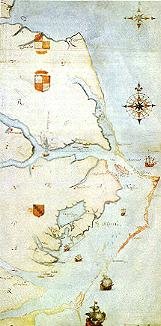
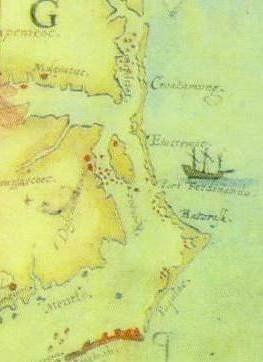
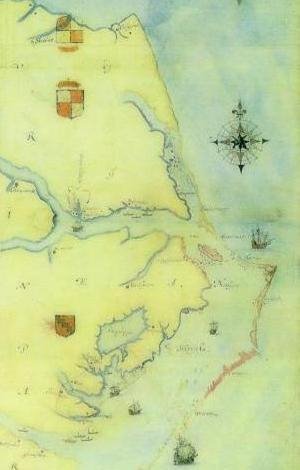
hard time visualizing the scene at Roanoke. Roanoke is surrounded by very
shallow waters, hence the name; Shallowbag Bay. The only way to get there
was by laborious offloading of men and supplies to shore boats and threading
through the one pass, Fernando Pass, and the treacherous shoals and currents
made worse at times by Northwestern winds blowing directly into the Bay. The
shore boats were large by our standards and equipped with a mast and sail.
They require a skilled pilot and several strong sailors to row. People didn't
just hop on one and go sight seeing. Only those with important business
such as Sir Francis Drake and Ralph Lane who negotiated several times were
transported back and forth. The rest of the fleet with the passengers
onboard stood out in the Roadway, the navigable waters off the Outer Banks,
which wrap around this area like protecting arms.
I am saying this to lay to rest the idea of a huge number of the passengers
dis-embarking and perhaps being caught off guard by the storms and staying
behind. Hume and David Beers Quinn are the authorities on this period and
both say there were no Turks left. Hume says no one else, Quinn, at most a
very few. Left with no supplies on the Outer Banks what would they have
found to eat? If the Indians had not killed them, they would have starved.
It should be noted that the Native Americans communicated by a"grapevine" so
efficient that Indians in Canada knew of happenings in the Virginias. No
mention of any dumped off passengers was ever made.
Additionally, there was plenty of room for these passengers to sail with
Drake. Hundreds had died in the battles in Florida, from fevers, and in the
hurricane. Drake was returning with more ships than he left with, having
captured many. And they would have furnished badly needed labor to sail
these ships back to England.
Add to this the extreme difficulty of unloading these passengers in addition
to loading the Roanoke settlers, which the crew deeply resented for the
delay and extra work and danger this imposed and it is highly unlikely Drake
would have taken such actions in the middle of a three day hurricane.
Ivor Noel Hume says:
Thus the hurricane of June 1586 may have ripped away the first page from the
history of blacks in English America.
A cruel and terrible fate for these forgotten people that historians of the
time did not consider important enough to even record their fate.
Two weeks later an emergency supply ship sent by Sir Richard Grenville
arrived and found no one although they searched diligently. They left to return to England.
About one or two weeks later a big supply ship arrived with Grenville on
board. They were as mystified at the deserted condition of the island as the
men on the earlier supply ship. They searched even further "into the main"
(mainland) and as far as Chesapeake. Grenville was heavily invested in this
first effort, having sold an entire estate (consisting at this time as a
manor house and every type of supporting industry needed to run the estate;
mills, stables, barns, houses, dairies, animals, tools, even small villages)
to finance the settlement of over 100 men for over a year. It was a
requirement of Raleigh's patent from Queen Elizabeth that the area be
occupied continuously by English people. Finding no one and not knowing where
they had gone, he left some 15 soldiers to hold the fort. Based upon later
interviews with Indians, they all perished.
It is quite clear they found no one who could have been the passengers Drake
was previously carrying.
As previously stated the Indians had a very effective rumor mill which
carried news far and wide. It is just inconceivable that these
people could have survived unnoticed when their appearance would have been a
matter of great curiosity among people who had never seen African natives.
Thus it seems there is no evidence that any people were left behind in the Colony and documented evidence that 100 turks were returned to their homeland.
Resources:
The Virginia Adventurers by Ivor Noel Hume Copyright 1994 p. 53
Corbett, Spanish War. Refers to the return of 100 ex-galley slaves to the
Turkish dominions.
William S. Powell, North Carolina through Four Centuries, p. 42. Refers to
Queen Elizabeth's reason for returning the Turks.
David Beers Quinn, Roanoke Voyages. Cites Wright in footnote regarding Turks
Wright, Further English Voyages. Source of Quinn's information about Turks.
Hakluyt Society for 1975, Second Series, No. 148, p. 202, Note 3. Sir
Francis Drake's West Indian Voyage, 1585-1586. A detailed and authorative
account.
Acts of the Privey Council, 1586-87, PP. 205-206. (Public Record Office
[London]), PC 2/14:169) Contains a letter from the Queen's Privey Council
addressed to a merchant in London, who traded with Turkey, that asks him to
make arrangements for the return of 200 Turks to Turkey.
Document 10, The Primrose Journal (British Library Royal MS.7C,xvi, folders
166-173. Capt. Frobisher's journal of the 1586 Drake-led voyage. Mentions
Turks being aboard his ship.
David Beers Quinn Set Fair for Roanoke
David Beers Quinn The Roanoke Voyages 1584-1590
This blog is © History Chasers
Click here to view all recent Lost Colony Research Group Blog posts
Tuesday, April 17, 2012

Saturday, January 7, 2012
Hatteras Dig Reveals Old and New World Artifacts pt. 2
Continued from yesterday: These artifacts discovered last spring on Hatteras Island are very important because this midden contained European and Native American artifacts in close proximity to each other, proving there was contact between the two cultures at this time. Imagine a midden in which not only were Indian artifacts found, but also a clay pipe and a thimble.


Photos property of Roberta Estes©
This blog is © History Chasers
Click here to view all recent Lost Colony Research Group Blog posts

Friday, January 6, 2012
Hatteras Dig Reveals Old and New World Artifacts
These artifacts discovered last spring on Hatteras Island are very important because this midden contained European and Native American artifacts in close proximity to each other, proving there was contact between the two cultures at this time.


This blog is © History Chasers
Click here to view all recent Lost Colony Research Group Blog posts
Monday, January 2, 2012
Lost Colony Research Group volunteers, grad students, and Outer Banks locals at an archaeological dig site on Hatteras Island

When White belatedly returned in 1590, the colonists had vanished—more than 100 men, women, and young children, their shelters and belongings, all gone. According to White’s writings, the only trace they left behind was a structure of tree trunks, with a single word carved into one post: CROATOAN.
The creepiness of the Lost Colonists’ disappearance didn’t discourage future American settlement. Nor has the lack of clues about their fate discouraged professional and amateur historians from trying to figure out what happened to them.
Archaeological digs, weather records, historical writings, genealogy—none have fully answered the question of what happened during White’s absence. But Roberta Estes, who owns DNAeXplain, a company that interprets the results of genetic heritage tests, is looking to DNA for help. Her hypothesis is that the Lost Colonists survived, and that evidence of their salvation is tucked away in the mitochondrial or Y chromosomal DNA of living descendants.
“They were stranded,” Estes says of the settlers. “They knew they couldn’t survive there on the island.” The colonists’ solution, in her estimation, was to go native.
“Croatoan,” Estes explains, was a message to White indicating that the colonists had gone to live with the Croatan Indians who lived on nearby Hatteras Island. Estes’s volunteer organization, the Lost Colony Research Group, is recruiting people from the area to submit DNA samples and family histories to test her theory.
Studying patterns of short tandem repeats (STRs) on the Y chromosomes of living men can determine whether they are likely to share a common ancestor that was a member of the Lost Colony. For example, Estes can compare the STR profile of a man whose family history suggests that his ancestors lived on Hatteras Island in the 17th century against genetic databases to see if he’s related to anyone with a Lost Colonist surname, such as Dare, Hewet, or Rufoote.
Additionally, it’s possible to scan that man’s mitochondrial or Y chromosomal DNA for evidence of Native American heritage, creating a clearer picture of what became of the vanished colonists. “It is true that with Y chromosome and mitochondrial DNA you can assign them unequivocally to different ethnic groups,” says Ugo Perego, a senior researcher at the Sorenson Molecular Genealogy Foundation. But, he adds, it would be difficult to tell exactly when the European ancestry was introduced.
Estes has amassed early land-grant records detailing who lived in the Outer Banks area a few centuries ago. Some of the putative Native Americans living there are thought to have adopted the last names of their European neighbors, she says. If Estes can show that the descendents of these Native American families have DNA matching families with Lost Colony surnames, that would suggest that the colonists mixed with the Croatan Indians.
Cont. Here:
http://the-scientist.com/2012/01/01/lost-colony-dna/
This blog is © History Chasers
Click here to view all recent Lost Colony Research Group Blog posts
Friday, September 2, 2011
Riding Out Huricane Irene on Hatteras Island
Huricane Irene: A Storm to Remember by Dawn Taylor |


http://www.newsobserver.com/2011/08/31/1449205/horror-in-rodanthe.html
http://www.facebook.com/?ref=home#!/help4hatteras
This blog is © History Chasers
Click here to view all recent Lost Colony Research Group Blog posts
Sunday, July 24, 2011
From Roanoke to Hatteras: A Two-day Hunt for Clues to the Lost Colony


Doug demonstrates to Celia how the wooden artifact was used as a well by Roanoke’s 16th-century Elizabethan visitors. Photos: Dawn Taylor
All of this study is backed up by historical records and analysis provided by ECU Maritime Studies graduate student, Baylus C. Brooks and Andrew Thomas Powell, former mayor of Bideford, England and author of the recently-published Grenville and the Lost Colony of Roanoke. Other members of LCRG include our web-mistress Nelda Percival, blog administrator and librarian Janet Crain, blog and DNA project administrator Penny Ferguson, early English records researcher Joe Chandler, NC genealogist Jennifer Shepherd, Spanish researcher Dr. Ana Oquendo Pabon, specialty genealogist, Robert Noles, with the contributions of myriad others. Hopefully, the preponderance of data from these varied disciplines and analysis of LCRG’s many more devoted scholars and support staff will finally prove that White’s colony is still among our state’s citizenry today and that the colony was, after all, successful and not “lost” as previously supposed.

This blog is © History Chasers
Click here to view all recent Lost Colony Research Group Blog posts
Wednesday, April 20, 2011
Archaeology – 99.9% Dig, Sweat, Move Dirt


This blog is © History Chasers
Click here to view all recent Lost Colony Research Group Blog posts
Tuesday, April 19, 2011
Crowned on Hatteras Island
You just never know what’s going to happen. When I travel, I make the local library a mandatory stop – and they are always a wonderful resource. But never, ever, have I been crowned a Princess in a library before. In fact, I’ve never been a princess anyplace. But everyone should be a princess at least once in their life, even if for a fleeting 15 minutes or so. So how was I crowned Princess? It has to do with a non-cooperative printer and beating said printer into submission. They brought be the “brainiac tierra” and I wore it around, forgetting about it. Some time later, I went to make copies and realized that the entire line of people waiting at the service counter were looking strangely at me. I kind of thought that was odd….but didn’t think any more about it until I went to the restroom and realized that I still was wearing by special tierra. Anne snapped a photo for posterity. I did my good deed for the day, and we were off to find our Lost Colonists!  |
Monday, April 18, 2011
Ghosthunt


This blog is © History Chasers
Click here to view all recent Lost Colony Research Group Blog posts
Thursday, April 14, 2011
Processing Artifacts
Most people think of an archaeological dig as the actual digging. That’s the Indiana-Jones-esque exciting part. After that, most people don’t think much about what happens – but in reality, that is only the beginning of the process.

Old shell sometimes disintegrates in water, so the shell has to be evaluated as to it’s condition before processing.


Editor's note: click on the images twice to open them up to their full size.
This blog is © History Chasers
Click here to view all recent Lost Colony Research Group Blog posts
Wednesday, April 13, 2011
Jasmine, Sweet Jasmine


Editor's note:
These photos can be viewed at high resolution by clicking on the image, then clicking again on the resultant image. Enjoy!
This blog is © History Chasers
Click here to view all recent Lost Colony Research Group Blog posts
Monday, April 4, 2011
Jonas Squires
by Roberta Estes While sometimes records are sparse, there are often clues held within records that convey more than the actual words. Let’s take a look at the Jonas Squires records and see what we can determine. According to the research records of Jonas Squires descendant, we first find Jonas Squires, planter, purchasing land, 88 acres on “Matchapongo Swamp” in 1732, adjacent to William Barrows, land first surveyed for Francis Gurganus. In 1741, Jonas witnessed a will for Cornelius Collier. In 1738, Jonas Squires, also again called “planter”, purchased land and in 1750 he trades his original 88 acres. In this document, Jonas signs his name. Jonas is shown on the 1743 and 1744 tithable tax lists and is not noted as a person of color. By 1765, Jonas was dead because his son, Appleton, conveys his land to his other son, Eyaberton. Aside from what these records say directly, there is a great deal more information just beneath the surname. First, this man had money to purchase land. This was not a land grant. Secondly, Jonas witnessed a will. A man of mixed race would never have been called up on to witness a will for a white man. Third, Jonas is referenced as a “planter”, twice, a term associated with the aristocracy of rather well-to-do farmers. Fourth, Jonas is on the tithable list. Indians holding Indian lands did not have to pay taxes on their land. Jonas is not listed as a “person of color”. Fifth, and perhaps most telling, Jonas knew how to sign his name. Native people and people of “mixed blood” in this era never knew how to sign their name and they always signed with a mark. For the past several years, the Lost Colony Research group has been compiling all records relating to various surnames of interest in Eastern NC. In this case, the first mention we find of the Squires surname is in 1728 in a 450 acre land patent on “the west side of the NW river of Cape Fear at the place where Samuel Swann and Mr. Squires were building a saw mill, joining Ephraim Vernon, Levingston's Creek to the mouth and the said river.” While this record does not give “Mr. Squires” first name, we know from this reference that he was a respected man, as only men of relatively high social stature were references as Mr. or Esquire or even as a planter. This record certainly implies that this man was white. An Indian would never have been referred to as “Mr.”. However, there certainly were Indians living in this area who had adopted the surname of Squires. The first record of these men is found in a 1731 deed that was not recorded until 1737 that says “John Squires, King of Aromallsket (sic) Indians with advice and consent of John Mackey and Long Tom to William Spencer Jr. all of Currituck County, 20 pounds, land on North side of old Aromattskeet Creek called Table of Pine Creek, 140 acres, total cost of 180 pounds, rest to be paid later. This man was definitely Indian, as he was stated to be such. John Squires could not sign his name. This begs the question of just how John Squires, the Mattamuskeet Indian, obtained his Squires surname. It’s well know that Native people often adopted surname of those they knew or respected or with whom they were establishing “fictive kinship relationships”. For example, one of the Mattamuskeet in a 1738 Mattamuskeet Indian land transaction was Charles Eden, an Indian who had adopted the same name as the Governor of NC. We know that in 1728 there is a successful white man by the surname of Squires on the Cape Fear River. We know that in 1732, Jonas Squires, who appears to be white, is purchasing land on the Mattchepungo Swamp and in 1731 a deed which was not filed until 1737 (assuming the 1731 or 1737 is not mis-transcribed) conveys land from the Indian John Squires, also living at Mattamuskeet, stated variously in different deeds as the King of the Aromuskeet and Mattamsukeet, by different spellings. John Squires, the Indian, could not spell his name and signed with a mark. Perhaps the Native Squires gentlemen took the surname of Jonas Squires, or Mr. Squires from the 1728 transaction. Taking a look at the Lost Colony Y-line DNA project, we have four descendants of Jonas Squires and all four individuals match. His haplogroup is definitely European, although it’s not unusual to find Native men who were (or their ancestors were) sired by European men, often traders. In this case, Jonas appears to be white based on the historical records and the DNA confirms that this line is genetically European. Now of course, we need the DNA from one of the Native Squires men for comparison. |
This blog is © History Chasers
Click here to view all recent Lost Colony Research Group Blog posts
Sunday, April 3, 2011
Reunion
One of the great things about working with a group of people is meeting folks you’ve known online in person, and to see old friends again. Events like this serve not only their stated purpose, but also as a conduit to build lasting relationships.
This blog is © History Chasers
Click here to view all recent Lost Colony Research Group Blog posts
Tuesday, March 15, 2011
Little Joshua Gray’s gravemarker, finds a temporary home…...
HIGPS, has found a temporary home for Little Joshua Gray’s, grave marker.
We’ve looked at several options and for now it will be housed
at the Chicamacomico Life Saving Station in Rodanthe, NC.
The station is to open April 18, and will be available for viewing at that time.
We wish that it could be returned to the Gray Family Cemetery, from where it came.
But, there is a big erosion issue and not to mention that with our sometimes
harsh environment, the marker would soon meet the same fate as all the other wood
markers on the island. And that is of total decay.
For Little Kinnakeet Life Saving Station’s restoration to finally be completed
and for the marker to be housed there. As soon as we get our non-profit status
and tax id taken care of, we plan on taking donations to help fund for a memorial
stone marker to be made in it’s place. We’d like the marker to look similar
in design to the original.
we’d like to have a dedication ceremony and memorial marker placement
around that time. This will all depend on funding for the project.
of Little Joshua Gray’s marker, back to Hatteras Island.
From the great new blog:
Hatteras Genealogical and Preservation Society
http://hatgensoc.wordpress.com/
This blog is © History Chasers
Click here to view all recent Lost Colony Research Group Blog posts
Wednesday, September 22, 2010
1580's Snaphaunce Gunlock Found on Hatteras

During my own research, I have sought other experts to help me understand the significance of certain finds, namely a gunlock that may date to the late 16th century (which would be highly significant!) and the Kendall ring (an artifact that may relate to one member of the Roanoke voyages, can be viewed here: http://digital.lib.ecu.edu/special/ead/view.aspx?id=1061&q=croatan ). These items were found by the late Dr. David S. Phelps, Professor Emeritus at East Carolina University. An ECU report on this archaeological site is available at http:///www.delabrooke.com/ECUreportGray.pdf. I have made the resources available to all for the sake of unbiased opinions.
This gunlock was examined previously by Dr. James D. Lavin of William & Mary University in Virginia. Unfortunately, I’ve not been able to locate the professor, who is retired and we know nothing about what he found. He may have had previous experience with research groups that turned him off to the Lost Colony project. That would be unfortunate. However, Dr. Lawrence Babits, director of the Maritime History program at ECU told me to contact Bly Straube of Jamestown Rediscovery who happens to be a published expert on snaphaunce mechanisms, which this piece is believed to be. My first email to her included this photo that you see above without mention of where it came from (I did not want to bias any opinions that she might give). Her immediate response was that it looked like “1580s snaphaunce” and she sounded mightily excited about it.

This blog is © History Chasers
Click here to view all recent Lost Colony Research Group Blog posts