Pages

Friday, September 28, 2007

English Colonies: the one that got away and the one that was here to stay


Wanted: A group of able-bodied folk willing to live together on a faraway land and endure hardships in order to have a shot at great riches.

No, no, it's not Survivor. It's time to play Who Wants to be an English Colonist? In this game, the riches are not guaranteed, the hardships can be deadly, and the land is far from being deserted.

Our story takes place in the late 16th and early 17th centuries. And instead of an exotic island or the Australian outback, our setting is right here, in what is now the United States. Spain is already active in the "New World " and England feels it needs to get in on the action. Both countries have a desire to grow bigger and more powerful. It is believed that the New World has an abundance of land to offer, and an abundance of gold, copper, pearls and other riches as well. To England and Spain, the New World seems to be the perfect place to send some adventuring souls with a desire for wealth.

If you think of early English colonies, the name Jamestown might stick out in your mind. But first we're going to go a little further back, to a colony that mysteriously disappeared!
Part 1: The "Lost Colony"

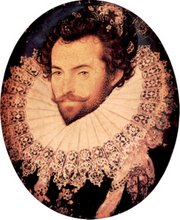
In 1585 an English gentleman by the name of Sir Walter Raleigh sent an expedition of 108 men to America to settle on what is now Roanoke Island, North Carolina. The trip was a failure, and at the first chance they got, the colonists ditched their settlement and caught a ride back home. So much for that.

By 1586, Raleigh was at it again, this time sending a group that included women and children and the hopes for a long-term community. Yet once again they ran into hardships. After a two month struggle for food, the colonists demanded that their governor, John White, return to England for supplies and more help. The poor fellow reluctantly agreed and never saw his family or any of the colonists again. It took three years for White to find a ship to go back to Roanoke and by the time he got there, all he could find was a high fence of logs that had been built where the village used to be. There were no houses left, no bodies, no pots and pans, nothing! The only clue was that on one of the fence posts was the carved word: "CROATOAN." So now we are left with this mystery. What happened to the Roanoke colonists? Were they killed by the natives? Ravished by disease? Destroyed in a fire? Washed away by a hurricane?

Full Article Here:


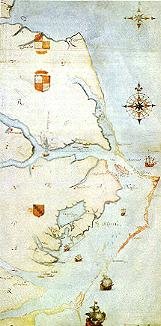
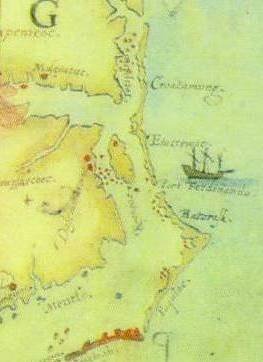
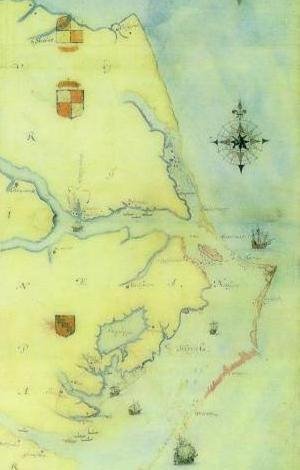
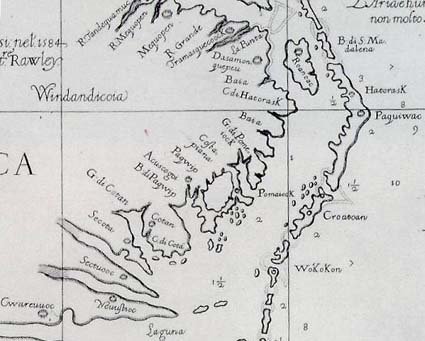
Click on the map for a large version.

Win a Free Weekend in Raleigh, NC


City Life, Carolina Style


*One night accommodations for two at the Courtyard by Marriott Raleigh Crabtree Valley
*$25 gift certificate to Bloomsbury Bistro
*Free VIP admission for two to Rum Runners
*2 tickets to the North Carolina Theatre
*2 tickets to the N.C. Museum of Art's Landscapes from the Age of Impressionism
*2 tickets to Dinosaurs: Ancient Fossils, New Discoveries at the N.C.Museum of Natural Sciences


All you have to do is register here:


Wednesday, September 26, 2007

Blogging Against Abuse, 9/27/07


All that is necessary for the triumph of evil is that good men do nothing.

~ Edmund Burke

Tuesday, September 25, 2007

Croatan Indians of Sampson County, North Carolina

THE CROATANS

The Indian Office at Washington had no knowledge of the existence of the Croatan Indians until the latter part of 1888, when that office received a petition sent by fifty-four of these Indians describing themselves as "a part of the Croatan Indians living in Robeson County," and claiming to be "a remnant of White's Lost Colony," and petitioned Congress for aid. On January 11, 1889, the directors of the Ethnological Bureau in response to this petition replied:

"I beg leave to say that Croatan was in 1585 and thereabouts the name of an island and Indian village just north of Cape Hatteras, N. C. White's Colony of 120 men and women was landed on Roanoke Island just to the north in 1587, and in 1590 when White returned to revisit the colony he found no trace of it on Roanoke Island, save the name 'Croatan' carved upon a tree, which, according to a previous understanding, was interpreted to mean that the colonists had left Roanoke Island for Croatan. No actual trace of the missing colonists was ever found, but more than 100 years afterwards Lawson obtained traditional information from the Hatteras Indians which led him to believe that the colonists had been incorporated with the Indians. It was thought that traces of white blood could be discovered among the Indians, some among they having grey eyes. It is probable that the greater number of the colonists were killed; but it was quite in keeping with Indian usages that a greater or less number, especially women and children, should have been made captive and subsequently incorporated into the tribe."

The Croatan Indians of Sampson County, North Carolina. Their Origin and Racial Status. A Plea for Separate Schools: Electronic Edition. Butler, George Edwin, 1868-1941
http://docsouth.unc.edu/nc/butler/butler.html

If you lost this cannon, please call scientists

A find at sea from 24 years ago begs the question of about how it came to rest on the ocean floor.

Courtesy of Roanoke Island Festival Park, September 19, 2007
This cannon on display at Roanoke Island Festival Park in North Carolina
was found off the Virginia coast in 1983 by scallop fishermen.
Researchers dated it to the 1580s.

BY PATRICK LYNCH 247-4534
September 23, 2007

A small cannon dredged up by scallop fishermen off the Virginia coast 24 years ago is getting a second look as a possible mark of a shipwreck with a - potentially - very interesting history.Some historians believe it is an English cannon from the 1580s, and if the dating is correct it would be one of the oldest English artifacts ever found in the Americas.Its mere existence begs larger questions: How did it get to the bottom of the ocean? Did it merely go overboard or did a shipwreck leave it there? Whose ship was it? When did it happen?

Full Article Here:


http://www.dailypress.com/news/dp-21163sy0sep23,0,4284916,full.story

Saturday, September 22, 2007

'Lost Colony' search goes on centuries later


North Carolina Division of Tourism, Film and Sports Development.
The Elizabeth II was one of the 16th-century ships that delivered members of the
so-called Lost Colony to the New World. The replica seen in this 2001 photo can
be found at the Roanoke


By Mike Baker, Associated Press

GREAT DISMAL SWAMP, N.C. — After trudging for two hours through thick vegetation to a blurry mark found on Google Earth, George Ray started making up a song: "If you're lost, I'll find you tomorrow," he sang in a thick Southern drawl.
Or, perhaps, he'll find you four centuries later.

Ray is one of the many amateur archaeologists entranced by the Lost Colony — the 117 English settlers who disappeared from North Carolina's Outer Banks in the late 1500s, having left behind only a single clue to their fate. In all the years since, no one has found much of anything else.

But there have long been stories told about a rotting boat in the Great Dismal Swamp, a national wildlife refuge that straddles North Carolina's border with Virginia. Ray's colleagues think the colonists may have passed through the swamp after leaving Roanoke Island. They studied satellite images until they found something that looked like a boat, then set out to find it.
"We're not looking for gold," Ray said. "We're looking for history."


Full Article Here:


Wednesday, September 19, 2007

Tracing Your Ancestry Through DNA


Kimberly Powell

Popularized in recent years by its use in high-profile criminal investigations and paternity cases, DNA, deoxyribonucleic acid, is most commonly used to prove a relationship to an individual. New tests created in recent years, however, have also turned DNA into a popular tool for determining ancestry. As DNA is passed down from one generation to the next, some parts remain almost unchanged, while other parts change greatly. This creates an unbreakable link between generations and it can be of great help in reconstructing our family histories.
While it can't provide you with your entire family tree or tell you who your ancestors are, DNA testing can:

*Determine if two people are related

*Determine if two people descend from the same ancestor

*Find out if you are related to others with the same surname

*Prove or disprove your family tree research

*Provide clues about your ethnic origin


Full Article Here:


Tuesday, September 18, 2007

Legends, Theories and DNA: Survivors?

Raleigh's "Lost Colony"


The Official Story

Speculation about the disappearance or demise of the Roanoke Island settlers began as soon as John White set foot on the deserted ground and saw the word "CROATOAN" carved in a tree. White himself found credible evidence that the colonists had merely moved on to safer ground. At the time he was unable to explore inland to look for them. The fact that the colonists had buried items too heavy to carry told White that the move was deliberate.

The prevailing theory carried back to England stated that the colonists had been attacked, if not while on Roanoke Island, shortly after they relocated--perhaps on Croatoan Island or further inland. No survivors were found. Ever.

But in the next decade explorers found little evidence of the colonists. However legends and theories about their fate began to form within these first decades. The attached bibliography contains writings from some of the earliest historians including John White, himself.

For those who like to keep an open mind regarding unresolved mysteries, the fate of the Lost Colony is worthy of further inquiry.

Ghost Ancestors?

Ghost Descendants?

If the Lost Colonists died without further issue, who could claim to be a descendant?

Cont. here:

http://www.westerly-journies.com/pilgrims/lostghosts.html

Sunday, September 16, 2007

Mysteries of the Lost Colony and New World


North Carolina Museum of History Press Release


Mysteries of the Lost Colony and A New World: England's First View of America from the British Museum


Oct. 20, 2007, to Jan. 13, 2008


August 18, 2007, marks the 420th birthday of Virginia Dare, the first English child born in America. Weeks after her birth, her grandfather, John White, governor of the Roanoke Island colony and an artist, traveled to England for supplies. When he returned three years later, the entire colony had vanished.

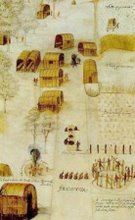
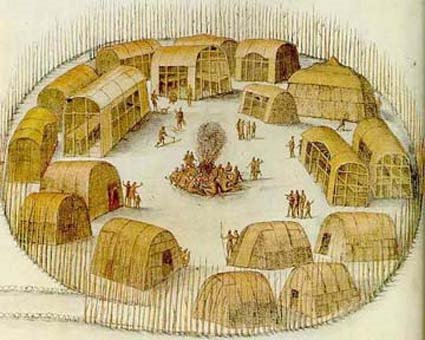
Today, the Lost Colony mystery remains ― as do the exceptional watercolor drawings White created of Roanoke Island in 1585 and 1586. Visitors to the N.C. Museum of History can see more than 70 of these original watercolors, on view for the first time in 40 years outside of England, in a major exhibition opening Saturday, October 20, in Raleigh. White’s detailed renderings from his expeditions to the New World give us the only surviving visual English record of America at the time of European contact.The complete collection of White’s extraordinary images of New World flora and fauna and Algonquian Indians will be featured in Mysteries of the Lost Colony and A New World: England’s First View of America from the British Museum.

This once-in-a-lifetime exhibition, presented through the collaboration of the N.C. Museum of History and British Museum, will run through January 13, 2008. White’s watercolors in A New World: England’s First View of America — called “enthralling” and “unmissable” by London’s Daily Telegraph — form the heart of the larger exhibition. Mysteries of the Lost Colony, produced by the N.C. Museum of History, will give visitors a deeper understanding of England’s first attempts at a permanent settlement in America and will offer several perspectives surrounding the colonists’ disappearance. Exhibit items, such as Algonquian Indian artifacts and other 16th-century objects, offer clues to this unsolved puzzle.

Visitors can follow the 70-year history of the outdoor drama “The Lost Colony,” produced by the Roanoke Island Historical Association, and walk through an Indian village made with set pieces from the drama. The Indian village will feature hands-on activities and the opportunity for further exploration with museum docents.Mysteries of the Lost Colony will include several engravings from the 1500s by Theodor de Bry, a Flemish publisher who engraved prints based on White’s watercolors. De Bry’s engravings were used to illustrate Thomas Harriot’s written account of the 1585 Roanoke voyage, A brief and true report of the new found land of Virginia. A rare 1590 German hand-colored version of Harriot’s manuscript will also be on view. An exhibition catalog, A New World: England’s First View of America, published by UNC Press (2007), is available in the Museum Shop for $60 (hardcover) and $29.95 (paperback).
Initial exhibition sponsors are Blue Cross/Blue Shield, GlaxoSmithKline, the Josephus Daniels Foundation and Time Warner Cable. To bring this exciting adventure to Raleigh, the N.C. Museum of History is collaborating with not only the British Museum, but with Brenau University; the Thomas Harriot College of Arts and Sciences at East Carolina University; Lost Colony Inc.; National Park Service; Roanoke Island Festival Park, a division of the N.C. Department of Cultural Resources; Roanoke Island Historical Association; UNC-Chapel Hill and private collectors.


Ticket and Group Tour Information


Tickets are $10 for adults; $8 for students, senior citizens, active military personnel and adult groups of 10 or more; $5 for children ages 5 to 12 and youth groups ages 5 to 18; free for children ages 4 and under and for Associates members. Purchase tickets at the Museum Shop, online at http://www.etix.com/ or through ncmuseumofhistory.org or ncmuseumofhistoryshop.com. (Service charges apply for etix purchases.) For more ticket information, call 919-807-7900. Most major credit cards are accepted.


To schedule tours for groups of 10 or more, call the Capital Area Visitor Center at 919-807-7950 or toll-free at 866-724-8687. Reservations are required for groups of 10 or more.


From Oct. 20, 2007, to Jan. 13, 2008, the N.C. Museum of History’s hours will be Monday through Saturday, 9 a.m. to 5 p.m., and Sunday, noon to 5 p.m. For more information about the N.C. Museum of History, call 919-807-7900 or visit ncmuseumofhistory.org. The museum is part of the Division of State History Museums, Office of Archives and History, an agency of the N.C. Department of Cultural Resources. The department’s Web site is


Sullivan County TN Library Benefits from Donation

The Sullivan County Library in Blountville, TN was the recent beneficiary of a generous donation by Pat Spurlock Elder, author of Melungeons: Examining an Appalachian Legend., a definitive work concerning the legendary dark-skinned people of the southern Appalachians.

Elder has donated most of her Melungeon research to the Sullivan County Library. When the cataloging is complete, researchers will have access to the large collection of materials amassed by Elder during her thirty years researching Southern families. At a later date, all the reels of Hancock County microfilmed court records, four reels of Grohse's work, the Chris Livesay microfilm and an original copy of Hamilton McMillian's work will eventually go to the library. About 150 or so reels of various microfilm have already been donated.

In addition Elder donated thirty years of Spurlock Family Association research. This is of interest not just to Spurlock researchers, but also to people with early connections to southwestern Virginia and northeastern Tennessee. The only Spurlock data retained was information that connects to Elder's direct line.

The library, located in Blountville, Tennessee, is one of the best genealogical research libraries around. Their genealogy room is small, but they have an extraordinary amount of material. Their website can be accessed here: http://www.wrlibrary.org/Sullivan/ . Copy services for the materials is or will be available for any of the above items.