Pages

Tuesday, November 6, 2007

Indian Food and Cooking in Eastern North Carolina


On their third day in the New World, sometime in July 1584, Sir Walter Ralegh's reconnaissance party under Philip Amadas and Arthur Barlowe met three natives. Having no language in common, the two groups quickly resorted to the universal media of polite discourse: food and drink. The explorers took an Indian aboard one of their ships and persuaded him to sample their meat and wine, which Barlowe said, "he liked very well." In return, the Indian caught them as many fish as his canoe could hold.

Over the next few days the Englishmen entertained Granganimeo, an Indian nobleman, and some of his retinue. He reciprocated by sending "euery daye a brase or two of fatte Buckes, Conies [common cottontail rabbits], Hares [marsh rabbits], Fishe....fruites, Melon [pumpkins], Walnuts, Cucumbers [probably squash], Gourdes, Pease, and diuers rootes." Barlowe made special note of the Indians' corn, which he found "very white, faire, and well tasted."

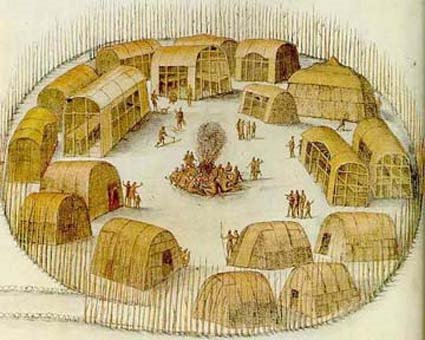
At length Barlowe and seven other Englishmen visited the palisaded village on the north end of Roanoke Island. Although they seem to have arrived unexpectedly while Granganimeo was elsewhere, they got a taste of local hospitality. After washing the visitors and their clothes, Granganimeo's wife and retainers served the Englishmen a feast in his five-room house. It included roasted and stewed venison and fish, boiled corn or hominy, raw and cooked pumpkins and squash, and various fruits.

Barlowe did not record what beverages the Indians served him and his companions, but he did say that the Indians customarily drank wine "while the grape lasteth" and water "sodden with Ginger [sic] in it, and blacke Sinamone [perhaps dogwood or magnolia bark], and sometimes Sassafras, and diuers other wholesome, and medicinable hearbes." (Black drink, made mostly or exclusively of scorched yaupon leaves, was common throughout the region, but the spiced beverages Barlowe describes were not, and wine, if he was not mistaken, was probably unique in the Western Hemisphere.)

For safety Barlowe and company declined to sleep in the village and spent a rainy night in open boats in the sound. Their hosts evidently took no offense, for they sent along the leftovers, pots and all, and kept watch on shore.

Not until Ralph Lane and his colonists spent eleven months in North Carolina (1585-1586) did Englishmen begin fully to appreciate the bounty of the region and the diversity of Indian cuisine. John White, who may not have stayed in the New World the whole time, made several revealing drawings of Indians cooking and eating. Thomas Harriot, a colonist with an analytical mind and a discriminating palate, devoted much of his "Briefe and True Report of the New Found Land of Virginia" to a catalog of native foodstuffs.

The waters of the region yielded tremendous quantities of fish-sturgeon, herring, mullet, and other species-upon which the Indians depended for much of their protein. Crabs, oysters, clams, scallops, and mussels were another major part of their diet. In spring, when stores laid in the previous fall were depleted and crops were not yet ripe, tribes living on the outer coastal plain often sent members who could be spared to nearby estuaries to subsist on shellfish. (In the spring of 1586, worsening relations with the Indians upon whom the colonists depended for food forced Ralph Lane to adopt this practice and disperse his band to various locations where fish and shellfish could be obtained easily.) Over generations, huge mounds of shells accumulated at favored spots. One of these, the present Tillett site on the south end of Roanoke Island, shows evidence of use from around the time of Christ to the disappearance of the coastal tribes in the seventeenth century. Harriot mentioned turtles and terrapins (both "very good meate, as also their egges" ), porpoises, and "Creuises" (crayfish or lobsters or both), but did not say whether Indians ate them.

The Indians of eastern North Carolina probably had no domestic animal except the dog, but the vast forests, marshes, and swamps abounded in bears, deer, rabbits, squirrels, turkeys, doves, partridges, and water birds. Several of the nominally edible mammals were entirely new to the Englishmen, and Harriot did a poor job of describing them. Saquenuckot, for example, could have been a muskrat, opossum, mink, or raccoon; so could Maquowoc.

Harriot listed six wild root vegetables eaten by the Indians. Openauk may have been the ground nut or the Indian or marsh potato-not the Irish potato. (Sir Walter Ralegh has long received undeserved credit for bringing the Irish potato to Europe. It is native to South America, and the Spanish probably introduced it before he was born.) Okeepenauk, "of the bignes of a mans head," may have been the wild potato, a relative of the sweet potato. The English identified coscushaw as casasava. If it belonged to the arum family, it was not poisonous like raw cassava; but the Indians' elaborate preparation probably made a considerable improvement in its taste. Harriot thought that tsinaw (probably some kind of smilax) was similar to the "China root" imported to England from the East Indies. Its name may be nothing more than a native's attempted pronunciation of China. Harriot had such a low opinion of kaishucpenauk (duck potatoes?) that he pointedly omitted "their place and manner of growing." He said little more about the hot-tasting habascon, perhaps the cow parsnip, except that the Indians added it to their stewpots for flavoring and never ate it alone.

Wild fruits added further zest and balance to the Indians' varied diet. Strawberries were available for the taking, as were crab apples, mulberries, persimmons, prickly pears, "Hurtleberies" (huckleberries, blueberries, or even cranberries), and many species that Harriot did not list. The Indians undoubtedly ate all four native varieties of grape (Harriot mentioned two) out of hand even if they did not make wine. In addition, the Indians collected many nuts and seeds, including chinquapins, two kinds of "walnuts" (probably the black walnut and one or more sorts of hickory nut), the five kinds of acorn that Harriot could distinguish (and perhaps others), and a grain that sounds like wild rice but probably came from an unrelated marsh grass.


Full Article Here:

http://www.nps.gov/archive/fora/indcooking.htm


Monday, November 5, 2007

Descendants of the 'Lost Colonists' Forced to Flee Their Own Homes

Cartuca was the capital of the people whose ancestors were known to Raleigh's colonists as Croatans. That the people of King Tom Taylor of Cartuca were descended from members of the Lost Colony may be concluded from the Congressional Report of 1914-1915, by Special Indian Agent O.M. McPherson. It precluded their classification as "Native Americans," with the benefits they would derive from this status. Hugh and Clement Taylor were both members of the Lost colony, but it is not known which, if either, was an ancestor of King Taylor.

When John Lawson and Baron De Graffenried conspired and contracted for the settlement of Palatines in the geographically strategic site of Cartuca--now New Bern--in 1710, the people of King Taylor were pleased at the prospect of European neighbors. Their king was maternally descended from Sir Manteo (knighted Lord of Roanoake and Dasamonguepeuk by Queen Elizabeth) and an english adventurer named Taylor, and they were pleased at the prospect of European neighbors.

The Palatines, from the border electorate of European kings, between France and Germany, had other plans, however. They had no intentions of allowing the Indians to remain in the area of the junction of the Trent and Neuse Rivers. The site controlled heavy freight traffic to the land's interior. With a few well-placed cannons De Graffenried could control shipping there as surely as his ancestors (cousins to the English royalty) controlled the junction of the Neckar and the Rhine.

The sale of Cartuca (Core Tucka, the new Currituck)was a momentous event for the Indians. They saw it as the beginning of a new way of life for them. What sort of a new way of life was soon to become clear to them as the mysterious Corees, who became extinct.

On the night of the celebration of the sale of Cartuca to the whites, it became clear to King Taylor that John Lawson had bargained away far more than Taylor ever intended to sell. His first awareness of the real extent of his peoples' loss brought from him an eloquent plea for brotherhood and cooperation between the whites and the Indians, in the English dialect of the Raleigh colonists.

The unaccustomed spectacle of a savage in European clothing, presenting an impassioned plea for unity with the Europeans, was more than one of the Palatines could take. Michel, a geologist and mining expert, raging drunk on raw rum, jumped on King Taylor and pummeled him mercilessly.

Such behavior on such an occasion was inconceivable to the Indians. To even interrupt a tribal chief was a capitol offense, at the chief's discretion. Michel's brutality ended the festivities for the natives of Cartuca. When Michel was pulled from the battered and bleeding Taylor, John Lawson delivered an ultimatum to the Indians. They must immediately leave Cartuca--and the surrounding area!

The shock to the Indians was profound. The loss to them was suddenly clear. Their home, with its wattled Welsh peasant style houses was no longer theirs. They were expected to vacate Cartuca immediately!

After his painful humiliation before the assembly of whites and his people, King Taylor raged in drunken indignation and disbelief in his own cabin. He rambled on about his white ancestry. He spoke of the nobility of his Indian ancestors, and the appreciation shown to them by the Virgin Queen. And he moaned his grief that John Lawson and the Palatines were such ungracious subjects of a sovereign who succeeded her.

As King Taylor rambled on, loudly and bitterly, English settlers and their friendly Tuscarora neighbors from the Albemarle, who had come to the celebration of New Bern's founding, continued to carouse around the big bonfire with the Palatines. Each outburst of rage and frustration from Taylor's house brought a roar of raucous laughter from the wild gang around the fire.

Loudly some wag in the crowd pointed out to Michel that his English was not nearly so fine as that of King Taylor! Another pointed out that the beating Michel gave him only served to sharpen Taylor's tongue! At this, Michel jumped up, kicked a shower of burning embers from the fire, and vowed to kick as many sparks from the Indian leader's arsch!

Michel ran to Taylor's house, followed by the drunken mob that roared its approval, and kicked open the door. King Taylor was astonished to find his privacy so violated. As he rose to protest, the enraged German pounced on him. Michel again pummeled Taylor mercilessly, knocking him down. When the Indian chief struggled to rise, Michel slammed a boot to his body that kicked him out the door. That was the way King Taylor left his home in Cartuca.
The Indian leader sprawled unconscious in the dirt, as Michel ordered the other Indians from their home. The women of the Taylor household were allowed to hastily gather a few belongings, as the young Indian men picked up their battered father and erstwhile spokesman, of whom they had always been so proud. Then they vanished into the darkness, the way Indians always do.

This was really the opening battle of the Tuscarora War, of which John Lawson was the first officially documented victim. This was the opening battle of the war that pitted the Iroquoian Tuscaroras of Roquis Pocosin, who allied themselves with their English neighbors, against a hodge-podge of Sioux, Algonquins and renegade Iroquois (mostly Tuscaroras)--who saw their destinies prefigured in the disgraceful beating Taylor took. King Taylor--who had so prided himself on his English ancestry.....

Full Article Here:
http://www.dickshovel.com/coreewho.html

Saturday, November 3, 2007

'Lost Colony' Works to Rebuild Costume Collection

By CATHERINE KOZAK The Virginian-Pilot
Posted: Today at 12:05 a.m. Updated: Today at 6:44 p.m.


Manteo — There's a vibe of intensity, similar to the electricity of being backstage before a show starts.

Usually it's a lot quieter this time of year at The Lost Colony Building, where the business of the nation's longest-running outdoor drama is administered.

But everyone has been on overdrive to recover from the devastating Sept. 11 fire that destroyed the production's costume shop and most of the show's costumes.

Losses, including the building and its contents, have been estimated at $2.7 million. The contents were insured for $40,000, based on the fact that they were always moving from building to building.

Since then, though, show officials said they've been overwhelmed by the outpouring from the public; the show's alumni; the theater, movie and television industries; amateur seamstresses; professional costumers; school children; community businesses; as well as public and private organizations from the Outer Banks and all over the country.

"It's amazing, absolutely amazing," Carl Curnutte, the show's executive director and producer said last month, as he briefly removed the phone from his ear to dash from his office to consult with staff.

In the center room where prospective cast members are auditioned every spring, big boards hold growing lists of names and phone numbers of people who want to help. Donations so far have totaled more than $184,000, not including a $250,000 grant from the Outer Banks Visitors Bureau.

"I'm of the opinion that everything we have to do is doable," said John H. Tucker Jr., the chairman of the board of the Roanoke Island Historical Association, the show's producer. "It's a monumental task, but all of sudden we have discovered that people love 'The Lost Colony.'"

Written by Pulitzer Prize-winning playwright Paul Green, the play tells the saga of the 117 men, women and children who sailed from England in 1587 to Roanoke Island and vanished without a trace.

Full article Here:

http://www.wral.com/news/state/story/1999254/

Friday, November 2, 2007

Captain Arthur/Edward Barlow

by Philip R. Beltz

Because I have begun to speak on the subject, I needed a working definition. From several authorities, the Melungeons have been variously described as: "One of a group of dark-skinned people of mixed Indian, White, Negro and other Cultures which live or have lived in the southern Appalachian Mountains".

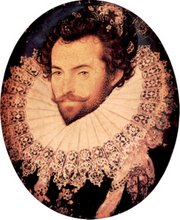
Once into the subject of Melungeons, one must read about the "Lost Colony of Roanoke." I was surprised to see Master Arthur Barlowe, and later, Captain Edward Barlow featured not only for his actions and authority; but also for his documentary writings. This is apparently the same man.

This pertains to Master, and later, Captain Arthur/Edward Barlow, of the 1584 voyage by Sir Walter Raleigh to Roanoke Island, North Carolina. This voyage began the "Lost Colony of Roanoke" story. But Captain Arthur Barlow returned to England. What happened to Arthur Barlow? What is the"official" response of the Barlow Family to this venture, 415 years ago?

I attended "THE MELUNGEON WORKSHOP" at Berea College, Kentucky on September 25 & 26, 1999. One of the speakers was an industrialist and immigrant from Portugal, Manuel Mira. Mira refers to "Master Arthur Barlowe". Mr. Mira spoke and autographed a copy of his book.

In addition, at the book sales table, I bought, "THE MELUNGEONS", by Bonnie Ball. She recounts the same story, but refers to "Captain Edward Barlow".

Please refer to Manuel Mira's:

"THE FORGOTTEN PORTUGUESE: THE MELUNGEONS AND OTHER GROUPS; THE PORTUGUESE MAKING OF AMERICA".

Master Arthur Barlow is referred to on pages: 33, 34, 110, 121 and 303.
Beginning with page 33:

"The Arrival of the Melungeons - Before 1558 or 1584?"

"Sir Walter Raleigh's first expedition departed England on April 27, 1584 and arrived at the Carolina coast on July 4. Included in this expedition were Captain Master Philip Amadas, Master Arthur Barlowe, and as Master Pilot, the Portuguese Simao Fernandes, from Terceira Island, Azores, ..."

"Master Arthur Barlow, who discovered part of the country now called Virginia, gave to Sir Walter Raleigh a narrative of the voyage. After having had contact with the natives, he writes the following description:"

"They are of colour yellowish,and their haire blacke for the most part, and yet we sawe children that had very fine auburn and chestnut colour haire .... and few early descriptions mention hair of other colours, except with the assumption that it represents a mixture with the Europeans. ... reddish hair is often found in children whose hair later becomes, to all appearances, black. 46"

Citation # 46 is "THE ROANOKE VOYAGES" by David Beers Quinn, Vol. I, pp. 102, 103.
Continuing on page 34:

"A similar story is told after Master Barlowe traveled inland near a town called Sequotan where Wingina appears to be the chief of all the villages from Pamlico River to Roanoke Island ...
'neere unto which, sixe and twentie yeers past, (1558) there was a shippe castaway, wherof some of the people were saved, and those were white people, whom the Countrey people preserved. After ten daies, remaining in and out Island uninhabited, called Wococan, (an island in the Carolina Outer Banks) they with the help of some of the dwellers of Sequotan, fastened two boates of the Countrey together, and made mastes unto them, and sailes of their shirtes, and having taken them such victuals as the Countrey yeelded, they departed after they had remained in this out Island three weeks: but shortly after, it seemed they were cast away, for the boates were found upon the coast, cast aland in another Island adioyning': ..."

"These shipwrecks prove that they were common in these parts of the east coast. They may not have survived but why not others?"

"'...other than these, there was never any people apparelled, or white of colour, either seen, or heard amongst these people'"[Ibid, page 111]

"These natives in particular may not have seen any other white men, but it is known that other explorers and navigators were traveling along the east coast since the early 1500s, ..."
Continuing, slightly repeating on page 110:

"In 1584, Sir Walter Raleigh obtained a charter from Queen Elizabeth I giving him the right to possess lands in the New World not already under Christian control. A voyage was planned with Arthur Barlowe and Philip Amadas in charge, and the Portuguese Simao Fernandes was the pilot. They departed on April 27 and arrived on July 13 at Roanoke, Virginia."

Full Article Here:
http://www.barlowgenealogy.com/Resources/melungeon.html

Monday, October 29, 2007

Can DNA Solve "The Lumbee Problem"?


How does a group of people who have American Indian ancestry but no records of treaties, reservations, Native language, or peculiarly "Indian" customs come to be accepted--socially and legally--as Indians?That question is asked on the jacket of the 2001 printing of The Lumbee Problem--The Making of an American Indian People by anthropologist Karen I. Blu (University of Nebraska Press, 2001; copyright 1980, Karen I. Blu). And that's just the surface of "the Lumbee problem."

Suppose Scots-Irish settlers in North Carolina in the early eighteenth century came upon a group of people who in some ways seemed to be indigenous, but spoke seventeenth century English and had English names. History or an episode of the Twilight Zone?

Indeed, this seems to be the history of the Lumbee Indians of North Carolina. But who are they really? Are they Indians? What is their origin?

A prominent theory is that the Lumbees are descendants of Native Americans and survivors of the Lost Colony of North Carolina.

In 1587, a group of colonists under Sir Walter Raleigh's charter landed in the Outer Banks of what is now North Carolina. This was the second or third group of colonists in the area. One group had returned to England with Sir Francis Drake. The latter group was headed by Governor John White. White returned to England to re-supply the colony; his voyage back to America was delayed by the complications of the English war with Spain and the winter weather. When White did return in 1590, the colonist were gone, but strange "clues" were found. The word "Croatan" was found carved in the wall of a structure that had been built by the colonists. The colonists were never found.

In the early 1700's, Scots-Irish settlers came upon English-speaking people in the interior of southeastern North Carolina. These people appeared to be of mixed race. It is said that in the early censuses, these people were enumerated as "mulattoes" or "free Negroes." The people themselves claimed to be Indians. They waged a legal and political struggle in t he nineteenth century for recognition as Indians.


http://geneablogie.blogspot.com/2007/10/can-dna-solve-lumbee-problem.html

Wednesday, October 24, 2007

'Mysteries of the Lost Colonies' Opens at N.C. Museum of History


Programs planned to comple-ment exhibit.


The N.C. Museum of History will offer a variety of programs that complement the exhibition "Mysteries of the Lost Colony and A New World: England's First View of America from the British Museum," on view from Saturday, Oct. 20, to Jan. 13, 2008, in Raleigh. All programs are free, except the Curator's Tour on Saturday and the program on historic plants on Oct. 25.


"Mysteries of the Lost Colony" is presented by the N.C. Museum of History in collaboration with the Roanoke Island Historical Association, producer of the outdoor drama "The Lost Colony."


"A New World: England's First View of America" is presented in collaboration with the British Museum. For ticket information, call (919) 807-7900 or go to http://www.ncmuseumofhistory.org/.


• Curator's Tour: "A New World: England's First View of America," Saturday, Oct. 20, 2 p.m. A ticket to "Mysteries of the Lost Colony and A New World: England's First View of America" is required. (Free for associates members.) Presented by Kim Sloan, curator of "British Drawings and Watercolours Before 1880" and Francis Finlay, curator of the Enlightenment Gallery, British Museum. The paintings of John White gave the Elizabethan world its first glimpse of America. Join the exhibition curator for a special look at Mr. White's works.


• "Historic Plants of Colonial America," Thursday, Oct. 25, 2-4 p.m., $15 ($10 associates members). The program will take place at the Doris Duke Center, Sarah P. Duke Gardens, Durham. To register, call (919) 730-2503. Presented by Mark McVicker, nursery manager, Thomas Jefferson Center for Historic Plants. Botanists John Clayton, AndrĂ© Michaux and John and William Bartram were instrumental in discovering many plants in North America and introducing them to colonial and European gardens. Mr. McVicker will discuss the impact and significance of their finds. The program is presented in conjunction with the Sarah P. Duke Gardens.


• "What Happened to the Lost Colony?," Saturday, Oct. 27, 2 p.m. To register, call (919) 807-7992 by Oct. 24. Presented by David LaVere, professor of history, University of North Carolina at Wilmington. "The Lost Colony" is North Carolina's legendary whodunit. Join Mr. LaVere as he presents his theory about this centuries-old unsolved mystery.


• "A Very Cold Case: A Progress Report on the Search for the Lost Colonists," Saturday, Nov. 10, 2 p.m., To register, call (919) 807-7992 by Nov. 8. Presented by Dr. Charles Ewen, professor of anthropology and director of Archaeology Laboratories, East Carolina University. Drawing upon recent archaeological research, Dr. Ewen will examine several theories concerning what happened to the colonists at Roanoke Island.


The N.C. Museum of History's hours are Tuesdays through Saturdays from 9 a.m. to 5 p.m., and Sunday from noon to 5 p.m. From Saturday, Oct. 20, through Jan. 13, 2008, the museum will be open on Mondays from 9 a.m. to 5 p.m. Admission is free.

The museum is part of the Division of State History Museums, Office of Archives and History, an agency of the N.C. Department of Cultural Resources. The department's Web site is http://www.ncculture.com/.

Roanoke, the Accidental Colony


by Janet Crain

The Lost Colony, an accident of fate with a tragic outcome that reverberates to this day, should never have happened. The group of colonists sent out by Sir Walter Raleigh in 1587 to establish the Cittee of Raleigh, had never intended to locate on the Island of Roanoke. But after a four month long trip marked by delays, mishaps, evasive tactics and possibly outright sabotage, these some 117 men, women and children were unceremoniously dumped on the island by Captain Fernandez. All but but two of them would vanish without a trace.

They had intended only to stop by the island where fifteen men had been left behind by Sir Richard Grenville the year before, after the failure of first settlement attempt. Governor John White and forty of his "best men" would make a short visit to check on the men, then they would continue on to their destination about 50 miles up the coast of the Chesapeake Bay. Exploration parties sent there previously had made favorable reports on the suitability of the area for settlement. But as soon as the pinnace carrying the men was in the water, Captain Fernandez ordered them to stay there on the island, forbidding them to re-board his ship, claiming he needed to return to the Caribbean as the season was growing short for privateering. Inexplicitly, he then sat at anchor for several weeks in a cruel taunting gesture to the colonists stranded on an island where something very sinister and unexplainable had obviously occurred. Among the first sights to greet the landing party were the bleaching bones of one of the fifteen Englishmen left behind the previous year. The other 14 had vanished without a trace, the fort had been destroyed and the houses had fallen into disrepair. Deer were grazing on melons which had grown up in the floors of the abandoned houses. Something was terribly wrong.

Trying to make the best of their situation, the Colonists began repairing the houses and building new more substantial ones of tile and brick. Their situation was truly precarious. Arriving too late to plant crops, they had not been allowed to take on salt, cattle, plants or fresh water at Hispaniola to replenish their dwindling supplies. They did not have sufficient food to exist for more than a few weeks. They were horrified when one of the assistants, George Howe, out crabbing alone, was killed and mutilated by Indians. Someone would have to return to England and get word to Sir Walter Raleigh that they were in peril. But who would even be able to see Raleigh and who would be believed? These men were, for the most part, middle class craftsmen and the like, unschooled in statecraft. There was only one answer after Christopher Cooper agreed to go, then withdrew his offer. The only man sure to get through to Raleigh and be believed was John White, the Colony Governor. He had been picked by Raleigh to lead this colony and was respected by him. John White did not want to leave his daughter, her husband and his granddaughter, nine day old Virginia Dare. The Colonists begged him to do so though and knowing it was their last chance, John White agreed to set sail with Edward Spicer, who had miraculously found the settlers after his flyboat became separated from them early in the voyage. White refused to sail with Captain Fernandez. He hurriedly prepared and left instructions for certain symbols to be carved if the colonists leave this location. They are to carve the name of the location to which they are relocating on door posts or trees; if they are in distress they are to carve a Moline or Maltese* cross over the name.

Continued here:

http://www.genpage.com/Roanoke_Lost_Colony.html#Unfortunately

Saturday, October 20, 2007

First of many replacement 'Lost Colony' costumes finished

By KRISTIN DAVIS,
The Virginian-Pilot © October 19, 2007

ROANOKE ISLAND

The Richmond fabric store, the one she'd shopped at all the years she'd lived in the city, had almost everything the costumer needed.

It didn't always turn out that way. There had been times when Joan Brumbach stopped in and couldn't find a thing. But she was lucky that Saturday almost two weeks ago. She needed 125 yards of all-natural fabrics right away.

Brumbach had been charged with making the first five replacement costumes for "The Lost Colony," the 70-year-old play that lost its costume shop and everything inside in a Sept. 11 fire at Roanoke Island's Waterside Theatre.

She had less than two weeks.

The costumes, fit for four Elizabethan ladies and one gentleman, were needed for the opening of a North Carolina Museum of History exhibit in Raleigh today.

Later, they will go into "The Lost Colony" costume stock.
There are no patterns to start from. The fire got those, too. But the costume bibles - big binders full of descriptions and photographs of every look at every angle - survived because they were someplace else.

This is where Brumbach starts.

White petticoat, bum roll, colored petticoat, colonist skirt (pinned up), white colonist blouse, colonist bodice, white cap. Times four. Good colonist breeches, good colonist shirt, good colonist singlet, Plymouth vendor hat.

Full Article Here:

http://content.hamptonroads.com/story.cfm?story=134989&ran=124526

Friday, October 19, 2007

Gods and Men: The Meeting of Indian and White Worlds on the Carolina Outer Banks


by Michael Leroy Oberg


It was on the fourth of July in 1584 that Philip Amadas and Arthur Barlowe, soldiers and sailors both in the service of Sir Walter Ralegh, arrived off the coast of what is today North Carolina, setting in motion the forces that would transform the life of Manteo The two explorers travelled with instructions to scout out the location for the colony Ralegh hoped to establish in America in the very near future.

By the 13th ofJuly, the English voyagers had landed on Hatorask Island, taking possession of the land in the name of the Queen 'according to the ceremonies used in such enterprises'. They then returned to their two ships, anchored off the western side of the island, and waited. On the third day, according to Barlowe, they 'espied one small boate rowing towards us, having in it three persons'. These Roanoke Indians landed at Hatorask. Two of them remained with their boat while 'the third came along the shoare side towards us'. Where 'he walked up and downe upon the point of the lande next unto us'. Several Englishmen, including Barlowe and Amadas, rowed ashore to greet him. After the lone Indian 'had spoken of many things not understoode by us, we brought him with his owne good liking, aboord the shippes, and gave him a shirt, a hatte, and some other things, and made him taste of our wine, and our meate, which he liked very well'. He then 'requited the former benefits receaved' before he departed by providing the explorers with enough fish for an impressive banquet.


The three natives returned to Roanoke Island with word that the newcomers posed no threat, for the next day, Barlowe reported, 'there came unto us divers boats, and in one of them the Kings brother, accompanied with fourtie or fiftie men, very handsome, and goodly people, and in their behaviour as mannerly, and civill, as any of Europe'. Granganimeo, the brother of the Roanoke weroance Wingina, met the English on the shore, and 'made all signes of joy, and welcome, striking on his head, and his breast, and afterwardes on ours, to shewe we were all one, smiling and making shewe the best he could, of all love, and familiaritie'.


'We were all one', Granganimeo tried to tell Barlowe. The Roanokes took great interest in the English voyagers. Trading commenced quickly. Indians offered deerskins for English trade goods. Others brought 'with them leather, corrall, divers kindes of dies very excellent, and exchanged with us'. Such intercultural exchange provided the foundation for a fragile middle ground on the coast of Hatorask Island, as Indians and Englishmen each took steps to incorporate the other into their own conceptual world, and to make sense of the strangers they then were encountering.


After several days, and after the Indians 'had beene divers times aboord our shippes', Barlowe and seven others sailed around the southern tip of Roanoke Island, and north along the island's western shore, before stopping for several nights at the Roanokes' village 'of nine houses, built of Cedar, and fortified round about with sharpe trees, to keepe out their enemies', on the northern tip of the island. Though far from trusting entirely in his hosts, Barlowe wrote that he and his companions 'were entertained with all love, and kindness and with as much bounties after their manner, as they could possibly devise'.


What Barlowe saw on Roanoke Island impressed him. The Indians were pure of heart, he wrote, and friendly. 'Wee found the people most gentle, loving, and faithful, void of all guile, and treason, and such as lived after the manner of the golden age. The earth', he wrote, brought forth for the Indians 'all things in aboundance, as in the first creation, without toile or labour'. Roanoke, or the surrounding islands, Barlowe reported, would provide the ideal location for a future English settlement.
Full Article Here:

Thursday, October 18, 2007

The Other Lost Colony Turns 400 Years Old October 19th

Popham, Maine's 'lost' colony turns 400 years old Oct. 19th!


Jamestown's forgotten sister colony turns 400 this month, but few realize its role in history.


Popham Colony is an English settlement that predates the Pilgrims by 13 years.


Melanie Stetson Freeman

Full Article Here:

http://www.csmonitor.com/2007/0815/p13s01-litr.html


October 19, 1607: English settlers officially found "the other" English colony on North America. Unlike Jamestown, Popham is settled by just men and boys. Popham, northeast of modern Portland, Maine, is established on the bluffs overlooking the spot where the Kennebec River flows into the ocean. The colony lasts only a little over one year. The colony's second leader returns to England, taking the settlers with him, when he inherits a sizeable estate in England.

BACKGROUND:

From http://www.mainesfirstship.org/

The Popham Colony was the first organized attempt to establish an English colony on the shores of what we now know as New England. It was planted at the mouth of the Kennebec River in the summer of 1607 and lasted for little over a year until it was abandoned in the fall of 1608. Popham was not the first European colony in New England. The French were earlier with a brief settlement on an island in the St. Croix River between Maine and New Brunswick in 1604. Although Popham was the first claim of possession of what was then called Northern Virginia by the English, the honor of the actual founding of a "New" England belongs to the Pilgrims who established the first permanent settlement in Massachusetts Bay thirteen years later. Despite its precedence, the failure of the Popham Colony to endure has rendered it a nearly forgotten historical footnote. Its failure, however, was an important step in the ongoing experience of English colonization and the lessons learned contributed directly to the ultimate success of the Pilgrims.

http://nativenewsonline.org/history/hist1019a.html