Pages

Wednesday, October 17, 2007

The Roanoke Voyages in Literature


After a pleasant visit to the Outer Banks, Ralegh's reconnaissance party under Philip Amadas and Arthur Barlowe returned to England in September 1584. Almost immediately chroniclers, spies, gossips, and dilettantes seized on reports of the Edenic land of Wingandacon — which turned out to be not the name of the place, but a garbled Algonquian reference to trees or to English clothing. Ever since, writers of many interests and attainments have occasionally taken on the first English attempts to colonize what is now the United States; most have paid special attention to the 1587 lost colony.


The Roanoke colonies pose several challenging questions: Who were the colonists? Who were their backers? How did they get along with one another? Why did they let relations with the Indians descend into open warfare? Where was their settlement? Was there more than one settlement? Does the restored sconce at Fort Raleigh National Historic Site make up Lane's New Fort in Virginia in toto? Is it the only substantial fortification the colonists built? What happened to the 1587 Lost Colony? Were the colonists failures? What does the whole exercise mean? Writers dealing with the Roanoke colonies have necessarily grappled with most of these questions. Even the most amateurish and tendentious of the answers they have assayed have stimulated lively, sometimes productive public debate over the scanty physical and documentary evidence the colonists left behind and over the place in history that the Roanoke colonies warrant.


Most works about the Roanoke colonies fit, seldom neatly, into one of four categories. There is no compelling reason to segregate them further, according to whether they seem predominantly factual or imaginative. Most nonfiction writers are heavily influenced by their own or their sources' imaginations. The indispensable contemporary accounts of the Roanoke colonies are by turns discursive, fictional, poetic, and dramatic. Not even Thomas Harriot's Briefe and True Report of the New Found Land of Virginia (1588), the first fundamentally scientific description of the peoples and resources of North America, is untainted by the author's imagination. The best fiction, poetry, and drama is solidly founded in historical research, if not in historical fact, and it engenders discussion and spreads information (correct or not) as few scholarly works could do. The reader should measure the ratio of fact to imagination in each work for himself.


Full Article Here:


Thursday, October 11, 2007

THE MYSTERIOUS “WOMEN’S TOWNE” OF NORTH CAROLINA


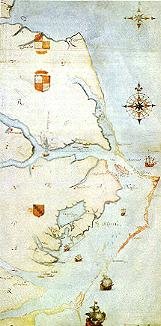
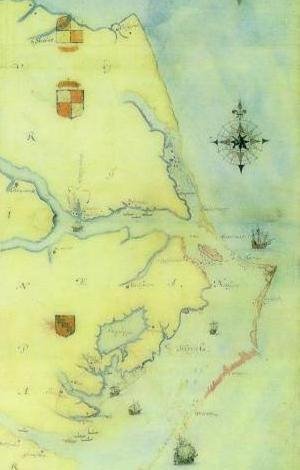
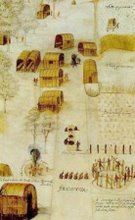
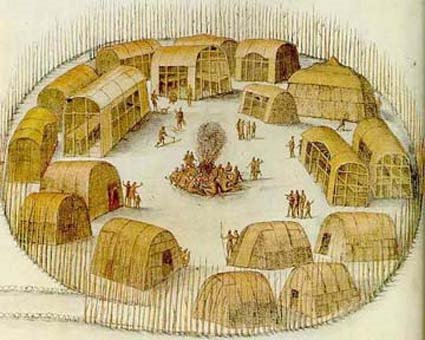
The earliest illustrations of North Carolina, painted by the artist John White, are coming to America this October. White traveled with a company of Englishmen who explored the region and left tantalizing records of their discoveries. One of their most unusual finds, an Indian “Women’s Towne,” was never illustrated or explained.

The expedition camped in America for a year, from 1585-86, under the leadership of Ralph Lane. In his journal, Lane describes venturing up the Roanoke River with a party of men, finding the Algonquian villages deserted, and growing desperate for food. He then mentions an Algonquian “women’s town” near the water.

He intends to plunder that settlement’s fish weirs: “… seeing all the Countrey fled before us, and therefore while wee had those two dayes victuall left, I thought it good for us to make our returne homeward, and that it were necessary for us to get the other side of the Sound of Weopomeiok in time, where wee might be relieved upon the wears [weirs] of Chypanum, and the womens Towne, although the people were fled.”

Historians have not determined why Lane referred to this village as“Women’s Towne.” According to Professor Michael Oberg, author of a newbook on the Roanoke Indians, “We do know that women could lead Algonquian village communities. It may be as simple as Lane referring to a village community governed by a weroansqua (female leader). But my short answer would be that we just don’t know.”

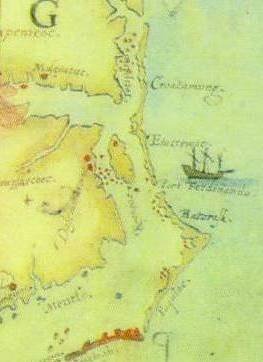
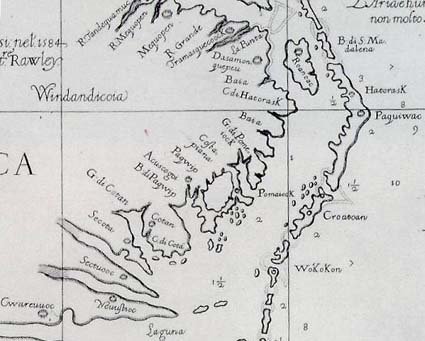
White’s map of the region shows two settlements at “Chypanum,” in Weapemeoc tribal territory on the north of Albemarle Bay, that are divided by the fork of an inlet and connected by a hatchmarked path.No other villages are shown linked in this way. Was one of these the Women’s Town, led by a Native American woman, or by women? It is unclear. Explorers reported that a weroansqua governed the Croatoan tribe on Croatoan Island (now Hatteras), but that village was never described as a “women’s town.”

A year after White ventured as an illustrator, he would return to America in a new role – as governor of the ill-fated “Lost Colony,” a gamble that cost him his daughter and granddaughter. Deborah Homsher has written a novel, THE RISING SHORE – ROANOKE, about that 1587 expedition. White’s daughter, Elenor Dare, is one of the narrators.

John White’s watercolors, on loan from the British Museum, will be on display at the North Carolina Museum of History in Raleigh from October 20 through January, in the exhibit, “Mysteries of the Lost Colony. A New World: England’s First View of America.” This is the first time these fragile paintings have been exhibited outside England in forty years.

For information, see http://ncmuseumofhistory.org/.

For information on Elizabethan pioneers, with links to their original reports, see http://www.risingshoreroaonke.com/.

Sunday, October 7, 2007

Proving Your Native American Heritage


Copyright 2007, Roberta Estes, all rights reserved
http://www.dnaexplain.com/

Many American families carry oral histories of Native American heritage. Most often, we think of either the Western tribes who still reside in or near their indigenous homes, or the Cherokee who were displaced in the 1830s, forced to march from Appalachia to Oklahoma in the dead of winter, an event subsequently known as the Trail of Tears.

In truth, the history of Native American heritage in North America is much, much more complex. It is probable that many of the people who carry oral history of “Cherokee heritage” are actually descended from a tribe other than the Cherokee initially. The Cherokee were well known for accepting remnants of other tribes whose members and numbers had been decimated by disease or war. Sometimes these alliances were created for mutual protection.

The Cherokees were not the only tribe in the Eastern United States. The Eastern seaboard was widely populated by varying tribes, some related and affiliated, and some not. There were in fact three major language groupings, Algonquin, Souian and Iroquoian scattered throughout the Eastern seaboard northward into Canada, westward to Appalachia and south to the Gulf of Mexico.

People from Africa were also imported very early, often, but not always, as slaves. Jamestown shows evidence of individuals of African heritage. Those who were later brought specifically as slaves sometimes ran away, escaping into the Native population. Conversely, Indians were often taken or sold by defeating tribes into slavery as well.

In the early years of settlement, European women were scarce. Some men immigrated with wives and families, but most did not, and few women came alone. Therefore, with nature taking its course, it is not unreasonable to surmise that many of the early settlers traded with, worked alongside and married into indigenous families, especially immigrants who were not wealthy. Wealthy individuals traveled back and forth across the Atlantic and could bring a bride on a subsequent journey.

Further complicating matters, there were numerous “lost” individuals of varying ethnicity in the very early years of colonization. Specifically, Juan Pardo established forts in many southern states from Florida to Mexico beginning in 1566. The Spanish settled Florida and explored the interior beginning in 1521, settling Santa Elena Island in present day South Carolina from 1566-1576. Their forays extended as far North as present day East Tennessee. In 1569, 3 English men arrived in Cape Breton, Nova Scotia having set out on foot with 100 men 4000 miles earlier in Tampico, Mexico. These individuals are in addition to the well-known Lost Colony of Roanoke, and the less well-known earlier military expeditions on which several individuals were “lost” or left behind.

What does this mean to the family historian who is trying to prove their genealogy and understand better just who they are and where they come from?

If your family has a long-standing oral history of Native American heritage, it is probably true. Historically, Native people were classified as “non-white” which severely limited (and sometimes prevented) their ability to function as free, white, people with equal rights. This means that free “people of color” often could not vote, could not own land, and could not attend schools along with white people, if at all.

Furthermore, laws varied and how much non-white heritage constituting “people of color” ranged from the infamous “one drop” rule to lesser admixture, sometimes much more liberal, to only the third generation. In essence, as soon as individuals could become or pass for “white” they did. It was socially and financially advantageous. It is not unusual to find a family who moved from one location to another, often westward, and while they were classified as mulatto in their old home, they were white in their new location.

Often there were only three or sometimes four classifications available, white, negro or black, mulatto and Indian. Sometimes Indian was a good thing to be, because in some colonial states, Indians weren’t taxed. However, this also means their existence in a particular area often went unrecorded.

Any classification other than white meant in terms of social and legal status that these people were lesser citizens. Therefore, Native American or other heritage that was not visually obvious was hidden and whispered about, sometimes renamed to much less emotionally and socially charged monikers, such as Black Dutch, Black Irish and possibly also Portuguese.

For genalogists who are lucky, there are records confirming their genealogy, such as the Dawes Rolls and other legal documents. More often, there are only hints, if even that, such as a census where an ancestor is listed as mulatto, or some other document that hints at their heritage. Most often though, the stories are very vague, and were whispered or hidden for generations. References may be oral or found in old letters or documents. Supporting documentation is often missing.

Many times, it was the woman of the couple who was admixed initially, of course leading to admixed children, but with 50% less admixture than their mixed parent. It was much more common for a male of European stock to intermarry with Native or admixed women, rather than the other way around.

This means to genetic genealogists today, that they are likely to meet with frustration when attempting to document Native heritage in a male line.

Let’s take a look at why this is and how we can build a DNA pedigree chart to track our ancestry.

Continue here:
http://www.genpage.com/Native_American_Heritage.html#Continued


Early History of the Outer Banks of North Carolina


Early Inhabitants


Jutting far into the ocean near the warm, circulating waters of the Gulf Stream, the Outer Banks was the first North American land reached by English explorers. A group of colonists dispatched by Sir Walter Raleigh set up the first English settlement on North American soil in 1587. But Native Americans inhabited these barrier islands long before white men and women arrived.

Historians believe humans have been living in the area that now encompasses North Carolina for more than 10,000 years. Three thousand years ago, people came to the Outer Banks to hunt, fish, and live off the land. The Carolina Algonkian culture, a confederation of 75,000 people divided into distinct tribes, spread across 6,000 square miles of northeastern North Carolina.

Archaeologists believe that as many as 5,000 Native Americans may have inhabited the southern end of Hatteras Island from 1000 to 1700. These Native Americans, known as the Croatan, formed the only island kingdom of the Algonkians. Isolation provided protection and the exclusive use of the island's seemingly limitless resources. For more than 800 years, the Croatan lived comfortably in what is now known as Buxton Woods Maritime Forest at Cape Hatteras. Contact with Europeans proved fateful, however. Disease, famine, and cultural demise eliminated all traces of the Croatan by the 1770s.

Early ventures to America's Atlantic Seaboard proved dangerous and difficult for European explorers because of the high winds, seething surf, and shifting sandbars. In 1524 Giovanni da Verrazano, an Italian in the service of France, plied the waters off the Outer Banks in an unsuccessful search for the Northwest Passage. To Verrazano, the barrier islands looked like an isthmus and the sounds behind them an endless sea. According to historian David Stick, the explorer reported to the French king that these silvery salt waters must certainly be the "Oriental sea . . . the one without doubt which goes about the extremity of India, China, and Cathay." This misconception-- that the Atlantic and Pacific Oceans were separated by only the skinny strip of sand we now call the Outer Banks-- was held by some Europeans for more than 150 years.

About 60 years after Verrazano's visit, two English boats arrived along the Outer Banks, searching for a navigable inlet and a place to anchor away from the ocean. The captains, Philip Amadas and Arthur Barlowe, had been dispatched by Sir Walter Raleigh to explore the New World's coast. They were hoping to find a suitable site for an English settlement.

The explorers finally found an entrance through the islands, well north of Cape Hatteras, probably at the present-day Ginguite Creek in northern Kitty Hawk. Traversing the inlet, they sailed south through the sounds to Roanoke Island. There, they disembarked, met the natives, and marveled at the abundant wildlife and cedar trees. Of their successful expedition they told Raleigh about the riches they discovered and the kindness with which the Native Americans had received them.

During the next three years, at least 40 English ships visited the Outer Banks, more than 100 English soldiers spent almost a year on Roanoke Island, and Great Britain began to gain a foothold on the continent, much to the dismay of Spanish sailors and fortune-seekers.

Full Article Here:

http://www.insiders.com/outerbanks/main-history2.htm


Thursday, October 4, 2007

The First Colony at Roanoke Island

John White drawing of fort in Puerto Rico, constructed by Ralph Lane, 1585 Lane built a fort called "The new Fort in Virginia," where the present Fort Raleigh National Historic Site is situated and where the remains of a fort were still visible as late as 1896. The fort was located near the shore on the east side of Roanoke Island between the "North Point" of the north end of the Island and a "creek." The mouth of the so-called creek was big enough to serve as the anchorage for small boats (Shallow Bag Bay, known as late as 1716 as "Town Creek").

Lane's fort on Roanoke Island resembled in some noteworthy respects the fort which he had built on St. Johns Island, Puerto Rico, in May 1585, when he seized the salt supply. Both forts seem to have been roughly shaped like a star built on a square with the bastions constructed on the sides of the square instead of at the corners, as was common in later fortifications. Copies of the plans of these forts may be seen in the Fort Raleigh museum.


The dwelling houses of the early colonists were near the fort, which was too small to enclose them. They were described by the colonists themselves as "decent dwelling houses" or "cottages" and must have been at least a story and a half or two stories high, because we have a reference to the "neather roomes of them." The roofs were thatched, as we learn from Ralph Lane's statement that the Indians by night "would have beset my house, and put fire in the reedes that the same was covered with." The chimneys and the foundations may have been of brick, because Darby Glande later testified that "as soon as they had disembarked [at Roanoke] they began to make brick and fabric for a fort and houses." Pieces of brick were reported found at the fort site as late as 1860, and recent archeological work at the fort turned up a few brickbats, possibly of the Elizabethan period.


Thomas Hariot remarked that though stone was not found on the island, there was good clay for making bricks, and lime could be made from nearby deposits of oyster shells in the same manner that lime was made "in the Isles of Tenet and Shepy, and also in divers other places of England." However, as no evidence of the extensive use of brick has yet been found, it is perhaps safe to assume that the chief building material was rough boards. It has already been noted that they had a forge which they could set up to make nails. Richard Hakluyt, in his Discourse of Western Planting, written at the request of Sir Walter Raleigh in 1584, about 1 year before the colony sailed, had recommended as "things to be prepared for the voyadge" that any colonial expedition should include "men experte in the arte of fortification," "makers of spades and shovells," "shipwrights," "millwrights, to make milles for spedy and cheape sawing of timber and boardes for trade, and first traficque of suertie," "millwrights, for corne milles," "Sawyers for common use," "Carpinters, for buildinges," "Brick makers," "Tile makers," "Lyme makers," "Bricklayers," "Tilers," "Thatchers with reedes, rushes, broome, or strawe," "Rough Masons," "Carpinters," and "Lathmakers." The presumption therefore is that typical English thatched cottages and houses, such as were found in rural Elizabethan England, were built at Roanoke. (The log cabin appears to have been introduced into America about 50 years later by the Swedes and Finns on the Delaware.) The Roanoke cottages were presumably well built. The skilled labor of the expedition had been able to construct a seaworthy pinnace at Puerto Rico in less than a month's time.


Full Article Here:


Wednesday, October 3, 2007

Pirates, Ghosts, and Coastal Lore


The Best of Judge Charles H. Whedbee

In 1963, Judge Charles Whedbee was asked to substitute on a morning show called Carolina Today on Greenville, North Carolina's, television station while one of the program's regulars was in the hospital. Whedbee took the opportunity to tell some of the Outer Banks stories he'd heard during his many summers at Nags Head. The station received such a volume of mail in praise of his tale-telling that he was invited to remain even after the man he was substituting for returned to the air. "He had a way of telling a story that really captured me," said one of the program's co-hosts. "Whether he was talking about a sunset, a ghost, or a shipwreck, I was there, living every minute of it."


Word traveled as far as Winston-Salem, where John F. Blair proposed to Whedbee that he compile his stories in book form. Whedbee welcomed the challenge, though his expectations for the manuscript that became Legends of the Outer Banks and Tar Heel Tidewater were modest. "I wrote it out of a love for this region and the people whom I'd known all my life," he said. "I didn't think it would sell a hundred copies."


From the very first sentence of the foreword, Whedbee stamped the collection with his inimitable style: "You are handed herewith a small pod or school of legends about various portions of that magical region known as the Outer Banks of North Carolina as well as stories from other sections of the broad bays, sounds, and estuaries that make up tidewater Tarheelia."

The Lost Colony, Indians, Blackbeard, an albino porpoise that guided ships into harbor—the tales in that volume form the core of Outer Banks folklore. Whedbee liked to tell people that his stories were of three kinds: those he knew to be true, those he believed to be true, and those he fabricated. But despite much prodding, he never revealed which were which.
Cont. Here:

Monday, October 1, 2007

First English Settlement in the New World

Walter Raleigh and son Wat


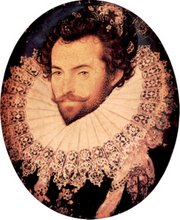
Fort Raleigh National Historic Site directly connects the American people with the Court of Queen Elizabeth and the golden age of English art, literature, and adventure. The figures who play the chief roles in the story of the exploration and attempted settlement of the island are the epic figures of English history: Queen Elizabeth, after whom the new land was named "Virginia," is easily the premier sovereign of England; Sir Walter Raleigh, poet, soldier, and statesman, and the inspiration and financial mainstay of the Roanoke Island project, is the best remembered of gallant English courtiers; Sir Richard Grenville, of the Revenge, who brought the first colony to America in 1585 and left another small group there in 1586, is the Elizabethan hero who in 1592 taught English sailors how to dare and die in the face of overwhelming odds; Sir Frances Drake, who rescued the first colony from starvation, is famous as the first English circumnavigator of the globe and as the preeminent seadog and explorer of English history.


As Plymouth and other early New England sites connect the United States with the great European movement known as the Reformation, so the scene of Raleigh's settlements connects the American people with the powerful activating force known as the Renaissance. When energized by the Renaissance movement, the human spirit knew no earthly bounds nor recognized any limits to intellectual or physical endeavor. Thus, Raleigh, who was born a gentleman of only moderate estate, willed to be the favorite of a Queen, aspired to found an empire across the seas in the teeth of Imperial Spain and undertook in prison to write the history of the world! For the glory and enrichment of England, Sir Francis Drake pillaged the cities and mighty galleons of Spain and dared to sail around the globe. Sir Richard Grenville, shortly after his memorable voyages to Roanoke Island, gave the British Navy an immortal tradition by dueling for a day and a night with one small ship against a Spanish fleet of 53.

Truly heroic was the Roanoke Island colonial venture. Here, despite the hostility of Spain and Spanish Florida, the greatest naval and colonial power of that day, the agents of Sir Walter Raleigh and the subjects of Queen Elizabeth suffered, or died, in the first serious effort to begin the conquest of the larger part of the North American continent by the slow process of agriculture, industry, trade, and natural increase. The hardships of the first colony under Governor Lane, 1585-86, and the disappearance of the "Lost Colony" of 1587 taught the English the practical difficulties that would be attendant upon the conquest of the continent and enabled them to grow in colonial wisdom. Thus, the birth of Virginia Dare, in the "Citie of Raleigh in Virginia," August 18, 1587, first child of English parentage to be born in the New World, was a prophetic symbol of the future rise of a new English-speaking nation beyond the seas.


Jamestown, Va., commemorates the successful settlement of English America growing out of the dreams of Sir Walter Raleigh and Sir Humphrey Gilbert, his elder half-brother. Fort Raleigh, because of the tragic mystery of the "Lost Colony," memorializes better than any other site the cost of early English colonial effort. To a certain degree it also commemorates a forgotten part of the price that England paid for English liberty. The colonists at Fort Raleigh were, in a sense, sacrificed that England might employ all her fighting strength against the juggernaut of Spain in the battle against the Armada. To relieve the Roanoke colony in 1588, in the place of Grenville's warships, only two small pinnaces could be spared, and these did not reach Roanoke. For the glorious victory over the Armada and for the gradual emergence of British sea power after 1588, England gave her infant colony in America.


Continued Here:

Friday, September 28, 2007

English Colonies: the one that got away and the one that was here to stay


Wanted: A group of able-bodied folk willing to live together on a faraway land and endure hardships in order to have a shot at great riches.

No, no, it's not Survivor. It's time to play Who Wants to be an English Colonist? In this game, the riches are not guaranteed, the hardships can be deadly, and the land is far from being deserted.

Our story takes place in the late 16th and early 17th centuries. And instead of an exotic island or the Australian outback, our setting is right here, in what is now the United States. Spain is already active in the "New World " and England feels it needs to get in on the action. Both countries have a desire to grow bigger and more powerful. It is believed that the New World has an abundance of land to offer, and an abundance of gold, copper, pearls and other riches as well. To England and Spain, the New World seems to be the perfect place to send some adventuring souls with a desire for wealth.

If you think of early English colonies, the name Jamestown might stick out in your mind. But first we're going to go a little further back, to a colony that mysteriously disappeared!
Part 1: The "Lost Colony"

In 1585 an English gentleman by the name of Sir Walter Raleigh sent an expedition of 108 men to America to settle on what is now Roanoke Island, North Carolina. The trip was a failure, and at the first chance they got, the colonists ditched their settlement and caught a ride back home. So much for that.

By 1586, Raleigh was at it again, this time sending a group that included women and children and the hopes for a long-term community. Yet once again they ran into hardships. After a two month struggle for food, the colonists demanded that their governor, John White, return to England for supplies and more help. The poor fellow reluctantly agreed and never saw his family or any of the colonists again. It took three years for White to find a ship to go back to Roanoke and by the time he got there, all he could find was a high fence of logs that had been built where the village used to be. There were no houses left, no bodies, no pots and pans, nothing! The only clue was that on one of the fence posts was the carved word: "CROATOAN." So now we are left with this mystery. What happened to the Roanoke colonists? Were they killed by the natives? Ravished by disease? Destroyed in a fire? Washed away by a hurricane?

Full Article Here:


Click on the map for a large version.

Win a Free Weekend in Raleigh, NC


City Life, Carolina Style


*One night accommodations for two at the Courtyard by Marriott Raleigh Crabtree Valley
*$25 gift certificate to Bloomsbury Bistro
*Free VIP admission for two to Rum Runners
*2 tickets to the North Carolina Theatre
*2 tickets to the N.C. Museum of Art's Landscapes from the Age of Impressionism
*2 tickets to Dinosaurs: Ancient Fossils, New Discoveries at the N.C.Museum of Natural Sciences


All you have to do is register here:


Wednesday, September 26, 2007

Blogging Against Abuse, 9/27/07


All that is necessary for the triumph of evil is that good men do nothing.

~ Edmund Burke