Pages

Tuesday, October 25, 2011

Birth of a Colony

As Thanksgiving approaches, we stop to honor those who went before without whom, our Nation would not have existed. Like all births this birth was not without pain. JC


Watch Birth of a Colony: North Carolina on PBS. See more from UNC-TV Presents.


This blog is © History Chasers
Click here to view all recent Lost Colony Research Group Blog posts
Bookmark and Share

Friday, October 21, 2011

Ocracoke History Hunting Trip Tomorrow at 9:00 AM

Time
Saturday, October 22 · 9:00am - 12:30pm

Location
Ocracoke Island, NC

Created By

ForHatteras Island Genealogical and Preservation Society

More Info

Ocracoke History Hunting Trip


Date: October 22, 2011

Where to meet: 8:30 a.m - Ferry terminal parking lot in Hatteras Village. We will be car pooling from there unless other prior arrangements are made. Please feel free to drive separately if desired. Ferry will be departing at 9 a.m

Start of tour: 11 a.m until noon (give or take). Phillip Howard will be giving our group a guided tour of the the Ocracoke Preservation Society Museum. He will be sharing some fascinating island history and discussing the museum and it's holdings.

12-ish - 1:30-ish p.m= Lunch @ the Flying Melon.

1:30 - 2:30 p.m: The walking tour of Howard Street and it's cemeteries will begin. Phillip will be sharing some spooktacular stories of the families of Ocracoke and their final resting places.

Tour will end at the Village Craftsman. Please follow the below link for more info on Phillip Howard and The Village Craftsman

After the tour, it will be up to the individual group members as to whether they stay on the island or head for the ferry. Please be sure if you are car pooling, to check w/ all who are riding with you as to their plans prior to leaving Hatteras that morning. It is a 14 mile drive from the south ferry dock to Ocracoke Village.

NCDOT: Ferry Division - Ferry Schedule

Fees:
$12 for walking tour. Will be due on day of tour.

The ride on the Hatteras/Ocracoke Ferry is free. No charge.

Update: Due to Hurricane Irene, those who are planning to join
us and do not live on Hatteras Island, may have to change their
travel plans by taking the Swan Quarter/Cedar Island ferries to
Ocracoke. Please follow the NCDOT's link below in order to keep
up with the latest info on NC HWY 12's Recovery Project.

http://www.ncdot.org/

Cost for touring the museum is a donation of your choice.

This blog is © History Chasers
Click here to view all recent Lost Colony Research Group Blog posts
Bookmark and Share

Tuesday, October 18, 2011

Fall lecture series at the North Carolina History Center in New Bern.Saturday Oct. 22th

Behalf Of David A. French
Sent: Tuesday, October 18, 2011 2:42 PM


Hi All,

We are pleased to host Mr. Dennis Jones and Ms. Cheryl Fetterman this
Saturday, October 22nd at 1pm for the second history feature of our Fall
lecture series at the North Carolina History Center in New Bern.

*Colonial Settlers Along the Lower Trent and Neuse Rivers*
Mr. Dennis E. Jones, a historical geographer, will talk about the French
Huguenot, English, Scots, Irish, German, and Swiss families
who settled along the Trent and Neuse Rivers during the Colonial period and
their geographical migrations.

*French Huguenot Society of North Carolina*
Ms. Cheryl Fetterman, President of the French Huguenot Society of North
Carolina, will talk about the French Huguenot Society organization.

*Saturday, October 22nd, 2011 at 1 pm*

Cullman Performance Hall . North Carolina History Center . 529 South Front
St., New Bern, NC

*Mr. Jones' and Ms. Fetterman's Presentations are Free and Open to the
Public. Everyone is Welcome!*

Delicious refreshments will be served after the presentation by Grandma's
Goodies of New Bern, 252.617.5828.

Come early and visit the beautiful Tryon Palace and the new North Carolina
History Center which has an excellent permanent exhibit about the history of
Eastern North Carolina. To learn more, please visit their website at
http://www.TryonPalace.org <http://www.tryonpalace.org/>.

For more information about the Family History Society of ENC and Upcoming
History and Cultural Events relating to Eastern North Carolina, please see
our website at http://www.ENCFamilies.org <http://www.encfamilies.org/>.
Also, a detailed flyer about the Jones and Fetterman talk are available on
our website as a PDF.
*
*
If you have a meeting, event, project, or book that relates to the
historical or cultural history of Eastern North Carolina that you would like
to be listed on our website, please contact us at
info@encfamilies.org<info@encfamilies.org?subject=Please%20list%20our%20even
t>
. It is a free service.

All the Best,

David French

--
*The Family History Society of Eastern North Carolina*
252.349.0405 (Telephone)
www.encfamilies.org
Visit the Hyde Co., NCGenWeb Pages at:
http://www.rootsweb.com/~nchyde/HYDE.HTM Contribute your research and
exchange info with others.


This blog is © History Chasers
Click here to view all recent Lost Colony Research Group Blog posts
Bookmark and Share

Thursday, October 13, 2011

Dr. James Horn to lecture at Roanoke Island Festival Park Auditorium Oct 15

 Anyone who is able to attend these events would surely benefit. JC

Roanoke Colonies Archaeology and History Week


All of the following events are free and open to the public.

Wednesday, Oct. 12

9 a.m. to 4 p.m. archaeological fieldwork continues and can be publicly viewed at Fort Raleigh National Historic Site.

7 p.m. Roanoke Island Festival Park Auditorium, Roanoke After Raleigh: Resettlement of the Island in the 17th and 18th Centuries lecture by Phillip W. Evans.

Evans is president and co-founder of the First Colony Foundation. Now in his second career as an attorney in private practice concentrating on juvenile and mental health law in Durham, he focused on colonial and pre-colonial American history in his first career -- most of which was spent at Fort Raleigh National Historic Site where he served the National Park Service as a park ranger/historian for 17 years.

Thursday, Oct. 13:

9 a.m. to 4 p.m. archaeological fieldwork continues and can be publicly viewed at Fort Raleigh National Historic Site.


7 p.m. Roanoke Island Festival Park Auditorium, Raleigh's Other Lost Colonies lecture by Dr. Eric Klingelhofer

Klingelhofer is a First Colony Foundation Board member and research vice president. He has led archaeological research efforts at sites related to Sir Walter Ralegh in Ireland and the Caribbean, and since the 1990s, has worked numerous digs on Roanoke Island. In addition, he was senior archaeologist during the Colonial Williamsburg excavations under Ivor Noel Hume. Currently, Klingelhofer is a professor of history at Mercer University in Georgia

Friday, Oct. 14

9 a.m. to 4 p.m. archaeological fieldwork continues and can be publicly viewed at Fort Raleigh National Historic Site.

7 p.m. Roanoke Island Festival Park Auditorium, The Lost Colony -- New Theories lecture by Dr. James Horn.

Horn is a First Colony Foundation Board member and is vice president of research and historical interpretation, and Abby & George O'Neill Director of the Rockefeller Library at Colonial Williamsburg; author of A Land as God Made It; Jamestown and the Birth of America; and A Kingdom Strange -- The Brief and Tragic History of the Lost Colony of Roanoke.


Saturday, Oct. 15

9 a.m. to 4 p.m. archaeological fieldwork continues and can be publicly viewed at Fort Raleigh National Historic Site.

Sunday, Oct. 16

9 a.m. to 1 p.m. archaeological fieldwork continues and can be publicly viewed at Fort Raleigh National Historic Site.


This blog is © History Chasers
Click here to view all recent Lost Colony Research Group Blog posts
Bookmark and Share

Sunday, October 9, 2011

New Exhibit Opening At Fort Raleigh National Historic Site

A new exhibit that explores how archaeology can help unravel the story of what happened to the "First Colony" opens Monday at Fort Raleigh National Historic Site in North Carolina's Outer Banks.

The exhibit, Beneath the Sands: Past and Present Archaeology at Fort Raleigh, is a joint production of the National Park Service, the First Colony Foundation, and Friends of the Outer Banks History Center.
The exhibition is presented as part of Roanoke Colonies Archaeology and History Week and is made possible by support from the Percy W. and Elizabeth G. Meekins Charitable Trust. Other activities of the week will include a weeklong series of events with theatre, symposium, and archaeological research at Roanoke Island Festival Park.

Outer Banks Superintendent Mike Murray announced that many of the artifacts, on display for the first time, show how scientific analysis of these objects, when combined with historical context, can provide clues to what may be America's greatest historical mystery.

Roanoke Colonies Archaeology and History Week includes a week-long professional archaeological search for evidence of Sir Walter Raleigh's colonies and Algonkian Indian habitation on Roanoke Island, with an interactive educational classroom without walls, and a public symposium focused on new discoveries.
Among the planned activities:

Click here:
http://www.nationalparkstraveler.com/2011/10/new-exhibit-opening-fort-raleigh-national-historic-site8868
This blog is © History Chasers
Click here to view all recent Lost Colony Research Group Blog posts
Bookmark and Share

Sunday, October 2, 2011

Ships of the Roanoke Voyages


Ships of the Roanoke Voyages

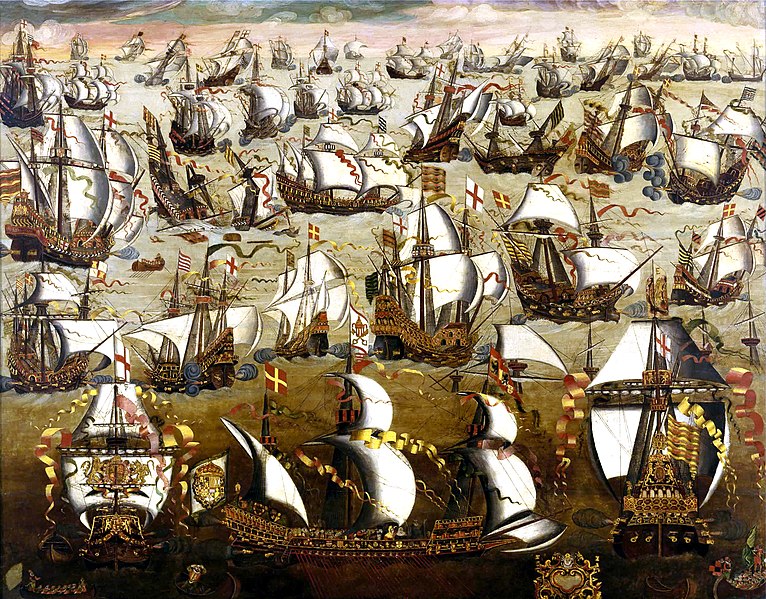
No plans for vessels used in the Roanoke voyages are known to exist, but reasonably accurate inferences about those vessels can be drawn from contemporary paintings, construction and performance records, woodcuts, and maritime treatises.
  The wooden sailing ships of the period, while much trimmer and sleeker than their tub-like fourteenth-and fifteenth-century ancestors, had considerable strength, durability and maneuverability. Rather than battering and slamming their way through the forces of a North Atlantic gale, the typical sixteenth century English ship was able to slip and bob through the waves with comparative ease.

Disasters at sea were rarely caused by the structural failure of a ship. Typically, the hull or shell of the vessel was either clinker-built, that is, with plank edges overlapped and fastened with nails; or carvel-built, with planks laid flush, edge to edge, over a skeleton frame. Both methods of hull construction had advantages and drawbacks.


The clinker-built ship, while extremely strong and durable, was difficult and expensive to repair, the services of a master shipwright being required. Moreover, gunports, which were cut through the overlapping, weakened the hull significantly. In spite of these drawbacks, the average life of a typical ship was an impressive sixty-five years. Even though this method of construction was being phased out by the mid 1540s, it is likely that some of the vessels that took part in the Roanoke ventures were clinker-built.

The carvel-built of skeleton-frame ship was also strong, durable, and difficult to repair. The skill of a master shipwright was not always required, however; a competent carpenter could handle many repairs and alterations.

Whether a merchantman or a ship of war, a sixteenth-century vessel contained a vast array of small pieces of wood, nails, iron bolts, washers, wooden pegs, and knees or braces. All seams were made water tight with a caulking of tarred hemp fibers. The result of the shipwright's art was a springy, flexible vessel able to work under the various and variable stresses exerted by the wind; the weight of cargo, the crew, and the ship itself; and the violent impacts of the sea.

The vast majority of sixteenth-century oceangoing vessels were three-masted and square-rigged. On a square-rigged ship, the large main square sails were laced to a yard or bar, which was attached horizontally to a mast. In addition to the square sails carried on the main and foremasts, square-rigged ships of the period also had, on the aftermast, a small lateen, or triangular sail which acted as a stabilizer. The square-rigged ship of the Elizabethan era was able to sail well to windward, that is, approximately in the same direction from which the wind was blowing. The versatility of this particular style of rigging enabled mariners to adjust sails to meet constantly changing wind conditions. Because of the strength and durability of its hull, its maneuverability, and its adaptability, the three-masted, square-rigged ship was the mainstay of the European voyages of discovery and exploration.

In sixteenth-century England, the size of a vessel was estimated in terms of tunnage --the ships capacity to carry 252 gallon tuns of hogshead barrels of wine. A 50-tun ship could carry fifty hogsheads. The tun was a measure of volume, not weight, and it was hardly uniform. The capacity of a Spanish tun, for example, was considerably less than that of an English tun. Thus a Spanish vessel of 50 tuns was not the same size as a 50-tun English ship. During the Elizabeth Era, tonnage, a more accurate and sophisticated measurement system based on a ship's dead weight and its displacement of water was in the early stage of development. As a system for standardizing the measurement of ship size, it was not uniformly applied to English shipping for many years thereafter. Though sometimes used interchangeably by post-Elizabethan writers, tunnage and tonnage are not synonyms.


The majority of ships used in the Roanoke ventures were privately owned, well-armed merchant ships ranging in size from 20 to 400 tuns. Other than names and tunnage, very few details about the vessels survive. The lack of information is complicated by the inexact system for estimating ship size--one ship could be listed with different tunnages. Identification of the vessels is made more difficult--and in some cases rendered impossible--by the Elizabethan practice of renaming ships often. Sir Francis Drake's Pelican (Golden Hind) is famous enough to be traceable, but most of the vessels associated with the Roanoke voyages are not. Contemporary descriptions of these vessels vary. A vessel called one thing in one document might be called something else in another. Further, more-or-less standard modern usage and definitions have little in common with sixteenth-century terminology.


Cont. here:


http://www.nps.gov/fora/forteachers/ships-of-the-roanoke-voyages.htm


This blog is © History Chasers
Click here to view all recent Lost Colony Research Group Blog posts
Bookmark and Share

Tuesday, September 13, 2011

"A Tuscarora War Trio: Core Tom, Captain Brice, and the Baron"


Dr. David La Vere, noted Author and Professor of History at UNC-Wilmington will present  "A Tuscarora War Trio:  Core Tom, Captain Brice, and the Baron" about the war that began in September 1711 in Eastern North Carolina.  In addition, a moment of silence and reflection will be observed in memory of those known and unknown whose lives were affected during the war.  For more information about Dr. La Vere's books and projects, please visit www.DavidLaVere.com.

Saturday, September 24, 2011 at 1 pm
Cullman Performance Hall • North Carolina History Center • 529 South Front St., New Bern, NC

Dr. La Vere’s Presentation is Free and Open to the Public.  Everyone is Welcome!

Delicious refreshments will be served after the presentation by Grandma’s Goodies of New Bern, 252.617.5828.

Come early and visit the beautiful Tryon Palace and the new North Carolina History Center which has an excellent permanent exhibit about the history of Eastern North Carolina.  To learn more, please visit their website at www.TryonPalace.org.

Please see the updated website at www.ENCFamilies.org for e a listing of other historical and cultural events that are scheduled in our area in the near future.


The Family History Society of Eastern North Carolina
252.349.0405 (Telephone)


This blog is © History Chasers
Click here to view all recent Lost Colony Research Group Blog posts
Bookmark and Share

Saturday, September 3, 2011

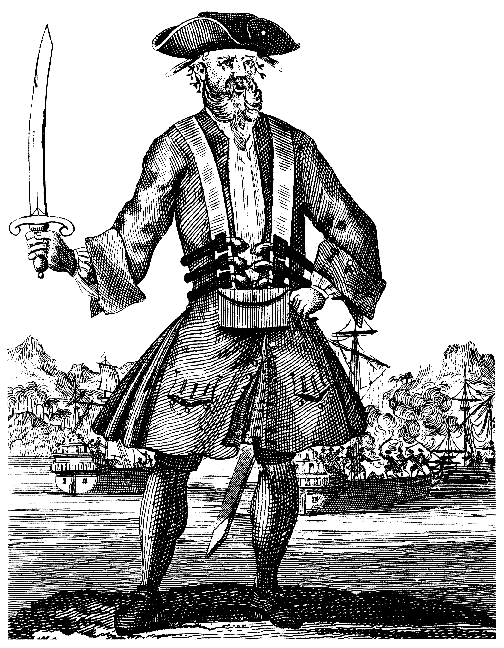
Blackbeard's Revenge


OCRACOKE ISLAND, N.C. -- When boarding a ship, he burned cannon wicks in his hair, scaring victims into thinking he'd come from Hell. He shot his own sailmaster in the knee to discourage mutiny and commanded a pirate navy bold enough to blockade a whole city.

Yet Edward Teach, alias Blackbeard, has never been more popular on the Crystal Coast and Outer Banks of North Carolina. His personal flag, a demon with hourglass and a spear piercing a crimson heart, flutters from many homes and shops. Blackbeard is big business here, from his one-time home at Bath, to Beaufort Inlet where his Queen Anne's Revenge is now being salvaged, to Ocracoke, where he met a violent end. There is everything from a beer to a rock band named for the world's most famous pirate, whose glory days covered 1717-18.

 Cont. here:

Friday, September 2, 2011

Riding Out Huricane Irene on Hatteras Island

Huricane Irene: A Storm to Remember
by Dawn Taylor
Mirlo Beach, NC 

As I sit here trying to come up with the opening words to write this blog, I can not help but think of all that has happened on Hatteras Island, since Hurricane Irene hit. By now, most of you have heard through the news media about the destruction here. Many homes and businesses were destroyed. Lives are now changed in so many different ways. But just as our ancestors have done over the years, we will persevere. We have pulled together and once again shown our strengths as a community. I am so proud and so thankful for all who have rolled up their sleeves, put on their waders and boots, in order to selflessly lend a hand. We are so blessed...

Tide coming in...Avon, NC

Dad and I have weathered quite a few storms together in our home. We live in my late Grandparent's old place in Avon. We feel secure here. This house is built like they used to build them...strong...sturdy...made to endure harsh winds and storms. Dad did however, have the house raised after dealing with it being only three feet off the ground. Only so many times of carpets ruined, walls warped, and furniture and appliances trashed, can one take. So up it went...12 feet into the air. 

About a week before Irene hit, all eyes pretty much stayed glued to the weather. A lot of the islanders, especially the old timers, are pretty good at predicting where storms are going and what should be done in order to prepare. With that said, Dad and I made several trips to the grocery store for canned goods and other items that might be needed during and afterwards. We gassed up the trucks. Made sure the generator worked. Moved the camper and both trucks to higher ground. Secured all outdoor items...and then waited.

Waiting for the storm to hit has always seemed the hardest part to me. Not knowing what the storm is going to do to your home, your family, your friends...it's nerve racking. So Dad and I, along with quite a few others, were feeling quite happy when Irene had dropped to a category 1. But boy, big things do come in small packages. The winds shifted around from the south east to the north west and a mean punch came a long with it. From Avon Village all the way to Manteo, there came a surge of ocean and sound tides. Irene was on a destructive path. A friend of mine who lives in New York called several days after...even the town he grew up in about an hour north of him was destroyed by her. Irene had left a mark.

Gerald Williams home place ~ Village of Avon

The above photo shows the home place of the late Gerald Williams. His house is located directly across the road from us. As you can see, the tide paid a visit to many of the homes and businesses of our village. Dad and I were lucky. Many others weren't. Piles of household items now lay along side the road with signs that read "Do not take away". Residence are waiting for insurance adjusters to arrive in order to receive aide in restoring what has been destroyed. Dad and I can deal with the stench of mud in the yard. We can deal with no air conditioner. No tv. No phone. Even the loss of the oil tank which heats our water and house, But to imagine dealing with the loss of treasured family photos, family heirlooms, and those things that help one get through everyday life, is hard to comprehend. 

And what is more hard to comprehend is the loss of loved ones through such disasters. Saturday night, our family almost lost two very dear members. Celia and Roger Meekins were owners of the house known as, Sentinel on Pamlico. It was their dream home. Located at Mirlo Beach, it was a landmark with it's tower that resembled a majestic lighthouse. But most of all, it was a place where they went to relax and enjoy the beauty of the island. Below is a link you may follow to read in detail about the fire that occurred there Saturday night and also the flood waters that Celia and Roger found themselves swimming through in order to reach the safe harbor of their nearby neighbors. It is through stories like theirs, that one realizes that there are still those in this world who would give their dearest possession, which is their life, in order to save others.

http://www.newsobserver.com/2011/08/31/1449205/horror-in-rodanthe.html
 
The rest of this article is cont. here:
http://hatgensoc.wordpress.com/2011/09/02/hurricane-irene-a-storm-to-remember-2/


http://www.facebook.com/?ref=home#!/help4hatteras

This blog is © History Chasers
Click here to view all recent Lost Colony Research Group Blog posts
Bookmark and Share

Tuesday, August 23, 2011

Tyrrell County Genealogical and Historical Society Meeting CANCELLED

Due to the current predictions for Hurricane Irene, the August 28, 2011 meeting of the Tyrrell County Genealogical Society has been canceled.

Our featured speaker was Jennifer Sheppard, and we're hoping to reschedule her presentation for early next year. When we have a new date for her presentation, we'll announce it here again, in case any Lost Colony Research Group members wish to attend.

Thanks,
Cathy Roberts
Vice President
Tyrrell County Genealogical and Historical Society
__._,_.___

This blog is © History Chasers
Click here to view all recent Lost Colony Research Group Blog posts
Bookmark and Share