Pages

Tuesday, July 27, 2010

"A Kingdom Strange"

by Janet Crain
It is important to remember that this little band of would be settlers carried an enormous weigh on their backs. They were the forerunners of the English colonies that became the United States. Had they been discovered they would have been murdered by the Spanish as the French Huguenots were in Florida. Had John White not have made it back to Ireland and later made an ill fated trip to Roanoke nothing would be known of the colonists.

Fortunately we do know a great deal and after more than 400 years more is being discovered.

Rob Hardy: "A Kingdom Strange"


The Lost Colony of Roanoke was a failed initial effort of England to colonize America. It may have been a failure, but it continues to fascinate people; there is a famous outdoor stage production with music that attempts to dramatize the settlement at its site and a reconstructed fort.

The fascination isn't so much because of historic significance, but because the 117 settlers vanished without a trace. That is, almost without a trace. In "A Kingdom Strange: The Brief and Tragic History of the Lost Colony of Roanoke" (Basic Books), historian James Horn finds all the traces we can ever expect to turn up, and speculates on answers as close as we are going to get. That ought to make it an attractive volume for anyone who has heard of the colony's mysterious disappearance.

The larger attraction of the book, however, is to put the colony into historic context. The colony was an attempted blow by Britain against Spain, and what's more, it became lost at least partially because of the larger war between Britain and Spain. The hapless colonists, who if things had gone differently would have been celebrated as the Jamestown settlers are now, were instead the victims of a global war.

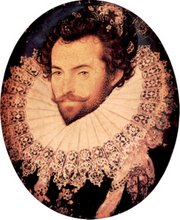
Horn imagines that Walter Raleigh, having moved to London in 1575, looked at a map of the New World and saw an extensive New France, and an even greater New Spain, but a "New England" was nowhere to be seen. During the reign of the father of Queen Elizabeth, Henry VIII, there was maritime trading with Europe and the Mediterranean, but little interest in America. Spain, however, had been particularly active in colonizing, and King Philip II had papal authority to convert the indigenous people to Catholicism. He deliberately took action to destroy the French settlements on the coasts of what are now South Carolina and Georgia because he did not want the Protestant heretics to take hold. Philip would have felt the same way about the attempts by Elizabeth to settle her Protestant countrymen into the area, although the British settlers, of course, would feel compelled to convert the heathens to their true church.

http://www.google.com/url?sa=X&q=http://www.cdispatch.com/lifestyles/article.asp%3Faid%3D7114&ct=ga&cad=:s7:f1:v0:i1:ld:e1:p1:t1280280831:&cd=sRGXXiFYHTQ&usg=AFQjCNGSD-JSleC7jChHTnYk8yF2UupGoA


This blog is © History Chasers
Click here to view all recent Searching for the Lost Colony DNA Blog posts Bookmark and Share

Monday, July 26, 2010

Was the Newly-Discovered NYC Ship Used to Transport Slaves?

This is an interesting account of a ship found at the base of the World Trade Center site in New York. Even more interesting is that this is not an anomaly. All of this area was filled in over the centuries. And part of the fill was old ships and shipwrecks. There is a world of information hidden here. And as the author says; "Ships were commerce, so there are ownership and insurance records, many still buried in archives in Holland and England. "
7-26-10

By Pearl Duncan

The author is completing a book about the variety of her ancestors’ DNA, ancestry and genealogy, and how each intersected with dramatic historical events.

People are willing to rewrite the story of the Wall Street-World Trade Center area in New York without knowing its history from a few centuries or even a few decades ago. But historical artifacts remind us where we’ve been.

The remains of a 32-foot section of a wooden ship, estimated to be about a third to a half of the hull, was discovered at the base of the World Trade Center site in New York. Archaeologists and scientists are collecting, testing and dating the wood of the ship’s hull. They are also testing a semicircular piece of metal arc, possibly part of the cooking galley, a shoe, spikes, anchor and other materials to identify the ship’ origins and use. They estimate that the ship dates back to the eighteenth century. They have determined that it was a cargo ship, from the size and shape of the hull. They have surmised that it was a sea-going vessel, since the layers of wooden planks are reinforced by layers of large, strong timbers. They figure from how it is situated in muddy ground that was once watery shore, and from maps of the harbor, that it was placed in the site as part the landfill that expanded the Lower Manhattan neighborhood in the late 1700s.

http://www.hnn.us/articles/129464.html


This blog is © History Chasers

Click here to view all recent Searching for the Lost Colony DNA Blog posts Bookmark and Share

Sunday, July 18, 2010

Wednesday, July 14, 2010

July 2010 Newsletter


July 9, 2010


Lots of work is going on behind the scenes. What did we ever do without e-mail and how did we collaborate on a project spanning two continents, three countries and many states, counties and provinces? Maybe the answer is that projects of this magnitude were handled differently, not at all, or proceeded much more slowly. Recently Andy and Baylus have been working together on the geography of the Outer Banks island chain. Come ride along with Baylus on their journey of discovery!!

Rediscovering The False Cape

By Baylus Brooks

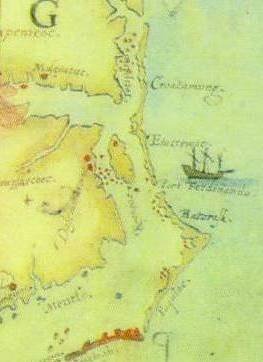
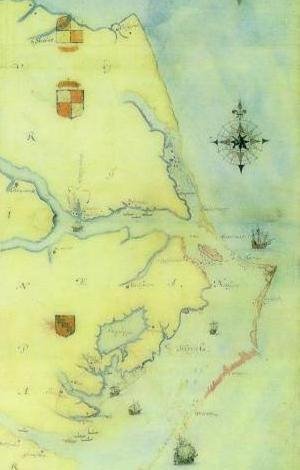
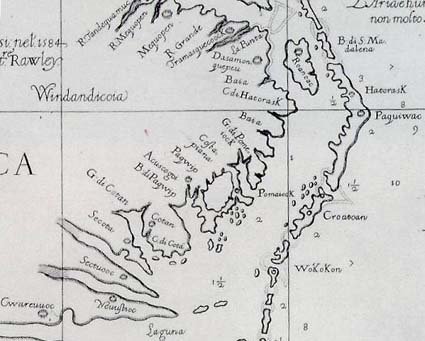
Ever since Andy Powell emailed about the “false cape” in the area of Rodanthe on the Outer Banks it has been bugging me about the current water levels as compared with the water levels suspected in 1585 when John White made his map. It was much lower in 1585. By how much was the next question. What did the Outer Banks look like at the time that John White watercolored them? Why in the world did he paint such a prominent cape that no longer exists?

Here are the two versions of White’s map, compared in DeBry’s chosen orientation of West on top:

The point that I want to make here is that John White, without the benefit of a surveyor’s eye, drew a darned fine map! The "extra cape" (what I indignantly and once loudly called it) was not a figment of White’s imagination. It’s real. Andy Powell told us where to find it. So, I looked.

con't here (scroll down when you get there)


This blog is © History Chasers
Click here to view all recent Searching for the Lost Colony DNA Blog posts Bookmark and Share

Friday, July 9, 2010

FTDNA offering special prices for Y-DNA upgrades


Y-DNA Upgrade Sale at Family Tree DNA

Those of our readers who have already Y Chromosome tested at Family Tree DNA of Houston, TX will be interested to learn of this special temporary price on upgrades.

FTDNA is currently offering special prices for Y-DNA upgrades. The table below compares the regular surname group rates with the sale prices.

The promotion won't last long. Kits need to be ordered and paid for by midnight on July 19, 2010.

Click on the link below to go to the FTDNA web site. Then log in to your personal page and click on the special offers link in the left hand navigation bar.

Click for more info


This blog is © History Chasers

Click here to view all recent Searching for the Lost Colony DNA Blog posts
Bookmark and Share

Monday, July 5, 2010

Cherokee Communities of the South

Robert K. Thomas
Abstract
Cherokee Communities of the South was written by Mr. Thomas in the mid-70's. It includes a hand drawn map at the end and appears to be a result of some of Mr. Thomas' survey work in the southeastern United States during the summer of 1978 (?). It was submitted to the Consortium of American Indian Title IV Programs of Southeastern Michigan in 1979
Read the article here, click on "Download the Paper."

This blog is © History Chasers
Click here to view all recent Searching for the Lost Colony DNA Blog posts Bookmark and Share

Saturday, July 3, 2010

Herbicide Accident has Tragic Consequences

Ancient N.C. grape vine has near-death experience

Posted to:

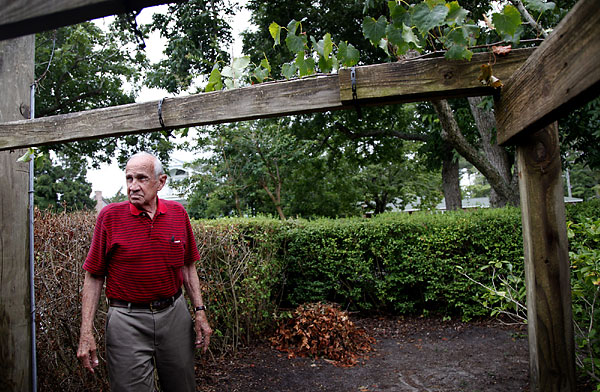
Jack Wilson stands next to the power pole and damaged portion of the grapevine at his home in Manteo, N.C., on Wednesday, June 30, 2010. The "mother vine" as it's known, is believed to be the first cultivated vine in America and more than 400 years old. It was sprayed with herbicide while utility workers were trying to clear the nearby power pole. Wilson works to clear away the dead leaves every day (the pile is visible in the background) and hopes that the vine will survive. (Preston Gannawayt)

MANTEO

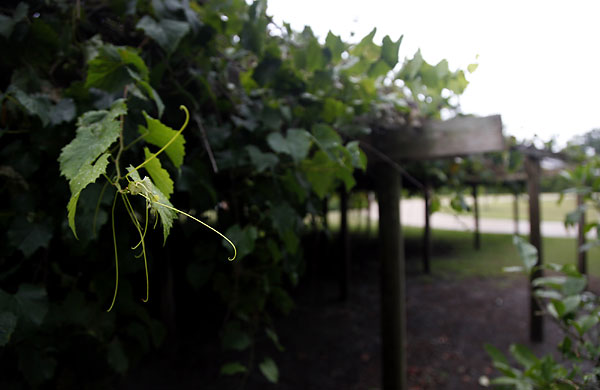
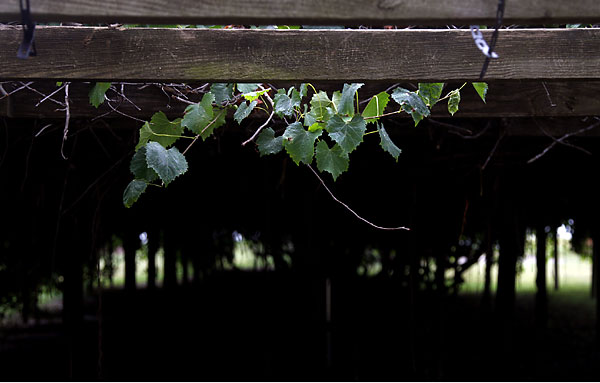
A large, old grape vine possibly growing here before the Lost Colony disappeared is on the mend after getting an accidental dose of a powerful herbicide.

But as experts continue to nurse the Mother Vine, including more pruning and fertilizing scheduled this week, a warning goes out to those who spray weeds in public places - be more cautious.

"From what I saw, this was just basically a lack of common sense," said Donald Hawkins, owner of Vineworks in Duplin County.


This blog is © History ChasersClick here to view all recent Searching for the Lost Colony DNA Blog posts Bookmark and Share

Monday, June 28, 2010

Barrell Beach at Roanoke Island Scene of Intense Maritime Investigation

Institute for International Maritime Research, Inc:
Raleigh Colony Investigation Update 2010
By Bill Utley

Dr. Gordon Watts uses a hydro probe

Ray Hayes, Bill Utley, and Josh Daniel prepare to use the suction dredge.

The Institute for International Maritime Research, Inc (IIMR), working for the First Colony Foundation, and under the direction of Dr. Gordon Watts, assisted by Josh Daniel, Dr. Ray Hayes, and Bill Utley, conducted Part 1 of the 2010 continuing survey searching for the Lost Colony of 1587. The survey was conducted with the cooperation of the National Park Service. The work, which lasted from 16 to 22 May, consisted of sand lift operations testing a shallow area off the northeast end of Roanoke Island, NC.

Dr. Gordon Watts,Josh Daniel, and Ray Hayes at the barrel Well  Site.

Dr. Gordon Watts, Josh Daniel, and Ray Hayes at the barrel Well Site.

The area, known locally as “barrel beach”, is an area in National Park Service waters adjoining Fort Raleigh Park land. It was in the area in the 1990s that the remains of two barrel wells were found just off a small sand beach in very shallow water. Barrel wells were a common land feature, particularly in new settlements, but anywhere water was needed and not readily visible. It simply meant that wells were dug and barrels, or their equivalent (even a large hollwed tree could be used), were used to line the hole as it got deeper - in place of later bricks and stone in more settled areas. It was also in this area that an axe head was found dating back to the end of the 16th century.

Wind conditions plagued the first three days of the effort. Since the area is so shallow, relatively calm conditions were needed to position the support boat, which had to anchor just off a submerged anti-erosion barrier. The boat was needed to deploy and run the sand lift, and the water depth was just under 4 feet at the anchor spot.

Cont. here
http://www.uri.edu/artsci/his/mua/in_the_field/iimr2.shtml


This blog is © History Chasers

Click here to view all recent Searching for the Lost Colony DNA Blog posts Bookmark and Share

Sunday, June 27, 2010

June 2010 Newsletter


In the book, The Colonists, Their Fortune and Probably Fate by David Beers Quinn, he sums thing up ever so succinctly in the introduction. Quoting David here:

"We have clear evidence that white settlers identified as having come from Roanoke were living in the area between the Elizabeth River and what is now Cape Henry in modern Virginia, during the 20 years after their presumed departure from Roanoke Island. We have equally positive evidence that colonists were killed by the Virginia Indian ruler Powhatan shortly before Jamestown was founded. But not all North Carolinians are prepared to accept this evidence because it is indirect and occurs a few years, perhaps only 2 or 3 years, after the event.

Intensive searches - but not intensive enough, we might think - were made for survivors of the colony in 1608, and 7 persons were heard of as having escaped the killing and reached the Chowan tribe not far from the head of Albemarle Sound in North Carolina. Held incommunicado by the Indians there, they were lost sight of and finally forgotten by the Virginia settlers. It can be conjectured with a degree of probability that some of the colonists remained with the Europeanized Indian Manteo on the Carolina Outer Banks near modern Cape Hatteras. All trace of these people was lost, however, and their subsequent fate is totally unknown, through speculation has suggested that they formed an element in later Indian populations on the Carolina sounds.

In assimilating the materials that survive on the Lost Colonists and their fate, there are many gaps in our documentation. These must be filled by working conjectures. Historians, especially of earlier periods of history, have to make assumptions that blend the materials at their disposal into a coherent story while carefully admitting where they are and are not relying directly on documents, which may be good or only imperfect evidence. Otherwise they could not make any sense of their reconstruction of a often poorly documented past. In what follows, assumptions have been made and conjecture proposed that are the best that one historian can do with the materials at his disposal. They do not lead to any dramatic conclusion except that the great majority of the Lost Colonists, after nearly 20 years of life alongside or mingled with the Indians living to the south of Chesapeake Bay, across the border from North Carolina in modern Virginia, were wiped out by a massacre by the despotic ruler of the Indian tribes of tidewater Virginia. Bur our knowledge leads thereafter to strong indications if not proof, that 7 survivors remained in the possession (as slaves?) of a chief who dominated the Chowan River and possibly the lower reaches of the Roanoke River Valley around 1608. There is also a probability that the younger men left on Roanoke Island in 1587 did not rejoin the main body of settlers but lived instead with the Croatoan (Hatteras) Indians of the Outer Banks.

There are bound to be differences of opinion as to what weight should be given each item of direct and indirect evidence. If new solutions are to be found, they must rest either on new documents (the finding of which is unlikely, if not impossible) or, most probably, on archaeological discoveries. If the Lost Colonists lived some 20 years on a site, it is suggested, was well inland near the present Elizabeth River in Virginia, they are bound to have left traces that Powhatan is unlikely to have destroyed completely. Such a discovery would be thrilling for all North Carolinians and Virginians, but there is no assurance that it will ever take place. Nevertheless, it is our best hope of solving what appears to be the crucial element in the mystery of the Lost Colonists and their fate."

David Beers Quinn was an incredible historian and a prolific writer. He penned many books not only about the Lost Colony, but about the historical aspects of England and in a wider perspective, Europe, of that timeframe that influenced the decisions surrounding Sir Walter Raleigh's Lost Colony and other settlement attempts. This timeframe could well be termed the "Voyages of Discovery". Many of David's books were published through the Hakluyt Society in London.

Not everyone agrees with his opinions, but few dispute his documentation. He is the most referenced historian of the modern Lost Colony period. David passed away in 2002 at age 93.

We've spent the past three years sorting through various publications and documents. Some are widely read, such as David Beers Quinn's works, and others are unpublished or original documents. Andy Powell has spent the past year retranslating and transcribing original 1590s documents with some surprises to share in upcoming months. His research, now in book format, is now under consideration by several publishers.

As an organization, I feel it's important to be flexible and to always give ourselves an opportunity to correct our course as new information and opportunities become available. As a result of our ongoing research and new opportunities, we have focused on three primary areas for our upcoming year.

2010 Focus

1. Croatoan (Hatteras Island) - The colonists told us where they went, in the first person. They went to Croatoan. Of course, there is speculation and some evidence, as David said, that they may not have stayed at Croatoan, or perhaps not everyone went to Croatoan. But the best evidence we have directly from the colonist themselves is that they went to Croatoan. John White upon his return trip in 1590 did not doubt that message and was preparing to go there to find the colonists when Mother Nature interfered.

My research focus this year will be on Croatoan, currently Hatteras Island. This is the reason for forming the Hatteras Island DNA projects. If we are going to find the colonists by using DNA evidence, the best place to look is where they told us they were going. Baylus Brooks, who was introduced in the last newsletter, as well as Dawn Taylor with the Hatteras Island Genealogy Society are working with me on this exciting project.

To facilitate this end, I am reconstructing the early families on the island by various forms of documentation. If you descend from one of the Hatteras Island families, please drop me a note and let me include your information in the project.

2. English Records Research - When David Beers Quinn was writing and researching, DNA was just being discovered and the information age was not yet upon us. These two advances together have indeed changed the face of what is possible. We need to find the colonists' families in England. Several individuals have worked around the edges of this challenge over the past few years and have made some significant discoveries. Nelda was able to produce estate records for John Dare from 1594 from her online research. However, English records research is not like American research, and understanding how to systematically research available records and how to obtain access to non-published records is essential. It is too much for anyone to handle as a secondary responsibility. As a companion project to the Hatteras Island project, Nancy Frey has come on board as our English Genealogist and has already begun focusing on doing a thorough records search for each one of the prioritized colonist surnames in England. We will provide that prioritized list later in the newsletter as well as provide a proper introduction for Nancy. I'm extremely glad to have her on board. I'm still amazed that more than 100 people can remain so elusive in English records.

3. Archaeology.....yes indeed....I said archaeology. David was right. Archaeology in combination with other historical, genealogical and DNA research may well be the key to finding the colonists. May I have a drum roll please!!! If you've been following the blog, you already have caught wind of this turn of events. Several of us have been participating in ongoing archaeological projects in which we are attempting to discover the location of the colonists. I can't say more, nor can I say where, but I can share a few photos with you.

Read more here, when the window opens scroll down


This blog is © History Chasers
Click here to view all recent Searching for the Lost Colony DNA Blog posts Bookmark and Share

Friday, May 7, 2010

Searching For the Lost Colony Receives a Hand From English Mayor

Andy Powell wants to use DNA to prove his claims.
Photo: IAN SNELL/APEX

Andy Powell, mayor of Bideford, north Devon, wants to use DNA testing to prove residents from the port town settled in the US three decades before the Pilgrim Fathers sailed there.

Mr Powell is trying to raise money for the research, which he hopes will prove his town’s "pivotal" role in the history of modern America.


This blog is © History ChasersClick here to view all recent Searching for the Lost Colony DNA Blog posts Bookmark and Share