Pages

Friday, May 4, 2012

Patch on 425-year-old map yields new clue to fate of Lost Colony


British, US researchers say patch on 425-year-old map yields new clue to fate of Lost Colony

CHAPEL HILL, N.C. (AP) — A new look at a 425-year-old map has yielded a tantalizing clue about the fate of the Lost Colony, the settlers who disappeared from North Carolina's Roanoke Island in the late 16th century.

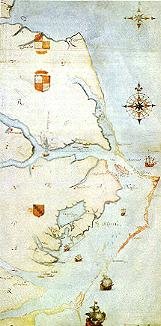
Experts from the First Colony Foundation and the British Museum in London discussed their findings Thursday at a scholarly meeting on the campus of the University of North Carolina at Chapel Hill. Their focus: the "Virginea Pars" map of Virginia and North Carolina created by explorer John White in the 1580s and owned by the British Museum since 1866.

"We believe that this evidence provides conclusive proof that they moved westward up the Albemarle Sound to the confluence of the Chowan and Roanoke rivers," said James Horn, vice president of research and historical interpretation at the Colonial Williamsburg Foundation and author of a 2010 book about the Lost Colony.

"Their intention was to create a settlement. And this is what we believe we are looking at with this symbol — their clear intention, marked on the map ..."

Attached to the map are two patches. One patch appears to merely correct a mistake on the map, but the other — in what is modern-day Bertie County in northeastern North Carolina — hides what appears to be a fort. Another symbol, appearing to be the very faint image of a different kind of fort, is drawn on top of the patch.


This blog is © History Chasers
Click here to view all recent Lost Colony Research Group Blog posts
Bookmark and Share

Thursday, May 3, 2012

John White's Maps Revealing Secrets Over Four Centuries Old


It is a mystery that has perplexed historians for more than 400 years - what ever became of the 120 settlers who tried to establish England's first colony on the north-east coast of America?
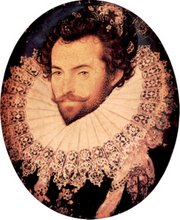
Queen Elizabeth I and famed explorer Sir Walter Raleigh had hoped the expedition in the 1580s would create a capital in the New World, but something went terribly wrong.
The men, women and children simply vanished - possibly massacred by native American Indians - any evidence of a settlement disappeared and the infamous 'lost colony' became rooted in American folklore.
But solving the centuries-old mystery may have come a step closer this week after experts identified a tantalising clue hidden in a map drawn by a man on that fateful voyage.


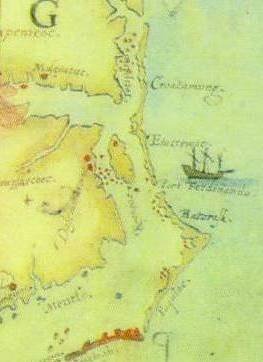
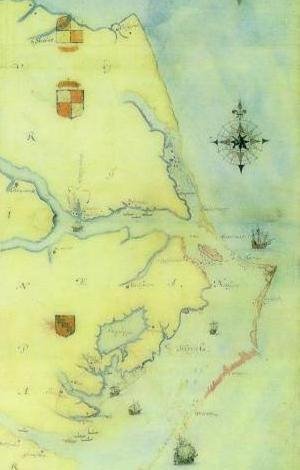
The map by John White in which scientists have found the possible location of Sir Walter Raleigh's 'lost colony'
The map illuminated from below which shows the hidden location

Read more: http://www.dailymail.co.uk/news/article-2138832/Is-Walter-Raleigh-s-lost-colony-drawn-invisible-ink-Clue-400-year-old-mystery-discovered-map-North-America.html#ixzz1tpWNFq2f

The ink, which is also disguised by a piece of paper glued to it, was likely put together using milk, citrus juice or urine, as was common at the time.
Its use during the 'lost colony expedition' also sheds light on an era of political suspicion at the time.
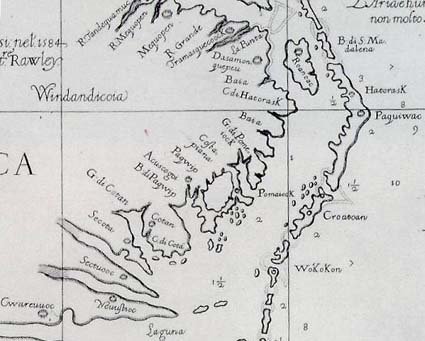
Location, location, location: Roanake Island is located just off what is now the state of North Carolina. White's maps have been praised for being particularly accurate

Read more: http://www.dailymail.co.uk/news/article-2138832/Is-Walter-Raleigh-s-lost-colony-drawn-invisible-ink-Clue-400-year-old-mystery-discovered-map-North-America.html#ixzz1tpVvn1o0

This blog is © History Chasers
Click here to view all recent Lost Colony Research Group Blog posts
Bookmark and Share

Wednesday, May 2, 2012

John White Map Speaks to Modern Historians

 
The fate of Sir Walter Raleigh's famed "lost colony" in the New World – and the disappearance without a trace of more than 100 English settlers – has been an unsolved mystery for 400 years, a lost chapter of Anglo-American history. That so many men, women and children could simply vanish has become the stuff of American folklore. Many assume that they were either slaughtered by native American Indians or assimilated into their communities.

Now, a clue has emerged that experts hope could help solve the centuries-old mystery of the settlers' disappearance, and lead them to the site of what Raleigh and Queen Elizabeth I hoped would be a capital, the first English attempt at colonisation.

Concealed on an Elizabethan map of the east coast of North America, but now identified by the British Museum, is a hint at the colony's location drawn in what appears to be invisible ink, further disguised by a barely-discernible patch of paper glued to it.

Scientific tests have revealed that a lozenge, the symbol for a fort, was hidden on the map drawn by John White, who accompanied Raleigh's first attempts to establish a colony. White led the settlers who were to establish the "Cittie of Raleigh" of which he was intended to be governor.

Its concealment on the map reflects an age mired in political intrigue – Elizabeth I was then facing plots to place the Catholic Mary Queen of Scots on the English throne – and fears of such a map getting into the hands of court spies.

Invisible ink was concocted at that time from milk, citrus juice or urine, and usually revealed by applying heat.

An official announcement will be made today, but an excavation of the site, now farmland, is planned.

 Cont.

This blog is © History Chasers
Click here to view all recent Lost Colony Research Group Blog posts
Bookmark and Share

Thursday, April 26, 2012

Hooray!!! There are still places where genealogists can search the SS index FREE.


Click here:

United States Social Security Death Index

 There are also a few other places. 

 http://genealogy.about.com/od/free_genealogy/a/ssdi.htm

 I always add this info to persons in my charts including the SS #. This proves I am putting the right person in the tree. 


This blog is © History Chasers
Click here to view all recent Lost Colony Research Group Blog posts
Bookmark and Share

Tuesday, April 17, 2012


Melungeon Myth of Drake Dropping off Passengers on Roanoke

By Janet Lewis Crain

A myth exists on the Internet that the Melungeons, a group of dark skinned
persons of mysterious origins found living in East Tennessee two hundred
 years ago descend from Turkish prisoners and sundry other non-English persons
 said to have been rescued by Sir Francis Drake during the sacking of Cartagena and
then deserted on Roanoke Island in 1586. In truth, there is NO evidence there
 were any left behind there, much less several hundred. This myth was introduced
in a book published in the 1990's by Brent Kennedy titled The Melungeons:
The Resurrection of a Proud People : An Untold Story of Ethnic Cleansing in
America.


This book might have lanquished in obscurity on the shelves of a few Libraries
 and book stores had it not been for the Internet and the new found surge
of interest in genealogy. Suddenly everyone fancied him or herself a Melungeon.
Several Unions were held of people from various mailing lists and persons attending
were happily discovering knots.on the back of their head, thought to indicate
 Turkish ancestry. Having someone in your Family tree who possessed six
fingers was a definite plus. These traits were all described in the afore mentioned book.
No one ever looked too closely into the incident said to have occurred in 1586. But
that is precisely what this paper intends to do.

In the sixteenth century, Sir Francis Drake was one of the most famous men in England, indeed the English speaking world and beyond. He could do no wrong in his Queen's eyes. He had brought her an enormous return on her personal investment in an earlier voyage. A brilliant man in many ways, Drake was ruthless, but highly admired by the captives he had freed and the Maroons who came to his aid to help him fight and share in the rewards.
Drake was returning home from the sacking of Cartagena when he decided to
visit Roanoke and dispose of some of the freed prisoners and Maroons he had
acquired during his adventures. He was carrying a human cargo of some several hundred. Ivor Noel Hume in "Virginia Adventures" contends Drake
highly inflated the numbers. The voyage had not been financially successful
in spite of his daring and flamboyant actions. It is quite likely he was
advancing his case by sending back reports of greater exploits than actually
had occurred. There were reports of many nationalities released from the
Spanish prisons as well as Maroons who had come in from their strongholds in
the surrounding areas to help Drake as he was known to be generous with the
spoils of his marauding. Alas this voyage would not compare to previous ones.

This voyage is of great interest to Melungeon researchers because this
voyage in 1586 is the basis of the Turkish connection first started by
statements in Brent Kennedy's book: Melungeons; an Untold Story of Ethnic
Cleansing
. It is, in fact, the keystone of the Turkish Connection Theory.
Remove it and the rest crumbles. That is what I propose to do.

It is known that many of the people with him never reached Roanoke. Many died of
strange fevers in Florida. These fevers were the scourge of sea travel at
that time. Caused in part by the crowding together of humans in the cargo
holds of ships where the fetid air trapped and spread any  contagious
disease like wildfire, and probably acerbated by nutritional deficiencies.
In any case, reports contend that anywhere between 350 and 750 people died of
these fevers. Apparently Drake intended to leave the rest of the freed
Africans and South American Indians to furnish labor for the new Colony on
Roanoke which he expected to have grown to some 600 English by then. In
truth There were only about 100 men, badly in need of food and suffering the
ill effects of their bad treatment of the local Indians. Ralph Lane was in
charge at Roanoke and he accepted Drake's offer of minimal food supplies
(Drake had been out a long time and was running low himself) and a ship, the
Francis, capable of navigation into the bay plus other pinnaces, etc. and
armament. All the supplies were loaded onto the Francis along with Lane's
best naval officers. Lane wanted to stay a few more weeks exploring the
Chesapeake.

Hume states:


When on June 11, the two men (Francis Drake and Ralph Lane) exchanged their
unsettling news, several truths became evident; Drake was not there (as the
Roanoke settlers had first hoped) to resupply the Colony; he was short of
food himself and so was better able to supply guns than butter. Futhermore,
Lane could not have had any desire or ability to house 250 blacks who would
out number his white settlers two to one.

They came to an agreement whereby Drake would leave skilled workers,
artisans, two pinnaces, several small boats and a large ship, the Francis.
All the supplies were loaded onto the Francis along with the skilled
mariners needed to sail such a ship. Immediately a terrible hurricano struck
and it was every man for himself. The ships standing out in the roadway cut
and ran, scurrying out to the deep ocean to get away from the treacherous
shoals and currents, dangerous enough in good weather. The Francis was among
those who sailed on to England.

Ralph Lane then accepted Drake's offer to transport the first colonists back
To England. Most of the small pinnaces carrying the extra passengers had
been dashed to pieces on the shoals during the storms. The Turks, known to
have been with Drake, were apparently better safeguarded. They were valuable
as trade for English prisoners lanquishing in Ottoman prisons. Some 100
Turks were, in fact, ransomed to their homeland.

So, just who might have gone ashore before the storm hit? Many people have a
hard time visualizing the scene at Roanoke. Roanoke is surrounded by very
shallow waters, hence the name; Shallowbag Bay. The only way to get there
was by laborious offloading of men and supplies to shore boats and threading
through the one pass, Fernando Pass, and the treacherous shoals and currents
made worse at times by Northwestern winds blowing directly into the Bay. The
shore boats were large by our standards and equipped with a mast and sail.
They require a skilled pilot and several strong sailors to row. People didn't
 just hop on one and go sight seeing. Only those with important business
such as Sir Francis Drake and Ralph Lane who negotiated several times were
transported back and forth. The rest of the fleet with the passengers
onboard stood out in the Roadway, the navigable waters off the Outer Banks,
which wrap around this area like protecting arms.

I am saying this to lay to rest the idea of a huge number of the passengers
dis-embarking and perhaps being caught off guard by the storms and staying
behind. Hume and David Beers Quinn are the authorities on this period and
both say there were no Turks left. Hume says no one else, Quinn, at most a
very few. Left with no supplies on the Outer Banks what would they have
found to eat? If the Indians had not killed them, they would have starved.

It should be noted that the Native Americans communicated by a"grapevine" so
efficient that Indians in Canada knew of happenings in the Virginias. No
mention of any dumped off passengers was ever made.

Additionally, there was plenty of room for these passengers to sail with
Drake. Hundreds had died in the battles in Florida, from fevers, and in the
hurricane. Drake was returning with more ships than he left with, having
captured many. And they would have furnished badly needed labor to sail
these ships back to England.

Add to this the extreme difficulty of unloading these passengers in addition
to loading the Roanoke settlers, which the crew deeply resented for the
delay and extra work and danger this imposed and it is highly unlikely Drake
would have taken such actions in the middle of a three day hurricane.

Ivor Noel Hume says:


Thus the hurricane of June 1586 may have ripped away the first page from the
history of blacks in English America.

A cruel and terrible fate for these forgotten people that historians of the
time did not consider important enough to even record their fate.

Two weeks later an emergency supply ship sent by Sir Richard Grenville
arrived and found no one although they searched diligently. They left to return to England.
About one or two weeks later a big supply ship arrived with Grenville on
board. They were as mystified at the deserted condition of the island as the
men on the earlier supply ship. They searched even further "into the main"
(mainland) and as far as Chesapeake. Grenville was heavily invested in this
first effort, having sold an entire estate (consisting at this time as a
manor house and every type of supporting industry needed to run the estate;
mills, stables, barns, houses, dairies, animals, tools, even small villages)
to finance the settlement of over 100 men for over a year. It was a
requirement of Raleigh's patent from Queen Elizabeth that the area be
occupied continuously by English people. Finding no one and not knowing where
they had gone, he left some 15 soldiers to hold the fort. Based upon later
interviews with Indians, they all perished.

It is quite clear they found no one who could have been the passengers Drake
was previously carrying.

As previously stated the Indians had a very effective rumor mill which
carried news far and wide. It is just inconceivable that these
people could have survived unnoticed when their appearance would have been a
matter of great curiosity among people who had never seen African natives.

Thus it seems there is no evidence that any people were left behind in the Colony and documented evidence that 100 turks were returned to their homeland.


Resources:

The Virginia Adventurers by Ivor Noel Hume Copyright 1994 p. 53
Corbett, Spanish War. Refers to the return of 100 ex-galley slaves to the
Turkish dominions.
William S. Powell, North Carolina through Four Centuries, p. 42. Refers to
Queen Elizabeth's reason for returning the Turks.
David Beers Quinn, Roanoke Voyages. Cites Wright in footnote regarding Turks
Wright, Further English Voyages. Source of Quinn's information about Turks.
Hakluyt Society for 1975, Second Series, No. 148, p. 202, Note 3. Sir
Francis Drake's West Indian Voyage, 1585-1586. A detailed and authorative
account.
Acts of the Privey Council, 1586-87, PP. 205-206. (Public Record Office
[London]), PC 2/14:169) Contains a letter from the Queen's Privey Council
addressed to a merchant in London, who traded with Turkey, that asks him to
make arrangements for the return of 200 Turks to Turkey.
Document 10, The Primrose Journal (British Library Royal MS.7C,xvi, folders
166-173. Capt. Frobisher's journal of the 1586 Drake-led voyage. Mentions
Turks being aboard his ship.
David Beers Quinn Set Fair for Roanoke
David Beers Quinn The Roanoke Voyages 1584-1590


This blog is © History Chasers
Click here to view all recent Lost Colony Research Group Blog posts
Bookmark and Share

Friday, March 30, 2012

Bideford's Portas Pilot

This is a great video about Bideford, England, connected to the Lost Colonists. They are trying to get funding for touristm and such. Bideford has applied for a share of £1 Million of funding from the Portas Pilot scheme for towns struggling to make good in these dire economic times. The youtube video needs your vote of support. You can watch the video here, but afterward, please click through to YouTube on the link below the video and click "Like".

http://www.youtube.com/watch?feature=player_embedded&v=BQ5EdKrHtOQ#!  

This blog is © History Chasers
Click here to view all recent Lost Colony Research Group Blog posts
Bookmark and Share

Friday, February 17, 2012

Priscilla's Coming Home!!!


Priscilla: The story of an African slave


By Leslie Goffe 
BBC News, New York
Using a rare and unbroken document trail, scholars have succeeded in tracing a 10-year old girl from her kidnap in Sierra Leone 249 years ago to her life on the plantation in the United States where she was taken, forced into slavery, and re-named Priscilla.


Thomalind Martin Polite in Sierra Leone
Thomalind Polite travelled to Sierra Leone, where her ancestor was kidnapped
Most amazing of all though, researchers have identified one of Priscilla's modern day descendants, great-great-great-great-great granddaughter, Thomalind Martin Polite, 31, who lives in South Carolina, not far from the plantation where her ancestor was a slave.


Priscilla's extraordinary story is featured in a major exhibition currently showing at the New York Historical Society, Finding Priscilla's Children: The Roots and Branches of Slavery, which can be seen until 5 March, 2006. Earlier this year, Priscilla's descendant, Thomalind, a speech therapist, made an extraordinary "homecoming" journey to Sierra Leone at the invitation of that country's government. She met President Ahmad Tejan Kabbah and other top national leaders, and was given an African name in a moving seaside ceremony. Sierra Leone's most popular music group wrote a song in Ms Polite's honour: "Rush with the message, go tell it to the people, open the gates, Priscilla's coming home."

 Cont:
 http://news.bbc.co.uk/2/hi/africa/4460964.stm

This blog is © History Chasers
Click here to view all recent Lost Colony Research Group Blog posts
Bookmark and Share

Thursday, February 16, 2012

David Stick: The Creation of the Outer Banks History Center


David Stick first came to the Outer Banks with his parents in 1929. His father was the renowned outdoor illustrator Frank Stick. His mother, Maud, was often a model for Frank and other artists. David's natural curiosity about North Carolina's untamed coast led him to explore the region, its history and peoples, fostering a lifelong passion for research and writing. He is the author of several books including Graveyard of the Atlantic: Shipwrecks of the North Carolina Coast, The Outer Banks of North Carolina: 1584-1958 and Roanoke Island: the Beginnings of English America.

David Stick, ca. 1987Throughout a long career as writer, historian, and community activist, Stick had amassed a very large collection of primary and secondary research materials, with emphasis on the North Carolina coast. In July 1986, Stick donated this personal library, an extensive private collection of North Caroliniana, to the North Carolina Department of Cultural Resources and it became the core around which the Outer Banks History Center was built. Throughout the years, the History Center has continued to add print, non-print and non-textual items to its initial collection.


Cont.
http://www.obhistorycenter.ncdcr.gov/history.htm

This blog is © History Chasers
Click here to view all recent Lost Colony Research Group Blog posts
Bookmark and Share

Wednesday, February 8, 2012

Pocahontas- Mischief and Joy

Native American princess Pocahontas was born around 1595 near Jamestown, Virginia. She first met English settlers in Jamestown Colony in 1607. Pocahontas and John Smith developed a friendship. She gave food to the colonists and warned them of an upcoming attack. When Smith left the colony in 1609, Pocahontas ended her support. In 1613 she married John Rolfe in the first U.S. mixed marriage.

Profile (born 1596, near present-day Jamestown, Virginia, U.S.—died March 1617, Gravesend, Kent, England) Powhatan Indian woman who fostered peace between English colonists and Native Americans by befriending the settlers at the Jamestown Colony in Virginia and eventually marrying one of them. Among her several native names, the one best known to the English was Pocahontas (translated at the time as “little wanton” or “mischievous one”). She was a daughter of Powhatan (as he was known to the English; he was also called Wahunsenacah), chief of the Powhatan empire, which consisted of some 28 tribes of the Tidewater region. Pocahontas was a young girl of age 10 or 11 when she first became acquainted with the colonists who settled in the Chesapeake Bay area in 1607.

This blog is © History Chasers
Click here to view all recent Lost Colony Research Group Blog posts
Bookmark and Share

Wednesday, February 1, 2012

Family Tree DNA now accepting 23andMe raw data uploads


By Janet Crain

Those of you who have tested at 23andMe may now upload your raw data to Family Tree DNA to be converted to Family Finder. If you tested at the V3 platform it will cost $50. Really a good deal as Family Finder is usually $299. It is a special price and won't last long. The conversion is not a perfect match as some snp's are different but with over 900,000 snp's to compare there should be plenty. 

If you tested at the V2 level it will cost more. The way I understand it, you pay your $50. Then when you upload it will say you don't have enough snp's and you will then be offered a $109. special price for the Family Finder test. That is also a really good temporary price. 

Is it worth it to have both? I think it is. You will need to download your raw data and unzip it before you upload.

If it uploads successfully you will get this message:

"Congratulations! The results file you uploaded was determined to be a V3
File with more than 900,000 SNP results. Please note, uploaded results files
Are batch processed once a week. You will be notified by e-mail when your
Results file has been processed.

After your results file is processed you will be able to enjoy the many
Family Tree DNA features and order additional tests to uncover more about
Your ancestral origins."


There was a glitch earlier but everything seems fine now.

By CeCe Moore 
The time has finally come for all of you who have been waiting. Family Tree DNA is now accepting raw data uploads from 23andMe. If you are already a customer of FTDNA, sign into your account from the home page and order from there to avoid creating a duplicate account.  If not, go to the product listing and scroll down to "Transfer Relative Finder" and order from there. They are offering an introductory price of only $50 to 23andMe customers with v3 results for both new and existing FTDNA customers. A discount will be offered to 23andMe customers on the v2 chip via a coupon code after an upload verification of the raw data file.

Transfer options are:
Option Price Project MembershipMatching
FTDNA Kit Import (V2) $50+$109 = $159 Yes Retest
FTDNA Kit Import (V3) $50 Yes Database Import
New Customer Transfer (V2) $50+$109 = $159 Yes Retest
New Customer Transfer (V3) $50 Yes Database Import


Cont:
http://www.yourgeneticgenealogist.com/2012/01/family-tree-dna-now-accepting-23andme.html


This blog is © History Chasers
Click here to view all recent Lost Colony Research Group Blog posts
Bookmark and Share