Pages

Monday, June 28, 2010

Barrell Beach at Roanoke Island Scene of Intense Maritime Investigation

Institute for International Maritime Research, Inc:
Raleigh Colony Investigation Update 2010
By Bill Utley

Dr. Gordon Watts uses a hydro probe

Ray Hayes, Bill Utley, and Josh Daniel prepare to use the suction dredge.

The Institute for International Maritime Research, Inc (IIMR), working for the First Colony Foundation, and under the direction of Dr. Gordon Watts, assisted by Josh Daniel, Dr. Ray Hayes, and Bill Utley, conducted Part 1 of the 2010 continuing survey searching for the Lost Colony of 1587. The survey was conducted with the cooperation of the National Park Service. The work, which lasted from 16 to 22 May, consisted of sand lift operations testing a shallow area off the northeast end of Roanoke Island, NC.

Dr. Gordon Watts,Josh Daniel, and Ray Hayes at the barrel Well  Site.

Dr. Gordon Watts, Josh Daniel, and Ray Hayes at the barrel Well Site.

The area, known locally as “barrel beach”, is an area in National Park Service waters adjoining Fort Raleigh Park land. It was in the area in the 1990s that the remains of two barrel wells were found just off a small sand beach in very shallow water. Barrel wells were a common land feature, particularly in new settlements, but anywhere water was needed and not readily visible. It simply meant that wells were dug and barrels, or their equivalent (even a large hollwed tree could be used), were used to line the hole as it got deeper - in place of later bricks and stone in more settled areas. It was also in this area that an axe head was found dating back to the end of the 16th century.

Wind conditions plagued the first three days of the effort. Since the area is so shallow, relatively calm conditions were needed to position the support boat, which had to anchor just off a submerged anti-erosion barrier. The boat was needed to deploy and run the sand lift, and the water depth was just under 4 feet at the anchor spot.

Cont. here
http://www.uri.edu/artsci/his/mua/in_the_field/iimr2.shtml


This blog is © History Chasers

Click here to view all recent Searching for the Lost Colony DNA Blog posts Bookmark and Share

Sunday, June 27, 2010

June 2010 Newsletter


In the book, The Colonists, Their Fortune and Probably Fate by David Beers Quinn, he sums thing up ever so succinctly in the introduction. Quoting David here:

"We have clear evidence that white settlers identified as having come from Roanoke were living in the area between the Elizabeth River and what is now Cape Henry in modern Virginia, during the 20 years after their presumed departure from Roanoke Island. We have equally positive evidence that colonists were killed by the Virginia Indian ruler Powhatan shortly before Jamestown was founded. But not all North Carolinians are prepared to accept this evidence because it is indirect and occurs a few years, perhaps only 2 or 3 years, after the event.

Intensive searches - but not intensive enough, we might think - were made for survivors of the colony in 1608, and 7 persons were heard of as having escaped the killing and reached the Chowan tribe not far from the head of Albemarle Sound in North Carolina. Held incommunicado by the Indians there, they were lost sight of and finally forgotten by the Virginia settlers. It can be conjectured with a degree of probability that some of the colonists remained with the Europeanized Indian Manteo on the Carolina Outer Banks near modern Cape Hatteras. All trace of these people was lost, however, and their subsequent fate is totally unknown, through speculation has suggested that they formed an element in later Indian populations on the Carolina sounds.

In assimilating the materials that survive on the Lost Colonists and their fate, there are many gaps in our documentation. These must be filled by working conjectures. Historians, especially of earlier periods of history, have to make assumptions that blend the materials at their disposal into a coherent story while carefully admitting where they are and are not relying directly on documents, which may be good or only imperfect evidence. Otherwise they could not make any sense of their reconstruction of a often poorly documented past. In what follows, assumptions have been made and conjecture proposed that are the best that one historian can do with the materials at his disposal. They do not lead to any dramatic conclusion except that the great majority of the Lost Colonists, after nearly 20 years of life alongside or mingled with the Indians living to the south of Chesapeake Bay, across the border from North Carolina in modern Virginia, were wiped out by a massacre by the despotic ruler of the Indian tribes of tidewater Virginia. Bur our knowledge leads thereafter to strong indications if not proof, that 7 survivors remained in the possession (as slaves?) of a chief who dominated the Chowan River and possibly the lower reaches of the Roanoke River Valley around 1608. There is also a probability that the younger men left on Roanoke Island in 1587 did not rejoin the main body of settlers but lived instead with the Croatoan (Hatteras) Indians of the Outer Banks.

There are bound to be differences of opinion as to what weight should be given each item of direct and indirect evidence. If new solutions are to be found, they must rest either on new documents (the finding of which is unlikely, if not impossible) or, most probably, on archaeological discoveries. If the Lost Colonists lived some 20 years on a site, it is suggested, was well inland near the present Elizabeth River in Virginia, they are bound to have left traces that Powhatan is unlikely to have destroyed completely. Such a discovery would be thrilling for all North Carolinians and Virginians, but there is no assurance that it will ever take place. Nevertheless, it is our best hope of solving what appears to be the crucial element in the mystery of the Lost Colonists and their fate."

David Beers Quinn was an incredible historian and a prolific writer. He penned many books not only about the Lost Colony, but about the historical aspects of England and in a wider perspective, Europe, of that timeframe that influenced the decisions surrounding Sir Walter Raleigh's Lost Colony and other settlement attempts. This timeframe could well be termed the "Voyages of Discovery". Many of David's books were published through the Hakluyt Society in London.

Not everyone agrees with his opinions, but few dispute his documentation. He is the most referenced historian of the modern Lost Colony period. David passed away in 2002 at age 93.

We've spent the past three years sorting through various publications and documents. Some are widely read, such as David Beers Quinn's works, and others are unpublished or original documents. Andy Powell has spent the past year retranslating and transcribing original 1590s documents with some surprises to share in upcoming months. His research, now in book format, is now under consideration by several publishers.

As an organization, I feel it's important to be flexible and to always give ourselves an opportunity to correct our course as new information and opportunities become available. As a result of our ongoing research and new opportunities, we have focused on three primary areas for our upcoming year.

2010 Focus

1. Croatoan (Hatteras Island) - The colonists told us where they went, in the first person. They went to Croatoan. Of course, there is speculation and some evidence, as David said, that they may not have stayed at Croatoan, or perhaps not everyone went to Croatoan. But the best evidence we have directly from the colonist themselves is that they went to Croatoan. John White upon his return trip in 1590 did not doubt that message and was preparing to go there to find the colonists when Mother Nature interfered.

My research focus this year will be on Croatoan, currently Hatteras Island. This is the reason for forming the Hatteras Island DNA projects. If we are going to find the colonists by using DNA evidence, the best place to look is where they told us they were going. Baylus Brooks, who was introduced in the last newsletter, as well as Dawn Taylor with the Hatteras Island Genealogy Society are working with me on this exciting project.

To facilitate this end, I am reconstructing the early families on the island by various forms of documentation. If you descend from one of the Hatteras Island families, please drop me a note and let me include your information in the project.

2. English Records Research - When David Beers Quinn was writing and researching, DNA was just being discovered and the information age was not yet upon us. These two advances together have indeed changed the face of what is possible. We need to find the colonists' families in England. Several individuals have worked around the edges of this challenge over the past few years and have made some significant discoveries. Nelda was able to produce estate records for John Dare from 1594 from her online research. However, English records research is not like American research, and understanding how to systematically research available records and how to obtain access to non-published records is essential. It is too much for anyone to handle as a secondary responsibility. As a companion project to the Hatteras Island project, Nancy Frey has come on board as our English Genealogist and has already begun focusing on doing a thorough records search for each one of the prioritized colonist surnames in England. We will provide that prioritized list later in the newsletter as well as provide a proper introduction for Nancy. I'm extremely glad to have her on board. I'm still amazed that more than 100 people can remain so elusive in English records.

3. Archaeology.....yes indeed....I said archaeology. David was right. Archaeology in combination with other historical, genealogical and DNA research may well be the key to finding the colonists. May I have a drum roll please!!! If you've been following the blog, you already have caught wind of this turn of events. Several of us have been participating in ongoing archaeological projects in which we are attempting to discover the location of the colonists. I can't say more, nor can I say where, but I can share a few photos with you.

Read more here, when the window opens scroll down


This blog is © History Chasers
Click here to view all recent Searching for the Lost Colony DNA Blog posts Bookmark and Share

Friday, May 7, 2010

Searching For the Lost Colony Receives a Hand From English Mayor

Andy Powell wants to use DNA to prove his claims.
Photo: IAN SNELL/APEX

Andy Powell, mayor of Bideford, north Devon, wants to use DNA testing to prove residents from the port town settled in the US three decades before the Pilgrim Fathers sailed there.

Mr Powell is trying to raise money for the research, which he hopes will prove his town’s "pivotal" role in the history of modern America.


This blog is © History ChasersClick here to view all recent Searching for the Lost Colony DNA Blog posts Bookmark and Share

Monday, April 19, 2010

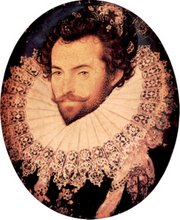
Sir Walter Raleigh


As a requirement for receiving the Ancestor Approved Award is to publish a report on 10 persons connected with the Lost Colony, I am starting with Sir Walter Raleigh. Though he never set foot on Roanoke Island himself, the idea was his brainchild and he furnished much of the financing. The settlers were to establish the Citee of Raleigh.

Sir Walter Raleigh

Biography, Timeline & Facts about the famous explorer, explorations & voyages in the Age of Exploration


Facts, Biography, Timeline & History about the life of Sir Walter Raleigh - Explorer, Poet and Courtier

  • 1554 Sir Walter Raleigh was born in Hayes Barton in Devonshire

  • Part of a leading Protestant family

  • Sir Walter Raleigh hated the Catholic Church

  • Distant relative of Francis Drake

  • On August 24 1572 Raleigh witnessed the St Bartholomew's Day massacre where French Protestants were massacred by French Catholics in Paris

  • A member of the Middle Temple in 1575

  • He was nearly 6 foot tall

  • In 1578 Sir Walter Raleigh sails with his half brother, Sir Humphrey Gilbert, to America

  • Raleigh captains 'The Falcon'

  • Raleigh has an illegitimate daughter by a local woman called Alice Goold

  • In 1580 Raleigh helps to put down the Irish rebellion, is knighted and becomes a favourite of Queen Elizabeth. He becomes extremely wealthy

  • Sir Walter Raleigh spoke with a soft Devonshire accent

  • He was noted for his courtly manners and was reputed to have placed his cloak over a puddle in order to prevent Queen Elizabeth I from muddying her shoes. This is not confirmed however a cloak was included in his coat of arms

  • Sir Walter Raleigh was a true man of the renaissance and a brilliant poet

  • He founded the secret society called "The School of Night" which was attended by fellow highly prominent Elizabethans - new beliefs were discussed and it is closely related to the mysterious Rosicrucian movement

  • March 25, 1584 - Walter Raleigh receives the patent to explore and settle in North America

  • 1584: Sir Walter Raleigh's fleet of seven vessels under Richard Grenville and Ralph Lane, with 108 men, reach Roanoke Island in June.

  • 1584 June 4, Virginia colony of Roanoke Island established by Sir Walter Raleigh.

  • 1585 January 6: Queen Elizabeth knights Walter Raleigh and makes him governor of the new territory discovered by Amadas and Barlowe. Raleigh names it "Virginia" in her honor.

  • 1586 - The Babington Plot - Sir Francis Walsingham and Sir Walter Raleigh discover plot to assassinate Queen Elizabeth and replace her with Mary Queen of Scots (called the Babington Plot)

  • July 22, 1587 - Sir Walter Raleigh backs the first English Colony in North America (North Carolina) led by John White to the English Roanoke Colony

  • 1587 August 18, Virginia Dare born in Roanoke colony , the first English child born in North America

  • 1588 Raleigh donated "Ark Royal" to the English navy which was chosen to lead the English fleet against the Armada. Sir Walter Raleigh & Sir Richard Grenville were responsible for the joint defence of Devon and Cornwall against the expected Spanish Armada. The land-based soldiers did not have the opportunity to fight the Spanish.

  • 1589: Sir Walter Raleigh & Sir Richard Grenville guard the sea approaches to Ireland

  • 1592 Raleigh falls out of favour with Elizabeth when she discovers that he has married one of her maids called Bessie Throckmorton

  • The Queen ordered that Sir Walter Raleigh is placed in the Tower of London but he was released when one of his ships brought back a huge treasure on the captured Spanish ship "Madre De Dios"

  • 6 February 1595 - Sir Walter Raleigh leaves England to sail to the New World to search for the city of El Dorado (the city of gold)

  • 1595 Sir Walter Raleigh explores the Orinoco

  • 24 March 1603 - Queen Elizabeth I dies and is succeeded by King James, the son of Mary Queen of Scots

  • 1603 King James, eager to make peace with the Spanish, imprisons Sir Walter Raleigh in the Tower of London on charges of treason

  • In 1612 King James releases Raleigh, who promises to give King James a fortune if he allows him to return to Guiana

  • In 1616 Raleigh travels to Guiana but his mission fails and he attacks a Spanish settlement

  • 1618 Sir Walter Raleigh is beheaded for attacking the Spanish.

http://www.elizabethan-era.org.uk/sir-walter-raleigh.htm


This blog is © History Chasers

Click here to view all recent Searching for the Lost Colony DNA Blog posts

Bookmark and Share

Sunday, April 18, 2010

On the Road Again with Roberta


Anne and I went to the beach today. The kids went to swim and play ball, but Anne and I found a deserted beach and just walked around and enjoyed the serenity for a few minutes. The wind was quite strong and it’s cool, but not cold. The sand beating against your skin actually hurts after a few minutes, so our stay wasn’t terribly long. The beach is beautiful this time of year after the winter storms. The locals are windsurfing in their favorite locations and the tourists aren’t here yet. The sand here is full of shells, mostly broken, becoming more grains of sand.

It’s beautiful just the same.Mostly though, as I wander here, I think of the colonists. I’m here tracking their footsteps, although the sand has obliterated them…..they still remain, hints, wisps, maybe just the after image that they were here…… but they were….and we will find them. My time here this week has been inspirational and given me some new ideas. You’ll be hearing about them soon so stay tuned.

On the Road Again With Roberta


Ever have one of those days where nothing goes right? Well, today was mine. I made little progress today in my treck for home. The person I was supposed to meet in the afternoon was elusive, I got lost multiple times between a poor map and an overzealous GPS system that insisted that I go back to the interstate no matter how far out of the way it was. Nothing is more irritating than a nagging machine. And to top it off, I had no cell signal for several hours.
But instead of detailing what went wrong, I’ll share with you the silver lining to the cloud. I wound up tonight in South Boston, Virginia. Don’t even ask how. Now the good news is that my family is from Halifax County, Virginia, where South Boston is located. Not my current family, my ancestral family. It’s somehow ironic that I had to make a concerted effort to get here many times for research, and now that my research is done, this is the second time I’ve “landed” here during another journey. Of course, I had to go and visit one of three family cemeteries here. The one I visited is public and relatively easily accessible. The other two are remote and on private land, so not easy to get to and certainly not without prior notice to the property owner. I visited my my great-great-great-great-grandfather, George Estes, who was born in 1761 and served in the Revolutionary War in place of his father Moses Estes. Thankfully he lived until 1859 and filed for both a pension and bounty land, giving us a plethora of information to work with. Unfortunately, the graves were moved by the family early in the 1900s when the city “bought” the land. They supposedly moved old George and perhaps his father Moses too, but the story was that all they found was a casket hinge and a collar bone. Whatever parts they found of him are now buried in the family plot in the public cemetery, and the rest of him, well, he’s under the city landfill now…..so he’s a lot more than 6 feet under.

One of the best things about South Boston is visiting Ernie’s Restaurant. No matter how unhappy I was with my lack of progress, it was somewhat soothed by the knowledge that I could visit one of my favorite haunts. Ernie’s has been a fixture in South Boston since 1958 when the original owner opened the first Ernie’s, which burned to the ground in 1991. Today, the “new” Ernie’s is a favorite of the locals and visitors alike. Ernie’s overlooks a creek and includes a mill wheel, I believe from the original building. Ernie retired in 1981 and sold the restaurant to his son and daughter-in-law who still own the establishment. Ernie’s claim to fame, aside from all-around good food at reasonable prices and southern hospitality is their buffet. On Friday and Saturday night, they have a seafood bar with lots of variety and that is in addition to their regular buffet offerings of fried chicken, Bar-B-Q made on the premises and other southern favorites. The seafood includes two kinds of steamed shrimp, fried oysters, oyster stew, baked cod, fried fish, deviled crabs (to die for) and lots of other goodies plus of course the veggies and salads and a dessert bar too. One of my favorites is the deviled crabs and on the veggie bar, their stewed tomatoes. Now I can hear you laughing….stewed tomatoes, or maybe I should call it stewed tomato pudding….but don’t laugh until you have tried it. It’s no laughing matter, but it will definitely tickle your fancy! For dessert, you just have to try the home made banana pudding, and maybe the chocolate divinity too. And after all of that, you’ll have to sit a spell on their inviting front porch because you’ll be too full to walk to your car.
This blog is © History Chasers

Click here to view all recent Searching for the Lost Colony DNA Blog posts

Bookmark and Share

On the Road Again with Roberta


The hills are alive, but it’s not with the sound of music. It’s with the power of wind and water and the hills are really sand dunes on the Outer Banks. You see, these sand banks move from place to place, and it’s always a battle between the land and the sea, or maybe more to the point, between bulldozers and the sand.

The sand banks shield Highway 12 which runs the length of Hatteras Island from the sea, but when a Noreaster or a hurricane or in some cases, a severe “tropical storm” which is a nice name for a severe storm which is not quite a hurricane strikes, the storm quickly blows the sand away and then the road and any buildings in the way are at the mercy of the sea. In 2003, hurricane Isabella opened a brand new inlet on Hatteras Island and in November 2009, it breached the island again at Mirlo Beach in Rodanthe.

Today, the road is routinely maintained by heavy equipment to keep the sand dunes off of the road and to put the sand back on the dunes from where it blows, daily, across the roads into drifts resembling snow drifts.

For those who routinely follow this blog, you may recall that I was on Hatteras Island during Hurricane Ida last November, and was likely the last person off of the island , at night, driving in the hurricane. I was truly terrified and will never do that again, either leaving earlier or staying put, but not driving at night to evacuate with no other traffic doing the same. The next day, I heard that the road washed out, was closed for weeks and several houses condemned and torn down.

One of the homes was Serendipity, a house that was featured in the movie Nights of Rodanthe for its precarious perch on the edge of the surf of the outer banks and its turreted Victorian appearance. Below is a picture of Serendipity as it stood before.

Below, a photo of both Serendipity and the road after Hurricane Ida last November. Notice the sand dunes along the road are entirely gone, poof, in one night of blowing.

After the hurricane, the owners were advised that the home was permanently condemned. It has previously been occasionally condemned, but brought up to snuff again after a storm, and then pronounced inhabitable again. Since its debut in the movie, it has generally been a high end rental, that is, when it wasn’t condemned.

However, with so much of beach gone it had to be moved or torn down. New owners purchased the home and moved it across the road.

The new owners have renovated the home, added decks and of course put it on a new foundation.

Here’s a slide show featuring Serendipity and the coastal destruction. It’s amazing to see this house sitting in the ocean.

Here is a blog about the home as well.

So, for today, Serendipity is once again safe for the sea, and is renovated and repaired, just in time for the 2010 hurricane season to begin.

This blog is © History Chasers

Click here to view all recent Searching for the Lost Colony DNA Blog posts

Bookmark and Share

On the Road Again With Roberta


No trip to the Outer Banks would be complete without a visit to the Outer Banks History Center in Manteo at Festival Park, a local satellite office of the North Carolina State Archives. They collect lots of information about the Outer Banks and make the originals available to the local population here. The history here is indeed rich, and they should be commended for keeping the information locally and available to the people who live here and in close proximity.
Today’s trip was to use the Beatrice McArthur collection. Mrs. McArthur, 1923-2002, was born in Buxton, NC to Joseph and Arville Credle Barnett. She was a school teacher on Maryland’s Eastern Shore and married Arthur Lee McArthur of Cordele, Georgia. They lived variously in Durham, Charlotte, Cramerton and Greensboro, NC but retired to Buxton where she continued to research and compile a history of the Hatteras Island families. Research was one of her greatest passions and she was instrumental in gathering the recorded history and genealogy of the Cape Hatteras region. She also co-founded the Hatteras Island Genealogical and Historical Society. The collection extends in some cases to Okracoke Island and occasionally to the mainland and Roanoke Island. The materials include family group sheets, correspondence, copies of birth records, death records, family Bible records, marriage licenses, obituaries, census records and more. It is truly a wealth of information. Aside from lots of history pertaining to the region and many newspaper clippings, there is family specific information on the following Island families: Austin, Balance, Barnett, Burrus, Casey, Dailey, Farrow, Flowers, Fulcher, Garrish, Gaskill, Gaskins, Grey, Hooper, Howard, Jackson, Jarvis, Jennett, Jennings, Meekins, Midgett, Miller, Neal, Norton, O’Neal, Oden, Payne, Peele, Pugh, Quidley, Relfe, Rollinson, Scarborough, Simpson, Stowe Styron, Taylor, Tolson, Toler, Whedbee, Williams, Willis, White.


This blog is © History Chasers

Click here to view all recent Searching for the Lost Colony DNA Blog posts

Bookmark and Share

Friday, April 16, 2010

Searching for the Lost Colony DNA Blog Receives the Ancestor Approved Award!

The Searching for the Lost Colony DNA Blog has been selected to receive the Ancestor Approved Award! We are honored and excited.

This award is given to blogs that exhibit value by publishing well documented articles about ancestors. While the Lost Colony ancestors may not be our ancestors, we really don't know whether they are or not. In any case they are someone's ancestor's, provided they did survive after being left behind on Roanoke and with a few exceptions seemingly forgotten by civilization.

Paul Green's famous play, the Lost Colony, first presented in 1937, was responsible for the public's rediscovery of the Lost Colony of Roanoke. Since that time the fascination has grown. Many have written about this group and some have made great Archeological discoveries, but the Lost Colony of Roanoke DNA Project is the first effort to search for DNA evidence of these brave settlers having survived and passed on their genes to present day populations in North Carolina and other areas.

Part of our participation as a blog receiving this award is for us to publish ten things we discovered about our ancestors. In this case the ten will be represented by Lost Colony major players. One of whom, Walter Raleigh, never even set foot on Roanoke.

The first person of the ten will be Walter Raleigh because the settlement was his brainchild.

To be continued.........

This blog is © History Chasers

Click here to view all recent Searching for the Lost Colony DNA Blog posts

Bookmark and Share

Wednesday, April 14, 2010

On the Road Again with Roberta


It’s official dig in the dirt day.

Yes, making mud pies is all in vogue again, and that’s what Anne and I did today. We are working with the students on an old homestead site, and Anne and I sifted as they excavated the old well with a barrel in the bottom, among other items.
In addition to the well, we’ve found barbed wire, broken pottery and plates, an old wagon wheel rim, plus lots of pieces of brick, mortar, iron pieces and such items that you would expect to find on an old homestead.

It’s fun to participate and a learning experience for them as well. We’ve enjoyed our week with them and tomorrow will be DNA education day. We’ve discussed history and research, standards and how to draw logical and not faulty conclusions. It has been particularly interesting as many of these students have a wealth of experience themselves in various fields, so there has been a great deal of give and take. Our participants, some of whom are volunteers and not students, range in age from 13 to 71, so as you might imagine, there is a great deal of diversity and experience to be drawn upon.At the end of the day, I looked at the reflection in the water once again gathered in the well so long underground and abandoned, and I wondered what the reflection is telling us about those who lived there so long ago….if we could only understand…...