Pages

Thursday, June 30, 2011

Following the Croatoan


Lost Colony Research Group
July Newsletter

Genealogy-DNA-Archaeology

Following the Croatoan 

In 2010 when the North Carolina Society of Historians awarded the Lost Colony Research Group the prestigious Malcolm Fowler Award, their question was why we weren't following the Croatoan. Little did they know, we are and have been for some time. Records that touch upon the Hatteras have been scattered throughout many different types of records in many locations. Altogether, there aren't many.

The Colonists left us one very clear message, in duplicate. When they left Fort Raleigh on Roanoke Island, they disassembled the houses and left in an orderly manner. In doing so, they also left two messages, "Cro" and "Croatoan", carved into a fort post and into a tree, in order to tell John White on his return trip where they would be found. They also left him another message, by omission. He had agreed with them that if they were in distress, they would carve a cross, the cross formee, along with any message, and there were no crosses. They were not in peril when they left. White tell us also that, prior to his departure in 1587, there had been discussion of plans to move "50 miles into the main", but his records are mute on any further location(s). The Chesapeake area has been speculated, but that doesn't match with the 50 mile criteria.

John White tells us in his journal in 1590 that he was greatly relieved that the colonists had joined their friends, the Croatoan, the tribe of Manteo, on Hatteras Island. And with that, they disappear from the English records. John White was blown back to England in a hurricane, never able to return. Subsequent expeditions were sporadic and had even less success in determining whether the colonists survived or not.

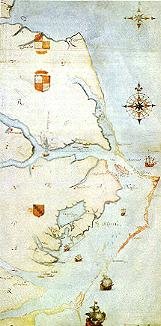
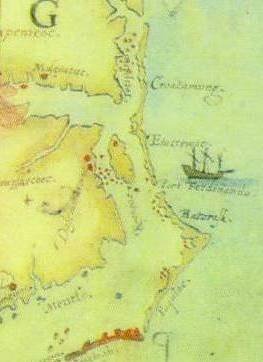
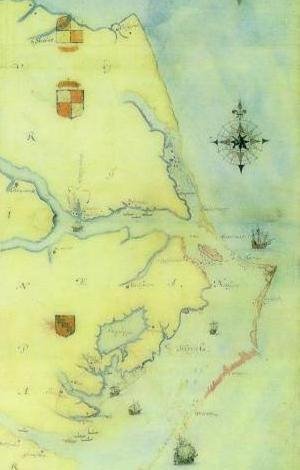
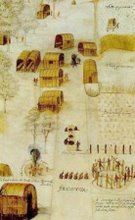
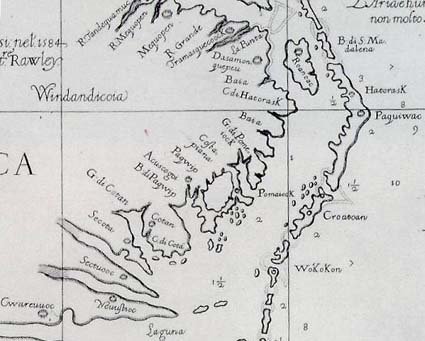
White and Harriot created a map in 1585 that showed in red the various locations of the Indian towns that were discovered during their explorations. The depiction of the Outer Banks was somewhat distorted, and of course the geography has changed between 1585 and 2010 as a result of various storms, but in essence, White showed the entire Island he called Croatoan as inhabited by Indians, as shown below. The outlet at the top of Croatoan is now closed so that Cape Hatteras today connects the two islands of Croatoan and Paquiwoc.


Cont. Here:


This blog is © History Chasers
Click here to view all recent Lost Colony Research Group Blog posts
Bookmark and Share

Monday, June 6, 2011

Hatteras Island Genealogy and Preservation Society is Not Your Grandma's Genealogy Society

 The Hatteras Island Genealogy Society is planning some rocking events. Check it out!


"We're planning to host cooking demonstrations by local chefs and cooks, using LOCALLY CAUGHT seafood and local NC produce. MORE information will be posted as the details are finalized, and a sponsor is assigned to the event. Hatteras Island, Ocracoke and Dare County restaurants and caterers who are interested in one of your own being the featured chef or cook during a 30-45 minute segment of the event, please post a comment...thanks!

Several Non Profit Groups will be on hand to give us more information about the FREE services they provide. We're also planning free cooking demonstrations, live music and entertainment, and at least one free toddler play area. More information to follow..."
This blog is © History Chasers
Click here to view all recent Lost Colony Research Group Blog posts
Bookmark and Share

Saturday, May 28, 2011

We've got a brand new pair of rollers skates....errr.....ahem.... a brand new new URL!!!

Our research group has a brand new URL for our website which is an extremely valuable repository of Lost Colony information and original research. Check it out!

http://www.lostcolonyresearch.org


This will take you to:


http://www.rootsweb.ancestry.com/~molcgdrg/

and the old URL will still work also. But just remember lost colony research dot org.

We hope this will be more convenient and easy to remember.


This blog is © History Chasers
Click here to view all recent Lost Colony Research Group Blog posts
Bookmark and Share

Friday, May 27, 2011

Sea Gives Up 300 Year Old Blackbeard Artifacts

Blackbeard's anchor recovered off NC coast


MOREHEAD CITY, N.C. – An anchor from what's believed to be the wreck of the pirate Blackbeard's flagship has been raised from the ocean floor off the North Carolina coast.
Archaeologists believe the anchor recovered Friday is from the Queen Anne's Revenge, which sank in 1718. That was five months before Blackbeard was killed in a battle.
The recovery coincides with the release this month of "Pirates of the Caribbean: On Stranger Tides."
The movie features both Blackbeard and the Queen Anne's Revenge.


This blog is © History Chasers
Click here to view all recent Lost Colony Research GroupQueen Anne's revenge,  Blog posts
Bookmark and Share

Friday, April 29, 2011

Pipe Band Caught Near Tornados

A 25-strong group from Bideford Youth Pipe Band also had first-hand experience of the natural disaster which hit North Carolina.


 See: http://hatgensoc.wordpress.com/2011/04/15/the-british-invasion-on-hatteras/

They were performing in Bideford’s twin town of Manteo when the tornadoes struck the region.
Although not directly affected, it was a scary time as the 17 youngsters and eight adults listened to the tornado sirens and watched news flashes on television tracing the paths of the ‘twisters’ on the screen.
At one point they were told to take shelter in the central corridor of the housing complex where they were staying and given cushions to hold over their heads, said band secretary Mike Harper.

cont. here:
http://www.northdevongazette.co.uk/news/pipe_band_among_the_twisters_1_877174.

This blog is © History Chasers
Click here to view all recent Lost Colony Research Group Blog posts
Bookmark and Share

Thursday, April 28, 2011

Andy's Tornado Terror

Andy was returning from his third visit to North Carolina, where he has been taking part in archaeological digs in his bid to find evidence of the first British settlements and prove the part played by people from Bideford in the founding of America.
All his visits have been strangely dogged by natural disasters, but this one ended in terror. “I really feel that this time I cheated death,” he said.
After two weeks of successful digs with Professor Mark Horton and students from Bristol University, Andy stayed behind an extra day to visit Bideford’s twin town of Manteo, where the Bideford Youth Pipe Band was performing.
Over the weekend the tornadoes struck.
“I was told they usually have around 20 tornadoes during April, but in two days they had 62,” he said.
“Three people died within a mile of the local airport from where my journey home began. We set off in a twin turbo-prop plane with 58 passengers. The 35 minute flight to the main Newark Airport for the flight home took us two hours. We flew straight into the storm over Newark. We were told to strap ourselves in and hold on to everything that was dear. Our descent was at a 45 degree angle as we tried to get down and beat the storm. There was zero visibility, lighting was flashing and 70mph cross-winds were reported. My 16 stone frame was lifted from the seat, despite being strapped in.
Cont. here:

This blog is © History Chasers
Click here to view all recent Lost Colony Research Group Blog posts
Bookmark and Share

Wednesday, April 20, 2011

Archaeology – 99.9% Dig, Sweat, Move Dirt

by Roberta Estes
 
Archaeology is so tangible.  Everyone wants to dig in the dirt and find treasure.   Indiana Jones watch out!
 
Today we took a break to come back and find a 9 year old boy happily digging in the bottom of one of our archaeology pits.  Not exactly the kind of “find” we wanted.  And yes, that tends to “ruin the pit”.
 
But for the most part, archaeology, for those doing the digging, is 99.9% dig, sweat and move dirt from place to place.  More precisely, you dig it out of one place, sift it with a screen sifter to be sure you have even the smallest artifacts, and then when the pile under the screen sifter gets too large, you either move the pile or the sifter, one or the other and start a new pile.  Eventually, when you’re done digging in that location, meaning you’re reached a “sterile” layer, you then get to backfill all of the dirt that you just dug out and sifted.
 
Many locations, known in the vernacular, as “pits”, produce nothing of note.  Here, we have lots of oyster shells, and I mean LOTS of shells.  In some of the earliest deeds this general location was called “Oyster Shell Banks” for a reason.  There are lots of other kinds of shells too.  One thing is for sure, the native people didn’t starve here, nor did the early settlers.  If you could fish or gather shellfish, you could survive. 
 
Other locations produce interesting things, but just not exactly what you are looking for.  Can anyone guess what the “find” below is?  It’s actually quite attractive with its design on the front.  If you can’t guess, I’ll tell at the end of this posting.

 
Many things that people threw away 100 or 200 or more years later, we find fascinating.  Trash piles, known as middens, are the archaeologist’s mainstay.  Find the midden and you can tell heaps, pardon the pun, about the people who lived there.  Think about our current middens, known as landfills.  People would think we worship an entity that looks like Ronald McDonald based on all of the fast food wrappers in the trash.
 
The area where we’ve been digging apparently served as a trash heap for some number of years, and apparently, off and on for centuries.  It’s in a rather high area very close to a sheltered channel that leads to the sea.  This would be a wonderful area for a fisherman to pull his boat in and unload his catch and clean it safely out of the wind and sun. 
 
In fact, can you see the artifact below in the photo?


If you can’t see it in the photo above, maybe the one below from the other direction will be easier.


This boat isn’t “old”, but it is in the process of being reclaimed by the earth.  One good storm with blowing dunes and this boat will be covered, waiting for the next group of archaeologist in another 100 or 200 years.
 
Oh yes, before I forget to tell you, the mystery artifact is a part of an old stove.

This blog is © History Chasers
Click here to view all recent Lost Colony Research Group Blog posts
Bookmark and Share

Tuesday, April 19, 2011

Tornado

4-16-2011

Just when we thought we had escaped the 2011 dig with no catastrophes, a tornado struck.  Fortunately, it only delayed Andy's flight by 5 or 6 hours, not 5 or 6 days like the previous events.  About this same time, I had left Beckley, West Virginia, (yes, Beckley again) and was driving near Charleston, down a hill, in construction, when I rounded a curve and wondered if the white "wall" ahead was fog.  Within seconds, I realized it was not fog, it was driving sheets of rain and hail.  I noticed a sign about this time stating an exit was about 2 miles away.  That last two miles, driving down a mountain in rain so hard that you could see nothing, not the lines on either side of the road, nothing at all...was terrifying.  Extremely harrowing - making me wonder at what point I would see my life pass before me. 

I was afraid to pull off in a construction zone because I didn't know if there was a shoulder.  I decided I had to stop, regardless, because I was going to hit something otherwise, although I was terrified that someone would hit me.  I knew someone, especially a truck, coming down that mountain wouldn't see my flashers until it was too late. 
I pulled over, just in time to see the green sign right beside me with an arrow pointing to the exit ramp.  I've never been so grateful for an exit ramp.  I crept down the ramp to the single filling station and discovered they had no power.  Do you know how difficult it is to visit the bathroom in total darkness?  

I knew George was taking Andy Powell to the airport and I had to wonder how they were being affected.  The storm was brutal and short, followed by flash floods.  Later, I would discover that a tornado struck very near George's home, where George and Andy had spent the night before George took Andy to the airport.  Andy was actually at the airport, and his flight did leave, even if significantly delayed by several hours.  So now, we've had our digs ushered out by a hurricane, a volcanic eruption and a tornado.  What's next? 

This blog is © History Chasers
Click here to view all recent Lost Colony Research Group Blog posts
Bookmark and Share

Crowned on Hatteras Island


You just never know what’s going to happen.  When I travel, I make the local library a mandatory stop – and they are always a wonderful resource.  But never, ever, have I been crowned a Princess in a library before.  In fact, I’ve never been a princess anyplace.  But everyone should be a princess at least once in their life, even if for a fleeting 15 minutes or so.
 
So how was I crowned Princess?  It has to do with a non-cooperative printer and beating said printer into submission.  They brought be the “brainiac tierra” and I wore it around, forgetting about it.  Some time later, I went to make copies and realized that the entire line of people waiting at the service counter were looking strangely at me.  I kind of thought that was odd….but didn’t think any more about it until I went to the restroom and realized that I still was wearing by special tierra. 
 
Anne snapped a photo for posterity.  I did my good deed for the day, and we were off to find our Lost Colonists!


Monday, April 18, 2011


April 14, 2011...was a special day for Manteo, NC., and it's twinned sister city... Bideford, England. Andy Powell, retired Mayor of Bideford and the Bideford Youth Pipe Band, graced the streets of Manteo with a visit from across the pond.

Andy, who was already on the Outer Banks to once again participate in an archaeology dig, shared this special occasion with two other LCRG members, Dawn Taylor and George Ray. They accompanied him for an hour long ride "up the beach", to hear a very talented group of young musicians, who ranged from ten to eighteen years of age, share a bit of England with locals and visitors alike.

The Bideford Youth Pipe Band, honored the retirement of Andrew Thomas Powell, by serenading him with the song, Auld Lang Syne. A song among several that echoed down Budleigh Street and onto the Manteo waterfront, where onlookers, including an English wedding party, listened as bagpipes were played and the beat of the drums, filled the air.


This blog is © History Chasers
Click here to view all recent Lost Colony Research Group Blog posts
Bookmark and Share