Pages

Friday, February 17, 2012

Priscilla's Coming Home!!!


Priscilla: The story of an African slave


By Leslie Goffe 
BBC News, New York
Using a rare and unbroken document trail, scholars have succeeded in tracing a 10-year old girl from her kidnap in Sierra Leone 249 years ago to her life on the plantation in the United States where she was taken, forced into slavery, and re-named Priscilla.


Thomalind Martin Polite in Sierra Leone
Thomalind Polite travelled to Sierra Leone, where her ancestor was kidnapped
Most amazing of all though, researchers have identified one of Priscilla's modern day descendants, great-great-great-great-great granddaughter, Thomalind Martin Polite, 31, who lives in South Carolina, not far from the plantation where her ancestor was a slave.


Priscilla's extraordinary story is featured in a major exhibition currently showing at the New York Historical Society, Finding Priscilla's Children: The Roots and Branches of Slavery, which can be seen until 5 March, 2006. Earlier this year, Priscilla's descendant, Thomalind, a speech therapist, made an extraordinary "homecoming" journey to Sierra Leone at the invitation of that country's government. She met President Ahmad Tejan Kabbah and other top national leaders, and was given an African name in a moving seaside ceremony. Sierra Leone's most popular music group wrote a song in Ms Polite's honour: "Rush with the message, go tell it to the people, open the gates, Priscilla's coming home."

 Cont:
 http://news.bbc.co.uk/2/hi/africa/4460964.stm

This blog is © History Chasers
Click here to view all recent Lost Colony Research Group Blog posts
Bookmark and Share

Thursday, February 16, 2012

David Stick: The Creation of the Outer Banks History Center


David Stick first came to the Outer Banks with his parents in 1929. His father was the renowned outdoor illustrator Frank Stick. His mother, Maud, was often a model for Frank and other artists. David's natural curiosity about North Carolina's untamed coast led him to explore the region, its history and peoples, fostering a lifelong passion for research and writing. He is the author of several books including Graveyard of the Atlantic: Shipwrecks of the North Carolina Coast, The Outer Banks of North Carolina: 1584-1958 and Roanoke Island: the Beginnings of English America.

David Stick, ca. 1987Throughout a long career as writer, historian, and community activist, Stick had amassed a very large collection of primary and secondary research materials, with emphasis on the North Carolina coast. In July 1986, Stick donated this personal library, an extensive private collection of North Caroliniana, to the North Carolina Department of Cultural Resources and it became the core around which the Outer Banks History Center was built. Throughout the years, the History Center has continued to add print, non-print and non-textual items to its initial collection.


Cont.
http://www.obhistorycenter.ncdcr.gov/history.htm

This blog is © History Chasers
Click here to view all recent Lost Colony Research Group Blog posts
Bookmark and Share

Wednesday, February 8, 2012

Pocahontas- Mischief and Joy

Native American princess Pocahontas was born around 1595 near Jamestown, Virginia. She first met English settlers in Jamestown Colony in 1607. Pocahontas and John Smith developed a friendship. She gave food to the colonists and warned them of an upcoming attack. When Smith left the colony in 1609, Pocahontas ended her support. In 1613 she married John Rolfe in the first U.S. mixed marriage.

Profile (born 1596, near present-day Jamestown, Virginia, U.S.—died March 1617, Gravesend, Kent, England) Powhatan Indian woman who fostered peace between English colonists and Native Americans by befriending the settlers at the Jamestown Colony in Virginia and eventually marrying one of them. Among her several native names, the one best known to the English was Pocahontas (translated at the time as “little wanton” or “mischievous one”). She was a daughter of Powhatan (as he was known to the English; he was also called Wahunsenacah), chief of the Powhatan empire, which consisted of some 28 tribes of the Tidewater region. Pocahontas was a young girl of age 10 or 11 when she first became acquainted with the colonists who settled in the Chesapeake Bay area in 1607.

This blog is © History Chasers
Click here to view all recent Lost Colony Research Group Blog posts
Bookmark and Share

Wednesday, February 1, 2012

Family Tree DNA now accepting 23andMe raw data uploads


By Janet Crain

Those of you who have tested at 23andMe may now upload your raw data to Family Tree DNA to be converted to Family Finder. If you tested at the V3 platform it will cost $50. Really a good deal as Family Finder is usually $299. It is a special price and won't last long. The conversion is not a perfect match as some snp's are different but with over 900,000 snp's to compare there should be plenty. 

If you tested at the V2 level it will cost more. The way I understand it, you pay your $50. Then when you upload it will say you don't have enough snp's and you will then be offered a $109. special price for the Family Finder test. That is also a really good temporary price. 

Is it worth it to have both? I think it is. You will need to download your raw data and unzip it before you upload.

If it uploads successfully you will get this message:

"Congratulations! The results file you uploaded was determined to be a V3
File with more than 900,000 SNP results. Please note, uploaded results files
Are batch processed once a week. You will be notified by e-mail when your
Results file has been processed.

After your results file is processed you will be able to enjoy the many
Family Tree DNA features and order additional tests to uncover more about
Your ancestral origins."


There was a glitch earlier but everything seems fine now.

By CeCe Moore 
The time has finally come for all of you who have been waiting. Family Tree DNA is now accepting raw data uploads from 23andMe. If you are already a customer of FTDNA, sign into your account from the home page and order from there to avoid creating a duplicate account.  If not, go to the product listing and scroll down to "Transfer Relative Finder" and order from there. They are offering an introductory price of only $50 to 23andMe customers with v3 results for both new and existing FTDNA customers. A discount will be offered to 23andMe customers on the v2 chip via a coupon code after an upload verification of the raw data file.

Transfer options are:
Option Price Project MembershipMatching
FTDNA Kit Import (V2) $50+$109 = $159 Yes Retest
FTDNA Kit Import (V3) $50 Yes Database Import
New Customer Transfer (V2) $50+$109 = $159 Yes Retest
New Customer Transfer (V3) $50 Yes Database Import


Cont:
http://www.yourgeneticgenealogist.com/2012/01/family-tree-dna-now-accepting-23andme.html


This blog is © History Chasers
Click here to view all recent Lost Colony Research Group Blog posts
Bookmark and Share

Thursday, January 26, 2012

Native Americans actually came from a tiny mountain region in Siberia, DNA research reveals


Altai in southern Siberia sits right at the centre of Russia. But the tiny, mountainous republic has a claim to fame unknown until now - Native Americans can trace their origins to the remote region.

DNA research revealed that genetic markers linking people living in the Russian republic of Altai, southern Siberia, with indigenous populations in North America.
A study of the mutations indicated a lineage shift between 13,000 and 14,000 years ago - when people are thought to have walked across the ice from Russia to America.
Altai in Siberia: A study of genetic markers in DNA showed that the lineage of Native Americans changed around 13-14,000 years ago - when people are thought to have walked across the Bering Strait
This roughly coincides with the period when humans from Siberia are thought to have crossed what is now the Bering strait and entered America.
'Altai is a key area because it's a place where people have been coming and going for thousands and thousands of years,' said Dr Theodore Schurr, from the University of Pennsylvania in the US.
Among the people who may have emerged from the Altai region are the predecessors of the first Native Americans. 
Roughly 20-25,000 years ago, these prehistoric humans carried their Asian genetic lineages up into the far reaches of Siberia and eventually across the then-exposed Bering land mass into the Americas.

'Our goal in working in this area was to better define what those founding lineages or sister lineages are to Native American populations,' Schurr said.


Read more: http://www.dailymail.co.uk/sciencetech/article-2092258/Native-Americans-actually-came-tiny-mountain-region-Russia-DNA-research-reveals.html#ixzz1kbO2uDKL


To be continued tomorrow


This blog is © History Chasers
Click here to view all recent Lost Colony Research Group Blog posts
Bookmark and Share

Tuesday, January 24, 2012

Who Do You Think You Are? Live

Photo-dating experts in the Photography Gallery | Who Do You Think You Are? Live 


The biggest family history event in the world. Whether you’re new to tracing your family tree or a seasoned researcher, Who Do You Think You Are? Live 2012 is packed with industry-leading genealogy experts, informative workshops and celebrities from the TV show to help with your own family history...


http://www.whodoyouthinkyouarelive.com/news/photo-dating-experts-photography-gallery


This blog is © History Chasers
Click here to view all recent Lost Colony Research Group Blog posts
Bookmark and Share

Wednesday, January 18, 2012

Good News for Outer Banks Area!!!

This just In!
National Park Service News Release
FOR IMMEDIATE RELEASE: DATE: January 18, 2012
CONTACT: Cyndy Holda, 252-473-2111, ext. 148

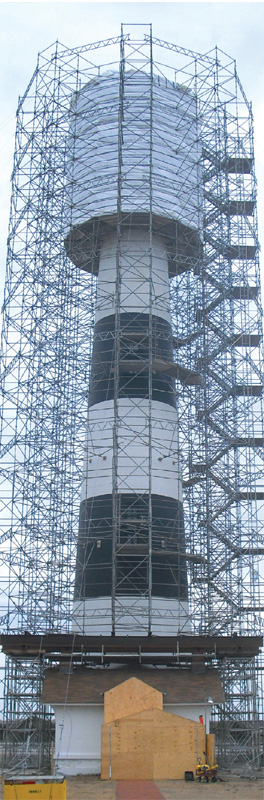
The Bodie Island Lighthouse is surrounded by scafolding, and the lightroom and balcony are enveloped in a wrap to protect them during restoration.Bodie Island Lighthouse Restoration Will 
Resume

Superintendent Mike Murray announced this week that a $1.89 million contract has been awarded to resume restoration of the famed Bodie Island Lighthouse located near Oregon Inlet. The National Park Service (NPS) Denver Service Center has issued a notice to proceed with the award of contract to the prime contractor, United Builders Group, LLC from New Bern, North Carolina.

The previous restoration project contract was terminated in Spring 2011 after significant new structural integrity issues were found in many of the main support beams under the balcony. The additional repairs needed were too costly to finish in the original restoration project and therefore work ceased. The contractor demobilized and was off-site by April 20, 2011.
NPS funding requests have since been approved to complete the restoration work in FY2012.

The new project is expected to begin in late February 2012 and be completed in October 2012. The work will include the following renovations:
Restore deteriorated metal
Restore components on the lantern level (support beams, masonry,
railing/ladder)
Replace galley cornice segments
Paint interior and exterior masonry
Replace windows and glass on lantern level
Repair the Oil house marble floor and roof, install new windows
Paint all newly installed metals/wood
Install fire suppression system and rehabilitate electrical power
Install stair strengtheners

Project update reports will be issued periodically. For more information, contact the Public Affairs Office at 252-473-2111 ext. 148.

-NPS-

NPS Photo
The Bodie Island Lighthouse is surrounded by scaffolding, and the lightroom and balcony are "wrapped" to protect the area during renovations.


This blog is © History Chasers
Click here to view all recent Lost Colony Research Group Blog posts
Bookmark and Share

Sunday, January 15, 2012

Jamestown and Lost Colony Surnames


What's in a Name??

 Roberta Estes

Recently we were able to obtain the records of the Jamestown colonists who share surnames with the Lost Colonists thanks to a contribution from a benefactor.  
The records have been extracted, by surname.  Historic Jamestown has done a superb job of researching their colonists and what information is known about every known Jamestown colonist up through about 1625 is provided on their site for a nominal fee.  You can see all of the biographies by surname at the site. 
 

The information has been incorporated on our website under the appropriate surname.  To view the results, click on this link to go to our website, then click on "surname research", then on the surname you are interested in viewing.  Then click on the Jamestown link.

The following Lost Colony surnames are also represented at Jamestown:

·       Archer (Archard perhaps)
·       Brooke(s)
·       Brown(e)
·       Cooper by variant spellings
·       Ellis
·       Flory/Flower
·       Johnson
·       Kendall
·       Martin
·       Nichols
·       Powell
·       Russell
·       Scott
·       Smith
·       Stephens/Stevens
·       Taverner
·       White
·       Wilkinson
·       Williams
·       Wotton
·       Yonge/Young

Several of these names have several Jamestown colonists.  There are 100 different records in total, so take a look and see if there is anything for one of your surnames.


This blog is © History Chasers
Click here to view all recent Lost Colony Research Group Blog posts
Bookmark and Share

Thursday, January 12, 2012

23andMe Reconsiders Several Planned Actions


 Thanks to those who complained about 23andMe's plans to drop non-paying subscribers from their data base, 23andMe announced they have reconsidered their plans. When the kits were first sold there were no subscription fees, then about a year ago, the company began requiring a one year $9. a month commitment to get new info, but said after that time, customers could keep their access to medical information and genealogy matches, just get go new info if they dropped the subscription. Many were very upset by the December announcement that they would just simply be dropped. This move would have also deprived subscription paying customers of many of their matches, distant cousins with the potential to break down brick walls.

Company statement:
 http://spittoon.23andme.com/2012/01/08/an-update-to-23andme-customers/


This blog is © History Chasers
Click here to view all recent Lost Colony Research Group Blog posts
Bookmark and Share

Wednesday, January 11, 2012

English Snaphance Guns

The English Snaphance developed during the second half of the sixteenth century and was in production by the 1580s.


Several dated examples exist, the earliest known being the English snaphance engraved 1584, now in the Tojhusmuseet, Copenhagen. Another, dated 1588, is in the Victoria & Albert Museum, London, and a third example, dated 1590, can be seen at the Royal Armouries, Leeds. These examples confirm that the lock was fully developed prior to 1580.


In the first two decades of the 17th century, snaphance guns were considered to be one of the leading technological innovations in England and they were included among gifts to the royalty of Europe. Much evidence survives to show that the snaphance remained popular in England until the 1640s, although comparatively few examples now exist.

For a detailed discussion of the English Snaphance Lock see: Brian C. Godwin, The English Snaphance Lock, London Park Lane Arms Fair catalogue, Spring 2006, pp.28.63

Cont. here: http://briangodwin.co.uk/snaphance.html


This blog is © History Chasers
Click here to view all recent Lost Colony Research Group Blog posts
Bookmark and Share